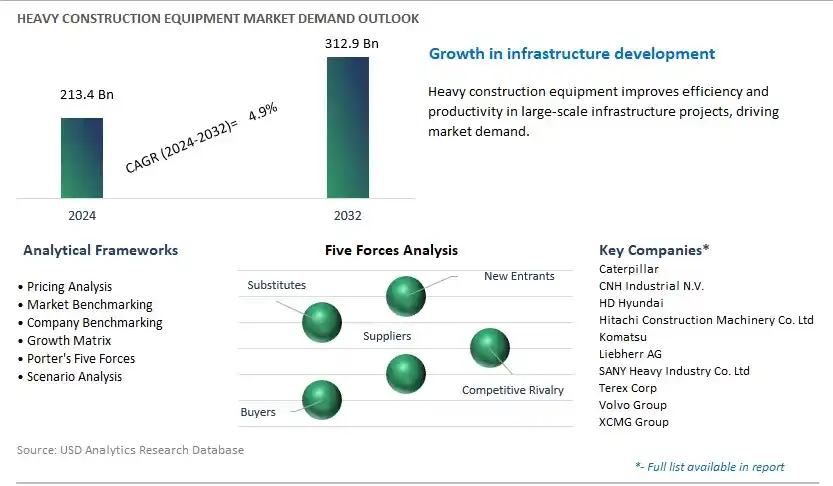
Global Heavy Construction Equipment Market Size is valued at $213.4 Billion in 2024 and is forecast to register a growth rate (CAGR) of 4.9% to reach $312.9 Billion by 2032.
The global Heavy Construction Equipment Market Study analyzes and forecasts the market size across 6 regions and 24 countries for diverse segments -By Type (Earthmoving Equipment, Material Handling Equipment, Heavy Construction Vehicles, Others), By Application (Excavation & Demolition, Heavy Lifting, Material Handling, Tunneling, Transportation, Recycling & Waste Management), By Propulsion (Disel, CNG/LNG/RNG, Electric), By End-User (Building & Construction, Forestry & Agriculture, Infrastructure, Mining, Others).
An Introduction to Heavy Construction Equipment Market in 2024
Heavy construction equipment, including excavators, bulldozers, loaders, cranes, and dump trucks, plays a vital role in infrastructure development, mining operations, and construction projects worldwide. In 2024, the market for heavy construction equipment is witnessing robust growth driven by increasing investments in infrastructure, urbanization trends, and demand for advanced machinery with enhanced performance and efficiency. These equipment, engineered for durability, productivity, and operator safety, offer advantages such as high horsepower, precision control systems, and integrated telematics for remote monitoring and fleet management. Further, advancements in heavy construction equipment technology, including electrification, automation, and digitalization, improve fuel efficiency, reduce emissions, and optimize project timelines and costs. As contractors and construction firms seek to improve productivity, safety, and sustainability, the demand for heavy construction equipment is expected to escalate, driving further innovation and market expansion.
Heavy Construction Equipment Market Competitive Landscape
The market report analyses the leading companies in the industry including Caterpillar, CNH Industrial N.V., HD Hyundai, Hitachi Construction Machinery Co. Ltd, Komatsu, Liebherr AG, SANY Heavy Industry Co. Ltd, Terex Corp, Volvo Group, XCMG Group, and others.
Heavy Construction Equipment Market Dynamics
Market Trend: Adoption of Advanced Technologies and Automation in Construction
The heavy construction equipment market is witnessing a prominent trend driven by the increasing adoption of advanced technologies and automation in construction projects. With the rise of smart infrastructure initiatives and the demand for more efficient and sustainable construction practices, there's a growing emphasis on integrating technologies such as telematics, GPS tracking, Building Information Modeling (BIM), and drones into heavy equipment operations. These technologies enable real-time monitoring, data-driven decision-making, and automation of various construction tasks, leading to improved productivity, safety, and cost-effectiveness on job sites. Moreover, the deployment of autonomous and semi-autonomous equipment, such as self-driving trucks and excavators, is reshaping the construction landscape by enhancing precision, efficiency, and overall project performance. This trend towards technological integration and automation is expected to continue as construction companies seek innovative solutions to address evolving market demands and regulatory requirements.
Market Driver: Infrastructure Development and Urbanization
A significant driver propelling the heavy construction equipment market is the ongoing infrastructure development projects and rapid urbanization worldwide. With increasing urbanization rates and population growth, there's a pressing need for the expansion and modernization of infrastructure, including transportation networks, utilities, residential buildings, and commercial facilities. Governments and private investors are investing heavily in infrastructure projects to support economic growth, improve connectivity, and address urban challenges such as traffic congestion, pollution, and housing shortages. This surge in infrastructure investment drives demand for heavy construction equipment, including excavators, loaders, cranes, and bulldozers, as these machines are essential for earthmoving, road construction, building erection, and other construction activities. The robust pipeline of infrastructure projects across regions presents lucrative opportunities for heavy equipment manufacturers and suppliers to capitalize on the growing demand and expand their market presence.
Market Opportunity: Shift Towards Sustainable and Eco-Friendly Solutions
An opportunity for market growth lies in the shift towards sustainable and eco-friendly solutions in the heavy construction equipment sector. As environmental concerns and regulations become increasingly stringent, there's a growing demand for greener construction practices and equipment that minimize carbon emissions, energy consumption, and environmental impact. This presents an opportunity for heavy equipment manufacturers to develop and offer sustainable solutions such as electric and hybrid-powered machinery, alternative fuels, and equipment with improved fuel efficiency and emissions control systems. Additionally, the adoption of circular economy principles, including equipment refurbishment, remanufacturing, and recycling, can help extend the lifecycle of heavy construction equipment, reduce resource consumption, and minimize waste generation. By embracing sustainability as a strategic imperative and innovating towards eco-friendly solutions, heavy equipment manufacturers can align with market trends, meet customer preferences, and unlock new opportunities for growth and differentiation in the evolving construction industry landscape.
Heavy Construction Equipment Market Share Analysis: Earthmoving Equipment segment generated the highest revenue in 2024
Within the Heavy Construction Equipment Market, the segment experiencing significant growth is Earthmoving Equipment. This surge can be attributed to the increasing demand for infrastructure development projects worldwide, coupled with rapid urbanization trends. Earthmoving equipment encompasses a wide range of machinery, including excavators, loaders, bulldozers, and graders, essential for various construction activities such as excavation, grading, and land clearing. As governments continue to invest in infrastructure upgrades, including roads, bridges, and railways, the need for earthmoving equipment rises correspondingly. Additionally, the expansion of urban areas necessitates extensive construction and land development, further driving the demand for earthmoving machinery. With ongoing advancements in technology, such as the integration of GPS and telematics systems for enhanced precision and efficiency, the earthmoving equipment segment is poised for continued growth, cementing its position as the largest segment in the Heavy Construction Equipment Market.
Heavy Construction Equipment Market Share Analysis: Tunneling is poised to register the fastest CAGR over the forecast period
Among the segments within the Heavy Construction Equipment Market categorized by application, Tunneling is the fastest-growing segment. This surge is primarily fuelled by the increasing demand for tunnel construction projects globally, driven by infrastructure development initiatives and urbanization trends. Tunneling applications include the construction of transportation tunnels, water supply tunnels, sewerage tunnels, and underground utilities. As cities expand and populations grow, there is a growing need for efficient transportation networks and underground infrastructure to alleviate congestion and accommodate utilities. Tunneling projects, therefore, play a crucial role in meeting these demands, driving the demand for specialized heavy construction equipment such as tunnel boring machines (TBMs), excavators, and loaders. With governments investing heavily in tunneling projects to enhance connectivity and address urban challenges, the tunneling segment is poised for rapid expansion, positioning it as the fastest-growing segment in the Heavy Construction Equipment Market.
Heavy Construction Equipment Market Share Analysis: Diesel segment generated the highest revenue in 2024
Within the Heavy Construction Equipment Market categorized by propulsion, the Diesel segment is the largest. The large revenue share is primarily anchored by the well-established infrastructure supporting diesel-powered equipment and the inherent power and reliability offered by diesel engines. Diesel engines have long been the standard choice for heavy construction equipment due to their high torque output, robustness, and fuel efficiency, making them ideal for demanding construction applications. Additionally, diesel fuel is readily available globally, ensuring uninterrupted operation of diesel-powered equipment even in remote locations. Despite the increasing focus on sustainability and environmental concerns, diesel-powered equipment remains prevalent in the construction industry, particularly for tasks requiring high horsepower and extended operational hours. While alternative propulsion technologies such as electric and CNG/LNG/RNG are gaining traction, the Diesel segment continues to dominate the Heavy Construction Equipment Market due to its reliability, power, and extensive infrastructure support.
Heavy Construction Equipment Market Share Analysis: Infrastructure is poised to register the fastest CAGR over the forecast period
Among the segments within the Heavy Construction Equipment Market categorized by end-users, the Infrastructure segment is experiencing the most rapid growth. This surge is primarily driven by increasing investments in infrastructure development projects worldwide. Governments and private sectors are heavily investing in the construction of roads, bridges, railways, airports, and other public utilities to support economic growth, urbanization, and population expansion. The need for modernization and expansion of existing infrastructure networks, particularly in emerging economies, further fuels the demand for heavy construction equipment. Additionally, the growing emphasis on sustainable infrastructure and smart city initiatives is driving the adoption of advanced construction equipment for efficient and eco-friendly construction practices. As infrastructure development remains a priority across various regions, the Infrastructure segment is poised for substantial growth, solidifying its position as the fastest-growing segment in the Heavy Construction Equipment Market.
Heavy Construction Equipment Market
By Type
Earthmoving Equipment
Material Handling Equipment
Heavy Construction Vehicles
Others
By Application
Excavation & Demolition
Heavy Lifting
Material Handling
Tunneling
Transportation
Recycling & Waste Management
By Propulsion
Disel
CNG/LNG/RNG
Electric
By End-User
Building & Construction
Forestry & Agriculture
Infrastructure
Mining
Others
Countries Analyzed
North America (US, Canada, Mexico)
Europe (Germany, UK, France, Spain, Italy, Russia, Rest of Europe)
Asia Pacific (China, India, Japan, South Korea, Australia, South East Asia, Rest of Asia)
South America (Brazil, Argentina, Rest of South America)
Middle East and Africa (Saudi Arabia, UAE, Rest of Middle East, South Africa, Egypt, Rest of Africa)
Heavy Construction Equipment Companies Profiled in the Study
Caterpillar
CNH Industrial N.V.
HD Hyundai
Hitachi Construction Machinery Co. Ltd
Komatsu
Liebherr AG
SANY Heavy Industry Co. Ltd
Terex Corp
Volvo Group
XCMG Group
*- List Not Exhaustive
TABLE OF CONTENTS
1 Introduction to 2024 Heavy Construction Equipment Market
1.1 Market Overview
1.2 Quick Facts
1.3 Scope/Objective of the Study
1.4 Market Definition
1.5 Countries and Regions Covered
1.6 Units, Currency, and Conversions
1.7 Industry Value Chain
2 Research Methodology
2.1 Market Size Estimation
2.2 Sources and Research Methodology
2.3 Data Triangulation
2.4 Assumptions and Limitations
3 Executive Summary
3.1 Global Heavy Construction Equipment Market Size Outlook, $ Million, 2021 to 2032
3.2 Heavy Construction Equipment Market Outlook by Type, $ Million, 2021 to 2032
3.3 Heavy Construction Equipment Market Outlook by Product, $ Million, 2021 to 2032
3.4 Heavy Construction Equipment Market Outlook by Application, $ Million, 2021 to 2032
3.5 Heavy Construction Equipment Market Outlook by Key Countries, $ Million, 2021 to 2032
4 Market Dynamics
4.1 Key Driving Forces of Heavy Construction Equipment Industry
4.2 Key Market Trends in Heavy Construction Equipment Industry
4.3 Potential Opportunities in Heavy Construction Equipment Industry
4.4 Key Challenges in Heavy Construction Equipment Industry
5 Market Factor Analysis
5.1 Value Chain Analysis
5.2 Competitive Landscape
5.2.1 Global Heavy Construction Equipment Market Share by Company (%), 2023
5.2.2 Product Offerings by Company
5.3 Porter’s Five Forces Analysis
5.4 Pricing Analysis and Outlook
6 Growth Outlook Across Scenarios
6.1 Growth Analysis-Case Scenario Definitions
6.2 Low Growth Scenario Forecasts
6.3 Reference Growth Scenario Forecasts
6.4 High Growth Scenario Forecasts
7 Global Heavy Construction Equipment Market Outlook by Segments
7.1 Heavy Construction Equipment Market Outlook by Segments, $ Million, 2021- 2032
By Type
Earthmoving Equipment
Material Handling Equipment
Heavy Construction Vehicles
Others
By Application
Excavation & Demolition
Heavy Lifting
Material Handling
Tunneling
Transportation
Recycling & Waste Management
By Propulsion
Disel
CNG/LNG/RNG
Electric
By End-User
Building & Construction
Forestry & Agriculture
Infrastructure
Mining
Others
8 North America Heavy Construction Equipment Market Analysis and Outlook To 2032
8.1 Introduction to North America Heavy Construction Equipment Markets in 2024
8.2 North America Heavy Construction Equipment Market Size Outlook by Country, 2021-2032
8.2.1 United States
8.2.2 Canada
8.2.3 Mexico
8.3 North America Heavy Construction Equipment Market size Outlook by Segments, 2021-2032
By Type
Earthmoving Equipment
Material Handling Equipment
Heavy Construction Vehicles
Others
By Application
Excavation & Demolition
Heavy Lifting
Material Handling
Tunneling
Transportation
Recycling & Waste Management
By Propulsion
Disel
CNG/LNG/RNG
Electric
By End-User
Building & Construction
Forestry & Agriculture
Infrastructure
Mining
Others
9 Europe Heavy Construction Equipment Market Analysis and Outlook To 2032
9.1 Introduction to Europe Heavy Construction Equipment Markets in 2024
9.2 Europe Heavy Construction Equipment Market Size Outlook by Country, 2021-2032
9.2.1 Germany
9.2.2 France
9.2.3 Spain
9.2.4 United Kingdom
9.2.4 Italy
9.2.5 Russia
9.2.6 Norway
9.2.7 Rest of Europe
9.3 Europe Heavy Construction Equipment Market Size Outlook by Segments, 2021-2032
By Type
Earthmoving Equipment
Material Handling Equipment
Heavy Construction Vehicles
Others
By Application
Excavation & Demolition
Heavy Lifting
Material Handling
Tunneling
Transportation
Recycling & Waste Management
By Propulsion
Disel
CNG/LNG/RNG
Electric
By End-User
Building & Construction
Forestry & Agriculture
Infrastructure
Mining
Others
10 Asia Pacific Heavy Construction Equipment Market Analysis and Outlook To 2032
10.1 Introduction to Asia Pacific Heavy Construction Equipment Markets in 2024
10.2 Asia Pacific Heavy Construction Equipment Market Size Outlook by Country, 2021-2032
10.2.1 China
10.2.2 India
10.2.3 Japan
10.2.4 South Korea
10.2.5 Indonesia
10.2.6 Malaysia
10.2.7 Australia
10.2.8 Rest of Asia Pacific
10.3 Asia Pacific Heavy Construction Equipment Market size Outlook by Segments, 2021-2032
By Type
Earthmoving Equipment
Material Handling Equipment
Heavy Construction Vehicles
Others
By Application
Excavation & Demolition
Heavy Lifting
Material Handling
Tunneling
Transportation
Recycling & Waste Management
By Propulsion
Disel
CNG/LNG/RNG
Electric
By End-User
Building & Construction
Forestry & Agriculture
Infrastructure
Mining
Others
11 South America Heavy Construction Equipment Market Analysis and Outlook To 2032
11.1 Introduction to South America Heavy Construction Equipment Markets in 2024
11.2 South America Heavy Construction Equipment Market Size Outlook by Country, 2021-2032
11.2.1 Brazil
11.2.2 Argentina
11.2.3 Rest of South America
11.3 South America Heavy Construction Equipment Market size Outlook by Segments, 2021-2032
By Type
Earthmoving Equipment
Material Handling Equipment
Heavy Construction Vehicles
Others
By Application
Excavation & Demolition
Heavy Lifting
Material Handling
Tunneling
Transportation
Recycling & Waste Management
By Propulsion
Disel
CNG/LNG/RNG
Electric
By End-User
Building & Construction
Forestry & Agriculture
Infrastructure
Mining
Others
12 Middle East and Africa Heavy Construction Equipment Market Analysis and Outlook To 2032
12.1 Introduction to Middle East and Africa Heavy Construction Equipment Markets in 2024
12.2 Middle East and Africa Heavy Construction Equipment Market Size Outlook by Country, 2021-2032
12.2.1 Saudi Arabia
12.2.2 UAE
12.2.3 Oman
12.2.4 Rest of Middle East
12.2.5 Egypt
12.2.6 Nigeria
12.2.7 South Africa
12.2.8 Rest of Africa
12.3 Middle East and Africa Heavy Construction Equipment Market size Outlook by Segments, 2021-2032
By Type
Earthmoving Equipment
Material Handling Equipment
Heavy Construction Vehicles
Others
By Application
Excavation & Demolition
Heavy Lifting
Material Handling
Tunneling
Transportation
Recycling & Waste Management
By Propulsion
Disel
CNG/LNG/RNG
Electric
By End-User
Building & Construction
Forestry & Agriculture
Infrastructure
Mining
Others
13 Company Profiles
13.1 Company Snapshot
13.2 SWOT Profiles
13.3 Products and Services
13.4 Recent Developments
13.5 Financial Profile
Caterpillar
CNH Industrial N.V.
HD Hyundai
Hitachi Construction Machinery Co. Ltd
Komatsu
Liebherr AG
SANY Heavy Industry Co. Ltd
Terex Corp
Volvo Group
XCMG Group
14 Appendix
14.1 Customization Offerings
14.2 Subscription Services
14.3 Related Reports
14.4 Publisher Expertise
By Type
Earthmoving Equipment
Material Handling Equipment
Heavy Construction Vehicles
Others
By Application
Excavation & Demolition
Heavy Lifting
Material Handling
Tunneling
Transportation
Recycling & Waste Management
By Propulsion
Disel
CNG/LNG/RNG
Electric
By End-User
Building & Construction
Forestry & Agriculture
Infrastructure
Mining
Others
Countries Analyzed
North America (US, Canada, Mexico)
Europe (Germany, UK, France, Spain, Italy, Russia, Rest of Europe)
Asia Pacific (China, India, Japan, South Korea, Australia, South East Asia, Rest of Asia)
South America (Brazil, Argentina, Rest of South America)
Middle East and Africa (Saudi Arabia, UAE, Rest of Middle East, South Africa, Egypt, Rest of Africa)
