Hemodynamic Monitoring Devices Market is estimated to increase at a growth rate of 5.9% CAGR over the forecast period from 2024 to 2030.
The Hemodynamic Monitoring Devices Market study analyzes and forecasts the market size across 6 regions and 24 countries for diverse segments including By Type (Invasive, Minimally Invasive, Non-Invasive), By Product (Disposables, Monitors), By End-User (Hospitals, Catheterization Labs, Others).
An Introduction to Hemodynamic Monitoring Devices Market in 2024
The hemodynamic monitoring devices market in 2024 addresses the demand for advanced monitoring technologies and systems used in critical care settings to assess cardiovascular function, fluid status, and tissue perfusion in patients with hemodynamic instability or shock, enabling early detection, intervention, and optimization of hemodynamic parameters to improve clinical outcomes and prevent complications. Hemodynamic monitoring devices include invasive (arterial catheters, central venous catheters) and non-invasive (echocardiography, pulse contour analysis, impedance cardiography) modalities, which provide real-time data on cardiac output, blood pressure, volume status, and tissue oxygenation, facilitating hemodynamic assessment, resuscitation, and titration of therapies in critically ill patients. Market dynamics are driven by factors such as the increasing prevalence of cardiovascular diseases, the aging population, and the demand for personalized, goal-directed hemodynamic management strategies in intensive care units (ICUs) and perioperative settings. Collaboration between device manufacturers, clinicians, and healthcare institutions drives innovation and market growth in hemodynamic monitoring solutions, enabling more precise and individualized patient care in critical care and anesthesia practice.
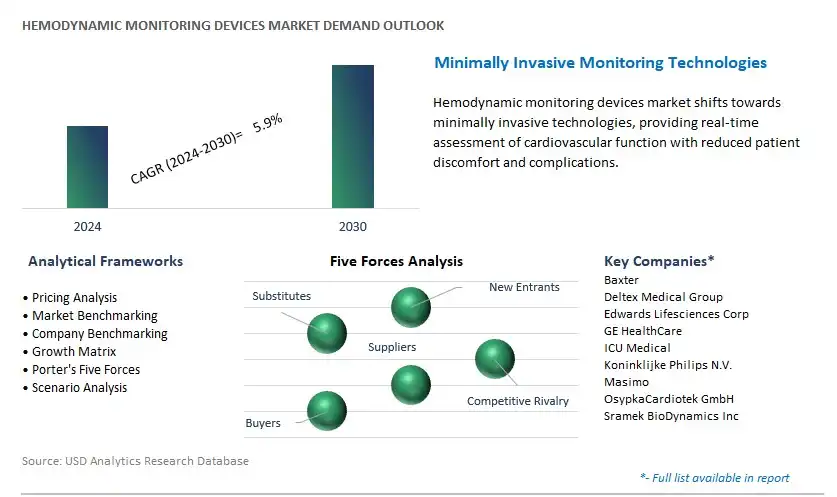
Hemodynamic Monitoring Devices Market Trend: Integration of Advanced Monitoring Technologies
A significant trend in the Hemodynamic Monitoring Devices market is the integration of advanced monitoring technologies into existing devices. Manufacturers are increasingly incorporating features such as wireless connectivity, cloud-based data storage, and real-time analytics to enhance the functionality and usability of hemodynamic monitors. Integration with electronic medical records (EMRs) and interoperability with other medical devices enable seamless data sharing and comprehensive patient monitoring. Furthermore, the development of portable and wearable hemodynamic monitoring solutions allows for continuous monitoring of patients outside traditional clinical settings, facilitating early detection of hemodynamic instability and timely intervention.
Hemodynamic Monitoring Devices Market Driver: Growing Adoption in Critical Care Settings
A key driver in the Hemodynamic Monitoring Devices market is the growing adoption of hemodynamic monitoring in critical care settings. With the rising prevalence of cardiovascular diseases, sepsis, and other critical illnesses, there is an increasing demand for accurate and timely hemodynamic assessment to guide treatment decisions and optimize patient outcomes. Hemodynamic monitoring provides clinicians with vital information about cardiac function, fluid status, and tissue perfusion, aiding in the early detection of hemodynamic instability and guiding hemodynamic-directed therapy. As healthcare facilities strive to improve patient outcomes and reduce mortality rates in critically ill patients, the demand for hemodynamic monitoring devices continues to grow, driving market expansion.
Hemodynamic Monitoring Devices Market Opportunity: Expansion into Home Healthcare and Remote Monitoring
An opportunity for market growth in the Hemodynamic Monitoring Devices market lies in the expansion into home healthcare and remote monitoring applications. As healthcare delivery shifts towards decentralized models and patients seek more personalized care options, there is a growing need for portable and user-friendly hemodynamic monitoring solutions that can be used outside traditional hospital settings. By developing compact and easy-to-use devices suitable for home monitoring, manufacturers can empower patients with chronic cardiovascular conditions to actively participate in their care and enable healthcare providers to remotely monitor patients' hemodynamic parameters in real-time. Expanding into the home healthcare market presents an opportunity to address unmet needs, improve patient satisfaction, and tap into new revenue streams in the evolving landscape of healthcare delivery.
Hemodynamic Monitoring Devices Market Segmentation
By Type
Invasive
Minimally Invasive
Non-Invasive
By Product
Disposables
Monitors
By End-User
Hospitals
Catheterization Labs
Others
Geographical Analysis
North America (United States, Canada, Mexico)
Europe (Germany, France, United Kingdom, Spain, Italy, Rest of Europe)
Asia Pacific (China, India, Japan, South Korea, Rest of Asia Pacific)
South America (Brazil, Argentina, Rest of South America)
Middle East and Africa (Saudi Arabia, UAE, Rest of Middle East, South Africa, Egypt, Rest of Africa)
Hemodynamic Monitoring Devices Market Companies
Baxter
Deltex Medical Group
Edwards Lifesciences Corp
GE HealthCare
ICU Medical
Koninklijke Philips N.V.
Masimo
OsypkaCardiotek GmbH
Sramek BioDynamics Inc
*- List Not Exhaustive
Reasons to Buy the Hemodynamic Monitoring Devices Market Study
• Deepen your industry insights and navigate uncertainties for strategy formulation, CAPEX, and Operational decisions
• Gain access to detailed insights on the Hemodynamic Monitoring Devices Market, encompassing current market size, growth trends, and forecasts till 2030.
• Access detailed competitor analysis, enabling competitive advantage through a thorough understanding of market players, strategies, and potential differentiation opportunities
• Stay ahead of the curve with insights on technological advancements, innovations, and upcoming trends
• Identify lucrative investment avenues and expansion opportunities within the Hemodynamic Monitoring Devices Market industry, guided by robust, data-backed analysis.
• Understand regional and global markets through country-wise analysis, regional market potential, regulatory nuances, and dynamics
• Execute strategies with confidence and speed through information, analytics, and insights on the industry value chain
• Corporate leaders, strategists, financial experts, shareholders, asset managers, and governmental representatives can make long-term planning scenarios and build an integrated and timely understanding of market dynamics
• Benefit from tailored solutions and expert consultation based on report insights, providing personalized strategies aligned with specific business needs.
TABLE OF CONTENTS
1 Introduction to 2024 Hemodynamic Monitoring Devices Market
1.1 Market Overview
1.2 Quick Facts
1.3 Scope/Objective of the Study
1.4 Market Definition
1.5 Countries and Regions Analyzed
1.6 Units, Currency, and Conversions
1.7 Industry Value Chain
2 Research Methodology
2.1 Market Size Estimation
2.2 Sources and Research Methodology
2.3 Data Triangulation
2.4 Assumptions and Limitations
3 Executive Summary
3.1 Global Hemodynamic Monitoring Devices Market Size Outlook, $ Million, 2021 to 2030
3.2 Hemodynamic Monitoring Devices Market Outlook by Type, $ Million, 2021 to 2030
3.3 Hemodynamic Monitoring Devices Market Outlook by Product, $ Million, 2021 to 2030
3.4 Hemodynamic Monitoring Devices Market Outlook by Application, $ Million, 2021 to 2030
3.5 Hemodynamic Monitoring Devices Market Outlook by Key Countries, $ Million, 2021 to 2030
4 Market Dynamics
4.1 Key Driving Forces of Hemodynamic Monitoring Devices Market Industry
4.2 Key Market Trends in Hemodynamic Monitoring Devices Market Industry
4.3 Potential Opportunities in Hemodynamic Monitoring Devices Market Industry
4.4 Key Challenges in Hemodynamic Monitoring Devices Market Industry
5 Market Factor Analysis
5.1 Competitive Landscape
5.1.1 Global Hemodynamic Monitoring Devices Market Share by Company (%), 2023
5.1.2 Product Offerings by Company
5.2 Porter’s Five Forces Analysis
6 Growth Outlook Across Scenarios
6.1 Growth Analysis-Case Scenario Definitions
6.2 Low Growth Scenario Forecasts
6.3 Reference Growth Scenario Forecasts
6.4 High Growth Scenario Forecasts
7 Global Hemodynamic Monitoring Devices Market Outlook By Segments
7.1 Hemodynamic Monitoring Devices Market Outlook by Segments
By Type
Invasive
Minimally Invasive
Non-Invasive
By Product
Disposables
Monitors
By End-User
Hospitals
Catheterization Labs
Others
8 North America Hemodynamic Monitoring Devices Market Analysis And Outlook To 2030
8.1 Introduction to North America Hemodynamic Monitoring Devices Markets in 2024
8.2 North America Hemodynamic Monitoring Devices Market Size Outlook by Country, 2021-2030
8.2.1 United States
8.2.2 Canada
8.2.3 Mexico
8.3 North America Hemodynamic Monitoring Devices Market size Outlook by Segments, 2021-2030
By Type
Invasive
Minimally Invasive
Non-Invasive
By Product
Disposables
Monitors
By End-User
Hospitals
Catheterization Labs
Others
9 Europe Hemodynamic Monitoring Devices Market Analysis And Outlook To 2030
9.1 Introduction to Europe Hemodynamic Monitoring Devices Markets in 2024
9.2 Europe Hemodynamic Monitoring Devices Market Size Outlook by Country, 2021-2030
9.2.1 Germany
9.2.2 France
9.2.3 Spain
9.2.4 United Kingdom
9.2.4 Italy
9.2.5 Russia
9.2.6 Norway
9.2.7 Rest of Europe
9.3 Europe Hemodynamic Monitoring Devices Market Size Outlook By Segments, 2021-2030
By Type
Invasive
Minimally Invasive
Non-Invasive
By Product
Disposables
Monitors
By End-User
Hospitals
Catheterization Labs
Others
10 Asia Pacific Hemodynamic Monitoring Devices Market Analysis And Outlook To 2030
10.1 Introduction to Asia Pacific Hemodynamic Monitoring Devices Markets in 2024
10.2 Asia Pacific Hemodynamic Monitoring Devices Market Size Outlook by Country, 2021-2030
10.2.1 China
10.2.2 India
10.2.3 Japan
10.2.4 South Korea
10.2.5 Indonesia
10.2.6 Malaysia
10.2.7 Australia
10.2.8 Rest of Asia Pacific
10.3 Asia Pacific Hemodynamic Monitoring Devices Market size Outlook by Segments, 2021-2030
By Type
Invasive
Minimally Invasive
Non-Invasive
By Product
Disposables
Monitors
By End-User
Hospitals
Catheterization Labs
Others
11 South America Hemodynamic Monitoring Devices Market Analysis And Outlook To 2030
11.1 Introduction to South America Hemodynamic Monitoring Devices Markets in 2024
11.2 South America Hemodynamic Monitoring Devices Market Size Outlook by Country, 2021-2030
11.2.1 Brazil
11.2.2 Argentina
11.2.3 Rest of South America
11.3 South America Hemodynamic Monitoring Devices Market size Outlook by Segments, 2021-2030
By Type
Invasive
Minimally Invasive
Non-Invasive
By Product
Disposables
Monitors
By End-User
Hospitals
Catheterization Labs
Others
12 Middle East And Africa Hemodynamic Monitoring Devices Market Analysis And Outlook To 2030
12.1 Introduction to Middle East and Africa Hemodynamic Monitoring Devices Markets in 2024
12.2 Middle East and Africa Hemodynamic Monitoring Devices Market Size Outlook by Country, 2021-2030
12.2.1 Saudi Arabia
12.2.2 UAE
12.2.3 Oman
12.2.4 Rest of Middle East
12.2.5 Egypt
12.2.6 Nigeria
12.2.7 South Africa
12.2.8 Rest of Africa
12.3 Middle East and Africa Hemodynamic Monitoring Devices Market size Outlook by Segments, 2021-2030
By Type
Invasive
Minimally Invasive
Non-Invasive
By Product
Disposables
Monitors
By End-User
Hospitals
Catheterization Labs
Others
13 Company Profiles
13.1 Company Snapshot
13.2 SWOT Profiles
13.3 Products and Services
13.4 Recent Developments
13.5 Financial Profile
List of Companies
Baxter
Deltex Medical Group
Edwards Lifesciences Corp
GE HealthCare
ICU Medical
Koninklijke Philips N.V.
Masimo
OsypkaCardiotek GmbH
Sramek BioDynamics Inc
14 Appendix
14.1 Customization Offerings
14.2 Subscription Services
14.3 Related Reports
14.4 Publisher Expertise
Hemodynamic Monitoring Devices Market Segmentation
By Type
Invasive
Minimally Invasive
Non-Invasive
By Product
Disposables
Monitors
By End-User
Hospitals
Catheterization Labs
Others
Geographical Analysis
North America (United States, Canada, Mexico)
Europe (Germany, France, United Kingdom, Spain, Italy, Rest of Europe)
Asia Pacific (China, India, Japan, South Korea, Rest of Asia Pacific)
South America (Brazil, Argentina, Rest of South America)
Middle East and Africa (Saudi Arabia, UAE, Rest of Middle East, South Africa, Egypt, Rest of Africa)
