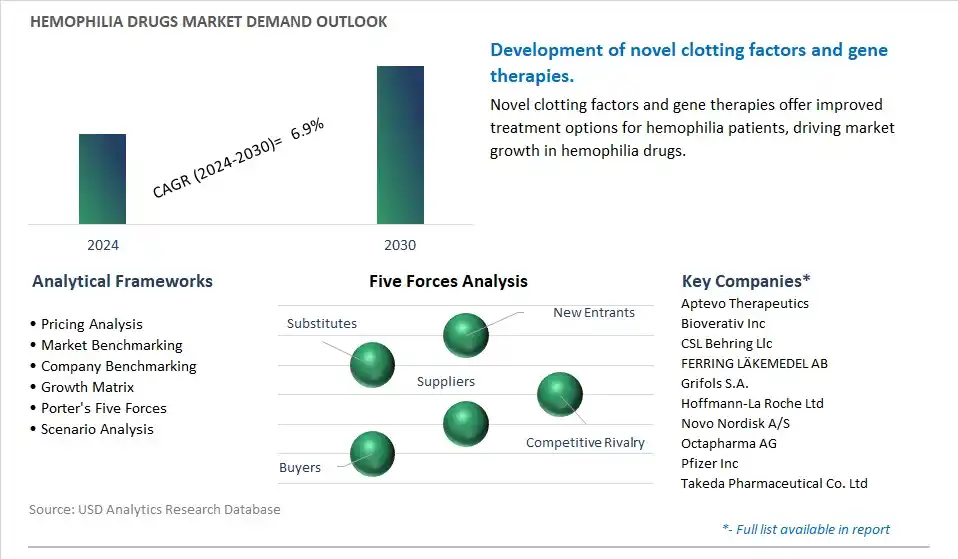
Hemophilia Drugs Market is estimated to increase at a growth rate of 6.9% CAGR over the forecast period from 2024 to 2030.
The global Hemophilia Drugs Market Study analyzes and forecasts the market size across 6 regions and 24 countries for diverse segments including By Type (Hemophilia A, Hemophilia B, Hemophilia C, Others), By Therapy (Recombination therapy, Plasma therapy, Others), By Distribution Channel (Hospital, Retail, Online).
An Introduction to Hemophilia Drugs Market in 2024
The Hemophilia Drugs Market encompasses a wide array of pharmaceuticals, biologics, and therapeutic interventions used in the management and treatment of hemophilia, including hemophilia A and hemophilia B. This market includes factor replacement therapies, clotting factor concentrates, recombinant factors, non-factor therapies, gene therapies, and hemostatic agents administered to control bleeding episodes, prevent joint damage, and manage complications associated with hemophilia. The market addresses the diverse needs of patients with hemophilia, focusing on personalized treatment approaches, innovative drug delivery systems, and advancements in hemostasis management to enhance patient outcomes and quality of life.
Hemophilia Drugs Market Competitive Landscape
The global Hemophilia Drugs Industry is highly competitive with a large number of companies focusing on niche market segments. Amidst intense competitive conditions, Hemophilia Drugs Companies are investing in new product launches and strengthening distribution channels. Key companies operating in the Hemophilia Drugs Industry include- Aptevo Therapeutics, Bioverativ Inc, CSL Behring Llc, FERRING LÄKEMEDEL AB, Grifols S.A., Hoffmann-La Roche Ltd, Novo Nordisk A/S, Octapharma AG, Pfizer Inc, Takeda Pharmaceutical Co. Ltd.
Hemophilia Drugs Market Trend: Advancements in Gene Therapy and Novel Treatment Approaches
A significant trend in the hemophilia drugs market is the continual advancements in gene therapy and the development of novel treatment approaches. Traditional treatments for hemophilia, such as clotting factor replacement therapy, have limitations including the need for frequent injections and the potential for inhibitor development. Gene therapy offers a promising alternative by introducing functional genes to restore clotting factor levels in patients with hemophilia. Additionally, novel treatment approaches such as RNA interference and gene editing technologies are being explored to address underlying genetic defects and improve hemostasis. These advancements represent a transformative trend in hemophilia treatment, offering the potential for more effective and durable therapeutic outcomes for patients.
Hemophilia Drugs Market Driver: Increasing Demand for Long-acting and Prophylactic Therapies
A primary driver propelling the hemophilia drugs market is the increasing demand for long-acting and prophylactic therapies. Hemophilia is characterized by deficient or dysfunctional clotting factor activity, leading to recurrent bleeding episodes and joint damage. Prophylactic treatment with clotting factor concentrates aims to prevent bleeding episodes and preserve joint health, thereby improving patients' overall quality of life. With a growing emphasis on preventive care and the need for fewer infusions, there is rising demand for long-acting clotting factor products that offer extended dosing intervals and improved convenience for patients. The pursuit of long-acting and prophylactic therapies drives innovation and investment in the hemophilia drugs market, addressing unmet medical needs and enhancing treatment options for patients.
Hemophilia Drugs Market Opportunity: Expansion into Emerging Markets and Patient Access Programs
An opportunity for growth within the hemophilia drugs market lies in expansion into emerging markets and the implementation of patient access programs. While hemophilia care has advanced significantly in developed regions, many patients in emerging economies face challenges in accessing affordable and quality treatment options. By expanding market presence and establishing partnerships with local healthcare providers and regulatory authorities, pharmaceutical companies can improve access to hemophilia drugs in underserved regions. Additionally, patient access programs, including reimbursement assistance and patient support services, can help alleviate financial barriers and improve treatment adherence among patients with hemophilia. Capitalizing on this opportunity not only expands market reach but also fulfills the mission of delivering equitable healthcare solutions to patients worldwide.
Hemophilia Drugs Market Share Analysis: Hemophilia A Drugs is the fastest growing market segment over the forecast period to 2030
Among the different types of hemophilia drugs, those targeting Hemophilia A are experiencing the fastest growth. Hemophilia A, characterized by a deficiency in clotting factor VIII, is the most common type of hemophilia, comprising approximately 80% of all cases. The increasing prevalence of Hemophilia A, coupled with advancements in treatment options such as recombinant factor VIII concentrates and extended half-life products, has contributed to the significant growth in this segment. Additionally, the growing emphasis on prophylactic treatment regimens to prevent bleeding episodes and improve patient outcomes has further fueled the demand for Hemophilia A drugs. As a result, pharmaceutical companies are increasingly focusing on research and development efforts to innovate new therapies and enhance existing treatment options for individuals with Hemophilia A.
Hemophilia Drugs Market Segmentation
By Type
Hemophilia A
Hemophilia B
Hemophilia C
Others
By Therapy
Recombination therapy
Plasma therapy
Others
By Distribution Channel
Hospital
Retail
Online
Geographical Analysis
North America (United States, Canada, Mexico)
Europe (Germany, France, United Kingdom, Spain, Italy, Rest of Europe)
Asia Pacific (China, India, Japan, South Korea, Rest of Asia Pacific)
South America (Brazil, Argentina, Rest of South America)
Middle East and Africa (Saudi Arabia, UAE, Rest of Middle East, South Africa, Egypt, Rest of Africa)
Hemophilia Drugs Companies
Aptevo Therapeutics
Bioverativ Inc
CSL Behring Llc
FERRING LÄKEMEDEL AB
Grifols S.A.
Hoffmann-La Roche Ltd
Novo Nordisk A/S
Octapharma AG
Pfizer Inc
Takeda Pharmaceutical Co. Ltd
* List not Exhaustive
Reasons to Buy the Hemophilia Drugs Market Study
• Deepen your industry insights and navigate uncertainties for strategy formulation, CAPEX, and Operational decisions
• Gain access to detailed insights on the Hemophilia Drugs Market, encompassing current market size, growth trends, and forecasts till 2030.
• Access detailed competitor analysis, enabling competitive advantage through a thorough understanding of market players, strategies, and potential differentiation opportunities
• Stay ahead of the curve with insights on technological advancements, innovations, and upcoming trends
• Identify lucrative investment avenues and expansion opportunities within the Hemophilia Drugs Industry, guided by robust, data-backed analysis.
• Understand regional and global markets through country-wise analysis, regional market potential, regulatory nuances, and dynamics
• Execute strategies with confidence and speed through information, analytics, and insights on the industry value chain
• Corporate leaders, strategists, financial experts, shareholders, asset managers, and governmental representatives can make long-term planning scenarios and build an integrated and timely understanding of market dynamics
• Benefit from tailored solutions and expert consultation based on report insights, providing personalized strategies aligned with specific business needs.
TABLE OF CONTENTS
1 Introduction to 2024 Hemophilia Drugs Market
1.1 Market Overview
1.2 Quick Facts
1.3 Scope/Objective of the Study
1.4 Market Definition
1.5 Countries and Regions Analyzed
1.6 Units, Currency, and Conversions
1.7 Industry Value Chain
2 Research Methodology
2.1 Market Size Estimation
2.2 Sources and Research Methodology
2.3 Data Triangulation
2.4 Assumptions and Limitations
3 Executive Summary
3.1 Global Hemophilia Drugs Market Size Outlook, $ Million, 2021 to 2030
3.2 Hemophilia Drugs Market Outlook by Type, $ Million, 2021 to 2030
3.3 Hemophilia Drugs Market Outlook by Product, $ Million, 2021 to 2030
3.4 Hemophilia Drugs Market Outlook by Application, $ Million, 2021 to 2030
3.5 Hemophilia Drugs Market Outlook by Key Countries, $ Million, 2021 to 2030
4 Market Dynamics
4.1 Key Driving Forces of Hemophilia Drugs Industry
4.2 Key Market Trends in Hemophilia Drugs Industry
4.3 Potential Opportunities in Hemophilia Drugs Industry
4.4 Key Challenges in Hemophilia Drugs Industry
5 Market Factor Analysis
5.1 Value Chain Analysis
5.2 Competitive Landscape
5.2.1 Global Hemophilia Drugs Market Share by Company (%), 2023
5.2.2 Product Offerings by Company
5.3 Porter’s Five Forces Analysis
5.4 Pricing Analysis and Outlook
6 Growth Outlook Across Scenarios
6.1 Growth Analysis-Case Scenario Definitions
6.2 Low Growth Scenario Forecasts
6.3 Reference Growth Scenario Forecasts
6.4 High Growth Scenario Forecasts
7 Global Hemophilia Drugs Market Outlook by Segments
7.1 Hemophilia Drugs Market Outlook by Segments, $ Million, 2021- 2030
By Type
Hemophilia A
Hemophilia B
Hemophilia C
Others
By Therapy
Recombination therapy
Plasma therapy
Others
By Distribution Channel
Hospital
Retail
Online
8 North America Hemophilia Drugs Market Analysis and Outlook To 2030
8.1 Introduction to North America Hemophilia Drugs Markets in 2024
8.2 North America Hemophilia Drugs Market Size Outlook by Country, 2021-2030
8.2.1 United States
8.2.2 Canada
8.2.3 Mexico
8.3 North America Hemophilia Drugs Market size Outlook by Segments, 2021-2030
By Type
Hemophilia A
Hemophilia B
Hemophilia C
Others
By Therapy
Recombination therapy
Plasma therapy
Others
By Distribution Channel
Hospital
Retail
Online
9 Europe Hemophilia Drugs Market Analysis and Outlook To 2030
9.1 Introduction to Europe Hemophilia Drugs Markets in 2024
9.2 Europe Hemophilia Drugs Market Size Outlook by Country, 2021-2030
9.2.1 Germany
9.2.2 France
9.2.3 Spain
9.2.4 United Kingdom
9.2.4 Italy
9.2.5 Russia
9.2.6 Norway
9.2.7 Rest of Europe
9.3 Europe Hemophilia Drugs Market Size Outlook by Segments, 2021-2030
By Type
Hemophilia A
Hemophilia B
Hemophilia C
Others
By Therapy
Recombination therapy
Plasma therapy
Others
By Distribution Channel
Hospital
Retail
Online
10 Asia Pacific Hemophilia Drugs Market Analysis and Outlook To 2030
10.1 Introduction to Asia Pacific Hemophilia Drugs Markets in 2024
10.2 Asia Pacific Hemophilia Drugs Market Size Outlook by Country, 2021-2030
10.2.1 China
10.2.2 India
10.2.3 Japan
10.2.4 South Korea
10.2.5 Indonesia
10.2.6 Malaysia
10.2.7 Australia
10.2.8 Rest of Asia Pacific
10.3 Asia Pacific Hemophilia Drugs Market size Outlook by Segments, 2021-2030
By Type
Hemophilia A
Hemophilia B
Hemophilia C
Others
By Therapy
Recombination therapy
Plasma therapy
Others
By Distribution Channel
Hospital
Retail
Online
11 South America Hemophilia Drugs Market Analysis and Outlook To 2030
11.1 Introduction to South America Hemophilia Drugs Markets in 2024
11.2 South America Hemophilia Drugs Market Size Outlook by Country, 2021-2030
11.2.1 Brazil
11.2.2 Argentina
11.2.3 Rest of South America
11.3 South America Hemophilia Drugs Market size Outlook by Segments, 2021-2030
By Type
Hemophilia A
Hemophilia B
Hemophilia C
Others
By Therapy
Recombination therapy
Plasma therapy
Others
By Distribution Channel
Hospital
Retail
Online
12 Middle East and Africa Hemophilia Drugs Market Analysis and Outlook To 2030
12.1 Introduction to Middle East and Africa Hemophilia Drugs Markets in 2024
12.2 Middle East and Africa Hemophilia Drugs Market Size Outlook by Country, 2021-2030
12.2.1 Saudi Arabia
12.2.2 UAE
12.2.3 Oman
12.2.4 Rest of Middle East
12.2.5 Egypt
12.2.6 Nigeria
12.2.7 South Africa
12.2.8 Rest of Africa
12.3 Middle East and Africa Hemophilia Drugs Market size Outlook by Segments, 2021-2030
By Type
Hemophilia A
Hemophilia B
Hemophilia C
Others
By Therapy
Recombination therapy
Plasma therapy
Others
By Distribution Channel
Hospital
Retail
Online
13 Company Profiles
13.1 Company Snapshot
13.2 SWOT Profiles
13.3 Products and Services
13.4 Recent Developments
13.5 Financial Profile
List of Companies
Aptevo Therapeutics
Bioverativ Inc
CSL Behring Llc
FERRING LÄKEMEDEL AB
Grifols S.A.
Hoffmann-La Roche Ltd
Novo Nordisk A/S
Octapharma AG
Pfizer Inc
Takeda Pharmaceutical Co. Ltd
14 Appendix
14.1 Customization Offerings
14.2 Subscription Services
14.3 Related Reports
14.4 Publisher Expertise
