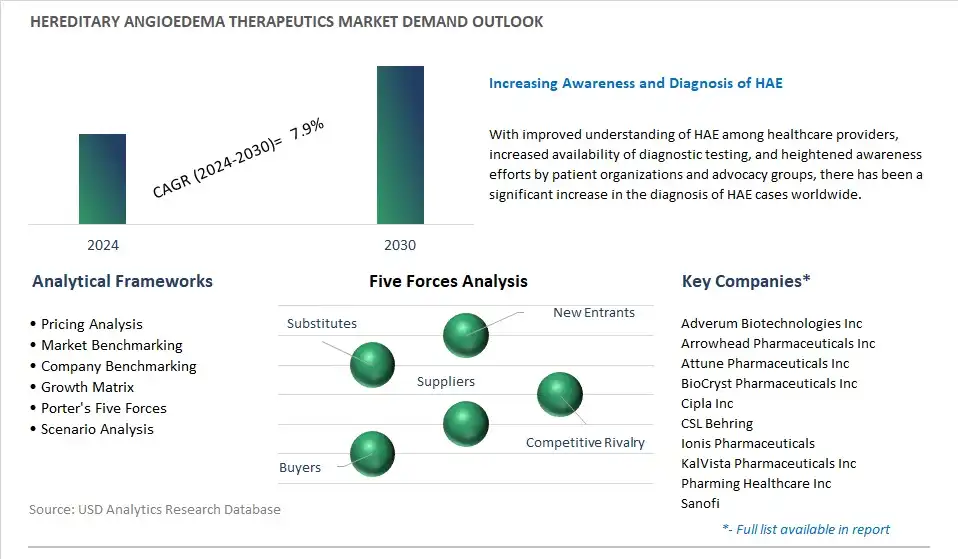
Hereditary Angioedema Therapeutics Market is estimated to increase at a growth rate of 7.9% CAGR over the forecast period from 2024 to 2030.
The Hereditary Angioedema Therapeutics Market study analyzes and forecasts the market size across 6 regions and 24 countries for diverse segments including By Treatment (C1-esterase inhibitor, Bradykinin B2 receptor antagonist, Kallikrein inhibitor, Others), By End-User (Prophylaxis, On-demand), By Route of Administration (Intravenous, Subcutaneous, Oral).
An Introduction to Hereditary Angioedema Therapeutics Market in 2024
The Hereditary Angioedema (HAE) Therapeutics market in 2024 is undergoing significant advancements in treatment options and management strategies for this rare genetic disorder characterized by recurrent episodes of severe swelling in various body tissues, including the skin, gastrointestinal tract, and respiratory system. HAE is caused by mutations in the C1 inhibitor gene, leading to uncontrolled activation of the complement system and excessive production of bradykinin, a potent vasodilator. Treatment options for HAE include plasma-derived or recombinant C1 inhibitor replacement therapies, bradykinin receptor antagonists, and kallikrein inhibitors, aimed at preventing or attenuating acute attacks, reducing disease severity, and improving quality of life for patients. Moreover, with a focus on personalized medicine and precision therapies, the market is witnessing the development of novel approaches such as gene therapy, RNA interference, and targeted biologics to address underlying genetic defects and provide long-term solutions for HAE management. Additionally, advancements in acute attack management protocols, self-administration techniques, and patient education programs are enhancing the comprehensive care and support services available to individuals living with HAE, optimizing treatment outcomes and reducing the burden of this debilitating condition. As the understanding of HAE pathophysiology and treatment paradigms continues to evolve, the HAE therapeutics market is poised for continued innovation and advancements in disease management to meet the evolving needs of patients and improve their quality of life.
Hereditary Angioedema Therapeutics Market Trend: Advancements in Targeted Therapies
A prominent trend in the hereditary angioedema (HAE) therapeutics market is the advancements in targeted therapies. Over recent years, there has been significant progress in the development of novel treatments specifically designed to address the underlying cause of HAE, which is characterized by deficient or dysfunctional C1 inhibitor protein. These targeted therapies include plasma-derived C1 inhibitor concentrates, recombinant C1 inhibitor proteins, and monoclonal antibodies that inhibit plasma kallikrein or bradykinin receptors. Advancements in targeted therapies offer improved efficacy, safety, and convenience compared to traditional treatments such as plasma-derived or recombinant C1 inhibitor concentrates, providing patients with more options for long-term management and prevention of HAE attacks. This trend reflects the industry's focus on developing innovative therapies that address the root cause of HAE and improve patient outcomes.
Hereditary Angioedema Therapeutics Market Driver: Increasing Awareness and Diagnosis of HAE
A key driver in the hereditary angioedema (HAE) therapeutics market is the increasing awareness and diagnosis of HAE. HAE is a rare genetic disorder characterized by recurrent episodes of swelling in various body parts, including the face, extremities, and gastrointestinal tract, which can be debilitating and life-threatening if left untreated. With improved understanding of HAE among healthcare providers, increased availability of diagnostic testing, and heightened awareness efforts by patient organizations and advocacy groups, there has been a significant increase in the diagnosis of HAE cases worldwide. The growing recognition of HAE and its impact on patients' quality of life has led to greater demand for effective treatment options, driving market growth for HAE therapeutics.
Hereditary Angioedema Therapeutics Market Opportunity: Development of Gene Therapy Approaches
An opportunity for growth in the hereditary angioedema (HAE) therapeutics market lies in the development of gene therapy approaches. Gene therapy holds promise for providing a long-term cure or disease-modifying treatment for HAE by addressing the underlying genetic defect responsible for deficient or dysfunctional C1 inhibitor protein production. Emerging gene therapy strategies include gene editing technologies such as CRISPR-Cas9 and adeno-associated viral (AAV) vectors for delivering functional copies of the C1 inhibitor gene to patients with HAE. By investing in the development of gene therapy approaches, pharmaceutical companies and biotechnology firms can potentially offer curative treatments for HAE, revolutionizing the treatment landscape and improving the lives of patients with this rare genetic disorder. This opportunity aligns with the industry's focus on advancing gene therapy technologies and personalized medicine approaches for rare genetic diseases like HAE.
Hereditary Angioedema Therapeutics Market Segmentation
By Treatment
C1-esterase inhibitor
Bradykinin B2 receptor antagonist
Kallikrein inhibitor
Others
By End-User
Prophylaxis
On-demand
By Route of Administration
Intravenous
Subcutaneous
Oral
Geographical Analysis
North America (United States, Canada, Mexico)
Europe (Germany, France, United Kingdom, Spain, Italy, Rest of Europe)
Asia Pacific (China, India, Japan, South Korea, Rest of Asia Pacific)
South America (Brazil, Argentina, Rest of South America)
Middle East and Africa (Saudi Arabia, UAE, Rest of Middle East, South Africa, Egypt, Rest of Africa)
Hereditary Angioedema Therapeutics Market Companies
Adverum Biotechnologies Inc
Arrowhead Pharmaceuticals Inc
Attune Pharmaceuticals Inc
BioCryst Pharmaceuticals Inc
Cipla Inc
CSL Behring
Ionis Pharmaceuticals
KalVista Pharmaceuticals Inc
Pharming Healthcare Inc
Sanofi
Takeda Pharmaceutical Company Ltd
Reasons to Buy the Hereditary Angioedema Therapeutics Market Study
• Deepen your industry insights and navigate uncertainties for strategy formulation, CAPEX, and Operational decisions
• Gain access to detailed insights on the Hereditary Angioedema Therapeutics Market, encompassing current market size, growth trends, and forecasts till 2030.
• Access detailed competitor analysis, enabling competitive advantage through a thorough understanding of market players, strategies, and potential differentiation opportunities
• Stay ahead of the curve with insights on technological advancements, innovations, and upcoming trends
• Identify lucrative investment avenues and expansion opportunities within the Hereditary Angioedema Therapeutics Market industry, guided by robust, data-backed analysis.
• Understand regional and global markets through country-wise analysis, regional market potential, regulatory nuances, and dynamics
• Execute strategies with confidence and speed through information, analytics, and insights on the industry value chain
• Corporate leaders, strategists, financial experts, shareholders, asset managers, and governmental representatives can make long-term planning scenarios and build an integrated and timely understanding of market dynamics
• Benefit from tailored solutions and expert consultation based on report insights, providing personalized strategies aligned with specific business needs.
TABLE OF CONTENTS
1 Introduction to 2024 Hereditary Angioedema Therapeutics Market
1.1 Market Overview
1.2 Quick Facts
1.3 Scope/Objective of the Study
1.4 Market Definition
1.5 Countries and Regions Analyzed
1.6 Units, Currency, and Conversions
1.7 Industry Value Chain
2 Research Methodology
2.1 Market Size Estimation
2.2 Sources and Research Methodology
2.3 Data Triangulation
2.4 Assumptions and Limitations
3 Executive Summary
3.1 Global Hereditary Angioedema Therapeutics Market Size Outlook, $ Million, 2021 to 2030
3.2 Hereditary Angioedema Therapeutics Market Outlook by Type, $ Million, 2021 to 2030
3.3 Hereditary Angioedema Therapeutics Market Outlook by Product, $ Million, 2021 to 2030
3.4 Hereditary Angioedema Therapeutics Market Outlook by Application, $ Million, 2021 to 2030
3.5 Hereditary Angioedema Therapeutics Market Outlook by Key Countries, $ Million, 2021 to 2030
4 Market Dynamics
4.1 Key Driving Forces of Hereditary Angioedema Therapeutics Market Industry
4.2 Key Market Trends in Hereditary Angioedema Therapeutics Market Industry
4.3 Potential Opportunities in Hereditary Angioedema Therapeutics Market Industry
4.4 Key Challenges in Hereditary Angioedema Therapeutics Market Industry
5 Market Factor Analysis
5.1 Competitive Landscape
5.1.1 Global Hereditary Angioedema Therapeutics Market Share by Company (%), 2023
5.1.2 Product Offerings by Company
5.2 Porter’s Five Forces Analysis
6 Growth Outlook Across Scenarios
6.1 Growth Analysis-Case Scenario Definitions
6.2 Low Growth Scenario Forecasts
6.3 Reference Growth Scenario Forecasts
6.4 High Growth Scenario Forecasts
7 Global Hereditary Angioedema Therapeutics Market Outlook By Segments
7.1 Hereditary Angioedema Therapeutics Market Outlook by Segments
By Treatment
C1-esterase inhibitor
Bradykinin B2 receptor antagonist
Kallikrein inhibitor
Others
By End-User
Prophylaxis
On-demand
By Route of Administration
Intravenous
Subcutaneous
Oral
8 North America Hereditary Angioedema Therapeutics Market Analysis And Outlook To 2030
8.1 Introduction to North America Hereditary Angioedema Therapeutics Markets in 2024
8.2 North America Hereditary Angioedema Therapeutics Market Size Outlook by Country, 2021-2030
8.2.1 United States
8.2.2 Canada
8.2.3 Mexico
8.3 North America Hereditary Angioedema Therapeutics Market size Outlook by Segments, 2021-2030
By Treatment
C1-esterase inhibitor
Bradykinin B2 receptor antagonist
Kallikrein inhibitor
Others
By End-User
Prophylaxis
On-demand
By Route of Administration
Intravenous
Subcutaneous
Oral
9 Europe Hereditary Angioedema Therapeutics Market Analysis And Outlook To 2030
9.1 Introduction to Europe Hereditary Angioedema Therapeutics Markets in 2024
9.2 Europe Hereditary Angioedema Therapeutics Market Size Outlook by Country, 2021-2030
9.2.1 Germany
9.2.2 France
9.2.3 Spain
9.2.4 United Kingdom
9.2.4 Italy
9.2.5 Russia
9.2.6 Norway
9.2.7 Rest of Europe
9.3 Europe Hereditary Angioedema Therapeutics Market Size Outlook By Segments, 2021-2030
By Treatment
C1-esterase inhibitor
Bradykinin B2 receptor antagonist
Kallikrein inhibitor
Others
By End-User
Prophylaxis
On-demand
By Route of Administration
Intravenous
Subcutaneous
Oral
10 Asia Pacific Hereditary Angioedema Therapeutics Market Analysis And Outlook To 2030
10.1 Introduction to Asia Pacific Hereditary Angioedema Therapeutics Markets in 2024
10.2 Asia Pacific Hereditary Angioedema Therapeutics Market Size Outlook by Country, 2021-2030
10.2.1 China
10.2.2 India
10.2.3 Japan
10.2.4 South Korea
10.2.5 Indonesia
10.2.6 Malaysia
10.2.7 Australia
10.2.8 Rest of Asia Pacific
10.3 Asia Pacific Hereditary Angioedema Therapeutics Market size Outlook by Segments, 2021-2030
By Treatment
C1-esterase inhibitor
Bradykinin B2 receptor antagonist
Kallikrein inhibitor
Others
By End-User
Prophylaxis
On-demand
By Route of Administration
Intravenous
Subcutaneous
Oral
11 South America Hereditary Angioedema Therapeutics Market Analysis And Outlook To 2030
11.1 Introduction to South America Hereditary Angioedema Therapeutics Markets in 2024
11.2 South America Hereditary Angioedema Therapeutics Market Size Outlook by Country, 2021-2030
11.2.1 Brazil
11.2.2 Argentina
11.2.3 Rest of South America
11.3 South America Hereditary Angioedema Therapeutics Market size Outlook by Segments, 2021-2030
By Treatment
C1-esterase inhibitor
Bradykinin B2 receptor antagonist
Kallikrein inhibitor
Others
By End-User
Prophylaxis
On-demand
By Route of Administration
Intravenous
Subcutaneous
Oral
12 Middle East And Africa Hereditary Angioedema Therapeutics Market Analysis And Outlook To 2030
12.1 Introduction to Middle East and Africa Hereditary Angioedema Therapeutics Markets in 2024
12.2 Middle East and Africa Hereditary Angioedema Therapeutics Market Size Outlook by Country, 2021-2030
12.2.1 Saudi Arabia
12.2.2 UAE
12.2.3 Oman
12.2.4 Rest of Middle East
12.2.5 Egypt
12.2.6 Nigeria
12.2.7 South Africa
12.2.8 Rest of Africa
12.3 Middle East and Africa Hereditary Angioedema Therapeutics Market size Outlook by Segments, 2021-2030
By Treatment
C1-esterase inhibitor
Bradykinin B2 receptor antagonist
Kallikrein inhibitor
Others
By End-User
Prophylaxis
On-demand
By Route of Administration
Intravenous
Subcutaneous
Oral
13 Company Profiles
13.1 Company Snapshot
13.2 SWOT Profiles
13.3 Products and Services
13.4 Recent Developments
13.5 Financial Profile
List of Companies
Adverum Biotechnologies Inc
Arrowhead Pharmaceuticals Inc
Attune Pharmaceuticals Inc
BioCryst Pharmaceuticals Inc
Cipla Inc
CSL Behring
Ionis Pharmaceuticals
KalVista Pharmaceuticals Inc
Pharming Healthcare Inc
Sanofi
Takeda Pharmaceutical Company Ltd
14 Appendix
14.1 Customization Offerings
14.2 Subscription Services
14.3 Related Reports
14.4 Publisher Expertise
By Treatment
C1-esterase inhibitor
Bradykinin B2 receptor antagonist
Kallikrein inhibitor
Others
By End-User
Prophylaxis
On-demand
By Route of Administration
Intravenous
Subcutaneous
Oral
