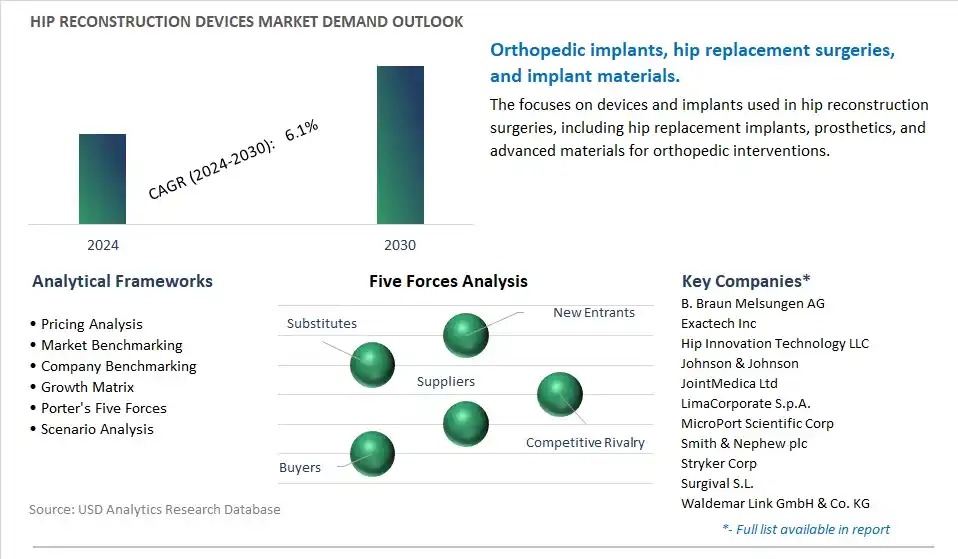
Hip Reconstruction Devices Market is estimated to increase at a Compounded Annual Growth Rate of 6.1% CAGR over the forecast period from 2024 to 2030
The Hip Reconstruction Devices Market study analyzes and forecasts the market size across 6 regions and 24 countries for diverse segments- By Product (Primary Hip Reconstruction Devices, Partial Hip Reconstruction Devices, Hip Resurfacing Devices, Other), By End-User (Hospitals, Orthopedic Clinics, Others).
An Introduction to Hip Reconstruction Devices Market in 2024
In 2024, the market for hip reconstruction devices continues to evolve with advancements in implant materials, surgical techniques, and patient-specific instrumentation, driving improved outcomes for individuals undergoing hip arthroplasty procedures. Hip reconstruction remains a critical intervention for patients with debilitating hip conditions such as osteoarthritis, fractures, and avascular necrosis, restoring mobility and quality of life. Innovations in implant design, including enhanced bearing surfaces, modular components, and porous coatings, are improving implant longevity and reducing the risk of complications such as implant loosening and wear-related failures. Furthermore, the integration of computer-assisted navigation and robotic-assisted surgery is facilitating more accurate implant placement and optimizing biomechanical alignment, leading to better functional outcomes and patient satisfaction. With an aging population and increasing demand for joint replacement surgeries, the hip reconstruction device market is poised for continued growth and innovation in addressing the diverse needs of patients requiring hip reconstruction procedures.
Market Trend: Shift Towards Minimally Invasive Hip Reconstruction Procedures
A significant trend in the market for hip reconstruction devices is the shift towards minimally invasive procedures. With advancements in surgical techniques and technology, there is a growing preference among patients and surgeons for minimally invasive approaches to hip reconstruction. These procedures typically involve smaller incisions, reduced tissue trauma, shorter hospital stays, and faster recovery times compared to traditional open surgeries. As a result, there is increasing demand for hip reconstruction devices that are specifically designed for use in minimally invasive procedures, driving innovation and growth in the market.
Market Driver: Aging Population and Increasing Incidence of Hip Fractures
The primary drivers propelling the hip reconstruction devices market is the aging population and the increasing incidence of hip fractures. As the global population continues to age, the prevalence of age-related conditions such as osteoporosis and osteoarthritis rises, leading to an increased risk of hip fractures and degenerative hip conditions. Consequently, there is a growing demand for hip reconstruction procedures to restore mobility, alleviate pain, and improve the quality of life for patients with hip disorders. This demographic shift and rising incidence of hip fractures contribute to the growing market for hip reconstruction devices worldwide.
Market Opportunity: Development of Patient-Specific Implants and 3D Printing Technologies
An attractive opportunity within the hip reconstruction devices market is the development of patient-specific implants and 3D printing technologies. By leveraging advanced imaging techniques and computer-aided design (CAD) software, manufacturers can create custom-made implants tailored to the unique anatomy and biomechanics of individual patients. Additionally, 3D printing technologies enable the production of complex implant designs with intricate structures and porous surfaces that promote osseointegration and long-term implant stability. Investing in the development of patient-specific implants and 3D printing capabilities presents an opportunity for stakeholders to enhance surgical outcomes, minimize implant-related complications, and improve patient satisfaction in hip reconstruction procedures.
Hip Reconstruction Devices Market Share Analysis: Hip Resurfacing Devices
In the Hip Reconstruction Devices Market, the segment experiencing the fastest growth is Hip Resurfacing Devices. Hip resurfacing is a surgical procedure that involves preserving the femoral head by removing only the damaged surface and capping it with a metal prosthesis, rather than removing the entire femoral head as in traditional total hip replacement. This technique is gaining popularity, particularly among younger and more active patients, due to its potential advantages such as bone preservation, reduced risk of dislocation, and improved range of motion. As the demand for less invasive and more anatomically-friendly hip reconstruction options continues to rise, hip resurfacing devices are witnessing increasing adoption. Additionally, advancements in materials and implant designs, along with improved surgical techniques, have further fueled the growth of the hip resurfacing segment. Hospitals and orthopedic clinics are the primary end-users driving the demand for hip resurfacing devices as they strive to offer patients the latest and most effective treatment options for hip conditions. Consequently, the hip resurfacing devices segment is poised for significant growth in the hip reconstruction devices market.
Hip Reconstruction Devices Competitive Analysis
The market research study provides in-depth insights into leading companies including the SWOT analyses, product profile, financial details, and recent developments acrossB. Braun Melsungen AG, Exactech Inc, Hip Innovation Technology LLC, Johnson & Johnson, JointMedica Ltd, LimaCorporate S.p.A., MicroPort Scientific Corp, Smith & Nephew plc, Stryker Corp, Surgival S.L., Waldemar Link GmbH & Co. KG, Zimmer Biomet Holdings Inc
Hip Reconstruction Devices Market Segmentation
By Product
Primary Hip Reconstruction Devices
Partial Hip Reconstruction Devices
Hip Resurfacing Devices
Other
By End-User
Hospitals
Orthopedic Clinics
Others
Geographical Analysis
North America (United States, Canada, Mexico)
Europe (Germany, France, United Kingdom, Spain, Italy, Rest of Europe)
Asia Pacific (China, India, Japan, South Korea, Rest of Asia Pacific)
South America (Brazil, Argentina, Rest of South America)
Middle East and Africa (Saudi Arabia, UAE, Rest of Middle East, South Africa, Egypt, Rest of Africa)
Hip Reconstruction Devices Market Companies
B. Braun Melsungen AG
Exactech Inc
Hip Innovation Technology LLC
Johnson & Johnson
JointMedica Ltd
LimaCorporate S.p.A.
MicroPort Scientific Corp
Smith & Nephew plc
Stryker Corp
Surgival S.L.
Waldemar Link GmbH & Co. KG
Zimmer Biomet Holdings Inc
Reasons to Buy the Hip Reconstruction Devices Market Study
• Deepen your industry insights and navigate uncertainties for strategy formulation, CAPEX, and Operational decisions
• Gain access to detailed insights on the Hip Reconstruction Devices Market, encompassing current market size, growth trends, and forecasts till 2030.
• Access detailed competitor analysis, enabling competitive advantage through a thorough understanding of market players, strategies, and potential differentiation opportunities
• Stay ahead of the curve with insights on technological advancements, innovations, and upcoming trends
• Identify lucrative investment avenues and expansion opportunities within the Hip Reconstruction Devices Market industry, guided by robust, data-backed analysis.
• Understand regional and global markets through country-wise analysis, regional market potential, regulatory nuances, and dynamics
• Execute strategies with confidence and speed through information, analytics, and insights on the industry value chain
• Corporate leaders, strategists, financial experts, shareholders, asset managers, and governmental representatives can make long-term planning scenarios and build an integrated and timely understanding of market dynamics
• Benefit from tailored solutions and expert consultation based on report insights, providing personalized strategies aligned with specific business needs.
TABLE OF CONTENTS
1 Introduction to 2024 Hip Reconstruction Devices Market
1.1 Market Overview
1.2 Quick Facts
1.3 Scope/Objective of the Study
1.4 Market Definition
1.5 Countries and Regions Covered
1.6 Units, Currency, and Conversions
1.7 Industry Value Chain
2 Research Methodology
2.1 Market Size Estimation
2.2 Sources and Research Methodology
2.3 Data Triangulation
2.4 Assumptions and Limitations
3 Executive Summary
3.1 Global Hip Reconstruction Devices Market Size Outlook, $ Million, 2021 to 2030
3.2 Hip Reconstruction Devices Market Outlook by Type, $ Million, 2021 to 2030
3.3 Hip Reconstruction Devices Market Outlook by Product, $ Million, 2021 to 2030
3.4 Hip Reconstruction Devices Market Outlook by Application, $ Million, 2021 to 2030
3.5 Hip Reconstruction Devices Market Outlook by Key Countries, $ Million, 2021 to 2030
4 Market Dynamics
4.1 Key Driving Forces of Hip Reconstruction Devices Industry
4.2 Key Market Trends in Hip Reconstruction Devices Industry
4.3 Potential Opportunities in Hip Reconstruction Devices Industry
4.4 Key Challenges in Hip Reconstruction Devices Industry
5 Market Factor Analysis
5.1 Value Chain Analysis
5.2 Competitive Landscape
5.2.1 Global Hip Reconstruction Devices Market Share by Company (%), 2023
5.2.2 Product Offerings by Company
5.3 Porter’s Five Forces Analysis
5.4 Pricing Analysis and Outlook
6 Growth Outlook Across Scenarios
6.1 Growth Analysis-Case Scenario Definitions
6.2 Low Growth Scenario Forecasts
6.3 Reference Growth Scenario Forecasts
6.4 High Growth Scenario Forecasts
7 Global Hip Reconstruction Devices Market Outlook by Segments
7.1 Hip Reconstruction Devices Market Outlook by Segments, $ Million, 2021- 2030
By Product
Primary Hip Reconstruction Devices
Partial Hip Reconstruction Devices
Hip Resurfacing Devices
Other
By End-User
Hospitals
Orthopedic Clinics
Others
8 North America Hip Reconstruction Devices Market Analysis and Outlook To 2030
8.1 Introduction to North America Hip Reconstruction Devices Markets in 2024
8.2 North America Hip Reconstruction Devices Market Size Outlook by Country, 2021-2030
8.2.1 United States
8.2.2 Canada
8.2.3 Mexico
8.3 North America Hip Reconstruction Devices Market size Outlook by Segments, 2021-2030
By Product
Primary Hip Reconstruction Devices
Partial Hip Reconstruction Devices
Hip Resurfacing Devices
Other
By End-User
Hospitals
Orthopedic Clinics
Others
9 Europe Hip Reconstruction Devices Market Analysis and Outlook To 2030
9.1 Introduction to Europe Hip Reconstruction Devices Markets in 2024
9.2 Europe Hip Reconstruction Devices Market Size Outlook by Country, 2021-2030
9.2.1 Germany
9.2.2 France
9.2.3 Spain
9.2.4 United Kingdom
9.2.4 Italy
9.2.5 Russia
9.2.6 Norway
9.2.7 Rest of Europe
9.3 Europe Hip Reconstruction Devices Market Size Outlook by Segments, 2021-2030
By Product
Primary Hip Reconstruction Devices
Partial Hip Reconstruction Devices
Hip Resurfacing Devices
Other
By End-User
Hospitals
Orthopedic Clinics
Others
10 Asia Pacific Hip Reconstruction Devices Market Analysis and Outlook To 2030
10.1 Introduction to Asia Pacific Hip Reconstruction Devices Markets in 2024
10.2 Asia Pacific Hip Reconstruction Devices Market Size Outlook by Country, 2021-2030
10.2.1 China
10.2.2 India
10.2.3 Japan
10.2.4 South Korea
10.2.5 Indonesia
10.2.6 Malaysia
10.2.7 Australia
10.2.8 Rest of Asia Pacific
10.3 Asia Pacific Hip Reconstruction Devices Market size Outlook by Segments, 2021-2030
By Product
Primary Hip Reconstruction Devices
Partial Hip Reconstruction Devices
Hip Resurfacing Devices
Other
By End-User
Hospitals
Orthopedic Clinics
Others
11 South America Hip Reconstruction Devices Market Analysis and Outlook To 2030
11.1 Introduction to South America Hip Reconstruction Devices Markets in 2024
11.2 South America Hip Reconstruction Devices Market Size Outlook by Country, 2021-2030
11.2.1 Brazil
11.2.2 Argentina
11.2.3 Rest of South America
11.3 South America Hip Reconstruction Devices Market size Outlook by Segments, 2021-2030
By Product
Primary Hip Reconstruction Devices
Partial Hip Reconstruction Devices
Hip Resurfacing Devices
Other
By End-User
Hospitals
Orthopedic Clinics
Others
12 Middle East and Africa Hip Reconstruction Devices Market Analysis and Outlook To 2030
12.1 Introduction to Middle East and Africa Hip Reconstruction Devices Markets in 2024
12.2 Middle East and Africa Hip Reconstruction Devices Market Size Outlook by Country, 2021-2030
12.2.1 Saudi Arabia
12.2.2 UAE
12.2.3 Oman
12.2.4 Rest of Middle East
12.2.5 Egypt
12.2.6 Nigeria
12.2.7 South Africa
12.2.8 Rest of Africa
12.3 Middle East and Africa Hip Reconstruction Devices Market size Outlook by Segments, 2021-2030
By Product
Primary Hip Reconstruction Devices
Partial Hip Reconstruction Devices
Hip Resurfacing Devices
Other
By End-User
Hospitals
Orthopedic Clinics
Others
13 Company Profiles
13.1 Company Snapshot
13.2 SWOT Profiles
13.3 Products and Services
13.4 Recent Developments
13.5 Financial Profile
List of Companies
B. Braun Melsungen AG
Exactech Inc
Hip Innovation Technology LLC
Johnson & Johnson
JointMedica Ltd
LimaCorporate S.p.A.
MicroPort Scientific Corp
Smith & Nephew plc
Stryker Corp
Surgival S.L.
Waldemar Link GmbH & Co. KG
Zimmer Biomet Holdings Inc
14 Appendix
14.1 Customization Offerings
14.2 Subscription Services
14.3 Related Reports
14.4 Publisher Expertise
By Product
Primary Hip Reconstruction Devices
Partial Hip Reconstruction Devices
Hip Resurfacing Devices
Other
By End-User
Hospitals
Orthopedic Clinics
Others
Countries Analyzed
North America (United States, Canada, Mexico)
Europe (Germany, France, United Kingdom, Spain, Italy, Rest of Europe)
Asia Pacific (China, India, Japan, South Korea, Rest of Asia Pacific)
South America (Brazil, Argentina, Rest of South America)
Middle East and Africa (Saudi Arabia, UAE, Rest of Middle East, South Africa, Egypt, Rest of Africa)
