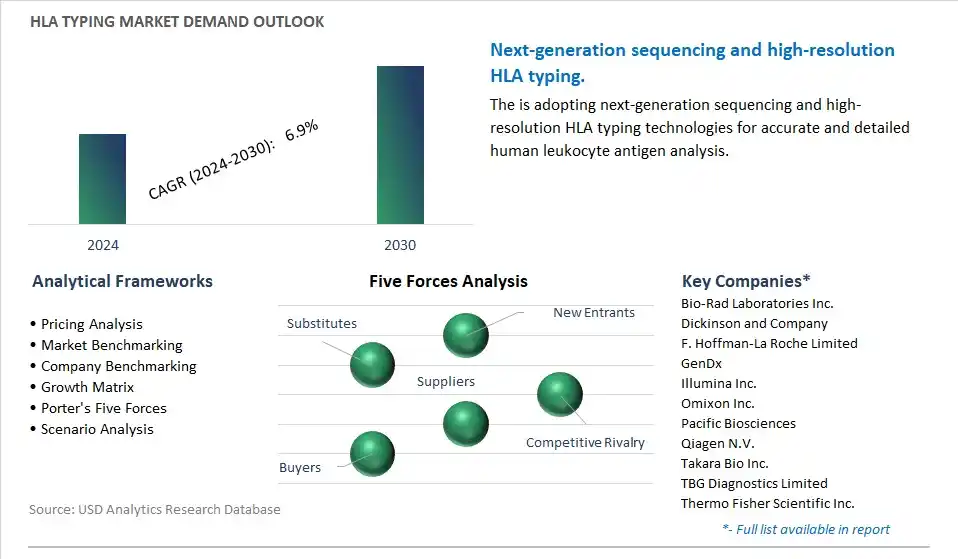
HLA Typing Market is estimated to increase at a Compounded Annual Growth Rate of 6.9% CAGR over the forecast period from 2024 to 2030
The HLA Typing Market study analyzes and forecasts the market size across 6 regions and 24 countries for diverse segments- By Technology (Molecular Assay Technologies, Non-molecular Assay Technologies), By Products and Services (Reagents & Consumables, Instruments, Software & Services), By Application (Diagnostic Applications, Research Applications, Donor-recipient cross-matching, Infectious disease testing, Cancer diagnosis & prevention, Transfusion therapy, Others), By End-User (Commercial service providers, Hospitals & surgical centers, Research laboratories).
An Introduction to HLA Typing Market in 2024
Human leukocyte antigen (HLA) typing is a laboratory technique used to identify specific variations in the genes that encode for the major histocompatibility complex (MHC) proteins in humans. In 2024, HLA typing remains a critical component of tissue matching and compatibility testing in organ transplantation, hematopoietic stem cell transplantation (HSCT), and blood transfusion medicine. The HLA genes, located on chromosome 6, play a central role in the immune system by regulating immune responses and distinguishing self from non-self antigens. HLA typing involves identifying the specific alleles present at HLA loci, including HLA-A, HLA-B, HLA-C, HLA-DR, HLA-DQ, and HLA-DP, through molecular methods such as polymerase chain reaction (PCR), sequence-specific oligonucleotide probes (SSOP), or next-generation sequencing (NGS). By accurately determining an individual's HLA genotype, healthcare providers can assess histocompatibility between donors and recipients, minimizing the risk of rejection and graft-versus-host disease (GVHD) following transplantation. HLA typing also plays a crucial role in matching compatible blood products for transfusion, reducing the risk of alloimmunization and transfusion reactions in recipients. With advancements in HLA typing technologies, such as high-resolution sequencing and allele-specific PCR, healthcare providers can achieve greater accuracy and precision in predicting transplant outcomes and optimizing patient care. By facilitating precise matching of donors and recipients based on HLA compatibility, HLA typing improves the success rates of organ and tissue transplantation, prolongs graft survival, and enhances the overall quality of life for transplant recipients.
Market Trend: Increasing Demand for Transplantation and Immunotherapy
A significant trend in the HLA typing market is the increasing demand for transplantation and immunotherapy. HLA typing plays a critical role in organ and tissue transplantation by matching donors and recipients based on human leukocyte antigen (HLA) compatibility to minimize the risk of rejection. With the growing prevalence of end-stage organ failure and autoimmune diseases, the demand for HLA typing services is rising to facilitate organ allocation and ensure successful transplant outcomes. Additionally, HLA typing is essential for personalized cancer immunotherapy, as it helps identify HLA-restricted tumor antigens and predict patient responses to immunotherapeutic interventions. As transplantation and immunotherapy become more prevalent treatment modalities for various diseases, the demand for accurate and high-throughput HLA typing solutions is expected to grow, driving market expansion and innovation in HLA typing technologies and services.
Market Driver: Advancements in Transplantation Medicine and Immunogenetics
A key driver fueling the HLA typing market is the rapid advancements in transplantation medicine and immunogenetics. With the advent of next-generation sequencing (NGS) technologies, high-resolution HLA typing has become more accessible, accurate, and cost-effective, enabling precise matching of donors and recipients for transplantation. Moreover, advancements in immunogenetics have led to a better understanding of the role of HLA alleles in immune responses, graft acceptance, and autoimmune diseases, driving the demand for comprehensive HLA typing solutions for clinical and research applications. Furthermore, the increasing prevalence of organ transplantation, stem cell transplantation, and adoptive cell therapy underscores the importance of HLA typing in personalized medicine and patient care. As healthcare providers and researchers continue to leverage HLA typing for transplantation and immunotherapy, the demand for advanced HLA typing technologies and services is expected to rise, driving market growth and investment in HLA typing platforms, reagents, and informatics solutions.
Market Opportunity: Expansion into Point-of-Care Testing (POCT) and Near-Patient Testing
A potential opportunity in the HLA typing market lies in the expansion into point-of-care testing (POCT) and near-patient testing applications. While traditional HLA typing methods typically involve centralized laboratory testing using molecular techniques such as polymerase chain reaction (PCR) and NGS, there is a growing demand for rapid and decentralized testing solutions that can be performed at the point of care or near the patient's bedside. By miniaturizing HLA typing platforms, simplifying assay workflows, and developing user-friendly interfaces, manufacturers can create portable and easy-to-use HLA typing devices for on-site testing in transplant clinics, emergency departments, and outpatient settings. These POCT and near-patient HLA typing solutions offer healthcare providers rapid turnaround times, enabling timely organ allocation decisions, donor-recipient matching, and personalized treatment planning. Additionally, POCT HLA typing devices have the potential to improve access to transplantation services in underserved and remote areas, enhance patient outcomes, and reduce healthcare costs associated with delayed transplantations and graft rejections. By expanding into POCT and near-patient testing applications, HLA typing providers can tap into new market segments, address unmet clinical needs, and contribute to the advancement of precision medicine and personalized transplantation. Expanding into POCT and near-patient testing represents a strategic opportunity for stakeholders to improve patient care, drive innovation, and deliver value to healthcare providers and transplant recipients alike.
HLA Typing Market Share Analysis: Sequencing-based Molecular Assays is the fastest growing segment over the forecast period to 2030
Among the segments of the HLA Typing Market, Sequencing-based Molecular Assays emerge as the fastest-growing technology. This accelerated growth is driven by several factors. Sequencing-based molecular assays, such as next-generation sequencing (NGS), offer unparalleled accuracy, resolution, and high-throughput capabilities in human leukocyte antigen (HLA) typing, facilitating precise matching between donors and recipients in transplantation procedures. Additionally, sequencing-based approaches enable comprehensive profiling of HLA genes, including detection of rare and novel alleles, thereby enhancing diagnostic accuracy and reducing the risk of transplant rejection. The expanding application of sequencing-based assays in infectious disease testing, cancer diagnosis, and personalized medicine further fuels its adoption across commercial service providers, hospitals, and research laboratories. Moreover, advancements in sequencing technology and bioinformatics tools continue to drive innovation in HLA typing, positioning sequencing-based molecular assays as a pivotal driver in shaping the future of transplantation medicine and immune-related diagnostics.
HLA Typing Competitive Analysis
The market research study provides in-depth insights into leading companies including the SWOT analyses, product profile, financial details, and recent developments acrossBio-Rad Laboratories Inc., Dickinson and Company, F. Hoffman-La Roche Limited, GenDx, Illumina Inc., Omixon Inc., Pacific Biosciences, Qiagen N.V., Takara Bio Inc., TBG Diagnostics Limited, Thermo Fisher Scientific Inc.
HLA Typing Market Segmentation
By Technology
Molecular Assay Technologies
-PCR-based Molecular Assays
-Sequencing-based Molecular Assays
Non-molecular Assay Technologies
By Products and Services
Reagents & Consumables
Instruments
Software & Services
By Application
Diagnostic Applications
Research Applications
Donor-recipient cross-matching
Infectious disease testing
Cancer diagnosis & prevention
Transfusion therapy
Others
By End-User
Commercial service providers
Hospitals & surgical centers
Research laboratories
Geographical Analysis
North America (United States, Canada, Mexico)
Europe (Germany, France, United Kingdom, Spain, Italy, Rest of Europe)
Asia Pacific (China, India, Japan, South Korea, Rest of Asia Pacific)
South America (Brazil, Argentina, Rest of South America)
Middle East and Africa (Saudi Arabia, UAE, Rest of Middle East, South Africa, Egypt, Rest of Africa)
HLA Typing Market Companies
Bio-Rad Laboratories Inc.
Dickinson and Company
F. Hoffman-La Roche Limited
GenDx
Illumina Inc.
Omixon Inc.
Pacific Biosciences
Qiagen N.V.
Takara Bio Inc.
TBG Diagnostics Limited
Thermo Fisher Scientific Inc.
Reasons to Buy the HLA Typing Market Study
• Deepen your industry insights and navigate uncertainties for strategy formulation, CAPEX, and Operational decisions
• Gain access to detailed insights on the HLA Typing Market, encompassing current market size, growth trends, and forecasts till 2030.
• Access detailed competitor analysis, enabling competitive advantage through a thorough understanding of market players, strategies, and potential differentiation opportunities
• Stay ahead of the curve with insights on technological advancements, innovations, and upcoming trends
• Identify lucrative investment avenues and expansion opportunities within the HLA Typing Market industry, guided by robust, data-backed analysis.
• Understand regional and global markets through country-wise analysis, regional market potential, regulatory nuances, and dynamics
• Execute strategies with confidence and speed through information, analytics, and insights on the industry value chain
• Corporate leaders, strategists, financial experts, shareholders, asset managers, and governmental representatives can make long-term planning scenarios and build an integrated and timely understanding of market dynamics
• Benefit from tailored solutions and expert consultation based on report insights, providing personalized strategies aligned with specific business needs.
TABLE OF CONTENTS
1 Introduction to 2024 HLA Typing Market
1.1 Market Overview
1.2 Quick Facts
1.3 Scope/Objective of the Study
1.4 Market Definition
1.5 Countries and Regions Covered
1.6 Units, Currency, and Conversions
1.7 Industry Value Chain
2 Research Methodology
2.1 Market Size Estimation
2.2 Sources and Research Methodology
2.3 Data Triangulation
2.4 Assumptions and Limitations
3 Executive Summary
3.1 Global HLA Typing Market Size Outlook, $ Million, 2021 to 2030
3.2 HLA Typing Market Outlook by Type, $ Million, 2021 to 2030
3.3 HLA Typing Market Outlook by Product, $ Million, 2021 to 2030
3.4 HLA Typing Market Outlook by Application, $ Million, 2021 to 2030
3.5 HLA Typing Market Outlook by Key Countries, $ Million, 2021 to 2030
4 Market Dynamics
4.1 Key Driving Forces of HLA Typing Industry
4.2 Key Market Trends in HLA Typing Industry
4.3 Potential Opportunities in HLA Typing Industry
4.4 Key Challenges in HLA Typing Industry
5 Market Factor Analysis
5.1 Value Chain Analysis
5.2 Competitive Landscape
5.2.1 Global HLA Typing Market Share by Company (%), 2023
5.2.2 Product Offerings by Company
5.3 Porter’s Five Forces Analysis
5.4 Pricing Analysis and Outlook
6 Growth Outlook Across Scenarios
6.1 Growth Analysis-Case Scenario Definitions
6.2 Low Growth Scenario Forecasts
6.3 Reference Growth Scenario Forecasts
6.4 High Growth Scenario Forecasts
7 Global HLA Typing Market Outlook by Segments
7.1 HLA Typing Market Outlook by Segments, $ Million, 2021- 2030
By Technology
Molecular Assay Technologies
-PCR-based Molecular Assays
-Sequencing-based Molecular Assays
Non-molecular Assay Technologies
By Products and Services
Reagents & Consumables
Instruments
Software & Services
By Application
Diagnostic Applications
Research Applications
Donor-recipient cross-matching
Infectious disease testing
Cancer diagnosis & prevention
Transfusion therapy
Others
By End-User
Commercial service providers
Hospitals & surgical centers
Research laboratories
8 North America HLA Typing Market Analysis and Outlook To 2030
8.1 Introduction to North America HLA Typing Markets in 2024
8.2 North America HLA Typing Market Size Outlook by Country, 2021-2030
8.2.1 United States
8.2.2 Canada
8.2.3 Mexico
8.3 North America HLA Typing Market size Outlook by Segments, 2021-2030
By Technology
Molecular Assay Technologies
-PCR-based Molecular Assays
-Sequencing-based Molecular Assays
Non-molecular Assay Technologies
By Products and Services
Reagents & Consumables
Instruments
Software & Services
By Application
Diagnostic Applications
Research Applications
Donor-recipient cross-matching
Infectious disease testing
Cancer diagnosis & prevention
Transfusion therapy
Others
By End-User
Commercial service providers
Hospitals & surgical centers
Research laboratories
9 Europe HLA Typing Market Analysis and Outlook To 2030
9.1 Introduction to Europe HLA Typing Markets in 2024
9.2 Europe HLA Typing Market Size Outlook by Country, 2021-2030
9.2.1 Germany
9.2.2 France
9.2.3 Spain
9.2.4 United Kingdom
9.2.4 Italy
9.2.5 Russia
9.2.6 Norway
9.2.7 Rest of Europe
9.3 Europe HLA Typing Market Size Outlook by Segments, 2021-2030
By Technology
Molecular Assay Technologies
-PCR-based Molecular Assays
-Sequencing-based Molecular Assays
Non-molecular Assay Technologies
By Products and Services
Reagents & Consumables
Instruments
Software & Services
By Application
Diagnostic Applications
Research Applications
Donor-recipient cross-matching
Infectious disease testing
Cancer diagnosis & prevention
Transfusion therapy
Others
By End-User
Commercial service providers
Hospitals & surgical centers
Research laboratories
10 Asia Pacific HLA Typing Market Analysis and Outlook To 2030
10.1 Introduction to Asia Pacific HLA Typing Markets in 2024
10.2 Asia Pacific HLA Typing Market Size Outlook by Country, 2021-2030
10.2.1 China
10.2.2 India
10.2.3 Japan
10.2.4 South Korea
10.2.5 Indonesia
10.2.6 Malaysia
10.2.7 Australia
10.2.8 Rest of Asia Pacific
10.3 Asia Pacific HLA Typing Market size Outlook by Segments, 2021-2030
By Technology
Molecular Assay Technologies
-PCR-based Molecular Assays
-Sequencing-based Molecular Assays
Non-molecular Assay Technologies
By Products and Services
Reagents & Consumables
Instruments
Software & Services
By Application
Diagnostic Applications
Research Applications
Donor-recipient cross-matching
Infectious disease testing
Cancer diagnosis & prevention
Transfusion therapy
Others
By End-User
Commercial service providers
Hospitals & surgical centers
Research laboratories
11 South America HLA Typing Market Analysis and Outlook To 2030
11.1 Introduction to South America HLA Typing Markets in 2024
11.2 South America HLA Typing Market Size Outlook by Country, 2021-2030
11.2.1 Brazil
11.2.2 Argentina
11.2.3 Rest of South America
11.3 South America HLA Typing Market size Outlook by Segments, 2021-2030
By Technology
Molecular Assay Technologies
-PCR-based Molecular Assays
-Sequencing-based Molecular Assays
Non-molecular Assay Technologies
By Products and Services
Reagents & Consumables
Instruments
Software & Services
By Application
Diagnostic Applications
Research Applications
Donor-recipient cross-matching
Infectious disease testing
Cancer diagnosis & prevention
Transfusion therapy
Others
By End-User
Commercial service providers
Hospitals & surgical centers
Research laboratories
12 Middle East and Africa HLA Typing Market Analysis and Outlook To 2030
12.1 Introduction to Middle East and Africa HLA Typing Markets in 2024
12.2 Middle East and Africa HLA Typing Market Size Outlook by Country, 2021-2030
12.2.1 Saudi Arabia
12.2.2 UAE
12.2.3 Oman
12.2.4 Rest of Middle East
12.2.5 Egypt
12.2.6 Nigeria
12.2.7 South Africa
12.2.8 Rest of Africa
12.3 Middle East and Africa HLA Typing Market size Outlook by Segments, 2021-2030
By Technology
Molecular Assay Technologies
-PCR-based Molecular Assays
-Sequencing-based Molecular Assays
Non-molecular Assay Technologies
By Products and Services
Reagents & Consumables
Instruments
Software & Services
By Application
Diagnostic Applications
Research Applications
Donor-recipient cross-matching
Infectious disease testing
Cancer diagnosis & prevention
Transfusion therapy
Others
By End-User
Commercial service providers
Hospitals & surgical centers
Research laboratories
13 Company Profiles
13.1 Company Snapshot
13.2 SWOT Profiles
13.3 Products and Services
13.4 Recent Developments
13.5 Financial Profile
List of Companies
Bio-Rad Laboratories Inc.
Dickinson and Company
F. Hoffman-La Roche Limited
GenDx
Illumina Inc.
Omixon Inc.
Pacific Biosciences
Qiagen N.V.
Takara Bio Inc.
TBG Diagnostics Limited
Thermo Fisher Scientific Inc.
14 Appendix
14.1 Customization Offerings
14.2 Subscription Services
14.3 Related Reports
14.4 Publisher Expertise
By Technology
Molecular Assay Technologies
-PCR-based Molecular Assays
-Sequencing-based Molecular Assays
Non-molecular Assay Technologies
By Products and Services
Reagents & Consumables
Instruments
Software & Services
By Application
Diagnostic Applications
Research Applications
Donor-recipient cross-matching
Infectious disease testing
Cancer diagnosis & prevention
Transfusion therapy
Others
By End-User
Commercial service providers
Hospitals & surgical centers
Research laboratories
Countries Analyzed
North America (United States, Canada, Mexico)
Europe (Germany, France, United Kingdom, Spain, Italy, Rest of Europe)
Asia Pacific (China, India, Japan, South Korea, Rest of Asia Pacific)
South America (Brazil, Argentina, Rest of South America)
Middle East and Africa (Saudi Arabia, UAE, Rest of Middle East, South Africa, Egypt, Rest of Africa)
