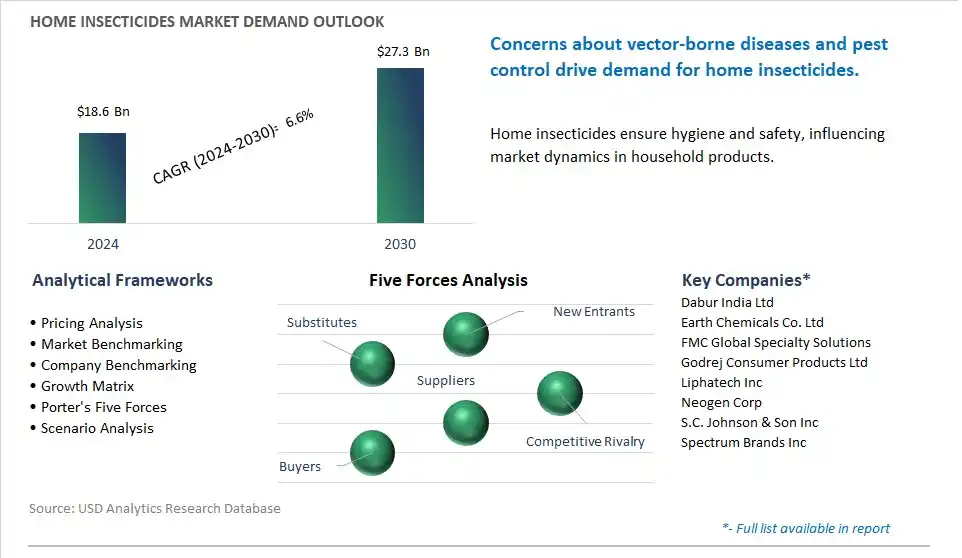
The global Home Insecticides Market is poised to register a 6.6% CAGR from $18.6 Billion in 2024 to $27.3 Billion in 2030.
The global Home Insecticides Market Study analyzes and forecasts the market size across 6 regions and 24 countries for diverse segments -By Form (Units, Liquid, Powdered Granule), By Application (Cockroaches, Ants, Mosquitoes, Flies & Moths, Rat & Rodent, Bedbugs & Beetles), By Product (Natural, Synthetic), By Distribution Channel (Supermarkets/Hypermarkets, Drug Stores & Pharmacies, Online Retailing, Others).
An Introduction to Global Home Insecticides Market in 2024
The home insecticides market is evolving in response to changing consumer preferences, environmental concerns, and regulatory landscape. Key trends shaping the future of the industry include the rising demand for natural and organic insecticides derived from plant-based ingredients, driven by growing health consciousness and sustainability initiatives. Moreover, advancements in formulation technology, such as microencapsulation and controlled release systems, are enhancing the efficacy and safety of home insecticides while minimizing environmental impact. Additionally, the market is witnessing a shift towards multifunctional insecticide products that offer not only pest control but also additional benefits such as air purification or fragrance, catering to the demand for value-added solutions.
Home Insecticides Market Competitive Landscape
The market report analyses the leading companies in the industry including Dabur India Ltd, Earth Chemicals Co. Ltd, FMC Global Specialty Solutions, Godrej Consumer Products Ltd, Liphatech Inc, Neogen Corp, S.C. Johnson & Son Inc, Spectrum Brands Inc.
Home Insecticides Market Dynamics
Home Insecticides Market Trend: Shift Towards Eco-Friendly and Child-Safe Formulations
A significant trend in the home insecticides market is the shift towards eco-friendly and child-safe formulations driven by increasing consumer awareness of health and environmental concerns, regulatory pressure, and changing preferences towards safer household products. Consumers are seeking insecticide products that effectively control pests while minimizing exposure to harmful chemicals, especially in homes with children and pets. As a result, there is a growing demand for insecticides formulated with natural, plant-based ingredients, and low-toxicity active ingredients such as botanical oils and microbial agents. Manufacturers are responding to this trend by developing insecticide products that are biodegradable, non-toxic, and safe for indoor use, providing effective pest control without compromising human health or environmental sustainability. This trend is reshaping the home insecticides market towards the production and adoption of safer and more environmentally friendly pest management solutions that align with consumer preferences and regulatory requirements.
Home Insecticides Market Driver: Rise in Urbanization and Awareness of Vector-Borne Diseases
A key driver propelling the home insecticides market is the rise in urbanization and growing awareness of vector-borne diseases, leading to increased concerns about household pests such as mosquitoes, flies, cockroaches, and ants. Rapid urbanization, population growth, and changes in land use patterns create conducive environments for pests to thrive in residential areas, posing health risks and nuisance to homeowners. Additionally, the spread of vector-borne diseases such as dengue fever, Zika virus, and Lyme disease heightens public awareness of the importance of pest control measures to prevent insect infestations and disease transmission. As a result, there is a rising demand for home insecticides that effectively target common household pests, providing homeowners with peace of mind and protection against insect-borne health threats. The increasing prevalence of pests in urban environments and the need for effective pest management solutions drive market demand for home insecticides as essential household products for maintaining hygiene and ensuring health and well-being.
Home Insecticides Market Opportunity: Development of Smart and IoT-enabled Pest Control Solutions
An opportunity for market expansion lies in the development of smart and IoT-enabled pest control solutions that offer advanced monitoring, detection, and management of household pests, providing convenience, efficiency, and effectiveness to consumers. With advancements in sensor technology, connectivity, and data analytics, there is potential to integrate smart devices such as sensors, traps, and insect monitoring systems into home insecticide products and pest control services. Smart pest control solutions can offer real-time insights into pest activity, environmental conditions, and treatment efficacy, allowing homeowners to monitor and manage pest infestations remotely through smartphone apps or web interfaces. Furthermore, IoT-enabled pest control devices can automate pest detection, alert homeowners of potential infestations, and deliver targeted treatments using precision application methods, reducing the need for conventional insecticide sprays and minimizing environmental impact. By embracing smart technology and IoT connectivity, home insecticide manufacturers can innovate and differentiate their products, enhance user experience, and capture opportunities in the growing market for intelligent pest management solutions, driving growth and competitiveness in the home insecticides market.
Home Insecticides Market Share Analysis: Liquid segment generated the highest revenue in the industry
The liquid segment is the largest segment in the home insecticides market, primarily due to diverse factors. Liquid insecticides offer convenience, ease of use, and versatility in application, making them highly preferred by consumers for controlling pests and insects in and around the home. Liquid insecticides come in ready-to-use formulations, which eliminate the need for measuring and mixing, simplifying the application process for consumers. Additionally, liquid formulations can be easily applied using spray bottles, trigger sprayers, or hose-end sprayers, allowing for precise and targeted application to areas where pests are present. In addition, liquid insecticides offer fast-acting and long-lasting effectiveness against a wide range of pests, including ants, cockroaches, spiders, mosquitoes, and flies, making them suitable for use in various indoor and outdoor settings. Further, advancements in formulation technology have led to the development of liquid insecticides with enhanced efficacy, low odor, and reduced environmental impact, further driving their popularity among consumers. Over the forecast period, the combination of convenience, effectiveness, and versatility positions the liquid segment as the largest segment in the home insecticides market.
Home Insecticides Market Share Analysis: Bedbugs & Beetles Segment is poised to register the fastest growth rate (CAGR) over the forecast period to 2030
The bedbugs & beetles segment is the fastest-growing segment in the home insecticides market, driven by diverse key factors. The there has been a resurgence in bedbug infestations globally, driven by factors such as increased international travel, changes in pest management practices, and resistance to traditional insecticides. Bedbugs are notoriously difficult to control and eliminate due to their ability to hide in cracks and crevices and their resistance to many conventional insecticides. As a result, there is a growing demand for effective insecticides specifically formulated to target bedbugs and other beetles. Secondly, the prevalence of stored product pests such as beetles (e.g., flour beetles, grain beetles) in homes and food storage areas poses significant challenges for homeowners and food processing facilities. These pests can infest stored food products, causing contamination, spoilage, and economic losses. Effective insecticides targeting bedbugs and beetles are essential for controlling infestations and preventing damage to property and food supplies. Additionally, consumers are increasingly concerned about the use of harsh chemicals and pesticides in and around their homes, leading to a growing demand for eco-friendly and low-toxicity insecticides formulated to target specific pests such as bedbugs and beetles. Further, advancements in formulation technology have led to the development of insecticides with improved efficacy, safety, and environmental profiles, further driving their adoption in the home insecticides market. Over the forecast period, the combination of increasing pest pressures, consumer preferences for effective and eco-friendly solutions, and technological advancements positions the bedbugs & beetles segment as the fastest-growing segment in the home insecticides market.
Home Insecticides Market Share Analysis: Natural Segment is poised to register the fastest growth rate (CAGR) over the forecast period to 2030
The natural segment is the fastest-growing segment in the home insecticides market, driven by diverse key factors. The there is a growing consumer preference for natural and eco-friendly products across various industries, including pest control. Consumers are becoming more aware of the potential health and environmental risks associated with synthetic insecticides containing harsh chemicals and are seeking safer and more sustainable alternatives. Natural insecticides, derived from plant extracts, essential oils, and other organic sources, offer a non-toxic and environmentally friendly solution for controlling pests in and around the home. Secondly, advancements in formulation technology and research into botanical and biological insecticides have led to the development of natural insecticides with improved efficacy and performance. Natural insecticides can effectively target a wide range of pests, including mosquitoes, ants, cockroaches, and flies, without posing risks to humans, pets, or beneficial insects such as bees and butterflies. Additionally, natural insecticides are biodegradable and do not leave harmful residues in the environment, making them suitable for use in sensitive areas such as homes, gardens, and organic farms. Further, regulatory initiatives and consumer awareness campaigns promoting the use of natural and organic products have further fueled the demand for natural insecticides in the home insecticides market. Over the forecast period, the combination of consumer preferences for safer and more sustainable pest control solutions, technological advancements, and regulatory support positions the natural segment as the fastest-growing segment in the home insecticides market.
Home Insecticides Market Report Segmentation
By Form
Units
Liquid
Powdered Granule
By Application
Cockroaches
Ants
Mosquitoes
Flies & Moths
Rat & Rodent
Bedbugs & Beetles
By Product
Natural
Synthetic
By Distribution Channel
Supermarkets/Hypermarkets
Drug Stores & Pharmacies
Online Retailing
Others
Regions Included
North America (US, Canada, Mexico)
Europe (Germany, UK, France, Spain, Italy, Russia, Rest of Europe)
Asia Pacific (China, India, Japan, South Korea, Australia, South East Asia, Rest of Asia)
South America (Brazil, Argentina, Rest of South America)
Middle East and Africa (Saudi Arabia, UAE, Rest of Middle East, South Africa, Egypt, Rest of Africa)
Home Insecticides Companies Profiled in the Market Study
Dabur India Ltd
Earth Chemicals Co. Ltd
FMC Global Specialty Solutions
Godrej Consumer Products Ltd
Liphatech Inc
Neogen Corp
S.C. Johnson & Son Inc
Spectrum Brands Inc
*- List Not Exhaustive
TABLE OF CONTENTS
1 Introduction to 2024 Home Insecticides Market
1.1 Market Overview
1.2 Quick Facts
1.3 Scope/Objective of the Study
1.4 Market Definition
1.5 Countries and Regions Covered
1.6 Units, Currency, and Conversions
1.7 Industry Value Chain
2 Research Methodology
2.1 Market Size Estimation
2.2 Sources and Research Methodology
2.3 Data Triangulation
2.4 Assumptions and Limitations
3 Executive Summary
3.1 Global Home Insecticides Market Size Outlook, $ Million, 2021 to 2030
3.2 Home Insecticides Market Outlook by Type, $ Million, 2021 to 2030
3.3 Home Insecticides Market Outlook by Product, $ Million, 2021 to 2030
3.4 Home Insecticides Market Outlook by Application, $ Million, 2021 to 2030
3.5 Home Insecticides Market Outlook by Key Countries, $ Million, 2021 to 2030
4 Market Dynamics
4.1 Key Driving Forces of Home Insecticides Industry
4.2 Key Market Trends in Home Insecticides Industry
4.3 Potential Opportunities in Home Insecticides Industry
4.4 Key Challenges in Home Insecticides Industry
5 Market Factor Analysis
5.1 Value Chain Analysis
5.2 Competitive Landscape
5.2.1 Global Home Insecticides Market Share by Company (%), 2023
5.2.2 Product Offerings by Company
5.3 Porter’s Five Forces Analysis
5.4 Pricing Analysis and Outlook
6 Growth Outlook Across Scenarios
6.1 Growth Analysis-Case Scenario Definitions
6.2 Low Growth Scenario Forecasts
6.3 Reference Growth Scenario Forecasts
6.4 High Growth Scenario Forecasts
7 Global Home Insecticides Market Outlook by Segments
7.1 Home Insecticides Market Outlook by Segments, $ Million, 2021- 2030
By Form
Units
Liquid
Powdered Granule
By Application
Cockroaches
Ants
Mosquitoes
Flies & Moths
Rat & Rodent
Bedbugs & Beetles
By Product
Natural
Synthetic
By Distribution Channel
Supermarkets/Hypermarkets
Drug Stores & Pharmacies
Online Retailing
Others
8 North America Home Insecticides Market Analysis and Outlook To 2030
8.1 Introduction to North America Home Insecticides Markets in 2024
8.2 North America Home Insecticides Market Size Outlook by Country, 2021-2030
8.2.1 United States
8.2.2 Canada
8.2.3 Mexico
8.3 North America Home Insecticides Market size Outlook by Segments, 2021-2030
By Form
Units
Liquid
Powdered Granule
By Application
Cockroaches
Ants
Mosquitoes
Flies & Moths
Rat & Rodent
Bedbugs & Beetles
By Product
Natural
Synthetic
By Distribution Channel
Supermarkets/Hypermarkets
Drug Stores & Pharmacies
Online Retailing
Others
9 Europe Home Insecticides Market Analysis and Outlook To 2030
9.1 Introduction to Europe Home Insecticides Markets in 2024
9.2 Europe Home Insecticides Market Size Outlook by Country, 2021-2030
9.2.1 Germany
9.2.2 France
9.2.3 Spain
9.2.4 United Kingdom
9.2.4 Italy
9.2.5 Russia
9.2.6 Norway
9.2.7 Rest of Europe
9.3 Europe Home Insecticides Market Size Outlook by Segments, 2021-2030
By Form
Units
Liquid
Powdered Granule
By Application
Cockroaches
Ants
Mosquitoes
Flies & Moths
Rat & Rodent
Bedbugs & Beetles
By Product
Natural
Synthetic
By Distribution Channel
Supermarkets/Hypermarkets
Drug Stores & Pharmacies
Online Retailing
Others
10 Asia Pacific Home Insecticides Market Analysis and Outlook To 2030
10.1 Introduction to Asia Pacific Home Insecticides Markets in 2024
10.2 Asia Pacific Home Insecticides Market Size Outlook by Country, 2021-2030
10.2.1 China
10.2.2 India
10.2.3 Japan
10.2.4 South Korea
10.2.5 Indonesia
10.2.6 Malaysia
10.2.7 Australia
10.2.8 Rest of Asia Pacific
10.3 Asia Pacific Home Insecticides Market size Outlook by Segments, 2021-2030
By Form
Units
Liquid
Powdered Granule
By Application
Cockroaches
Ants
Mosquitoes
Flies & Moths
Rat & Rodent
Bedbugs & Beetles
By Product
Natural
Synthetic
By Distribution Channel
Supermarkets/Hypermarkets
Drug Stores & Pharmacies
Online Retailing
Others
11 South America Home Insecticides Market Analysis and Outlook To 2030
11.1 Introduction to South America Home Insecticides Markets in 2024
11.2 South America Home Insecticides Market Size Outlook by Country, 2021-2030
11.2.1 Brazil
11.2.2 Argentina
11.2.3 Rest of South America
11.3 South America Home Insecticides Market size Outlook by Segments, 2021-2030
By Form
Units
Liquid
Powdered Granule
By Application
Cockroaches
Ants
Mosquitoes
Flies & Moths
Rat & Rodent
Bedbugs & Beetles
By Product
Natural
Synthetic
By Distribution Channel
Supermarkets/Hypermarkets
Drug Stores & Pharmacies
Online Retailing
Others
12 Middle East and Africa Home Insecticides Market Analysis and Outlook To 2030
12.1 Introduction to Middle East and Africa Home Insecticides Markets in 2024
12.2 Middle East and Africa Home Insecticides Market Size Outlook by Country, 2021-2030
12.2.1 Saudi Arabia
12.2.2 UAE
12.2.3 Oman
12.2.4 Rest of Middle East
12.2.5 Egypt
12.2.6 Nigeria
12.2.7 South Africa
12.2.8 Rest of Africa
12.3 Middle East and Africa Home Insecticides Market size Outlook by Segments, 2021-2030
By Form
Units
Liquid
Powdered Granule
By Application
Cockroaches
Ants
Mosquitoes
Flies & Moths
Rat & Rodent
Bedbugs & Beetles
By Product
Natural
Synthetic
By Distribution Channel
Supermarkets/Hypermarkets
Drug Stores & Pharmacies
Online Retailing
Others
13 Company Profiles
13.1 Company Snapshot
13.2 SWOT Profiles
13.3 Products and Services
13.4 Recent Developments
13.5 Financial Profile
Dabur India Ltd
Earth Chemicals Co. Ltd
FMC Global Specialty Solutions
Godrej Consumer Products Ltd
Liphatech Inc
Neogen Corp
S.C. Johnson & Son Inc
Spectrum Brands Inc
14 Appendix
14.1 Customization Offerings
14.2 Subscription Services
14.3 Related Reports
14.4 Publisher Expertise
By Form
Units
Liquid
Powdered Granule
By Application
Cockroaches
Ants
Mosquitoes
Flies & Moths
Rat & Rodent
Bedbugs & Beetles
By Product
Natural
Synthetic
By Distribution Channel
Supermarkets/Hypermarkets
Drug Stores & Pharmacies
Online Retailing
Others
Countries Analyzed
North America (US, Canada, Mexico)
Europe (Germany, UK, France, Spain, Italy, Russia, Rest of Europe)
Asia Pacific (China, India, Japan, South Korea, Australia, South East Asia, Rest of Asia)
South America (Brazil, Argentina, Rest of South America)
Middle East and Africa (Saudi Arabia, UAE, Rest of Middle East, South Africa, Egypt, Rest of Africa)
