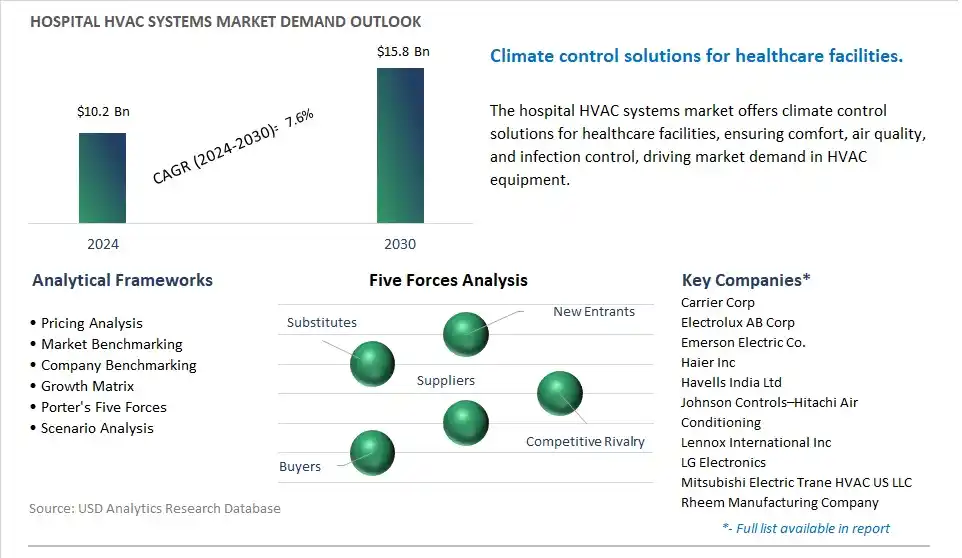
The global Hospital HVAC Systems Market is poised to register a 7.6% CAGR from $10.2 Billion in 2024 to $15.8 Billion in 2030.
The global Hospital HVAC Systems Market Study analyzes and forecasts the market size across 6 regions and 24 countries for diverse segments -By Product (Heating, Ventilation, Cooling), By End-User (Intensive Care Unit, Operating Rooms, Airborne Infection Isolation Rooms, Protective Environment Rooms, Compounding Pharmacies, Others).
An Introduction to Global Hospital HVAC Systems Market in 2024
Heating, ventilation, and air conditioning (HVAC) systems are essential for maintaining indoor air quality, comfort, and infection control in hospitals and healthcare facilities, providing temperature regulation, humidity control, and air filtration to ensure patient safety and well-being. One key trend shaping the future of hospital HVAC systems is the integration of advanced HVAC technologies, filtration systems, and building automation systems to improve energy efficiency, infection control, and occupant comfort while reducing operational costs and environmental impact. HVAC manufacturers are developing energy-efficient HVAC equipment such as variable refrigerant flow (VRF) systems, heat recovery ventilation (HRV) units, and chilled beam systems tailored to the specific requirements of healthcare environments, optimizing thermal comfort and air quality while minimizing energy consumption and carbon emissions. Additionally, advancements in air filtration technologies such as high-efficiency particulate air (HEPA) filters, ultraviolet germicidal irradiation (UVGI), and bipolar ionization are enhancing the effectiveness of HVAC systems in removing airborne pathogens, allergens, and volatile organic compounds (VOCs), reducing the risk of nosocomial infections and improving overall indoor environmental quality. Moreover, the integration of smart HVAC controls, occupancy sensors, and real-time monitoring systems is enabling proactive maintenance, fault detection, and optimization of HVAC performance, ensuring reliable operation and compliance with regulatory standards and infection control protocols. As healthcare facilities prioritize patient safety, comfort, and operational efficiency, the hospital HVAC systems industry is poised for innovation and growth, with opportunities for collaboration, technology integration, and market expansion to meet the evolving needs of healthcare providers and patients.
Hospital HVAC Systems Market Competitive Landscape
The market report analyses the leading companies in the industry including Carrier Corp, Electrolux AB Corp, Emerson Electric Co., Haier Inc, Havells India Ltd, Johnson Controls–Hitachi Air Conditioning, Lennox International Inc, LG Electronics, Mitsubishi Electric Trane HVAC US LLC, Rheem Manufacturing Company, Samsung Electronics Co. Ltd, United Technologies Corp.
Hospital HVAC Systems Market Dynamics
Hospital HVAC Systems Market Trend: Increasing Focus on Indoor Air Quality and Patient Comfort
A prominent trend in the market for Hospital HVAC Systems is the increasing focus on indoor air quality (IAQ) and patient comfort within healthcare facilities. Hospitals and healthcare institutions are prioritizing the implementation of HVAC systems that provide clean, filtered air to maintain a healthy indoor environment for patients, staff, and visitors. With a heightened awareness of airborne pathogens, allergens, and pollutants, there is a growing demand for HVAC systems equipped with advanced filtration technologies and air purification systems to reduce the risk of healthcare-associated infections and improve overall IAQ. Additionally, hospitals are seeking HVAC solutions that offer precise temperature and humidity control to enhance patient comfort and promote healing. This is driven by regulatory guidelines for IAQ in healthcare settings, patient satisfaction initiatives, and advancements in HVAC technology that enable the delivery of clean, comfortable air in hospital environments, leading to increased adoption of hospital HVAC systems worldwide.
Hospital HVAC Systems Market Driver: Healthcare Infrastructure Investments and Facility Upgrades
The market for Hospital HVAC Systems is being driven by healthcare infrastructure investments and facility upgrades aimed at improving patient care, operational efficiency, and energy performance. As healthcare systems face growing demands for services and aging infrastructure, there is a significant need for HVAC solutions that can support the expansion, renovation, and modernization of hospital facilities. Factors such as population growth, advances in medical technology, and the need to comply with regulatory standards for healthcare facility design drive investments in HVAC infrastructure projects. This driver is further fueled by government funding for healthcare infrastructure development, incentives for energy-efficient building upgrades, and the adoption of sustainable building practices in healthcare construction, driving market growth and adoption of hospital HVAC systems as essential components of modern healthcare facilities.
Hospital HVAC Systems Market Opportunity: Integration of Smart Building Technologies and Energy Management Systems
An exciting opportunity within the market for Hospital HVAC Systems lies in the integration of smart building technologies and energy management systems to optimize HVAC performance, reduce energy consumption, and enhance operational efficiency in healthcare facilities. Companies can explore opportunities to provide HVAC solutions equipped with sensors, controls, and building automation systems that enable real-time monitoring, predictive maintenance, and adaptive control of HVAC equipment based on occupancy patterns, patient needs, and environmental conditions. Additionally, there is potential to develop energy management platforms that integrate HVAC systems with other building systems such as lighting, power distribution, and renewable energy sources to create holistic, energy-efficient healthcare environments. By leveraging their expertise in HVAC engineering, building automation, and data analytics, companies can capitalize on the growing demand for smart and sustainable HVAC solutions in healthcare facilities and position themselves as leaders in providing innovative HVAC technologies for the healthcare market, driving growth and differentiation in the hospital HVAC systems industry.
Hospital HVAC Systems Market Ecosystem
The Hospital HVAC Systems Market operates through a multifaceted Market Ecosystem involving various stakeholders at different stages of the system's lifecycle. Initially, consulting engineering firms including WSP and AECOM lend their expertise in designing HVAC systems tailored specifically for healthcare facilities, while hospitals rely on their in-house engineering teams for this purpose. Following the design phase, HVAC equipment manufacturers including Johnson Controls and Trane Technologies produce a wide range of essential components including chillers, air handling units, and boilers, with companies specializing in healthcare-specific equipment including air filtration systems (e.g., Ruskin) or specialized air handling units (e.g., Halton Group).
The distribution of HVAC equipment to contractors and hospitals is facilitated by HVAC equipment distributors including Ingram Micro and Rexel, while large manufacturers opt for direct sales through dedicated teams for significant projects. Mechanical contractors including Siemens and Skanska then take charge of the installation and construction of HVAC systems, with hospitals maintaining in-house maintenance teams for minor repairs. Building Automation System (BAS) providers including Honeywell and Siemens offer solutions for controlling and monitoring HVAC systems, typically integrating them into the overall building automation system, while HVAC service companies including Johnson Controls and Trane Technologies, alongside independent service providers, ensure the ongoing maintenance and servicing of hospital HVAC systems. Further, hospitals and healthcare facilities serve as the end-users of these systems, relying on them to maintain optimal environmental conditions critical for patient comfort, infection control, and staff well-being.
Hospital HVAC Systems Market Share Analysis: Ventilation held the dominant revenue share in 2024
The largest segment in the Hospital HVAC Systems Market is the Ventilation product segment. This dominance is primarily due to diverse key factors. Ventilation systems play a critical role in hospitals by maintaining indoor air quality, controlling airborne pathogens, and creating a safe and healthy environment for patients, staff, and visitors. Hospital ventilation systems are designed to remove contaminants, such as bacteria, viruses, and airborne particles, from the air and supply fresh, filtered air to patient rooms, operating theaters, and other critical areas. Additionally, proper ventilation is essential for controlling humidity levels, preventing the spread of infectious diseases, and minimizing the risk of hospital-acquired infections (HAIs). In addition, advancements in ventilation technology, including high-efficiency particulate air (HEPA) filters, ultraviolet germicidal irradiation (UVGI) systems, and energy recovery ventilation (ERV) units, further enhance the performance and efficiency of hospital ventilation systems, driving their widespread adoption. Further, regulatory standards and guidelines, such as those set forth by organizations like the American Society of Heating, Refrigerating and Air-Conditioning Engineers (ASHRAE) and the Centers for Disease Control and Prevention (CDC), mandate the implementation of effective ventilation systems in healthcare facilities to ensure patient safety and infection control. Overall, the Ventilation product segment holds the largest share of the Hospital HVAC Systems Market due to its critical role in maintaining indoor air quality, infection control, and patient safety in hospital environments.
Hospital HVAC Systems Market Share Analysis: Airborne Infection Isolation Rooms (AIIR) is the fastest growing market segment over the forecast period to 2030
The fastest-growing segment in the Hospital HVAC Systems Market is the Airborne Infection Isolation Rooms (AIIR) segment. This growth is primarily due to diverse key factors. Firstly, the increasing prevalence of infectious diseases and the emergence of antibiotic-resistant pathogens have heightened the need for effective infection control measures in healthcare facilities. Airborne Infection Isolation Rooms (AIIRs) are specialized hospital rooms equipped with enhanced ventilation systems designed to prevent the spread of airborne pathogens, including bacteria, viruses, and fungi. These rooms feature negative pressure ventilation systems that create a pressure gradient to prevent contaminated air from escaping into surrounding areas, thereby reducing the risk of airborne transmission of infectious diseases. Additionally, AIIRs are equipped with high-efficiency particulate air (HEPA) filters and ultraviolet germicidal irradiation (UVGI) systems to further enhance air filtration and disinfection capabilities. In addition, the COVID-19 pandemic has underscored the importance of AIIRs in healthcare settings, leading to increased investments in AIIR infrastructure and HVAC systems to combat the spread of respiratory viruses and other airborne pathogens. Further, regulatory standards and guidelines, such as those established by organizations like the Centers for Disease Control and Prevention (CDC) and the World Health Organization (WHO), mandate the implementation of AIIRs in healthcare facilities to mitigate the risk of nosocomial infections and protect vulnerable patient populations. Overall, the Airborne Infection Isolation Rooms (AIIR) segment is experiencing rapid growth in the Hospital HVAC Systems Market due to the increasing focus on infection control, the emergence of infectious diseases, and the need to ensure patient safety in healthcare environments.
Hospital HVAC Systems Market Report Scope-
By Product
Heating
Ventilation
Cooling
By End-User
Intensive Care Unit
Operating Rooms
Airborne Infection Isolation Rooms
Protective Environment Rooms
Compounding Pharmacies
Others
Hospital HVAC Systems Market Companies Profiled
Carrier Corp
Electrolux AB Corp
Emerson Electric Co.
Haier Inc
Havells India Ltd
Johnson Controls–Hitachi Air Conditioning
Lennox International Inc
LG Electronics
Mitsubishi Electric Trane HVAC US LLC
Rheem Manufacturing Company
Samsung Electronics Co. Ltd
United Technologies Corp
*- List Not Exhaustive
TABLE OF CONTENTS
1 Introduction to 2024 Hospital HVAC Systems Market
1.1 Market Overview
1.2 Quick Facts
1.3 Scope/Objective of the Study
1.4 Market Definition
1.5 Countries and Regions Covered
1.6 Units, Currency, and Conversions
1.7 Industry Value Chain
2 Research Methodology
2.1 Market Size Estimation
2.2 Sources and Research Methodology
2.3 Data Triangulation
2.4 Assumptions and Limitations
3 Executive Summary
3.1 Global Hospital HVAC Systems Market Size Outlook, $ Million, 2021 to 2030
3.2 Hospital HVAC Systems Market Outlook by Type, $ Million, 2021 to 2030
3.3 Hospital HVAC Systems Market Outlook by Product, $ Million, 2021 to 2030
3.4 Hospital HVAC Systems Market Outlook by Application, $ Million, 2021 to 2030
3.5 Hospital HVAC Systems Market Outlook by Key Countries, $ Million, 2021 to 2030
4 Market Dynamics
4.1 Key Driving Forces of Hospital HVAC Systems Industry
4.2 Key Market Trends in Hospital HVAC Systems Industry
4.3 Potential Opportunities in Hospital HVAC Systems Industry
4.4 Key Challenges in Hospital HVAC Systems Industry
5 Market Factor Analysis
5.1 Value Chain Analysis
5.2 Competitive Landscape
5.2.1 Global Hospital HVAC Systems Market Share by Company (%), 2023
5.2.2 Product Offerings by Company
5.3 Porter’s Five Forces Analysis
5.4 Pricing Analysis and Outlook
6 Growth Outlook Across Scenarios
6.1 Growth Analysis-Case Scenario Definitions
6.2 Low Growth Scenario Forecasts
6.3 Reference Growth Scenario Forecasts
6.4 High Growth Scenario Forecasts
7 Global Hospital HVAC Systems Market Outlook by Segments
7.1 Hospital HVAC Systems Market Outlook by Segments, $ Million, 2021- 2030
By Product
Heating
Ventilation
Cooling
By End-User
Intensive Care Unit
Operating Rooms
Airborne Infection Isolation Rooms
Protective Environment Rooms
Compounding Pharmacies
Others
8 North America Hospital HVAC Systems Market Analysis and Outlook To 2030
8.1 Introduction to North America Hospital HVAC Systems Markets in 2024
8.2 North America Hospital HVAC Systems Market Size Outlook by Country, 2021-2030
8.2.1 United States
8.2.2 Canada
8.2.3 Mexico
8.3 North America Hospital HVAC Systems Market size Outlook by Segments, 2021-2030
By Product
Heating
Ventilation
Cooling
By End-User
Intensive Care Unit
Operating Rooms
Airborne Infection Isolation Rooms
Protective Environment Rooms
Compounding Pharmacies
Others
9 Europe Hospital HVAC Systems Market Analysis and Outlook To 2030
9.1 Introduction to Europe Hospital HVAC Systems Markets in 2024
9.2 Europe Hospital HVAC Systems Market Size Outlook by Country, 2021-2030
9.2.1 Germany
9.2.2 France
9.2.3 Spain
9.2.4 United Kingdom
9.2.4 Italy
9.2.5 Russia
9.2.6 Norway
9.2.7 Rest of Europe
9.3 Europe Hospital HVAC Systems Market Size Outlook by Segments, 2021-2030
By Product
Heating
Ventilation
Cooling
By End-User
Intensive Care Unit
Operating Rooms
Airborne Infection Isolation Rooms
Protective Environment Rooms
Compounding Pharmacies
Others
10 Asia Pacific Hospital HVAC Systems Market Analysis and Outlook To 2030
10.1 Introduction to Asia Pacific Hospital HVAC Systems Markets in 2024
10.2 Asia Pacific Hospital HVAC Systems Market Size Outlook by Country, 2021-2030
10.2.1 China
10.2.2 India
10.2.3 Japan
10.2.4 South Korea
10.2.5 Indonesia
10.2.6 Malaysia
10.2.7 Australia
10.2.8 Rest of Asia Pacific
10.3 Asia Pacific Hospital HVAC Systems Market size Outlook by Segments, 2021-2030
By Product
Heating
Ventilation
Cooling
By End-User
Intensive Care Unit
Operating Rooms
Airborne Infection Isolation Rooms
Protective Environment Rooms
Compounding Pharmacies
Others
11 South America Hospital HVAC Systems Market Analysis and Outlook To 2030
11.1 Introduction to South America Hospital HVAC Systems Markets in 2024
11.2 South America Hospital HVAC Systems Market Size Outlook by Country, 2021-2030
11.2.1 Brazil
11.2.2 Argentina
11.2.3 Rest of South America
11.3 South America Hospital HVAC Systems Market size Outlook by Segments, 2021-2030
By Product
Heating
Ventilation
Cooling
By End-User
Intensive Care Unit
Operating Rooms
Airborne Infection Isolation Rooms
Protective Environment Rooms
Compounding Pharmacies
Others
12 Middle East and Africa Hospital HVAC Systems Market Analysis and Outlook To 2030
12.1 Introduction to Middle East and Africa Hospital HVAC Systems Markets in 2024
12.2 Middle East and Africa Hospital HVAC Systems Market Size Outlook by Country, 2021-2030
12.2.1 Saudi Arabia
12.2.2 UAE
12.2.3 Oman
12.2.4 Rest of Middle East
12.2.5 Egypt
12.2.6 Nigeria
12.2.7 South Africa
12.2.8 Rest of Africa
12.3 Middle East and Africa Hospital HVAC Systems Market size Outlook by Segments, 2021-2030
By Product
Heating
Ventilation
Cooling
By End-User
Intensive Care Unit
Operating Rooms
Airborne Infection Isolation Rooms
Protective Environment Rooms
Compounding Pharmacies
Others
13 Company Profiles
13.1 Company Snapshot
13.2 SWOT Profiles
13.3 Products and Services
13.4 Recent Developments
13.5 Financial Profile
Carrier Corp
Electrolux AB Corp
Emerson Electric Co.
Haier Inc
Havells India Ltd
Johnson Controls–Hitachi Air Conditioning
Lennox International Inc
LG Electronics
Mitsubishi Electric Trane HVAC US LLC
Rheem Manufacturing Company
Samsung Electronics Co. Ltd
United Technologies Corp
14 Appendix
14.1 Customization Offerings
14.2 Subscription Services
14.3 Related Reports
14.4 Publisher Expertise
By Product
Heating
Ventilation
Cooling
By End-User
Intensive Care Unit
Operating Rooms
Airborne Infection Isolation Rooms
Protective Environment Rooms
Compounding Pharmacies
Others
Countries Analyzed
North America (US, Canada, Mexico)
Europe (Germany, UK, France, Spain, Italy, Russia, Rest of Europe)
Asia Pacific (China, India, Japan, South Korea, Australia, South East Asia, Rest of Asia)
South America (Brazil, Argentina, Rest of South America)
Middle East and Africa (Saudi Arabia, UAE, Rest of Middle East, South Africa, Egypt, Rest of Africa)
