The global Humate Market is poised to register a 10.2% CAGR from $756 Million in 2024 to $1354 Million in 2030.
The global Humate Market Study analyzes and forecasts the market size across 6 regions and 24 countries for diverse segments -By Type (Powder, Flake, Spherical), By Application (Pharmaceutical, Agriculture Use Fertilizer, Feed Additive, Others).
An Introduction to Global Humate Market in 2024
Humates, derived from decomposed organic matter such as leonardite and lignite, are natural soil amendments used in agriculture, horticulture, and environmental remediation to improve soil fertility, water retention, and nutrient uptake by plants. One key trend shaping the future of humates is the growing demand for organic and sustainable soil management practices, driven by increasing awareness of soil health, climate change mitigation, and food security. Humate producers are innovating new extraction methods, formulations, and application techniques to enhance the effectiveness and versatility of humate-based soil amendments, providing solutions for soil conditioning, plant nutrition, and crop protection in diverse agricultural systems. Additionally, advancements in humic acid analysis, characterization, and quality control are improving understanding of humate chemistry, bioavailability, and interactions with soil microorganisms, facilitating evidence-based recommendations for optimal humate application rates and timing. Moreover, the integration of humates with complementary soil health practices such as cover cropping, crop rotation, and conservation tillage is promoting regenerative agriculture principles, enhancing soil organic matter content, microbial diversity, and ecosystem resilience while reducing reliance on synthetic fertilizers and agrochemicals. As farmers and growers seek sustainable and cost-effective solutions for soil fertility and crop productivity, the humate industry is poised for innovation and growth, with opportunities for collaboration, education, and market expansion to meet the evolving needs of agricultural producers and environmental stewardship initiatives.
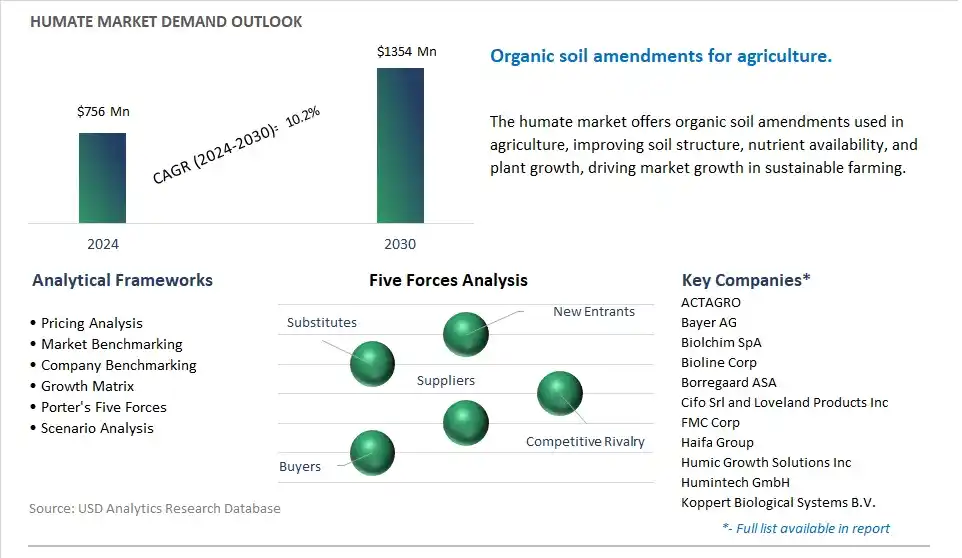
Humate Market Competitive Landscape
The market report analyses the leading companies in the industry including ACTAGRO, Bayer AG, Biolchim SpA, Bioline Corp, Borregaard ASA, Cifo Srl and Loveland Products Inc, FMC Corp, Haifa Group, Humic Growth Solutions Inc, Humintech GmbH, Koppert Biological Systems B.V., Novihum Technologies GmbH, Promisol, Qingdao Future Group Co. Ltd, Rovensa, Sikko Industries Ltd, TAGROW CO. Ltd, UPL Ltd, Valagro SpA.
Humate Market Dynamics
Humate Market Trend: Increasing Demand for Organic and Sustainable Agriculture Practices
A prominent trend in the market for Humate is the increasing demand for organic and sustainable agriculture practices. With growing concerns about soil health, environmental sustainability, and food safety, there is a rising preference among farmers and growers for natural and environmentally friendly soil amendments and fertilizers. Humate, derived from organic matter such as leonardite or lignite coal, offers a rich source of humic substances that improve soil structure, nutrient retention, and water holding capacity, leading to increased crop yields, resilience to environmental stress, and reduced reliance on synthetic fertilizers and pesticides. This is driven by consumer demand for organic and sustainably produced food, regulatory support for environmentally friendly farming practices, and awareness campaigns promoting the benefits of humate-based soil amendments, leading to increased adoption of humate products in agriculture and horticulture sectors worldwide.
Humate Market Driver: Soil Degradation and Declining Agricultural Productivity
The market for Humate is being driven by soil degradation and declining agricultural productivity, which necessitates the use of soil amendments to restore soil health and fertility. As intensive agricultural practices, erosion, and chemical inputs deplete soil organic matter, nutrient levels, and microbial diversity, there is a pressing need for solutions that can rejuvenate and revitalize soils for sustainable crop production. Humate offers a natural and cost-effective solution by replenishing soil organic carbon, enhancing nutrient availability, and promoting beneficial microbial activity, leading to improved soil structure, fertility, and productivity. Factors such as population growth, food security concerns, and climate change impacts drive investments in soil health management practices and drive demand for humate-based soil amendments as essential components of sustainable agriculture systems, driving market growth and adoption of humate products in agricultural markets.
Humate Market Opportunity: Expansion into Organic Farming and Specialty Crop Markets
An exciting opportunity within the market for Humate lies in the expansion into organic farming and specialty crop markets, where there is a growing demand for natural and sustainable inputs to meet consumer preferences and market trends. Companies can explore opportunities to provide humate-based soil amendments and fertilizers tailored for organic farming practices, where synthetic inputs are restricted or prohibited. Additionally, there is potential to develop specialty formulations for high-value crops such as fruits, vegetables, and specialty herbs, where soil health, nutrient management, and crop quality are paramount. By leveraging their expertise in humic substance extraction, formulation development, and agronomic expertise, companies can capitalize on the growing demand for organic and specialty crops and position themselves as leaders in providing innovative humate-based solutions for sustainable agriculture, driving growth and differentiation in the humate market.
Humate Market Ecosystem
The humate market operates through a structured Market Ecosystem encompassing diverse key stages. Initially, humic material suppliers including Leonard J. Guarisco Inc. and The Andersons play a vital role in sourcing raw materials rich in humic substances including lignite, peat, or leonardite through mining or harvesting processes. Following raw material acquisition, humate processing companies including Humic Growth Products and AgraMinerals undertake the conversion of these raw materials into usable humate products through extraction, separation, and drying processes, with companies specializing in further modification techniques including micronization or complexing for specific applications, as seen with Brandt Consolidated and NOMATIC.
The distribution phase sees the involvement of fertilizer distributors including Yara International and The Mosaic Company, which supply various fertilizers and soil amendments, including humate products, to agricultural retailers and farmers. Further, large humate processing companies opt for direct sales through dedicated teams for bulk sales or direct to industrial users. Further, humates serve diverse end-user industries, including agriculture, where they are utilized as soil amendments to enhance soil health and plant growth.
Humate Market Share Analysis: Powder held the dominant revenue share in 2024
The largest segment in the Humate Market is the Powder type segment. This dominance is primarily due to diverse key factors. Powdered humates offer diverse advantages over other forms, such as flakes or spherical pellets. Firstly, powdered humates are highly versatile and easy to handle, allowing for convenient application across various industries and agricultural practices. They can be easily mixed with soil, fertilizers, or other additives, ensuring uniform distribution and effective incorporation into the soil profile. Additionally, powdered humates exhibit faster solubility and dispersion in water compared to other forms, making them suitable for use in liquid formulations, foliar sprays, and fertigation systems. In addition, powdered humates are often preferred for their cost-effectiveness and scalability, as they can be produced in large quantities and packaged for bulk distribution. Further, powdered humates offer excellent soil conditioning properties, including improved soil structure, water retention, nutrient availability, and microbial activity, making them valuable inputs in agriculture, horticulture, landscaping, and environmental remediation projects. Overall, the Powder type segment holds the largest share in the Humate Market due to its versatility, ease of use, cost-effectiveness, and superior soil conditioning properties.
Humate Market Share Analysis: Agriculture Use Fertilizer is the fastest growing market segment over the forecast period to 2030
The fastest-growing segment in the Humate Market is the Agriculture Use Fertilizer application segment. This growth is primarily due to diverse key factors. Firstly, there is increasing global awareness of the importance of sustainable agricultural practices and the need to improve soil health and fertility. Humates, derived from organic matter such as peat, lignite, and leonardite, offer valuable soil conditioning properties, including improved soil structure, water retention, nutrient availability, and microbial activity. These benefits enhance crop productivity, nutrient uptake, and resilience to environmental stressors, such as drought, salinity, and nutrient deficiencies, thereby driving the demand for humate-based fertilizers in agriculture. Additionally, humate-based fertilizers are compatible with various crop production systems, including conventional, organic, and sustainable farming practices, making them versatile inputs for growers worldwide. In addition, the increasing adoption of humate-based fertilizers is supported by scientific research and field trials demonstrating their efficacy in improving crop yield, quality, and sustainability. Further, regulatory initiatives promoting organic and sustainable agriculture, along with consumer demand for safe and environmentally friendly food products, further drive the demand for humate-based fertilizers as part of integrated soil fertility management strategies. Overall, the Agriculture Use Fertilizer application segment is experiencing rapid growth in the Humate Market due to the increasing recognition of humates' benefits in enhancing soil health, crop productivity, and sustainability in agriculture.
Humate Market Report Scope-
By Type
Powder
Flake
Spherical
By Application
Pharmaceutical
Agriculture Use Fertilizer
Feed Additive
Others
Humate Market Companies Profiled
ACTAGRO
Bayer AG
Biolchim SpA
Bioline Corp
Borregaard ASA
Cifo Srl and Loveland Products Inc
FMC Corp
Haifa Group
Humic Growth Solutions Inc
Humintech GmbH
Koppert Biological Systems B.V.
Novihum Technologies GmbH
Promisol
Qingdao Future Group Co. Ltd
Rovensa
Sikko Industries Ltd
TAGROW CO. Ltd
UPL Ltd
Valagro SpA
*- List Not Exhaustive
TABLE OF CONTENTS
1 Introduction to 2024 Humate Market
1.1 Market Overview
1.2 Quick Facts
1.3 Scope/Objective of the Study
1.4 Market Definition
1.5 Countries and Regions Covered
1.6 Units, Currency, and Conversions
1.7 Industry Value Chain
2 Research Methodology
2.1 Market Size Estimation
2.2 Sources and Research Methodology
2.3 Data Triangulation
2.4 Assumptions and Limitations
3 Executive Summary
3.1 Global Humate Market Size Outlook, $ Million, 2021 to 2030
3.2 Humate Market Outlook by Type, $ Million, 2021 to 2030
3.3 Humate Market Outlook by Product, $ Million, 2021 to 2030
3.4 Humate Market Outlook by Application, $ Million, 2021 to 2030
3.5 Humate Market Outlook by Key Countries, $ Million, 2021 to 2030
4 Market Dynamics
4.1 Key Driving Forces of Humate Industry
4.2 Key Market Trends in Humate Industry
4.3 Potential Opportunities in Humate Industry
4.4 Key Challenges in Humate Industry
5 Market Factor Analysis
5.1 Value Chain Analysis
5.2 Competitive Landscape
5.2.1 Global Humate Market Share by Company (%), 2023
5.2.2 Product Offerings by Company
5.3 Porter’s Five Forces Analysis
5.4 Pricing Analysis and Outlook
6 Growth Outlook Across Scenarios
6.1 Growth Analysis-Case Scenario Definitions
6.2 Low Growth Scenario Forecasts
6.3 Reference Growth Scenario Forecasts
6.4 High Growth Scenario Forecasts
7 Global Humate Market Outlook by Segments
7.1 Humate Market Outlook by Segments, $ Million, 2021- 2030
By Type
Powder
Flake
Spherical
By Application
Pharmaceutical
Agriculture Use Fertilizer
Feed Additive
Others
8 North America Humate Market Analysis and Outlook To 2030
8.1 Introduction to North America Humate Markets in 2024
8.2 North America Humate Market Size Outlook by Country, 2021-2030
8.2.1 United States
8.2.2 Canada
8.2.3 Mexico
8.3 North America Humate Market size Outlook by Segments, 2021-2030
By Type
Powder
Flake
Spherical
By Application
Pharmaceutical
Agriculture Use Fertilizer
Feed Additive
Others
9 Europe Humate Market Analysis and Outlook To 2030
9.1 Introduction to Europe Humate Markets in 2024
9.2 Europe Humate Market Size Outlook by Country, 2021-2030
9.2.1 Germany
9.2.2 France
9.2.3 Spain
9.2.4 United Kingdom
9.2.4 Italy
9.2.5 Russia
9.2.6 Norway
9.2.7 Rest of Europe
9.3 Europe Humate Market Size Outlook by Segments, 2021-2030
By Type
Powder
Flake
Spherical
By Application
Pharmaceutical
Agriculture Use Fertilizer
Feed Additive
Others
10 Asia Pacific Humate Market Analysis and Outlook To 2030
10.1 Introduction to Asia Pacific Humate Markets in 2024
10.2 Asia Pacific Humate Market Size Outlook by Country, 2021-2030
10.2.1 China
10.2.2 India
10.2.3 Japan
10.2.4 South Korea
10.2.5 Indonesia
10.2.6 Malaysia
10.2.7 Australia
10.2.8 Rest of Asia Pacific
10.3 Asia Pacific Humate Market size Outlook by Segments, 2021-2030
By Type
Powder
Flake
Spherical
By Application
Pharmaceutical
Agriculture Use Fertilizer
Feed Additive
Others
11 South America Humate Market Analysis and Outlook To 2030
11.1 Introduction to South America Humate Markets in 2024
11.2 South America Humate Market Size Outlook by Country, 2021-2030
11.2.1 Brazil
11.2.2 Argentina
11.2.3 Rest of South America
11.3 South America Humate Market size Outlook by Segments, 2021-2030
By Type
Powder
Flake
Spherical
By Application
Pharmaceutical
Agriculture Use Fertilizer
Feed Additive
Others
12 Middle East and Africa Humate Market Analysis and Outlook To 2030
12.1 Introduction to Middle East and Africa Humate Markets in 2024
12.2 Middle East and Africa Humate Market Size Outlook by Country, 2021-2030
12.2.1 Saudi Arabia
12.2.2 UAE
12.2.3 Oman
12.2.4 Rest of Middle East
12.2.5 Egypt
12.2.6 Nigeria
12.2.7 South Africa
12.2.8 Rest of Africa
12.3 Middle East and Africa Humate Market size Outlook by Segments, 2021-2030
By Type
Powder
Flake
Spherical
By Application
Pharmaceutical
Agriculture Use Fertilizer
Feed Additive
Others
13 Company Profiles
13.1 Company Snapshot
13.2 SWOT Profiles
13.3 Products and Services
13.4 Recent Developments
13.5 Financial Profile
ACTAGRO
Bayer AG
Biolchim SpA
Bioline Corp
Borregaard ASA
Cifo Srl and Loveland Products Inc
FMC Corp
Haifa Group
Humic Growth Solutions Inc
Humintech GmbH
Koppert Biological Systems B.V.
Novihum Technologies GmbH
Promisol
Qingdao Future Group Co. Ltd
Rovensa
Sikko Industries Ltd
TAGROW CO. Ltd
UPL Ltd
Valagro SpA
14 Appendix
14.1 Customization Offerings
14.2 Subscription Services
14.3 Related Reports
14.4 Publisher Expertise
By Type
Powder
Flake
Spherical
By Application
Pharmaceutical
Agriculture Use Fertilizer
Feed Additive
Others
Countries Analyzed
North America (US, Canada, Mexico)
Europe (Germany, UK, France, Spain, Italy, Russia, Rest of Europe)
Asia Pacific (China, India, Japan, South Korea, Australia, South East Asia, Rest of Asia)
South America (Brazil, Argentina, Rest of South America)
Middle East and Africa (Saudi Arabia, UAE, Rest of Middle East, South Africa, Egypt, Rest of Africa)
