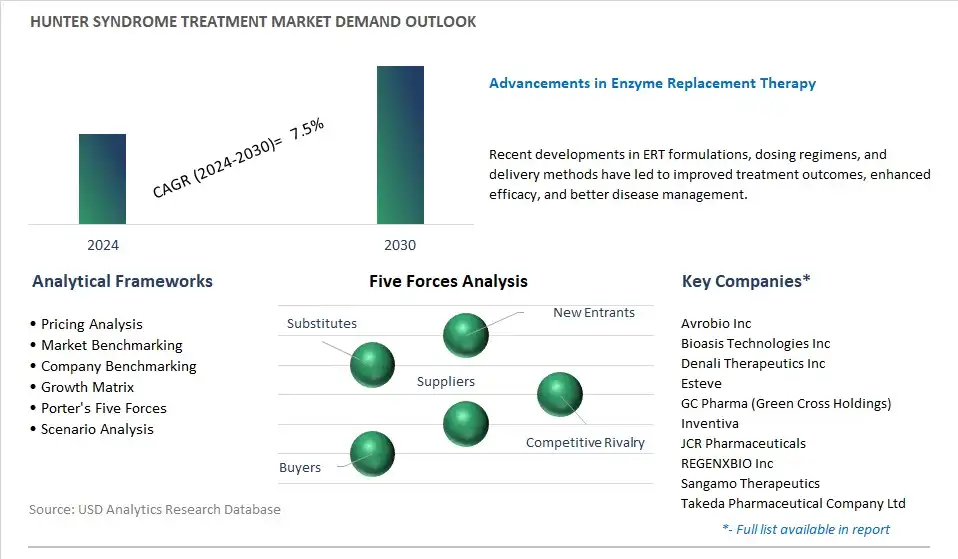
Hunter Syndrome Treatment Market is estimated to increase at a growth rate of 7.5% CAGR over the forecast period from 2024 to 2030.
The Hunter Syndrome Treatment Market study analyzes and forecasts the market size across 6 regions and 24 countries for diverse segments including By Treatment Type (Enzyme Replacement Therapy (ERT), Hematopoietic Stem Cell Transplant (HSCT), Others), By End-User (Hospitals, Diagnostic Centers, Others).
An Introduction to Hunter Syndrome Treatment Market in 2024
The Hunter Syndrome Treatment market in 2024 is witnessing significant advancements in therapeutic options, supportive care interventions, and disease management strategies aimed at improving outcomes for patients affected by this rare genetic disorder. Hunter syndrome, also known as mucopolysaccharidosis type II (MPS II), is a progressive metabolic disorder caused by deficiency of the enzyme iduronate-2-sulfatase, leading to the accumulation of glycosaminoglycans (GAGs) in various tissues and organs. Treatment options for Hunter syndrome include enzyme replacement therapy (ERT), hematopoietic stem cell transplantation (HSCT), and supportive care measures to manage symptoms and complications, such as airway obstruction, skeletal abnormalities, and cognitive impairment. With factors such as early diagnosis, multidisciplinary care, and patient advocacy driving demand for comprehensive treatment approaches, the market is witnessing efforts to improve access to therapy, enhance treatment efficacy, and optimize disease management protocols for patients with Hunter syndrome. Moreover, with advancements in gene therapy, substrate reduction therapy, and novel treatment modalities targeting underlying disease mechanisms, the market is evolving to include next-generation therapies aimed at addressing unmet medical needs, reducing disease burden, and improving quality of life for affected individuals. As the understanding of Hunter syndrome pathophysiology and treatment paradigms continues to evolve, the market is poised for continued innovation, collaboration, and investment in research and development efforts aimed at finding curative treatments and improving long-term outcomes for patients with this rare genetic disorder.
Hunter Syndrome Treatment Market Trend: Advancements in Enzyme Replacement Therapy
A prominent trend in the Hunter Syndrome Treatment market is the continuous advancements in enzyme replacement therapy (ERT). ERT has been a cornerstone in the management of Hunter syndrome, a rare genetic disorder characterized by deficiency or absence of the enzyme iduronate-2-sulfatase. Recent developments in ERT formulations, dosing regimens, and delivery methods have led to improved treatment outcomes, enhanced efficacy, and better disease management. Additionally, ongoing research efforts are focusing on the development of next-generation ERTs with improved pharmacokinetic properties, enhanced tissue penetration, and reduced immunogenicity, aiming to address unmet needs and further improve the quality of life for patients with Hunter syndrome.
Hunter Syndrome Treatment Market Driver: Increasing Awareness and Diagnosis Rates
A key driver in the Hunter Syndrome Treatment market is the increasing awareness and diagnosis rates of Hunter syndrome among healthcare professionals, patients, and caregivers. With improved understanding of the clinical manifestations, genetic basis, and diagnostic criteria for Hunter syndrome, there has been heightened recognition of the importance of early detection and intervention. Healthcare providers are increasingly screening at-risk populations, conducting genetic testing, and referring suspected cases for confirmatory diagnostic evaluations. Furthermore, advocacy efforts by patient organizations and rare disease foundations are raising awareness about Hunter syndrome, facilitating early diagnosis, and promoting access to appropriate treatment and supportive care services.
Hunter Syndrome Treatment Market Opportunity: Development of Novel Therapeutic Modalities
An opportunity for growth in the Hunter Syndrome Treatment market lies in the development of novel therapeutic modalities beyond enzyme replacement therapy. While ERT has revolutionized the management of Hunter syndrome, there remains a need for alternative treatment options, particularly for patients who may not respond optimally to ERT or experience limitations in treatment efficacy. Potential opportunities include gene therapy, substrate reduction therapy, chaperone therapy, and small molecule inhibitors targeting disease pathways associated with Hunter syndrome. By investing in research and development initiatives focused on novel therapeutic approaches, pharmaceutical companies can expand the treatment armamentarium, address unmet medical needs, and offer personalized treatment options tailored to the individual needs of patients with Hunter syndrome. This opportunity aligns with the industry's commitment to advancing precision medicine, innovative therapies, and improving outcomes for rare and genetic disorders.
Hunter Syndrome Treatment Market Segmentation
By Treatment Type
Enzyme Replacement Therapy (ERT)
Hematopoietic Stem Cell Transplant (HSCT)
Others
By End-User
Hospitals
Diagnostic Centers
Others
Geographical Analysis
North America (United States, Canada, Mexico)
Europe (Germany, France, United Kingdom, Spain, Italy, Rest of Europe)
Asia Pacific (China, India, Japan, South Korea, Rest of Asia Pacific)
South America (Brazil, Argentina, Rest of South America)
Middle East and Africa (Saudi Arabia, UAE, Rest of Middle East, South Africa, Egypt, Rest of Africa)
Hunter Syndrome Treatment Market Companies
Avrobio Inc
Bioasis Technologies Inc
Denali Therapeutics Inc
Esteve
GC Pharma (Green Cross Holdings)
Inventiva
JCR Pharmaceuticals
REGENXBIO Inc
Sangamo Therapeutics
Takeda Pharmaceutical Company Ltd
Triley Bidco Ltd (Clinigen Group PLC)
Reasons to Buy the Hunter Syndrome Treatment Market Study
• Deepen your industry insights and navigate uncertainties for strategy formulation, CAPEX, and Operational decisions
• Gain access to detailed insights on the Hunter Syndrome Treatment Market, encompassing current market size, growth trends, and forecasts till 2030.
• Access detailed competitor analysis, enabling competitive advantage through a thorough understanding of market players, strategies, and potential differentiation opportunities
• Stay ahead of the curve with insights on technological advancements, innovations, and upcoming trends
• Identify lucrative investment avenues and expansion opportunities within the Hunter Syndrome Treatment Market industry, guided by robust, data-backed analysis.
• Understand regional and global markets through country-wise analysis, regional market potential, regulatory nuances, and dynamics
• Execute strategies with confidence and speed through information, analytics, and insights on the industry value chain
• Corporate leaders, strategists, financial experts, shareholders, asset managers, and governmental representatives can make long-term planning scenarios and build an integrated and timely understanding of market dynamics
• Benefit from tailored solutions and expert consultation based on report insights, providing personalized strategies aligned with specific business needs.
TABLE OF CONTENTS
1 Introduction to 2024 Hunter Syndrome Treatment Market
1.1 Market Overview
1.2 Quick Facts
1.3 Scope/Objective of the Study
1.4 Market Definition
1.5 Countries and Regions Analyzed
1.6 Units, Currency, and Conversions
1.7 Industry Value Chain
2 Research Methodology
2.1 Market Size Estimation
2.2 Sources and Research Methodology
2.3 Data Triangulation
2.4 Assumptions and Limitations
3 Executive Summary
3.1 Global Hunter Syndrome Treatment Market Size Outlook, $ Million, 2021 to 2030
3.2 Hunter Syndrome Treatment Market Outlook by Type, $ Million, 2021 to 2030
3.3 Hunter Syndrome Treatment Market Outlook by Product, $ Million, 2021 to 2030
3.4 Hunter Syndrome Treatment Market Outlook by Application, $ Million, 2021 to 2030
3.5 Hunter Syndrome Treatment Market Outlook by Key Countries, $ Million, 2021 to 2030
4 Market Dynamics
4.1 Key Driving Forces of Hunter Syndrome Treatment Market Industry
4.2 Key Market Trends in Hunter Syndrome Treatment Market Industry
4.3 Potential Opportunities in Hunter Syndrome Treatment Market Industry
4.4 Key Challenges in Hunter Syndrome Treatment Market Industry
5 Market Factor Analysis
5.1 Competitive Landscape
5.1.1 Global Hunter Syndrome Treatment Market Share by Company (%), 2023
5.1.2 Product Offerings by Company
5.2 Porter’s Five Forces Analysis
6 Growth Outlook Across Scenarios
6.1 Growth Analysis-Case Scenario Definitions
6.2 Low Growth Scenario Forecasts
6.3 Reference Growth Scenario Forecasts
6.4 High Growth Scenario Forecasts
7 Global Hunter Syndrome Treatment Market Outlook By Segments
7.1 Hunter Syndrome Treatment Market Outlook by Segments
By Treatment Type
Enzyme Replacement Therapy (ERT)
Hematopoietic Stem Cell Transplant (HSCT)
Others
By End-User
Hospitals
Diagnostic Centers
Others
8 North America Hunter Syndrome Treatment Market Analysis And Outlook To 2030
8.1 Introduction to North America Hunter Syndrome Treatment Markets in 2024
8.2 North America Hunter Syndrome Treatment Market Size Outlook by Country, 2021-2030
8.2.1 United States
8.2.2 Canada
8.2.3 Mexico
8.3 North America Hunter Syndrome Treatment Market size Outlook by Segments, 2021-2030
By Treatment Type
Enzyme Replacement Therapy (ERT)
Hematopoietic Stem Cell Transplant (HSCT)
Others
By End-User
Hospitals
Diagnostic Centers
Others
9 Europe Hunter Syndrome Treatment Market Analysis And Outlook To 2030
9.1 Introduction to Europe Hunter Syndrome Treatment Markets in 2024
9.2 Europe Hunter Syndrome Treatment Market Size Outlook by Country, 2021-2030
9.2.1 Germany
9.2.2 France
9.2.3 Spain
9.2.4 United Kingdom
9.2.4 Italy
9.2.5 Russia
9.2.6 Norway
9.2.7 Rest of Europe
9.3 Europe Hunter Syndrome Treatment Market Size Outlook By Segments, 2021-2030
By Treatment Type
Enzyme Replacement Therapy (ERT)
Hematopoietic Stem Cell Transplant (HSCT)
Others
By End-User
Hospitals
Diagnostic Centers
Others
10 Asia Pacific Hunter Syndrome Treatment Market Analysis And Outlook To 2030
10.1 Introduction to Asia Pacific Hunter Syndrome Treatment Markets in 2024
10.2 Asia Pacific Hunter Syndrome Treatment Market Size Outlook by Country, 2021-2030
10.2.1 China
10.2.2 India
10.2.3 Japan
10.2.4 South Korea
10.2.5 Indonesia
10.2.6 Malaysia
10.2.7 Australia
10.2.8 Rest of Asia Pacific
10.3 Asia Pacific Hunter Syndrome Treatment Market size Outlook by Segments, 2021-2030
By Treatment Type
Enzyme Replacement Therapy (ERT)
Hematopoietic Stem Cell Transplant (HSCT)
Others
By End-User
Hospitals
Diagnostic Centers
Others
11 South America Hunter Syndrome Treatment Market Analysis And Outlook To 2030
11.1 Introduction to South America Hunter Syndrome Treatment Markets in 2024
11.2 South America Hunter Syndrome Treatment Market Size Outlook by Country, 2021-2030
11.2.1 Brazil
11.2.2 Argentina
11.2.3 Rest of South America
11.3 South America Hunter Syndrome Treatment Market size Outlook by Segments, 2021-2030
By Treatment Type
Enzyme Replacement Therapy (ERT)
Hematopoietic Stem Cell Transplant (HSCT)
Others
By End-User
Hospitals
Diagnostic Centers
Others
12 Middle East And Africa Hunter Syndrome Treatment Market Analysis And Outlook To 2030
12.1 Introduction to Middle East and Africa Hunter Syndrome Treatment Markets in 2024
12.2 Middle East and Africa Hunter Syndrome Treatment Market Size Outlook by Country, 2021-2030
12.2.1 Saudi Arabia
12.2.2 UAE
12.2.3 Oman
12.2.4 Rest of Middle East
12.2.5 Egypt
12.2.6 Nigeria
12.2.7 South Africa
12.2.8 Rest of Africa
12.3 Middle East and Africa Hunter Syndrome Treatment Market size Outlook by Segments, 2021-2030
By Treatment Type
Enzyme Replacement Therapy (ERT)
Hematopoietic Stem Cell Transplant (HSCT)
Others
By End-User
Hospitals
Diagnostic Centers
Others
13 Company Profiles
13.1 Company Snapshot
13.2 SWOT Profiles
13.3 Products and Services
13.4 Recent Developments
13.5 Financial Profile
List of Companies
Avrobio Inc
Bioasis Technologies Inc
Denali Therapeutics Inc
Esteve
GC Pharma (Green Cross Holdings)
Inventiva
JCR Pharmaceuticals
REGENXBIO Inc
Sangamo Therapeutics
Takeda Pharmaceutical Company Ltd
Triley Bidco Ltd (Clinigen Group PLC)
14 Appendix
14.1 Customization Offerings
14.2 Subscription Services
14.3 Related Reports
14.4 Publisher Expertise
