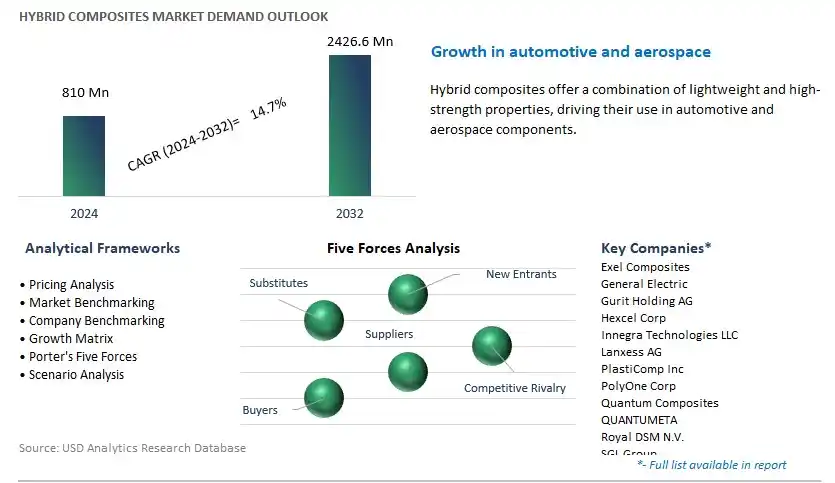
Global Hybrid Composites Market Size is valued at $810 Million in 2024 and is forecast to register a growth rate (CAGR) of 14.7% to reach $2426.6 Million by 2032.
The global Hybrid Composites Market Study analyzes and forecasts the market size across 6 regions and 24 countries for diverse segments -By Fiber (Carbon/Glass, Aramid/Carbon, HMPP, UHMWPE, Others), By Resin (Thermoset, Thermoplastic), By End-User (Automotive & Transportation, Aerospace & Defense, Wind Energy, Marine, Sporting Goods).
An Introduction to Hybrid Composites Market in 2024
In 2024, the market for hybrid composites demonstrates robust growth propelled by increasing demand from industries such as aerospace, automotive, marine, and construction. Hybrid composites are advanced materials composed of a combination of two or more types of reinforcing fibers, such as carbon, glass, aramid, or natural fibers, embedded in a polymer matrix. These composites offer a synergistic blend of properties, including high strength, stiffness, impact resistance, and fatigue resistance, making them suitable for a wide range of structural and functional applications. In the aerospace sector, hybrid composites are utilized for aircraft components such as fuselage panels, wings, and interior structures, where lightweight materials with exceptional mechanical properties are essential for fuel efficiency and performance. Similarly, in the automotive industry, these composites are employed for manufacturing lightweight body panels, chassis components, and structural reinforcements, contributing to improved fuel economy and vehicle safety. Further, the marine and construction sectors rely on hybrid composites for boat hulls, bridges, and building facades, offering corrosion resistance, durability, and design flexibility. With ongoing advancements in composite manufacturing processes, resin formulations, and fiber reinforcements, the market is witnessing the development of hybrid composites with tailored properties and performance characteristics to meet specific application requirements. As industries to pursue lightweighting, sustainability, and performance optimization, the demand for hybrid composites is expected to drive further innovation and market expansion, enabling the development of next-generation products and solutions for diverse industries.
Hybrid Composites Market Competitive Landscape
The market report analyses the leading companies in the industry including Exel Composites, General Electric, Gurit Holding AG, Hexcel Corp, Innegra Technologies LLC, Lanxess AG, PlastiComp Inc, PolyOne Corp, Quantum Composites, QUANTUMETA, Royal DSM N.V., SGL Group, Solvay S.A., STRUCTeam Ltd, Teijin Ltd, and others.
Hybrid Composites Market Dynamics
Market Trend: Growing Demand for Lightweight and High-Performance Materials
The market for Hybrid Composites is witnessing a prominent trend towards the growing demand for lightweight and high-performance materials across various industries such as automotive, aerospace, and renewable energy. With increasing emphasis on fuel efficiency, emissions reduction, and performance optimization, there's a surge in the adoption of hybrid composite materials that offer the advantages of both traditional composites and metals. Hybrid composites combine the strength, stiffness, and corrosion resistance of fibers such as carbon or glass with the ductility and formability of metals like aluminum or titanium, resulting in superior mechanical properties and weight savings. This trend is driven by the need for innovative materials solutions that enable manufacturers to achieve lightweighting goals while maintaining structural integrity and enhancing product performance in demanding applications.
Market Driver: Advancements in Material Science and Manufacturing Technologies
A key driver fueling the growth of the Hybrid Composites market is the continuous advancements in material science and manufacturing technologies. Innovations such as nanotechnology, additive manufacturing, and multi-material fabrication processes have revolutionized the design, production, and performance of hybrid composite materials. These advancements enable the development of tailored hybrid composite formulations with enhanced properties such as improved strength-to-weight ratios, fatigue resistance, and damage tolerance. Manufacturers are investing in research and development to innovate new hybrid composite materials and manufacturing techniques that meet the stringent requirements of diverse industries, driving market growth and differentiation. The ability to customize hybrid composites according to specific application needs and performance criteria is accelerating their adoption across various end-use sectors.
Market Opportunity: Expansion in Automotive Lightweighting and Electric Vehicles
An emerging opportunity in the Hybrid Composites market lies in the expansion into automotive lightweighting and electric vehicles (EVs). With the automotive industry transitioning towards electrification and sustainability, there's a significant demand for lightweight materials to improve vehicle efficiency, range, and performance. Hybrid composites offer advantages such as reduced weight, enhanced structural rigidity, and improved crashworthiness, making them suitable for use in EV components such as chassis, body panels, battery enclosures, and interior parts. By targeting the automotive sector with innovative hybrid composite solutions tailored for lightweighting and EV applications, manufacturers can capitalize on this market opportunity and drive further growth and innovation. Expanding product portfolios to include hybrid composites optimized for automotive use, collaborating with automakers on material development projects, and leveraging government incentives for electric vehicle adoption are key strategies for success in this burgeoning market segment.
Hybrid Composites Market Share Analysis: Carbon/Glass segment generated the highest revenue in 2024
Among the segments delineated in the Hybrid Composites market by fiber, the Carbon/Glass category is the largest segment. Carbon/glass hybrid composites combine the advantages of carbon fibers, such as high strength-to-weight ratio and stiffness, with those of glass fibers, including cost-effectiveness and impact resistance. This combination results in hybrid composites that offer a balance of performance, durability, and affordability, making them widely favored in various industries. Additionally, carbon/glass hybrid composites find extensive applications in automotive, aerospace, marine, sports equipment, and construction sectors, where they are utilized for structural components, panels, and reinforcements. Moreover, the versatility and adaptability of carbon/glass hybrid composites make them suitable for a wide range of manufacturing processes, including filament winding, pultrusion, and resin transfer molding. As industries continue to prioritize lightweighting, performance, and cost efficiency, the Carbon/Glass segment maintains its dominance within the hybrid composites market, driving continued growth and innovation in the industry.
Hybrid Composites Market Share Analysis: Thermoplastic is poised to register the fastest CAGR over the forecast period
Among the segments delineated in the Hybrid Composites market by resin, thermoplastic category is the fastest-growing segment. Thermoplastic resins offer potential advantages over thermoset resins, including shorter processing times, recyclability, and improved impact resistance. These properties make thermoplastic hybrid composites increasingly preferred in industries such as automotive, aerospace, and consumer goods manufacturing. Additionally, thermoplastic hybrid composites facilitate rapid manufacturing processes such as injection molding and 3D printing, enabling faster production cycles and reduced lead times. Moreover, the growing emphasis on sustainability and environmental responsibility further fuels the adoption of thermoplastic hybrid composites, as they can be recycled and reused, reducing waste and environmental impact. Furthermore, advancements in material formulations and manufacturing technologies continue to expand the application possibilities of thermoplastic hybrid composites across various industries, driving their rapid growth and market penetration. As industries seek lightweight, durable, and sustainable materials for their applications, thermoplastic segment experiences significant growth, positioning it as the fastest-growing segment in the hybrid composites market.
Hybrid Composites Market Share Analysis: Automotive & Transportation segment generated the highest revenue in 2024
Among the segments delineated in the Hybrid Composites market by end-user, the Automotive & Transportation category is the largest segment. The automotive and transportation industry represents a significant portion of the hybrid composites market due to the widespread adoption of composite materials in vehicle manufacturing. Hybrid composites offer a compelling combination of lightweight properties, high strength-to-weight ratio, and durability, making them ideal for various automotive applications such as body panels, chassis components, and interior parts. Additionally, the automotive sector's increasing focus on fuel efficiency, emissions reduction, and electric vehicle (EV) adoption further drives the demand for lightweight materials like hybrid composites to enhance vehicle performance and range. Moreover, stringent regulatory standards regarding vehicle safety, crashworthiness, and sustainability incentivize automakers to incorporate advanced composite materials into their product designs. As the automotive industry continues to innovate and evolve to meet consumer demands and regulatory requirements, the Automotive & Transportation segment remains the largest and most significant market for hybrid composites, driving continued growth and innovation in the industry.
Hybrid Composites Market
By Fiber
Carbon/Glass
Aramid/Carbon
HMPP
UHMWPE
Others
By Resin
Thermoset
Thermoplastic
By End-User
Automotive & Transportation
Aerospace & Defense
Wind Energy
Marine
Sporting GoodsCountries Analyzed
North America (US, Canada, Mexico)
Europe (Germany, UK, France, Spain, Italy, Russia, Rest of Europe)
Asia Pacific (China, India, Japan, South Korea, Australia, South East Asia, Rest of Asia)
South America (Brazil, Argentina, Rest of South America)
Middle East and Africa (Saudi Arabia, UAE, Rest of Middle East, South Africa, Egypt, Rest of Africa)
Hybrid Composites Companies Profiled in the Study
Exel Composites
General Electric
Gurit Holding AG
Hexcel Corp
Innegra Technologies LLC
Lanxess AG
PlastiComp Inc
PolyOne Corp
Quantum Composites
QUANTUMETA
Royal DSM N.V.
SGL Group
Solvay S.A.
STRUCTeam Ltd
Teijin Ltd
*- List Not Exhaustive
TABLE OF CONTENTS
1 Introduction to 2024 Hybrid Composites Market
1.1 Market Overview
1.2 Quick Facts
1.3 Scope/Objective of the Study
1.4 Market Definition
1.5 Countries and Regions Covered
1.6 Units, Currency, and Conversions
1.7 Industry Value Chain
2 Research Methodology
2.1 Market Size Estimation
2.2 Sources and Research Methodology
2.3 Data Triangulation
2.4 Assumptions and Limitations
3 Executive Summary
3.1 Global Hybrid Composites Market Size Outlook, $ Million, 2021 to 2032
3.2 Hybrid Composites Market Outlook by Type, $ Million, 2021 to 2032
3.3 Hybrid Composites Market Outlook by Product, $ Million, 2021 to 2032
3.4 Hybrid Composites Market Outlook by Application, $ Million, 2021 to 2032
3.5 Hybrid Composites Market Outlook by Key Countries, $ Million, 2021 to 2032
4 Market Dynamics
4.1 Key Driving Forces of Hybrid Composites Industry
4.2 Key Market Trends in Hybrid Composites Industry
4.3 Potential Opportunities in Hybrid Composites Industry
4.4 Key Challenges in Hybrid Composites Industry
5 Market Factor Analysis
5.1 Value Chain Analysis
5.2 Competitive Landscape
5.2.1 Global Hybrid Composites Market Share by Company (%), 2023
5.2.2 Product Offerings by Company
5.3 Porter’s Five Forces Analysis
5.4 Pricing Analysis and Outlook
6 Growth Outlook Across Scenarios
6.1 Growth Analysis-Case Scenario Definitions
6.2 Low Growth Scenario Forecasts
6.3 Reference Growth Scenario Forecasts
6.4 High Growth Scenario Forecasts
7 Global Hybrid Composites Market Outlook by Segments
7.1 Hybrid Composites Market Outlook by Segments, $ Million, 2021- 2032
By Fiber
Carbon/Glass
Aramid/Carbon
HMPP
UHMWPE
Others
By Resin
Thermoset
Thermoplastic
By End-User
Automotive & Transportation
Aerospace & Defense
Wind Energy
Marine
Sporting Goods
8 North America Hybrid Composites Market Analysis and Outlook To 2032
8.1 Introduction to North America Hybrid Composites Markets in 2024
8.2 North America Hybrid Composites Market Size Outlook by Country, 2021-2032
8.2.1 United States
8.2.2 Canada
8.2.3 Mexico
8.3 North America Hybrid Composites Market size Outlook by Segments, 2021-2032
By Fiber
Carbon/Glass
Aramid/Carbon
HMPP
UHMWPE
Others
By Resin
Thermoset
Thermoplastic
By End-User
Automotive & Transportation
Aerospace & Defense
Wind Energy
Marine
Sporting Goods
9 Europe Hybrid Composites Market Analysis and Outlook To 2032
9.1 Introduction to Europe Hybrid Composites Markets in 2024
9.2 Europe Hybrid Composites Market Size Outlook by Country, 2021-2032
9.2.1 Germany
9.2.2 France
9.2.3 Spain
9.2.4 United Kingdom
9.2.4 Italy
9.2.5 Russia
9.2.6 Norway
9.2.7 Rest of Europe
9.3 Europe Hybrid Composites Market Size Outlook by Segments, 2021-2032
By Fiber
Carbon/Glass
Aramid/Carbon
HMPP
UHMWPE
Others
By Resin
Thermoset
Thermoplastic
By End-User
Automotive & Transportation
Aerospace & Defense
Wind Energy
Marine
Sporting Goods
10 Asia Pacific Hybrid Composites Market Analysis and Outlook To 2032
10.1 Introduction to Asia Pacific Hybrid Composites Markets in 2024
10.2 Asia Pacific Hybrid Composites Market Size Outlook by Country, 2021-2032
10.2.1 China
10.2.2 India
10.2.3 Japan
10.2.4 South Korea
10.2.5 Indonesia
10.2.6 Malaysia
10.2.7 Australia
10.2.8 Rest of Asia Pacific
10.3 Asia Pacific Hybrid Composites Market size Outlook by Segments, 2021-2032
By Fiber
Carbon/Glass
Aramid/Carbon
HMPP
UHMWPE
Others
By Resin
Thermoset
Thermoplastic
By End-User
Automotive & Transportation
Aerospace & Defense
Wind Energy
Marine
Sporting Goods
11 South America Hybrid Composites Market Analysis and Outlook To 2032
11.1 Introduction to South America Hybrid Composites Markets in 2024
11.2 South America Hybrid Composites Market Size Outlook by Country, 2021-2032
11.2.1 Brazil
11.2.2 Argentina
11.2.3 Rest of South America
11.3 South America Hybrid Composites Market size Outlook by Segments, 2021-2032
By Fiber
Carbon/Glass
Aramid/Carbon
HMPP
UHMWPE
Others
By Resin
Thermoset
Thermoplastic
By End-User
Automotive & Transportation
Aerospace & Defense
Wind Energy
Marine
Sporting Goods
12 Middle East and Africa Hybrid Composites Market Analysis and Outlook To 2032
12.1 Introduction to Middle East and Africa Hybrid Composites Markets in 2024
12.2 Middle East and Africa Hybrid Composites Market Size Outlook by Country, 2021-2032
12.2.1 Saudi Arabia
12.2.2 UAE
12.2.3 Oman
12.2.4 Rest of Middle East
12.2.5 Egypt
12.2.6 Nigeria
12.2.7 South Africa
12.2.8 Rest of Africa
12.3 Middle East and Africa Hybrid Composites Market size Outlook by Segments, 2021-2032
By Fiber
Carbon/Glass
Aramid/Carbon
HMPP
UHMWPE
Others
By Resin
Thermoset
Thermoplastic
By End-User
Automotive & Transportation
Aerospace & Defense
Wind Energy
Marine
Sporting Goods
13 Company Profiles
13.1 Company Snapshot
13.2 SWOT Profiles
13.3 Products and Services
13.4 Recent Developments
13.5 Financial Profile
Exel Composites
General Electric
Gurit Holding AG
Hexcel Corp
Innegra Technologies LLC
Lanxess AG
PlastiComp Inc
PolyOne Corp
Quantum Composites
QUANTUMETA
Royal DSM N.V.
SGL Group
Solvay S.A.
STRUCTeam Ltd
Teijin Ltd
14 Appendix
14.1 Customization Offerings
14.2 Subscription Services
14.3 Related Reports
14.4 Publisher Expertise
By Fiber
Carbon/Glass
Aramid/Carbon
HMPP
UHMWPE
Others
By Resin
Thermoset
Thermoplastic
By End-User
Automotive & Transportation
Aerospace & Defense
Wind Energy
Marine
Sporting Goods
Countries Analyzed
North America (US, Canada, Mexico)
Europe (Germany, UK, France, Spain, Italy, Russia, Rest of Europe)
Asia Pacific (China, India, Japan, South Korea, Australia, South East Asia, Rest of Asia)
South America (Brazil, Argentina, Rest of South America)
Middle East and Africa (Saudi Arabia, UAE, Rest of Middle East, South Africa, Egypt, Rest of Africa)
