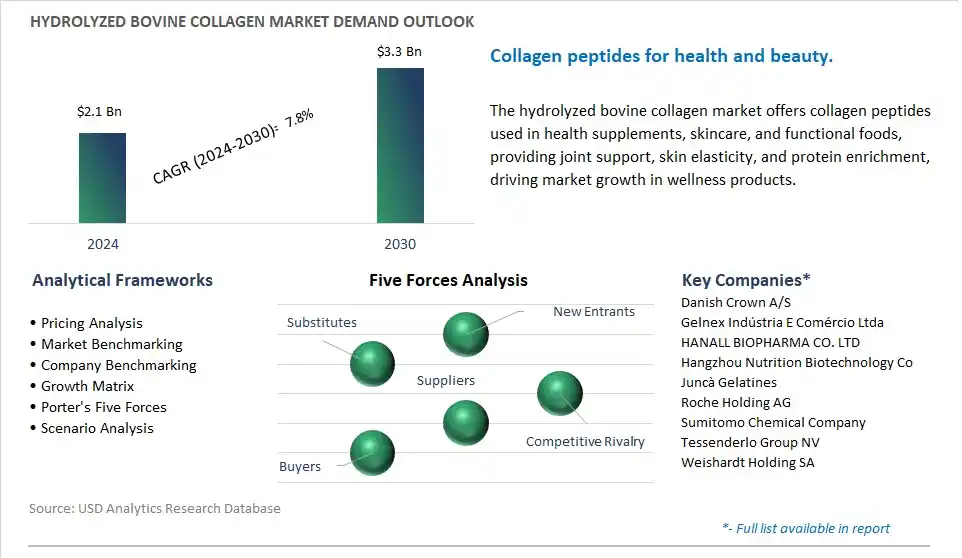
The global Hydrolyzed Bovine Collagen Market is poised to register a 7.8% CAGR from $2.1 Billion in 2024 to $3.3 Billion in 2030.
The global Hydrolyzed Bovine Collagen Market Study analyzes and forecasts the market size across 6 regions and 24 countries for diverse segments -By Type (Regular Fine Powder, Granular Powder), By Application (Food and Beverage, Pharmaceuticals, Others).
An Introduction to Global Hydrolyzed Bovine Collagen Market in 2024
Hydrolyzed bovine collagen, derived from bovine hides and bones, is a popular ingredient in cosmetic, food, and nutraceutical products for its health benefits, including skin health, joint support, and protein supplementation. One key trend shaping the future of hydrolyzed bovine collagen is the growing demand for collagen peptides with enhanced bioavailability, purity, and sustainability, driven by consumer preferences for clean-label, natural, and ethically sourced ingredients. Collagen manufacturers are investing in advanced extraction methods, enzymatic hydrolysis processes, and purification techniques to produce collagen peptides with smaller molecular weights, higher solubility, and improved digestibility, ensuring optimal absorption and efficacy in the body. Additionally, advancements in collagen peptide customization, encapsulation technologies, and delivery systems are expanding the range of functional applications and product formats for hydrolyzed bovine collagen, including beverages, snacks, and topical skincare formulations. Moreover, the integration of sustainable sourcing practices, animal welfare standards, and traceability systems is ensuring transparency and ethical compliance throughout the collagen supply chain, reassuring consumers about product quality and safety. As consumers seek natural and effective solutions for skin and joint health, the hydrolyzed bovine collagen industry is poised for innovation and growth, with opportunities for collaboration, research, and market expansion to meet the evolving needs of manufacturers, brand owners, and consumers.
Hydrolyzed Bovine Collagen Market Competitive Landscape
The market report analyses the leading companies in the industry including Danish Crown A/S, Gelnex Indústria E Comércio Ltda, HANALL BIOPHARMA CO. LTD, Hangzhou Nutrition Biotechnology Co, Juncà Gelatines, Roche Holding AG, Sumitomo Chemical Company, Tessenderlo Group NV, Weishardt Holding SA.
Hydrolyzed Bovine Collagen Market Dynamics
Hydrolyzed Bovine Collagen Market Trend: Growing Demand for Natural and Functional Ingredients in Personal Care and Nutraceuticals
A prominent trend in the market for Hydrolyzed Bovine Collagen is the growing demand for natural and functional ingredients in the personal care and nutraceuticals industries. Consumers are increasingly seeking products that offer health benefits and are derived from natural sources, driving the popularity of collagen supplements and skincare formulations. Hydrolyzed bovine collagen, obtained from the connective tissues of cattle, is prized for its ability to promote skin elasticity, joint health, and overall well-being. This is driven by consumer preferences for clean label products, the need for anti-aging and beauty-enhancing solutions, and the growing awareness of collagen's role in supporting skin, hair, and nail health, leading to increased adoption of hydrolyzed bovine collagen in personal care and nutraceutical applications worldwide.
Hydrolyzed Bovine Collagen Market Driver: Aging Population and Health Consciousness
The market for Hydrolyzed Bovine Collagen is being driven by the aging population and increasing health consciousness among consumers. As people age, there is a natural decline in collagen production, leading to issues such as joint stiffness, wrinkles, and decreased skin elasticity. To address these concerns, consumers are turning to collagen supplements and skincare products enriched with hydrolyzed bovine collagen to support their overall health and appearance. Additionally, with the rising prevalence of chronic diseases and lifestyle-related health conditions, there is a growing emphasis on preventive healthcare and wellness-focused lifestyles, driving demand for functional ingredients like hydrolyzed collagen. Factors such as the need for healthy aging, beauty from within trends, and the pursuit of holistic wellness drive market growth and adoption of hydrolyzed bovine collagen in dietary supplements, functional foods, and skincare formulations.
Hydrolyzed Bovine Collagen Market Opportunity: Expansion into Functional Food and Beverage Formulations
An exciting opportunity within the market for Hydrolyzed Bovine Collagen lies in the expansion into functional food and beverage formulations, where there is a growing demand for products that offer nutritional benefits and support overall health and wellness. Companies can explore opportunities to develop collagen-infused food and beverage products such as protein bars, beverages, and snacks that provide convenient and enjoyable ways for consumers to incorporate collagen into their daily diets. Additionally, there is potential to innovate in formulation techniques to enhance the solubility, stability, and bioavailability of hydrolyzed collagen in food and beverage matrices, ensuring optimal delivery of collagen peptides to the body. By leveraging their expertise in food science, formulation development, and ingredient technology, companies can capitalize on the growing market for functional foods and beverages and position themselves as leaders in providing innovative collagen-enriched products that cater to the health and wellness needs of consumers, driving growth and expansion in the hydrolyzed bovine collagen market.
Hydrolyzed Bovine Collagen Market Ecosystem
The hydrolyzed bovine collagen market involves multiple stages, with various companies contributing to its production and distribution. Cattle ranchers and feedlots including JBS USA and Tyson Foods provide the raw materials, while hide processors including members of the American Leather Processors Association transform hides into collagen-rich materials. Gelatin and collagen manufacturers including Gelita (Darling Ingredients) and Rousselot (Darling Ingredients) extract collagen from these materials, with processors specializing in the hydrolysis step to break down collagen into smaller peptides. Specialty collagen processors including Peptan (ROQUETTE) and Great Lakes Gelatin Co. further purify and concentrate hydrolyzed collagen for specific applications, including nutritional supplements, food and beverage products, and cosmetics.
The distribution of hydrolyzed bovine collagen involves nutritional supplement distributors including Puritan's Pride and Holland & Barrett, food and beverage ingredient distributors including Ingram Foodservice and US Foods, and cosmetics ingredient distributors including Seppic and Ashland. Additionally, manufacturers including Herbalife, Glanbia, Nestlé, and PepsiCo formulate hydrolyzed collagen into various products for end-users. Consumers purchase hydrolyzed collagen supplements for health benefits including joint health and skin health, while the food and beverage industry incorporates it into functional products. Similarly, the cosmetics and personal care industry utilizes hydrolyzed collagen in skincare products for its perceived ability to improve skin elasticity and hydration, highlighting its versatility across different end-user segments.
Hydrolyzed Bovine Collagen Market Share Analysis: Regular Fine Powder held the dominant revenue share in 2024
The largest segment in the Hydrolyzed Bovine Collagen Market is the Regular Fine Powder type segment. This dominance is primarily due to diverse key factors. Regular fine powder hydrolyzed bovine collagen is widely preferred in various industries such as food and beverage, cosmetics, pharmaceuticals, and nutraceuticals due to its versatility, ease of use, and compatibility with a wide range of applications. Additionally, regular fine powder collagen offers diverse advantages over granular powder collagen, including better solubility, faster dissolution, and superior dispersibility in liquid formulations. In addition, regular fine powder collagen is well-suited for use in food and beverage products such as protein bars, beverages, and supplements, where it can be easily incorporated without affecting taste, texture, or appearance. Further, regular fine powder collagen is commonly used in cosmetic and skincare formulations for its moisturizing, anti-aging, and skin-rejuvenating properties, as it can penetrate the skin more effectively due to its smaller particle size. Overall, the Regular Fine Powder type segment holds the largest share in the Hydrolyzed Bovine Collagen Market due to its wide-ranging applications, superior properties, and ease of formulation in various industries.
Hydrolyzed Bovine Collagen Market Share Analysis: Pharmaceuticals is the fastest growing market segment over the forecast period to 2030
The fastest-growing segment in the Hydrolyzed Bovine Collagen Market is the Pharmaceuticals application segment. This growth is primarily due to diverse key factors. Firstly, there is increasing interest and investment in collagen-based pharmaceutical products due to the growing awareness of the health benefits associated with collagen supplementation. Hydrolyzed bovine collagen is widely recognized for its potential therapeutic properties, including promoting skin health, supporting joint function, and improving bone density. Consequently, pharmaceutical companies are developing a wide range of collagen-based formulations such as capsules, tablets, and topical creams for various health conditions, including osteoarthritis, wound healing, and skin aging. Additionally, hydrolyzed bovine collagen is being investigated for its potential applications in tissue engineering, regenerative medicine, and drug delivery systems due to its biocompatibility, bioactivity, and ability to promote cell proliferation and tissue repair. In addition, advancements in collagen extraction and purification technologies, along with innovative formulations and delivery methods, contribute to the development of novel pharmaceutical products containing hydrolyzed bovine collagen. Further, demographic trends such as aging populations and increasing health consciousness drive the demand for collagen-based pharmaceuticals as consumers seek natural and effective solutions for age-related health issues. Overall, the Pharmaceuticals application segment is experiencing rapid growth in the Hydrolyzed Bovine Collagen Market due to expanding research and development efforts, rising demand for collagen-based therapeutics, and the potential for collagen to address unmet medical needs and improve patient outcomes.
Hydrolyzed Bovine Collagen Market Report Scope-
By Type
Regular Fine Powder
Granular Powder
By Application
Food and Beverage
Pharmaceuticals
Others
Hydrolyzed Bovine Collagen Market Companies Profiled
Danish Crown A/S
Gelnex Indústria E Comércio Ltda
HANALL BIOPHARMA CO. LTD
Hangzhou Nutrition Biotechnology Co
Juncà Gelatines
Roche Holding AG
Sumitomo Chemical Company
Tessenderlo Group NV
Weishardt Holding SA
*- List Not Exhaustive
TABLE OF CONTENTS
1 Introduction to 2024 Hydrolyzed Bovine Collagen Market
1.1 Market Overview
1.2 Quick Facts
1.3 Scope/Objective of the Study
1.4 Market Definition
1.5 Countries and Regions Covered
1.6 Units, Currency, and Conversions
1.7 Industry Value Chain
2 Research Methodology
2.1 Market Size Estimation
2.2 Sources and Research Methodology
2.3 Data Triangulation
2.4 Assumptions and Limitations
3 Executive Summary
3.1 Global Hydrolyzed Bovine Collagen Market Size Outlook, $ Million, 2021 to 2030
3.2 Hydrolyzed Bovine Collagen Market Outlook by Type, $ Million, 2021 to 2030
3.3 Hydrolyzed Bovine Collagen Market Outlook by Product, $ Million, 2021 to 2030
3.4 Hydrolyzed Bovine Collagen Market Outlook by Application, $ Million, 2021 to 2030
3.5 Hydrolyzed Bovine Collagen Market Outlook by Key Countries, $ Million, 2021 to 2030
4 Market Dynamics
4.1 Key Driving Forces of Hydrolyzed Bovine Collagen Industry
4.2 Key Market Trends in Hydrolyzed Bovine Collagen Industry
4.3 Potential Opportunities in Hydrolyzed Bovine Collagen Industry
4.4 Key Challenges in Hydrolyzed Bovine Collagen Industry
5 Market Factor Analysis
5.1 Value Chain Analysis
5.2 Competitive Landscape
5.2.1 Global Hydrolyzed Bovine Collagen Market Share by Company (%), 2023
5.2.2 Product Offerings by Company
5.3 Porter’s Five Forces Analysis
5.4 Pricing Analysis and Outlook
6 Growth Outlook Across Scenarios
6.1 Growth Analysis-Case Scenario Definitions
6.2 Low Growth Scenario Forecasts
6.3 Reference Growth Scenario Forecasts
6.4 High Growth Scenario Forecasts
7 Global Hydrolyzed Bovine Collagen Market Outlook by Segments
7.1 Hydrolyzed Bovine Collagen Market Outlook by Segments, $ Million, 2021- 2030
By Type
Regular Fine Powder
Granular Powder
By Application
Food and Beverage
Pharmaceuticals
Others
8 North America Hydrolyzed Bovine Collagen Market Analysis and Outlook To 2030
8.1 Introduction to North America Hydrolyzed Bovine Collagen Markets in 2024
8.2 North America Hydrolyzed Bovine Collagen Market Size Outlook by Country, 2021-2030
8.2.1 United States
8.2.2 Canada
8.2.3 Mexico
8.3 North America Hydrolyzed Bovine Collagen Market size Outlook by Segments, 2021-2030
By Type
Regular Fine Powder
Granular Powder
By Application
Food and Beverage
Pharmaceuticals
Others
9 Europe Hydrolyzed Bovine Collagen Market Analysis and Outlook To 2030
9.1 Introduction to Europe Hydrolyzed Bovine Collagen Markets in 2024
9.2 Europe Hydrolyzed Bovine Collagen Market Size Outlook by Country, 2021-2030
9.2.1 Germany
9.2.2 France
9.2.3 Spain
9.2.4 United Kingdom
9.2.4 Italy
9.2.5 Russia
9.2.6 Norway
9.2.7 Rest of Europe
9.3 Europe Hydrolyzed Bovine Collagen Market Size Outlook by Segments, 2021-2030
By Type
Regular Fine Powder
Granular Powder
By Application
Food and Beverage
Pharmaceuticals
Others
10 Asia Pacific Hydrolyzed Bovine Collagen Market Analysis and Outlook To 2030
10.1 Introduction to Asia Pacific Hydrolyzed Bovine Collagen Markets in 2024
10.2 Asia Pacific Hydrolyzed Bovine Collagen Market Size Outlook by Country, 2021-2030
10.2.1 China
10.2.2 India
10.2.3 Japan
10.2.4 South Korea
10.2.5 Indonesia
10.2.6 Malaysia
10.2.7 Australia
10.2.8 Rest of Asia Pacific
10.3 Asia Pacific Hydrolyzed Bovine Collagen Market size Outlook by Segments, 2021-2030
By Type
Regular Fine Powder
Granular Powder
By Application
Food and Beverage
Pharmaceuticals
Others
11 South America Hydrolyzed Bovine Collagen Market Analysis and Outlook To 2030
11.1 Introduction to South America Hydrolyzed Bovine Collagen Markets in 2024
11.2 South America Hydrolyzed Bovine Collagen Market Size Outlook by Country, 2021-2030
11.2.1 Brazil
11.2.2 Argentina
11.2.3 Rest of South America
11.3 South America Hydrolyzed Bovine Collagen Market size Outlook by Segments, 2021-2030
By Type
Regular Fine Powder
Granular Powder
By Application
Food and Beverage
Pharmaceuticals
Others
12 Middle East and Africa Hydrolyzed Bovine Collagen Market Analysis and Outlook To 2030
12.1 Introduction to Middle East and Africa Hydrolyzed Bovine Collagen Markets in 2024
12.2 Middle East and Africa Hydrolyzed Bovine Collagen Market Size Outlook by Country, 2021-2030
12.2.1 Saudi Arabia
12.2.2 UAE
12.2.3 Oman
12.2.4 Rest of Middle East
12.2.5 Egypt
12.2.6 Nigeria
12.2.7 South Africa
12.2.8 Rest of Africa
12.3 Middle East and Africa Hydrolyzed Bovine Collagen Market size Outlook by Segments, 2021-2030
By Type
Regular Fine Powder
Granular Powder
By Application
Food and Beverage
Pharmaceuticals
Others
13 Company Profiles
13.1 Company Snapshot
13.2 SWOT Profiles
13.3 Products and Services
13.4 Recent Developments
13.5 Financial Profile
Danish Crown A/S
Gelnex Indústria E Comércio Ltda
HANALL BIOPHARMA CO. LTD
Hangzhou Nutrition Biotechnology Co
Juncà Gelatines
Roche Holding AG
Sumitomo Chemical Company
Tessenderlo Group NV
Weishardt Holding SA
14 Appendix
14.1 Customization Offerings
14.2 Subscription Services
14.3 Related Reports
14.4 Publisher Expertise
By Type
Regular Fine Powder
Granular Powder
By Application
Food and Beverage
Pharmaceuticals
Others
Countries Analyzed
North America (US, Canada, Mexico)
Europe (Germany, UK, France, Spain, Italy, Russia, Rest of Europe)
Asia Pacific (China, India, Japan, South Korea, Australia, South East Asia, Rest of Asia)
South America (Brazil, Argentina, Rest of South America)
Middle East and Africa (Saudi Arabia, UAE, Rest of Middle East, South Africa, Egypt, Rest of Africa)
