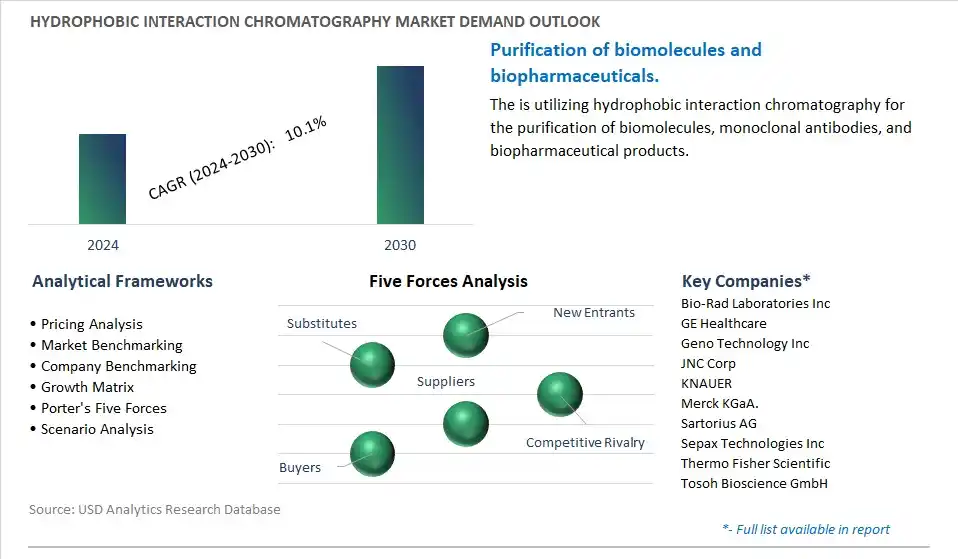
Hydrophobic Interaction Chromatography Market is estimated to increase at a Compounded Annual Growth Rate of 10.1% CAGR over the forecast period from 2024 to 2030
The Hydrophobic Interaction Chromatography Market study analyzes and forecasts the market size across 6 regions and 24 countries for diverse segments- By Product (Columns, Resins, Buffers), By Sample Type (Monoclonal Antibodies, Vaccines, Others), By End-User (Contract Research Organizations, Pharma and Biopharmaceutical Companies, Others).
An Introduction to Hydrophobic Interaction Chromatography Market in 2024
Hydrophobic interaction chromatography (HIC) is a powerful separation technique used for purifying proteins and biomolecules based on their hydrophobicity. In 2024, HIC continues to play a crucial role in biopharmaceutical manufacturing processes, offering high selectivity and gentle purification conditions that preserve the structural integrity and biological activity of therapeutic proteins. With advancements in chromatography media, resin chemistry, and process optimization strategies, HIC columns deliver improved resolution, capacity, and throughput for downstream purification applications. Additionally, the integration of automated chromatography systems and in-line analytics enhances process control and productivity, enabling seamless scale-up from laboratory-scale to industrial-scale production. As the demand for biologic drugs grows and regulatory requirements for product quality and safety become increasingly stringent, the versatility and efficiency of HIC technology make it an indispensable tool in the biopharmaceutical industry's quest for robust and cost-effective purification solutions.
Market Trend: Increasing Demand for Biopharmaceuticals
A prominent trend in the hydrophobic interaction chromatography (HIC) market is the increasing demand for biopharmaceuticals. As the biopharmaceutical industry continues to expand rapidly, there is a growing need for efficient and reliable chromatography techniques for the purification of biomolecules, such as proteins, antibodies, and vaccines. Hydrophobic interaction chromatography has emerged as a versatile and effective separation method for purifying hydrophobic or partially hydrophobic biomolecules from complex mixtures. The trend towards the development of novel biologics and biosimilars, coupled with the increasing adoption of monoclonal antibody therapies and gene therapies, drives market demand for HIC columns and resins capable of purifying biopharmaceuticals with high purity and yield.
Market Driver: Advancements in Chromatography Technologies
A primary driver fueling the growth of the hydrophobic interaction chromatography market is the advancements in chromatography technologies. Recent innovations in HIC column design, stationary phase chemistry, and chromatographic instrumentation have led to improvements in chromatographic resolution, separation efficiency, and throughput. Manufacturers are developing HIC resins with enhanced selectivity and binding capacities to meet the evolving needs of biopharmaceutical purification processes. Furthermore, advancements in chromatography hardware, such as high-performance liquid chromatography (HPLC) systems and automated chromatography platforms, enable faster and more reproducible separations, reducing purification cycle times and increasing productivity in biopharmaceutical manufacturing. These technological advancements drive market adoption of HIC chromatography for downstream processing applications in the biopharmaceutical industry.
Market Opportunity: Expansion into Viral Vector Purification
An enticing opportunity within the hydrophobic interaction chromatography market lies in the expansion into viral vector purification for gene therapy applications. Viral vectors, such as adeno-associated viruses (AAV) and lentiviruses, are widely used as delivery vehicles for gene therapies, gene editing tools, and viral vector vaccines. Purifying viral vectors from cell culture supernatants or cell lysates is a critical step in viral vector production, as it ensures the removal of impurities and contaminants while maintaining vector integrity and potency. Hydrophobic interaction chromatography offers a robust and scalable purification method for viral vectors based on their surface hydrophobicity and size, allowing for efficient separation from host cell proteins, nucleic acids, and other process-related impurities. By leveraging HIC technology for viral vector purification, manufacturers can streamline downstream processing workflows, increase viral vector yields, and meet the growing demand for gene therapy products. Investing in HIC-based purification solutions for viral vectors presents opportunities for market expansion and innovation in the rapidly evolving field of gene and cell therapy.
Hydrophobic Interaction Chromatography Market Share Analysis: Resins is the fastest growing segment over the forecast period to 2030
The Resins segment within the Hydrophobic Interaction Chromatography (HIC) Market is experiencing the most rapid growth, and several factors contribute to this trend. Firstly, there is an increasing demand for HIC resins in the purification of monoclonal antibodies (mAbs) and other biotherapeutics due to their high selectivity and scalability. With the rising prevalence of chronic and infectious diseases, the demand for mAbs and vaccines has surged, driving the need for efficient and cost-effective purification methods. HIC resins offer several advantages, including high binding capacity, excellent resolution, and compatibility with aqueous and organic solvents, making them ideal for the purification of biomolecules. Additionally, advancements in resin technology have led to the development of novel HIC resins with enhanced performance characteristics, such as improved binding kinetics and reduced non-specific interactions, further driving their adoption in biopharmaceutical manufacturing processes. Moreover, the outsourcing of biopharmaceutical production to contract research organizations (CROs) has increased, leading to a higher demand for HIC resins in downstream processing applications. Furthermore, pharmaceutical and biopharmaceutical companies are investing in research and development activities aimed at developing innovative biologics, which are driving the growth of the HIC resin market. Overall, the Resins segment within the HIC Market is experiencing rapid growth due to the increasing demand for efficient purification solutions in the biopharmaceutical industry.
Hydrophobic Interaction Chromatography Competitive Analysis
The market research study provides in-depth insights into leading companies including the SWOT analyses, product profile, financial details, and recent developments acrossBio-Rad Laboratories Inc, GE Healthcare, Geno Technology Inc, JNC Corp, KNAUER, Merck KGaA., Sartorius AG, Sepax Technologies Inc, Thermo Fisher Scientific, Tosoh Bioscience GmbH
Hydrophobic Interaction Chromatography Market Segmentation
By Product
Columns
Resins
Buffers
By Sample Type
Monoclonal Antibodies
Vaccines
Others
By End-User
Contract Research Organizations
Pharma and Biopharmaceutical Companies
Others
Geographical Analysis
North America (United States, Canada, Mexico)
Europe (Germany, France, United Kingdom, Spain, Italy, Rest of Europe)
Asia Pacific (China, India, Japan, South Korea, Rest of Asia Pacific)
South America (Brazil, Argentina, Rest of South America)
Middle East and Africa (Saudi Arabia, UAE, Rest of Middle East, South Africa, Egypt, Rest of Africa)
Hydrophobic Interaction Chromatography Market Companies
Bio-Rad Laboratories Inc
GE Healthcare
Geno Technology Inc
JNC Corp
KNAUER
Merck KGaA.
Sartorius AG
Sepax Technologies Inc
Thermo Fisher Scientific
Tosoh Bioscience GmbH
Reasons to Buy the Hydrophobic Interaction Chromatography Market Study
• Deepen your industry insights and navigate uncertainties for strategy formulation, CAPEX, and Operational decisions
• Gain access to detailed insights on the Hydrophobic Interaction Chromatography Market, encompassing current market size, growth trends, and forecasts till 2030.
• Access detailed competitor analysis, enabling competitive advantage through a thorough understanding of market players, strategies, and potential differentiation opportunities
• Stay ahead of the curve with insights on technological advancements, innovations, and upcoming trends
• Identify lucrative investment avenues and expansion opportunities within the Hydrophobic Interaction Chromatography Market industry, guided by robust, data-backed analysis.
• Understand regional and global markets through country-wise analysis, regional market potential, regulatory nuances, and dynamics
• Execute strategies with confidence and speed through information, analytics, and insights on the industry value chain
• Corporate leaders, strategists, financial experts, shareholders, asset managers, and governmental representatives can make long-term planning scenarios and build an integrated and timely understanding of market dynamics
• Benefit from tailored solutions and expert consultation based on report insights, providing personalized strategies aligned with specific business needs.
TABLE OF CONTENTS
1 Introduction to 2024 Hydrophobic Interaction Chromatography Market
1.1 Market Overview
1.2 Quick Facts
1.3 Scope/Objective of the Study
1.4 Market Definition
1.5 Countries and Regions Covered
1.6 Units, Currency, and Conversions
1.7 Industry Value Chain
2 Research Methodology
2.1 Market Size Estimation
2.2 Sources and Research Methodology
2.3 Data Triangulation
2.4 Assumptions and Limitations
3 Executive Summary
3.1 Global Hydrophobic Interaction Chromatography Market Size Outlook, $ Million, 2021 to 2030
3.2 Hydrophobic Interaction Chromatography Market Outlook by Type, $ Million, 2021 to 2030
3.3 Hydrophobic Interaction Chromatography Market Outlook by Product, $ Million, 2021 to 2030
3.4 Hydrophobic Interaction Chromatography Market Outlook by Application, $ Million, 2021 to 2030
3.5 Hydrophobic Interaction Chromatography Market Outlook by Key Countries, $ Million, 2021 to 2030
4 Market Dynamics
4.1 Key Driving Forces of Hydrophobic Interaction Chromatography Industry
4.2 Key Market Trends in Hydrophobic Interaction Chromatography Industry
4.3 Potential Opportunities in Hydrophobic Interaction Chromatography Industry
4.4 Key Challenges in Hydrophobic Interaction Chromatography Industry
5 Market Factor Analysis
5.1 Value Chain Analysis
5.2 Competitive Landscape
5.2.1 Global Hydrophobic Interaction Chromatography Market Share by Company (%), 2023
5.2.2 Product Offerings by Company
5.3 Porter’s Five Forces Analysis
5.4 Pricing Analysis and Outlook
6 Growth Outlook Across Scenarios
6.1 Growth Analysis-Case Scenario Definitions
6.2 Low Growth Scenario Forecasts
6.3 Reference Growth Scenario Forecasts
6.4 High Growth Scenario Forecasts
7 Global Hydrophobic Interaction Chromatography Market Outlook by Segments
7.1 Hydrophobic Interaction Chromatography Market Outlook by Segments, $ Million, 2021- 2030
By Product
Columns
Resins
Buffers
By Sample Type
Monoclonal Antibodies
Vaccines
Others
By End-User
Contract Research Organizations
Pharma and Biopharmaceutical Companies
Others
8 North America Hydrophobic Interaction Chromatography Market Analysis and Outlook To 2030
8.1 Introduction to North America Hydrophobic Interaction Chromatography Markets in 2024
8.2 North America Hydrophobic Interaction Chromatography Market Size Outlook by Country, 2021-2030
8.2.1 United States
8.2.2 Canada
8.2.3 Mexico
8.3 North America Hydrophobic Interaction Chromatography Market size Outlook by Segments, 2021-2030
By Product
Columns
Resins
Buffers
By Sample Type
Monoclonal Antibodies
Vaccines
Others
By End-User
Contract Research Organizations
Pharma and Biopharmaceutical Companies
Others
9 Europe Hydrophobic Interaction Chromatography Market Analysis and Outlook To 2030
9.1 Introduction to Europe Hydrophobic Interaction Chromatography Markets in 2024
9.2 Europe Hydrophobic Interaction Chromatography Market Size Outlook by Country, 2021-2030
9.2.1 Germany
9.2.2 France
9.2.3 Spain
9.2.4 United Kingdom
9.2.4 Italy
9.2.5 Russia
9.2.6 Norway
9.2.7 Rest of Europe
9.3 Europe Hydrophobic Interaction Chromatography Market Size Outlook by Segments, 2021-2030
By Product
Columns
Resins
Buffers
By Sample Type
Monoclonal Antibodies
Vaccines
Others
By End-User
Contract Research Organizations
Pharma and Biopharmaceutical Companies
Others
10 Asia Pacific Hydrophobic Interaction Chromatography Market Analysis and Outlook To 2030
10.1 Introduction to Asia Pacific Hydrophobic Interaction Chromatography Markets in 2024
10.2 Asia Pacific Hydrophobic Interaction Chromatography Market Size Outlook by Country, 2021-2030
10.2.1 China
10.2.2 India
10.2.3 Japan
10.2.4 South Korea
10.2.5 Indonesia
10.2.6 Malaysia
10.2.7 Australia
10.2.8 Rest of Asia Pacific
10.3 Asia Pacific Hydrophobic Interaction Chromatography Market size Outlook by Segments, 2021-2030
By Product
Columns
Resins
Buffers
By Sample Type
Monoclonal Antibodies
Vaccines
Others
By End-User
Contract Research Organizations
Pharma and Biopharmaceutical Companies
Others
11 South America Hydrophobic Interaction Chromatography Market Analysis and Outlook To 2030
11.1 Introduction to South America Hydrophobic Interaction Chromatography Markets in 2024
11.2 South America Hydrophobic Interaction Chromatography Market Size Outlook by Country, 2021-2030
11.2.1 Brazil
11.2.2 Argentina
11.2.3 Rest of South America
11.3 South America Hydrophobic Interaction Chromatography Market size Outlook by Segments, 2021-2030
By Product
Columns
Resins
Buffers
By Sample Type
Monoclonal Antibodies
Vaccines
Others
By End-User
Contract Research Organizations
Pharma and Biopharmaceutical Companies
Others
12 Middle East and Africa Hydrophobic Interaction Chromatography Market Analysis and Outlook To 2030
12.1 Introduction to Middle East and Africa Hydrophobic Interaction Chromatography Markets in 2024
12.2 Middle East and Africa Hydrophobic Interaction Chromatography Market Size Outlook by Country, 2021-2030
12.2.1 Saudi Arabia
12.2.2 UAE
12.2.3 Oman
12.2.4 Rest of Middle East
12.2.5 Egypt
12.2.6 Nigeria
12.2.7 South Africa
12.2.8 Rest of Africa
12.3 Middle East and Africa Hydrophobic Interaction Chromatography Market size Outlook by Segments, 2021-2030
By Product
Columns
Resins
Buffers
By Sample Type
Monoclonal Antibodies
Vaccines
Others
By End-User
Contract Research Organizations
Pharma and Biopharmaceutical Companies
Others
13 Company Profiles
13.1 Company Snapshot
13.2 SWOT Profiles
13.3 Products and Services
13.4 Recent Developments
13.5 Financial Profile
List of Companies
Bio-Rad Laboratories Inc
GE Healthcare
Geno Technology Inc
JNC Corp
KNAUER
Merck KGaA.
Sartorius AG
Sepax Technologies Inc
Thermo Fisher Scientific
Tosoh Bioscience GmbH
14 Appendix
14.1 Customization Offerings
14.2 Subscription Services
14.3 Related Reports
14.4 Publisher Expertise
By Product
Columns
Resins
Buffers
By Sample Type
Monoclonal Antibodies
Vaccines
Others
By End-User
Contract Research Organizations
Pharma and Biopharmaceutical Companies
Others
Countries Analyzed
North America (United States, Canada, Mexico)
Europe (Germany, France, United Kingdom, Spain, Italy, Rest of Europe)
Asia Pacific (China, India, Japan, South Korea, Rest of Asia Pacific)
South America (Brazil, Argentina, Rest of South America)
Middle East and Africa (Saudi Arabia, UAE, Rest of Middle East, South Africa, Egypt, Rest of Africa)
