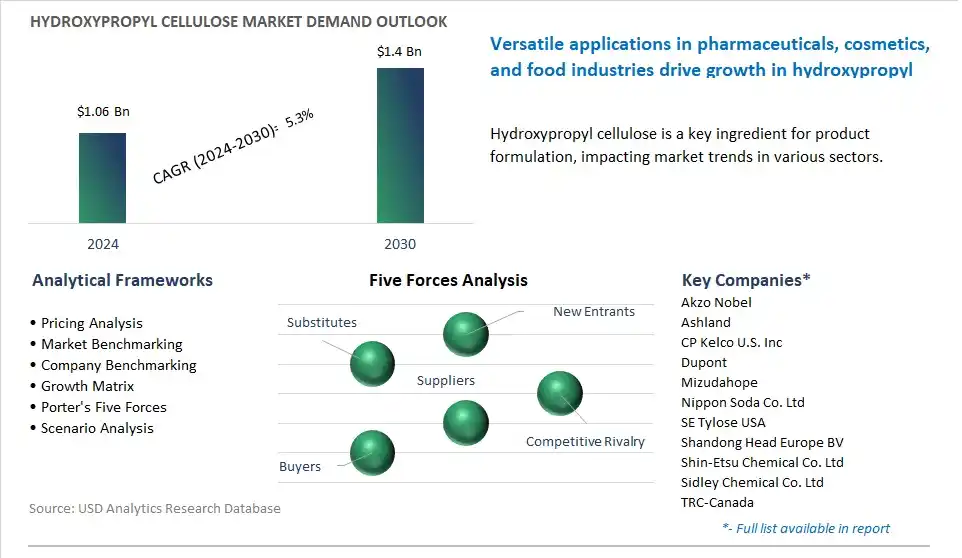
The global Hydroxypropyl Cellulose Market is poised to register a 5.3% CAGR from $1.06 Billion in 2024 to $1.4 Billion in 2030.
The global Hydroxypropyl Cellulose Market Study analyzes and forecasts the market size across 6 regions and 24 countries for diverse segments -By Type (L- Hydroxypropyl Cellulose, H- Hydroxypropyl Cellulose), By Application (Pharmaceutical, Cosmetics, Food Additives, Textile Industry, Oil Field Chemicals, Others).
An Introduction to Global Hydroxypropyl Cellulose Market in 2024
Hydroxypropyl Cellulose (HPC) is witnessing a surge in demand owing to its versatile applications in industries such as pharmaceuticals, personal care, and construction. Key trends shaping its future include the increasing focus on sustainable and bio-based materials, driving the development of HPC from renewable sources. Additionally, the pharmaceutical sector's growing preference for controlled-release drug delivery systems is propelling the demand for HPC in tablet coatings and sustained-release formulations. Moreover, in the personal care industry, HPC is gaining traction as a thickening agent in cosmetic formulations, particularly in products catering to the growing demand for natural and organic ingredients. Furthermore, advancements in manufacturing technologies are expected to improve the efficiency and cost-effectiveness of HPC production, fostering its widespread adoption across various sectors.
Hydroxypropyl Cellulose Market Competitive Landscape
The market report analyses the leading companies in the industry including Akzo Nobel, Ashland, CP Kelco U.S. Inc, Dupont, Mizudahope, Nippon Soda Co. Ltd, SE Tylose USA, Shandong Head Europe BV, Shin-Etsu Chemical Co. Ltd, Sidley Chemical Co. Ltd, TRC-Canada, Zhicheng Cellulose Co. Ltd.
Hydroxypropyl Cellulose Market Dynamics
Hydroxypropyl Cellulose Market Trend: Growing Demand for Pharmaceutical Excipients and Controlled-Release Formulations
A significant trend in the hydroxypropyl cellulose (HPC) market is the growing demand for pharmaceutical excipients and controlled-release formulations driven by advancements in drug delivery technologies, increasing prevalence of chronic diseases, and regulatory requirements for drug safety and efficacy. Hydroxypropyl cellulose, a versatile polymer derived from cellulose, is widely used in pharmaceutical formulations as a viscosity modifier, binder, film former, and controlled-release agent. With the rise of precision medicine and personalized therapies, there is a growing need for excipients like HPC that enable precise control over drug release rates, bioavailability, and pharmacokinetics, enhancing therapeutic outcomes and patient compliance. Additionally, the development of novel drug delivery systems such as oral dissolvable films, transdermal patches, and implantable devices further drives market demand for HPC as a key ingredient in advanced pharmaceutical formulations designed to improve drug solubility, stability, and bioavailability.
Hydroxypropyl Cellulose Market Driver: Expansion of the Pharmaceutical Industry and Drug Development Pipeline
A key driver propelling the hydroxypropyl cellulose market is the expansion of the pharmaceutical industry and the growing drug development pipeline, driven by aging populations, rising healthcare expenditures, and increased prevalence of chronic diseases worldwide. As pharmaceutical companies invest in research and development to address unmet medical needs and bring innovative therapies to market, there is a growing demand for high-quality excipients like HPC to support drug formulation and delivery. HPC offers pharmaceutical manufacturers advantages such as excellent compatibility with active pharmaceutical ingredients (APIs), low toxicity, and good solubility in water and organic solvents, making it a preferred choice for a wide range of dosage forms including tablets, capsules, suspensions, and topical formulations. The expansion of the pharmaceutical industry and the robust drug development pipeline create opportunities for HPC suppliers to collaborate with pharmaceutical companies, contract manufacturers, and research institutions to meet the increasing demand for excipients and support the development of novel drug products for diverse therapeutic areas and patient populations.
Hydroxypropyl Cellulose Market Opportunity: Diversification into Nutraceuticals and Personal Care Applications
An opportunity for market expansion lies in diversifying the use of hydroxypropyl cellulose into nutraceuticals and personal care applications, leveraging its properties as a safe, biocompatible, and multifunctional ingredient. With the growing interest in health and wellness products, there is a rising demand for natural and functional ingredients in the nutraceuticals industry, including dietary supplements, functional foods, and nutraceutical beverages. HPC can be utilized as a thickener, stabilizer, and encapsulation agent in nutraceutical formulations, offering benefits such as improved texture, shelf stability, and controlled release of active ingredients. Similarly, in the personal care sector, HPC finds applications in cosmetics, skincare, and hair care products as a viscosity modifier, emulsifier, and film-forming agent. By expanding into nutraceuticals and personal care applications, HPC manufacturers can diversify their product portfolio, access new markets, and capitalize on the growing demand for natural and functional ingredients in the health, wellness, and beauty industries, driving growth and innovation in the hydroxypropyl cellulose market.
Hydroxypropyl Cellulose Market Share Analysis: H-Hydroxypropyl Cellulose segment generated the highest revenue in the industry
The H-hydroxypropyl cellulose segment is the largest segment in the hydroxypropyl cellulose market, primarily due to diverse factors. H-hydroxypropyl cellulose, also known as hydroxypropyl methylcellulose (HPMC), is a widely used derivative of cellulose with various industrial applications, including pharmaceuticals, personal care products, food, and construction. H-Hydroxypropyl cellulose offers superior properties such as thickening, film-forming, binding, and moisture retention, making it a versatile ingredient in formulations across multiple industries. In the pharmaceutical industry, H-hydroxypropyl cellulose is used as a pharmaceutical excipient in tablet coatings, sustained-release formulations, and ophthalmic solutions due to its compatibility with active pharmaceutical ingredients (APIs) and its ability to modify drug release profiles. In addition, H-hydroxypropyl cellulose is widely used in the production of oral disintegrating tablets (ODTs) and controlled-release drug delivery systems, where it provides controlled drug release and improved patient compliance. In the personal care industry, H-hydroxypropyl cellulose is used in cosmetic and skincare formulations as a thickener, stabilizer, and film former in products such as creams, lotions, gels, and hair care products. Additionally, H-hydroxypropyl cellulose finds applications in food products as a food additive, where it acts as a thickener, emulsifier, and stabilizer in processed foods, beverages, and dairy products. Further, H-hydroxypropyl cellulose is used in construction materials such as mortars, tile adhesives, and grouts as a thickening agent and water retention additive to improve workability and adhesion properties. Over the forecast period, the versatility, wide-ranging applications, and superior performance characteristics of H-hydroxypropyl cellulose contribute to its dominance as the largest segment in the hydroxypropyl cellulose market.
Hydroxypropyl Cellulose Market Share Analysis: Pharmaceutical Segment is poised to register the fastest growth rate (CAGR) over the forecast period to 2030
The pharmaceutical segment is the fastest-growing segment in the hydroxypropyl cellulose market, driven by diverse key factors. The there is a growing demand for hydroxypropyl cellulose in the pharmaceutical industry due to its versatile properties and wide range of applications. Hydroxypropyl cellulose is widely used as a pharmaceutical excipient in tablet formulations, where it serves various functions such as binder, disintegrant, and controlled-release agent. As the pharmaceutical industry continues to innovate and develop new drug formulations with enhanced therapeutic efficacy, there is an increasing need for excipients like hydroxypropyl cellulose that can improve drug delivery, bioavailability, and patient compliance. Additionally, hydroxypropyl cellulose is used in the production of oral disintegrating tablets (ODTs), which are gaining popularity due to their convenience and ease of administration, particularly for pediatric and geriatric patients. Secondly, advancements in pharmaceutical technology and formulation science have expanded the applications of hydroxypropyl cellulose in novel drug delivery systems such as sustained-release formulations, transdermal patches, and ophthalmic solutions. Hydroxypropyl cellulose offers advantages such as biocompatibility, stability, and compatibility with a wide range of active pharmaceutical ingredients (APIs), making it suitable for use in advanced drug delivery platforms. In addition, the pharmaceutical industry's increasing focus on quality, safety, and regulatory compliance drives the demand for high-quality excipients like hydroxypropyl cellulose that meet stringent regulatory standards and quality requirements. Further, the pharmaceutical segment's resilience and growth potential, particularly in light of global health challenges and the development of new therapies and vaccines, contribute to the robust demand for hydroxypropyl cellulose in pharmaceutical applications. Over the forecast period, the combination of increasing pharmaceutical innovation, expanding applications, and regulatory compliance drives the pharmaceutical segment's growth as the fastest-growing segment in the hydroxypropyl cellulose market.
Hydroxypropyl Cellulose Market Report Segmentation
By Type
L- Hydroxypropyl Cellulose
H- Hydroxypropyl Cellulose
By Application
Pharmaceutical
Cosmetics
Food Additives
Textile Industry
Oil Field Chemicals
Others
Regions Included
North America (US, Canada, Mexico)
Europe (Germany, UK, France, Spain, Italy, Russia, Rest of Europe)
Asia Pacific (China, India, Japan, South Korea, Australia, South East Asia, Rest of Asia)
South America (Brazil, Argentina, Rest of South America)
Middle East and Africa (Saudi Arabia, UAE, Rest of Middle East, South Africa, Egypt, Rest of Africa)
Hydroxypropyl Cellulose Companies Profiled in the Market Study
Akzo Nobel
Ashland
CP Kelco U.S. Inc
Dupont
Mizudahope
Nippon Soda Co. Ltd
SE Tylose USA
Shandong Head Europe BV
Shin-Etsu Chemical Co. Ltd
Sidley Chemical Co. Ltd
TRC-Canada
Zhicheng Cellulose Co. Ltd
*- List Not Exhaustive
TABLE OF CONTENTS
1 Introduction to 2024 Hydroxypropyl Cellulose Market
1.1 Market Overview
1.2 Quick Facts
1.3 Scope/Objective of the Study
1.4 Market Definition
1.5 Countries and Regions Covered
1.6 Units, Currency, and Conversions
1.7 Industry Value Chain
2 Research Methodology
2.1 Market Size Estimation
2.2 Sources and Research Methodology
2.3 Data Triangulation
2.4 Assumptions and Limitations
3 Executive Summary
3.1 Global Hydroxypropyl Cellulose Market Size Outlook, $ Million, 2021 to 2030
3.2 Hydroxypropyl Cellulose Market Outlook by Type, $ Million, 2021 to 2030
3.3 Hydroxypropyl Cellulose Market Outlook by Product, $ Million, 2021 to 2030
3.4 Hydroxypropyl Cellulose Market Outlook by Application, $ Million, 2021 to 2030
3.5 Hydroxypropyl Cellulose Market Outlook by Key Countries, $ Million, 2021 to 2030
4 Market Dynamics
4.1 Key Driving Forces of Hydroxypropyl Cellulose Industry
4.2 Key Market Trends in Hydroxypropyl Cellulose Industry
4.3 Potential Opportunities in Hydroxypropyl Cellulose Industry
4.4 Key Challenges in Hydroxypropyl Cellulose Industry
5 Market Factor Analysis
5.1 Value Chain Analysis
5.2 Competitive Landscape
5.2.1 Global Hydroxypropyl Cellulose Market Share by Company (%), 2023
5.2.2 Product Offerings by Company
5.3 Porter’s Five Forces Analysis
5.4 Pricing Analysis and Outlook
6 Growth Outlook Across Scenarios
6.1 Growth Analysis-Case Scenario Definitions
6.2 Low Growth Scenario Forecasts
6.3 Reference Growth Scenario Forecasts
6.4 High Growth Scenario Forecasts
7 Global Hydroxypropyl Cellulose Market Outlook by Segments
7.1 Hydroxypropyl Cellulose Market Outlook by Segments, $ Million, 2021- 2030
By Type
L- Hydroxypropyl Cellulose
H- Hydroxypropyl Cellulose
By Application
Pharmaceutical
Cosmetics
Food Additives
Textile Industry
Oil Field Chemicals
Others
8 North America Hydroxypropyl Cellulose Market Analysis and Outlook To 2030
8.1 Introduction to North America Hydroxypropyl Cellulose Markets in 2024
8.2 North America Hydroxypropyl Cellulose Market Size Outlook by Country, 2021-2030
8.2.1 United States
8.2.2 Canada
8.2.3 Mexico
8.3 North America Hydroxypropyl Cellulose Market size Outlook by Segments, 2021-2030
By Type
L- Hydroxypropyl Cellulose
H- Hydroxypropyl Cellulose
By Application
Pharmaceutical
Cosmetics
Food Additives
Textile Industry
Oil Field Chemicals
Others
9 Europe Hydroxypropyl Cellulose Market Analysis and Outlook To 2030
9.1 Introduction to Europe Hydroxypropyl Cellulose Markets in 2024
9.2 Europe Hydroxypropyl Cellulose Market Size Outlook by Country, 2021-2030
9.2.1 Germany
9.2.2 France
9.2.3 Spain
9.2.4 United Kingdom
9.2.4 Italy
9.2.5 Russia
9.2.6 Norway
9.2.7 Rest of Europe
9.3 Europe Hydroxypropyl Cellulose Market Size Outlook by Segments, 2021-2030
By Type
L- Hydroxypropyl Cellulose
H- Hydroxypropyl Cellulose
By Application
Pharmaceutical
Cosmetics
Food Additives
Textile Industry
Oil Field Chemicals
Others
10 Asia Pacific Hydroxypropyl Cellulose Market Analysis and Outlook To 2030
10.1 Introduction to Asia Pacific Hydroxypropyl Cellulose Markets in 2024
10.2 Asia Pacific Hydroxypropyl Cellulose Market Size Outlook by Country, 2021-2030
10.2.1 China
10.2.2 India
10.2.3 Japan
10.2.4 South Korea
10.2.5 Indonesia
10.2.6 Malaysia
10.2.7 Australia
10.2.8 Rest of Asia Pacific
10.3 Asia Pacific Hydroxypropyl Cellulose Market size Outlook by Segments, 2021-2030
By Type
L- Hydroxypropyl Cellulose
H- Hydroxypropyl Cellulose
By Application
Pharmaceutical
Cosmetics
Food Additives
Textile Industry
Oil Field Chemicals
Others
11 South America Hydroxypropyl Cellulose Market Analysis and Outlook To 2030
11.1 Introduction to South America Hydroxypropyl Cellulose Markets in 2024
11.2 South America Hydroxypropyl Cellulose Market Size Outlook by Country, 2021-2030
11.2.1 Brazil
11.2.2 Argentina
11.2.3 Rest of South America
11.3 South America Hydroxypropyl Cellulose Market size Outlook by Segments, 2021-2030
By Type
L- Hydroxypropyl Cellulose
H- Hydroxypropyl Cellulose
By Application
Pharmaceutical
Cosmetics
Food Additives
Textile Industry
Oil Field Chemicals
Others
12 Middle East and Africa Hydroxypropyl Cellulose Market Analysis and Outlook To 2030
12.1 Introduction to Middle East and Africa Hydroxypropyl Cellulose Markets in 2024
12.2 Middle East and Africa Hydroxypropyl Cellulose Market Size Outlook by Country, 2021-2030
12.2.1 Saudi Arabia
12.2.2 UAE
12.2.3 Oman
12.2.4 Rest of Middle East
12.2.5 Egypt
12.2.6 Nigeria
12.2.7 South Africa
12.2.8 Rest of Africa
12.3 Middle East and Africa Hydroxypropyl Cellulose Market size Outlook by Segments, 2021-2030
By Type
L- Hydroxypropyl Cellulose
H- Hydroxypropyl Cellulose
By Application
Pharmaceutical
Cosmetics
Food Additives
Textile Industry
Oil Field Chemicals
Others
13 Company Profiles
13.1 Company Snapshot
13.2 SWOT Profiles
13.3 Products and Services
13.4 Recent Developments
13.5 Financial Profile
Akzo Nobel
Ashland
CP Kelco U.S. Inc
Dupont
Mizudahope
Nippon Soda Co. Ltd
SE Tylose USA
Shandong Head Europe BV
Shin-Etsu Chemical Co. Ltd
Sidley Chemical Co. Ltd
TRC-Canada
Zhicheng Cellulose Co. Ltd
14 Appendix
14.1 Customization Offerings
14.2 Subscription Services
14.3 Related Reports
14.4 Publisher Expertise
By Type
L- Hydroxypropyl Cellulose
H- Hydroxypropyl Cellulose
By Application
Pharmaceutical
Cosmetics
Food Additives
Textile Industry
Oil Field Chemicals
Others
Countries Analyzed
North America (US, Canada, Mexico)
Europe (Germany, UK, France, Spain, Italy, Russia, Rest of Europe)
Asia Pacific (China, India, Japan, South Korea, Australia, South East Asia, Rest of Asia)
South America (Brazil, Argentina, Rest of South America)
Middle East and Africa (Saudi Arabia, UAE, Rest of Middle East, South Africa, Egypt, Rest of Africa)
