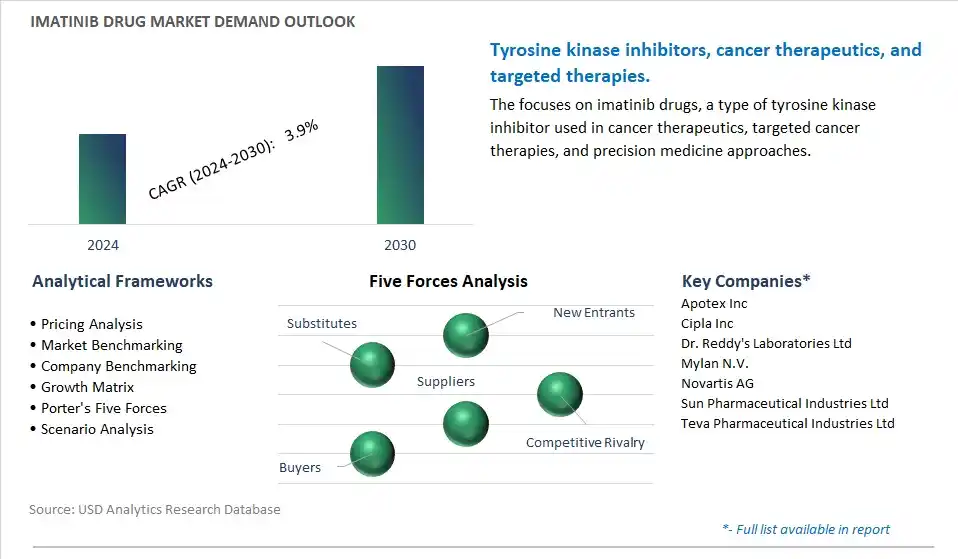
Imatinib Drug Market is estimated to increase at a Compounded Annual Growth Rate of 3.9% CAGR over the forecast period from 2024 to 2030
The Imatinib Drug Market study analyzes and forecasts the market size across 6 regions and 24 countries for diverse segments- By Application (Aggressive Systemic Mastocytosis (ASM), Chronic Eosinophilic Leukemia (CEL), Dermatofibrosarcoma Protuberans (DFSP), Gastrointestinal Stromal Tumors (GIST), Hyper-eosinophilic Syndrome (HES), Myelodysplastic Syndrome (MDS), Myeloproliferative Diseases (MPD), Philadelphia Chromosome-positive Acute, Lymphoblastic Leukemia (Ph+ ALL), Philadelphia Chromosome-positive Chronic Myeloid, Leukemia (Ph+ CML)), By Form (Tablets, Capsules).
An Introduction to Imatinib Drug Market in 2024
In 2024, the market for imatinib, a tyrosine kinase inhibitor (TKI) used in the treatment of various cancers, continues to be a cornerstone therapy in oncology practice, offering significant clinical benefits and improved outcomes for patients with specific malignancies. Imatinib was the first TKI approved for the treatment of chronic myeloid leukemia (CML) and gastrointestinal stromal tumors (GIST), revolutionizing the management of these diseases and serving as a paradigm for targeted cancer therapy. By selectively inhibiting the activity of specific tyrosine kinases implicated in the pathogenesis of CML and GIST, imatinib effectively suppresses tumor growth, induces remission, and prolongs survival in affected patients. Furthermore, ongoing research efforts are exploring the potential of imatinib in other malignancies and treatment settings, including pediatric cancers and adjuvant therapy for high-risk disease. With its established efficacy, favorable safety profile, and expanding therapeutic indications, imatinib remains a vital component of cancer treatment regimens, underscoring its enduring significance in the oncology market.
Market Trend: Emergence of Generic Imatinib Formulations
A significant trend in the market for imatinib drugs is the emergence of generic formulations. Imatinib, a tyrosine kinase inhibitor used primarily in the treatment of chronic myeloid leukemia (CML) and gastrointestinal stromal tumors (GIST), was initially marketed under brand names such as Gleevec and Glivec. However, with the expiration of patents and regulatory approvals for generic imatinib formulations, there has been an increase in the availability of lower-cost generic versions of the drug. This trend has led to greater affordability and accessibility of imatinib therapy for patients, as well as increased competition among pharmaceutical manufacturers in the imatinib market segment.
Market Driver: Growing Incidence of Chronic Myeloid Leukemia (CML) and Gastrointestinal Stromal Tumors (GIST)
The primary driver propelling the market for imatinib drugs is the growing incidence of chronic myeloid leukemia (CML) and gastrointestinal stromal tumors (GIST). CML and GIST are both malignancies characterized by abnormal cellular proliferation driven by genetic mutations, such as the BCR-ABL fusion gene in CML and KIT mutations in GIST. With advancements in diagnostic techniques and increasing awareness of these diseases, there has been a rise in the number of patients diagnosed with CML and GIST globally. Imatinib, as a targeted therapy that specifically inhibits the activity of tyrosine kinases implicated in the pathogenesis of CML and GIST, remains a cornerstone of treatment for these conditions, thus driving demand for the drug.
Market Opportunity: Expansion into Adjuvant and Combination Therapies
An attractive opportunity within the market for imatinib drug is the expansion into adjuvant and combination therapies. While imatinib monotherapy has demonstrated significant efficacy in the treatment of CML and GIST, there remains a need for adjuvant therapies to improve outcomes, prevent disease recurrence, and overcome resistance mechanisms. Opportunities exist for pharmaceutical companies to explore the use of imatinib in combination with other targeted agents, immunotherapies, or traditional chemotherapy drugs as part of multidrug regimens for CML and GIST. Additionally, there is potential for the development of adjuvant therapies that enhance the activity of imatinib or mitigate treatment-related toxicities, thereby optimizing treatment outcomes and expanding the therapeutic applications of imatinib in oncology. By capitalizing on these opportunities, stakeholders can enhance the clinical utility and market potential of imatinib drugs in the management of CML and GIST.
Imatinib Drug Market Share Analysis: Gastrointestinal Stromal Tumors (GIST)
In the Imatinib Drug Market, the segment experiencing the fastest growth is Gastrointestinal Stromal Tumors (GIST). Imatinib, a tyrosine kinase inhibitor, is widely used for the treatment of GIST, a rare type of cancer that originates in the gastrointestinal tract. Imatinib has demonstrated significant efficacy in inhibiting the growth of GIST tumors by targeting specific genetic mutations, such as those in the KIT and PDGFRA genes. As the understanding of GIST biology and treatment options improves, there is a growing demand for imatinib therapy among patients with GIST. Additionally, advancements in molecular diagnostics and personalized medicine have led to increased identification of GIST cases that may benefit from imatinib treatment. Tablets and capsules are the primary forms of imatinib formulations used for GIST treatment, offering convenient oral administration and precise dosing. With the expanding applications of imatinib in GIST management and ongoing research in this field, the GIST segment is poised for significant growth in the imatinib drug market.
Imatinib Drug Competitive Analysis
The market research study provides in-depth insights into leading companies including the SWOT analyses, product profile, financial details, and recent developments acrossApotex Inc, Cipla Inc, Dr. Reddy's Laboratories Ltd, Mylan N.V., Novartis AG, Sun Pharmaceutical Industries Ltd, Teva Pharmaceutical Industries Ltd
Imatinib Drug Market Segmentation
By Application
Aggressive Systemic Mastocytosis (ASM)
Chronic Eosinophilic Leukemia (CEL)
Dermatofibrosarcoma Protuberans (DFSP)
Gastrointestinal Stromal Tumors (GIST)
Hyper-eosinophilic Syndrome (HES)
Myelodysplastic Syndrome (MDS)
Myeloproliferative Diseases (MPD)
Philadelphia Chromosome-positive Acute
Lymphoblastic Leukemia (Ph+ ALL)
Philadelphia Chromosome-positive Chronic Myeloid
Leukemia (Ph+ CML)
By Form
Tablets
Capsules
Geographical Analysis
North America (United States, Canada, Mexico)
Europe (Germany, France, United Kingdom, Spain, Italy, Rest of Europe)
Asia Pacific (China, India, Japan, South Korea, Rest of Asia Pacific)
South America (Brazil, Argentina, Rest of South America)
Middle East and Africa (Saudi Arabia, UAE, Rest of Middle East, South Africa, Egypt, Rest of Africa)
Imatinib Drug Market Companies
Apotex Inc
Cipla Inc
Dr. Reddy's Laboratories Ltd
Mylan N.V.
Novartis AG
Sun Pharmaceutical Industries Ltd
Teva Pharmaceutical Industries Ltd
Reasons to Buy the Imatinib Drug Market Study
• Deepen your industry insights and navigate uncertainties for strategy formulation, CAPEX, and Operational decisions
• Gain access to detailed insights on the Imatinib Drug Market, encompassing current market size, growth trends, and forecasts till 2030.
• Access detailed competitor analysis, enabling competitive advantage through a thorough understanding of market players, strategies, and potential differentiation opportunities
• Stay ahead of the curve with insights on technological advancements, innovations, and upcoming trends
• Identify lucrative investment avenues and expansion opportunities within the Imatinib Drug Market industry, guided by robust, data-backed analysis.
• Understand regional and global markets through country-wise analysis, regional market potential, regulatory nuances, and dynamics
• Execute strategies with confidence and speed through information, analytics, and insights on the industry value chain
• Corporate leaders, strategists, financial experts, shareholders, asset managers, and governmental representatives can make long-term planning scenarios and build an integrated and timely understanding of market dynamics
• Benefit from tailored solutions and expert consultation based on report insights, providing personalized strategies aligned with specific business needs.
TABLE OF CONTENTS
1 Introduction to 2024 Imatinib Drug Market
1.1 Market Overview
1.2 Quick Facts
1.3 Scope/Objective of the Study
1.4 Market Definition
1.5 Countries and Regions Covered
1.6 Units, Currency, and Conversions
1.7 Industry Value Chain
2 Research Methodology
2.1 Market Size Estimation
2.2 Sources and Research Methodology
2.3 Data Triangulation
2.4 Assumptions and Limitations
3 Executive Summary
3.1 Global Imatinib Drug Market Size Outlook, $ Million, 2021 to 2030
3.2 Imatinib Drug Market Outlook by Type, $ Million, 2021 to 2030
3.3 Imatinib Drug Market Outlook by Product, $ Million, 2021 to 2030
3.4 Imatinib Drug Market Outlook by Application, $ Million, 2021 to 2030
3.5 Imatinib Drug Market Outlook by Key Countries, $ Million, 2021 to 2030
4 Market Dynamics
4.1 Key Driving Forces of Imatinib Drug Industry
4.2 Key Market Trends in Imatinib Drug Industry
4.3 Potential Opportunities in Imatinib Drug Industry
4.4 Key Challenges in Imatinib Drug Industry
5 Market Factor Analysis
5.1 Value Chain Analysis
5.2 Competitive Landscape
5.2.1 Global Imatinib Drug Market Share by Company (%), 2023
5.2.2 Product Offerings by Company
5.3 Porter’s Five Forces Analysis
5.4 Pricing Analysis and Outlook
6 Growth Outlook Across Scenarios
6.1 Growth Analysis-Case Scenario Definitions
6.2 Low Growth Scenario Forecasts
6.3 Reference Growth Scenario Forecasts
6.4 High Growth Scenario Forecasts
7 Global Imatinib Drug Market Outlook by Segments
7.1 Imatinib Drug Market Outlook by Segments, $ Million, 2021- 2030
By Application
Aggressive Systemic Mastocytosis (ASM)
Chronic Eosinophilic Leukemia (CEL)
Dermatofibrosarcoma Protuberans (DFSP)
Gastrointestinal Stromal Tumors (GIST)
Hyper-eosinophilic Syndrome (HES)
Myelodysplastic Syndrome (MDS)
Myeloproliferative Diseases (MPD)
Philadelphia Chromosome-positive Acute
Lymphoblastic Leukemia (Ph+ ALL)
Philadelphia Chromosome-positive Chronic Myeloid
Leukemia (Ph+ CML)
By Form
Tablets
Capsules
8 North America Imatinib Drug Market Analysis and Outlook To 2030
8.1 Introduction to North America Imatinib Drug Markets in 2024
8.2 North America Imatinib Drug Market Size Outlook by Country, 2021-2030
8.2.1 United States
8.2.2 Canada
8.2.3 Mexico
8.3 North America Imatinib Drug Market size Outlook by Segments, 2021-2030
By Application
Aggressive Systemic Mastocytosis (ASM)
Chronic Eosinophilic Leukemia (CEL)
Dermatofibrosarcoma Protuberans (DFSP)
Gastrointestinal Stromal Tumors (GIST)
Hyper-eosinophilic Syndrome (HES)
Myelodysplastic Syndrome (MDS)
Myeloproliferative Diseases (MPD)
Philadelphia Chromosome-positive Acute
Lymphoblastic Leukemia (Ph+ ALL)
Philadelphia Chromosome-positive Chronic Myeloid
Leukemia (Ph+ CML)
By Form
Tablets
Capsules
9 Europe Imatinib Drug Market Analysis and Outlook To 2030
9.1 Introduction to Europe Imatinib Drug Markets in 2024
9.2 Europe Imatinib Drug Market Size Outlook by Country, 2021-2030
9.2.1 Germany
9.2.2 France
9.2.3 Spain
9.2.4 United Kingdom
9.2.4 Italy
9.2.5 Russia
9.2.6 Norway
9.2.7 Rest of Europe
9.3 Europe Imatinib Drug Market Size Outlook by Segments, 2021-2030
By Application
Aggressive Systemic Mastocytosis (ASM)
Chronic Eosinophilic Leukemia (CEL)
Dermatofibrosarcoma Protuberans (DFSP)
Gastrointestinal Stromal Tumors (GIST)
Hyper-eosinophilic Syndrome (HES)
Myelodysplastic Syndrome (MDS)
Myeloproliferative Diseases (MPD)
Philadelphia Chromosome-positive Acute
Lymphoblastic Leukemia (Ph+ ALL)
Philadelphia Chromosome-positive Chronic Myeloid
Leukemia (Ph+ CML)
By Form
Tablets
Capsules
10 Asia Pacific Imatinib Drug Market Analysis and Outlook To 2030
10.1 Introduction to Asia Pacific Imatinib Drug Markets in 2024
10.2 Asia Pacific Imatinib Drug Market Size Outlook by Country, 2021-2030
10.2.1 China
10.2.2 India
10.2.3 Japan
10.2.4 South Korea
10.2.5 Indonesia
10.2.6 Malaysia
10.2.7 Australia
10.2.8 Rest of Asia Pacific
10.3 Asia Pacific Imatinib Drug Market size Outlook by Segments, 2021-2030
By Application
Aggressive Systemic Mastocytosis (ASM)
Chronic Eosinophilic Leukemia (CEL)
Dermatofibrosarcoma Protuberans (DFSP)
Gastrointestinal Stromal Tumors (GIST)
Hyper-eosinophilic Syndrome (HES)
Myelodysplastic Syndrome (MDS)
Myeloproliferative Diseases (MPD)
Philadelphia Chromosome-positive Acute
Lymphoblastic Leukemia (Ph+ ALL)
Philadelphia Chromosome-positive Chronic Myeloid
Leukemia (Ph+ CML)
By Form
Tablets
Capsules
11 South America Imatinib Drug Market Analysis and Outlook To 2030
11.1 Introduction to South America Imatinib Drug Markets in 2024
11.2 South America Imatinib Drug Market Size Outlook by Country, 2021-2030
11.2.1 Brazil
11.2.2 Argentina
11.2.3 Rest of South America
11.3 South America Imatinib Drug Market size Outlook by Segments, 2021-2030
By Application
Aggressive Systemic Mastocytosis (ASM)
Chronic Eosinophilic Leukemia (CEL)
Dermatofibrosarcoma Protuberans (DFSP)
Gastrointestinal Stromal Tumors (GIST)
Hyper-eosinophilic Syndrome (HES)
Myelodysplastic Syndrome (MDS)
Myeloproliferative Diseases (MPD)
Philadelphia Chromosome-positive Acute
Lymphoblastic Leukemia (Ph+ ALL)
Philadelphia Chromosome-positive Chronic Myeloid
Leukemia (Ph+ CML)
By Form
Tablets
Capsules
12 Middle East and Africa Imatinib Drug Market Analysis and Outlook To 2030
12.1 Introduction to Middle East and Africa Imatinib Drug Markets in 2024
12.2 Middle East and Africa Imatinib Drug Market Size Outlook by Country, 2021-2030
12.2.1 Saudi Arabia
12.2.2 UAE
12.2.3 Oman
12.2.4 Rest of Middle East
12.2.5 Egypt
12.2.6 Nigeria
12.2.7 South Africa
12.2.8 Rest of Africa
12.3 Middle East and Africa Imatinib Drug Market size Outlook by Segments, 2021-2030
By Application
Aggressive Systemic Mastocytosis (ASM)
Chronic Eosinophilic Leukemia (CEL)
Dermatofibrosarcoma Protuberans (DFSP)
Gastrointestinal Stromal Tumors (GIST)
Hyper-eosinophilic Syndrome (HES)
Myelodysplastic Syndrome (MDS)
Myeloproliferative Diseases (MPD)
Philadelphia Chromosome-positive Acute
Lymphoblastic Leukemia (Ph+ ALL)
Philadelphia Chromosome-positive Chronic Myeloid
Leukemia (Ph+ CML)
By Form
Tablets
Capsules
13 Company Profiles
13.1 Company Snapshot
13.2 SWOT Profiles
13.3 Products and Services
13.4 Recent Developments
13.5 Financial Profile
List of Companies
Apotex Inc
Cipla Inc
Dr. Reddy's Laboratories Ltd
Mylan N.V.
Novartis AG
Sun Pharmaceutical Industries Ltd
Teva Pharmaceutical Industries Ltd
14 Appendix
14.1 Customization Offerings
14.2 Subscription Services
14.3 Related Reports
14.4 Publisher Expertise
By Application
Aggressive Systemic Mastocytosis (ASM)
Chronic Eosinophilic Leukemia (CEL)
Dermatofibrosarcoma Protuberans (DFSP)
Gastrointestinal Stromal Tumors (GIST)
Hyper-eosinophilic Syndrome (HES)
Myelodysplastic Syndrome (MDS)
Myeloproliferative Diseases (MPD)
Philadelphia Chromosome-positive Acute
Lymphoblastic Leukemia (Ph+ ALL)
Philadelphia Chromosome-positive Chronic Myeloid
Leukemia (Ph+ CML)
By Form
Tablets
Capsules
Countries Analyzed
North America (United States, Canada, Mexico)
Europe (Germany, France, United Kingdom, Spain, Italy, Rest of Europe)
Asia Pacific (China, India, Japan, South Korea, Rest of Asia Pacific)
South America (Brazil, Argentina, Rest of South America)
Middle East and Africa (Saudi Arabia, UAE, Rest of Middle East, South Africa, Egypt, Rest of Africa)
