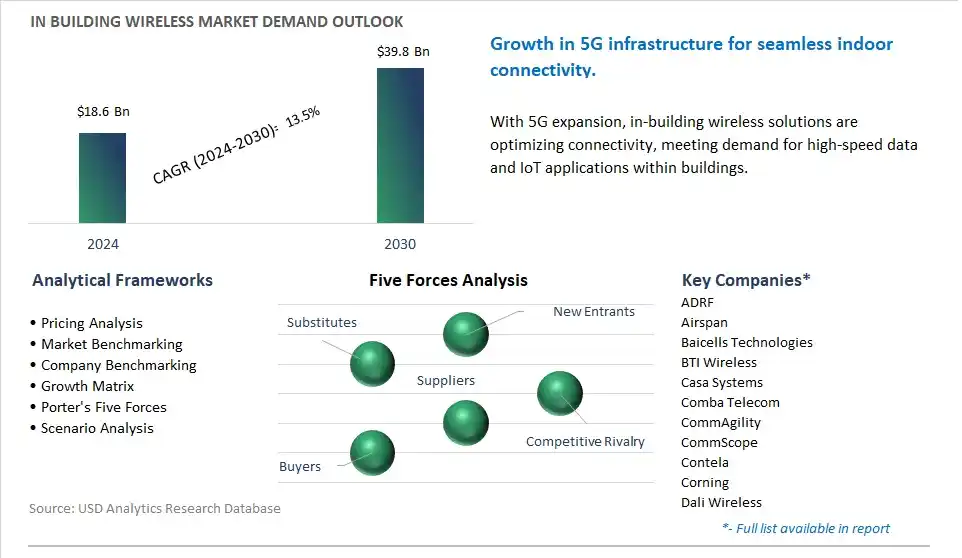
The global In-building Wireless Market is poised to register a 13.5% CAGR from $18.6 Billion in 2024 to $39.8 Billion in 2030.
The global In-building Wireless Market Study analyzes and forecasts the market size across 6 regions and 24 countries for diverse segments -By Offering (Infrastructure, Distributed Antenna System, Small Cells, Services), By Business Model (Service Providers, Enterprises, Neutral Host Operators), By Building Size (Large Buildings, Medium-sized Buildings, Small Buildings), By End-User (Commercial, Government, Transportation, Hospitality, Manufacturing, Education, Others)
An Introduction to Global In-building Wireless Market in 2024
In-building Wireless refers to the wireless communication systems and infrastructure deployed within buildings, such as offices, hospitals, hotels, malls, and residential complexes, to provide seamless connectivity and enhanced network coverage. These systems include distributed antenna systems (DAS), small cells, Wi-Fi networks, and cellular repeaters, enabling reliable voice, data, and multimedia services indoors. The In-building Wireless market is experiencing rapid expansion driven by the growing demand for high-speed internet access, mobile connectivity, Internet of Things (IoT) applications, and digital services within buildings. With the increasing reliance on mobile devices, remote working trends, and smart building technologies, In-building Wireless solutions play a crucial role in ensuring efficient communication, productivity, and user experience for occupants, visitors, and tenants in indoor environments.
In-building Wireless Market Competitive Landscape
The market report analyses the leading companies in the industry including ADRF, Airspan, Baicells Technologies, BTI Wireless, Casa Systems, Comba Telecom, CommAgility, CommScope, Contela, Corning, Dali Wireless, Ericsson, Fujitsu, Galtronics, Huawei, Huber+Suhner, JMA Wireless, Microlab, NEC, Nextivity, Nokia, PBE Axell, PCTEL, Qucell, Samsung, Sercomm, SignalBoosters.com., SOLiD, Whoop Wireless, Zinwave, ZTE.
In-building Wireless Market Dynamics
In-building Wireless Market Trend: Increasing Demand for 5G In-building Wireless Solutions
The most prominent trend in the in-building wireless market is the increasing demand for 5G in-building wireless solutions. With the rollout of 5G networks and the proliferation of connected devices, there is a growing need for robust in-building wireless infrastructure to support high-speed data transmission, low-latency communication, and seamless connectivity inside buildings. This trend includes the deployment of distributed antenna systems (DAS), small cells, Wi-Fi 6 networks, and cellular repeaters to enhance indoor wireless coverage and capacity, driving market growth in the 5G in-building segment.
In-building Wireless Market Driver: Rising Data Consumption and Connectivity Requirements
A significant driver for the in-building wireless market is the rising data consumption and connectivity requirements in indoor environments. As more people rely on mobile devices for work, communication, entertainment, and IoT applications, the demand for reliable and high-performance indoor wireless networks increases. Factors such as remote work trends, smart building initiatives, digital transformation, and the Internet of Things (IoT) ecosystem drive the adoption of in-building wireless solutions, supporting market expansion and technological advancements.
In-building Wireless Market Opportunity: Integration of IoT and Smart Building Technologies
One Market Opportunity in the in-building wireless market lies in the integration of IoT (Internet of Things) and smart building technologies with wireless infrastructure. In-building wireless networks can serve as the backbone for IoT devices, sensors, and smart building systems such as energy management, security systems, asset tracking, and environmental monitoring. Integrating IoT data analytics, AI-driven automation, and cloud-based platforms with in-building wireless solutions offers opportunities to create smart, efficient, and connected indoor environments. Capitalizing on this opportunity involves collaboration with IoT providers, development of interoperable solutions, customization for specific verticals (e.g., healthcare, retail, hospitality), and educating stakeholders on the benefits of integrated IoT and wireless technologies for smart buildings.
In-building Wireless Market Share Analysis: Infrastructure is the largest segment in 2023
Infrastructure Dominates In-Building Wireless Market, Serving as Foundation for Reliable Indoor Connectivity. The market growth is driven by infrastructure components form the backbone of in-building wireless systems, including cabling, routers, switches, access points, and other networking equipment. These components are essential for establishing and maintaining a reliable wireless communication network within buildings.
In-building Wireless Market Share Analysis: Enterprises is the dominant segment in the industry
The largest market segment among "In-building Wireless by Business Model" is "Enterprises." Enterprises Drive Growth in In-Building Wireless Market, Focusing on Seamless Connectivity and Operational Efficiency. This is driven by enterprises that encompass a broad range of organizations, including offices, retail stores, hospitals, educational institutions, and more. These entities often invest in in-building wireless solutions to improve communication, productivity, and customer experience within their premises. Enterprises have specific needs for reliable and high-performance wireless connectivity to support their operations, employee productivity, and customer engagement. They may deploy in-building wireless infrastructure, distributed antenna systems, small cells, and other technologies to ensure seamless connectivity throughout their buildings.
In-building Wireless Market Share Analysis: Large Buildings is the fastest growing application to 2030
Demand Surges for In-Building Wireless Solutions in Large Buildings is fueling Rapid Market Growth and Connectivity Innovations. Large buildings, such as skyscrapers, corporate headquarters, shopping malls, and convention centers, require robust in-building wireless solutions to provide seamless connectivity to a high volume of users across extensive areas. With the increasing adoption of mobile devices, Internet of Things (IoT) devices, and the demand for high-speed data transmission, large buildings are investing significantly in advanced in-building wireless infrastructure, distributed antenna systems (DAS), small cells, and other technologies. Additionally, large buildings often house diverse businesses, organizations, and amenities, leading to complex connectivity requirements that drive the demand for sophisticated in-building wireless solutions.
The US In-building Wireless Market Size Outlook to 2030
The US in-building wireless market is poised for significant growth as the demand for seamless and high-speed connectivity continues to rise across various industries and sectors. Factors such as the proliferation of smart devices, increasing data traffic, and the adoption of IoT technologies are driving the need for reliable and efficient wireless communication solutions within buildings. This market is witnessing a shift towards advanced technologies like 5G, small cells, distributed antenna systems (DAS), and Wi-Fi 6, enabling enhanced coverage, capacity, and performance indoors. With the ongoing digital transformation and emphasis on connected environments, the US in-building wireless market is expected to experience substantial expansion in the coming years, catering to the evolving connectivity needs of businesses, enterprises, and consumers.
In-building Wireless Market Scope-
By Offering
Infrastructure
Distributed Antenna System
Small Cells
Services
By Business Model
Service Providers
Enterprises
Neutral Host Operators
By Building Size
Large Buildings
Medium-sized Buildings
Small Buildings
By End-User
Commercial
Government
Transportation
Hospitality
Manufacturing
Education
Others
Geographical Analysis
North America (United States, Canada, Mexico)
Europe (Germany, France, United Kingdom, Spain, Italy, Rest of Europe)
Asia Pacific (China, India, Japan, South Korea, Rest of Asia Pacific)
South America (Brazil, Argentina, Rest of South America)
Middle East and Africa (Saudi Arabia, UAE, Rest of Middle East, South Africa, Egypt, Rest of Africa
In-building Wireless Market Companies Profiled
ADRF
Airspan
Baicells Technologies
BTI Wireless
Casa Systems
Comba Telecom
CommAgility
CommScope
Contela
Corning
Dali Wireless
Ericsson
Fujitsu
Galtronics
Huawei
Huber+Suhner
JMA Wireless
Microlab
NEC
Nextivity
Nokia
PBE Axell
PCTEL
Qucell
Samsung
Sercomm
SignalBoosters.com.
SOLiD
Whoop Wireless
Zinwave
ZTE
*- List not Exhaustive
TABLE OF CONTENTS
1 Introduction to 2024 In-building Wireless Market
1.1 Market Overview
1.2 Quick Facts
1.3 Scope/Objective of the Study
1.4 Market Definition
1.5 Countries and Regions Covered
1.6 Units, Currency, and Conversions
1.7 Industry Value Chain
2 Research Methodology
2.1 Market Size Estimation
2.2 Sources and Research Methodology
2.3 Data Triangulation
2.4 Assumptions and Limitations
3 Executive Summary
3.1 Global In-building Wireless Market Size Outlook, $ Million, 2021 to 2030
3.2 In-building Wireless Market Outlook by Type, $ Million, 2021 to 2030
3.3 In-building Wireless Market Outlook by Product, $ Million, 2021 to 2030
3.4 In-building Wireless Market Outlook by Application, $ Million, 2021 to 2030
3.5 In-building Wireless Market Outlook by Key Countries, $ Million, 2021 to 2030
4 Market Dynamics
4.1 Key Driving Forces of In-building Wireless Industry
4.2 Key Market Trends in In-building Wireless Industry
4.3 Potential Opportunities in In-building Wireless Industry
4.4 Key Challenges in In-building Wireless Industry
5 Market Factor Analysis
5.1 Value Chain Analysis
5.2 Competitive Landscape
5.2.1 Global In-building Wireless Market Share by Company (%), 2023
5.2.2 Product Offerings by Company
5.3 Porter’s Five Forces Analysis
5.4 Pricing Analysis and Outlook
6 Growth Outlook Across Scenarios
6.1 Growth Analysis-Case Scenario Definitions
6.2 Low Growth Scenario Forecasts
6.3 Reference Growth Scenario Forecasts
6.4 High Growth Scenario Forecasts
7 Global In-building Wireless Market Outlook by Segments
7.1 In-building Wireless Market Outlook by Segments, $ Million, 2021- 2030
By Offering
Infrastructure
Distributed Antenna System
Small Cells
Services
By Business Model
Service Providers
Enterprises
Neutral Host Operators
By Building Size
Large Buildings
Medium-sized Buildings
Small Buildings
By End-User
Commercial
Government
Transportation
Hospitality
Manufacturing
Education
Others
8 North America In-building Wireless Market Analysis and Outlook To 2030
8.1 Introduction to North America In-building Wireless Markets in 2024
8.2 North America In-building Wireless Market Size Outlook by Country, 2021-2030
8.2.1 United States
8.2.2 Canada
8.2.3 Mexico
8.3 North America In-building Wireless Market size Outlook by Segments, 2021-2030
By Offering
Infrastructure
Distributed Antenna System
Small Cells
Services
By Business Model
Service Providers
Enterprises
Neutral Host Operators
By Building Size
Large Buildings
Medium-sized Buildings
Small Buildings
By End-User
Commercial
Government
Transportation
Hospitality
Manufacturing
Education
Others
9 Europe In-building Wireless Market Analysis and Outlook To 2030
9.1 Introduction to Europe In-building Wireless Markets in 2024
9.2 Europe In-building Wireless Market Size Outlook by Country, 2021-2030
9.2.1 Germany
9.2.2 France
9.2.3 Spain
9.2.4 United Kingdom
9.2.4 Italy
9.2.5 Russia
9.2.6 Norway
9.2.7 Rest of Europe
9.3 Europe In-building Wireless Market Size Outlook by Segments, 2021-2030
By Offering
Infrastructure
Distributed Antenna System
Small Cells
Services
By Business Model
Service Providers
Enterprises
Neutral Host Operators
By Building Size
Large Buildings
Medium-sized Buildings
Small Buildings
By End-User
Commercial
Government
Transportation
Hospitality
Manufacturing
Education
Others
10 Asia Pacific In-building Wireless Market Analysis and Outlook To 2030
10.1 Introduction to Asia Pacific In-building Wireless Markets in 2024
10.2 Asia Pacific In-building Wireless Market Size Outlook by Country, 2021-2030
10.2.1 China
10.2.2 India
10.2.3 Japan
10.2.4 South Korea
10.2.5 Indonesia
10.2.6 Malaysia
10.2.7 Australia
10.2.8 Rest of Asia Pacific
10.3 Asia Pacific In-building Wireless Market size Outlook by Segments, 2021-2030
By Offering
Infrastructure
Distributed Antenna System
Small Cells
Services
By Business Model
Service Providers
Enterprises
Neutral Host Operators
By Building Size
Large Buildings
Medium-sized Buildings
Small Buildings
By End-User
Commercial
Government
Transportation
Hospitality
Manufacturing
Education
Others
11 South America In-building Wireless Market Analysis and Outlook To 2030
11.1 Introduction to South America In-building Wireless Markets in 2024
11.2 South America In-building Wireless Market Size Outlook by Country, 2021-2030
11.2.1 Brazil
11.2.2 Argentina
11.2.3 Rest of South America
11.3 South America In-building Wireless Market size Outlook by Segments, 2021-2030
By Offering
Infrastructure
Distributed Antenna System
Small Cells
Services
By Business Model
Service Providers
Enterprises
Neutral Host Operators
By Building Size
Large Buildings
Medium-sized Buildings
Small Buildings
By End-User
Commercial
Government
Transportation
Hospitality
Manufacturing
Education
Others
12 Middle East and Africa In-building Wireless Market Analysis and Outlook To 2030
12.1 Introduction to Middle East and Africa In-building Wireless Markets in 2024
12.2 Middle East and Africa In-building Wireless Market Size Outlook by Country, 2021-2030
12.2.1 Saudi Arabia
12.2.2 UAE
12.2.3 Oman
12.2.4 Rest of Middle East
12.2.5 Egypt
12.2.6 Nigeria
12.2.7 South Africa
12.2.8 Rest of Africa
12.3 Middle East and Africa In-building Wireless Market size Outlook by Segments, 2021-2030
By Offering
Infrastructure
Distributed Antenna System
Small Cells
Services
By Business Model
Service Providers
Enterprises
Neutral Host Operators
By Building Size
Large Buildings
Medium-sized Buildings
Small Buildings
By End-User
Commercial
Government
Transportation
Hospitality
Manufacturing
Education
Others
13 Company Profiles
13.1 Company Snapshot
13.2 SWOT Profiles
13.3 Products and Services
13.4 Recent Developments
13.5 Financial Profile
ADRF
Airspan
Baicells Technologies
BTI Wireless
Casa Systems
Comba Telecom
CommAgility
CommScope
Contela
Corning
Dali Wireless
Ericsson
Fujitsu
Galtronics
Huawei
Huber+Suhner
JMA Wireless
Microlab
NEC
Nextivity
Nokia
PBE Axell
PCTEL
Qucell
Samsung
Sercomm
SignalBoosters.com.
SOLiD
Whoop Wireless
Zinwave
ZTE
14 Appendix
14.1 Customization Offerings
14.2 Subscription Services
14.3 Related Reports
14.4 Publisher Expertise
