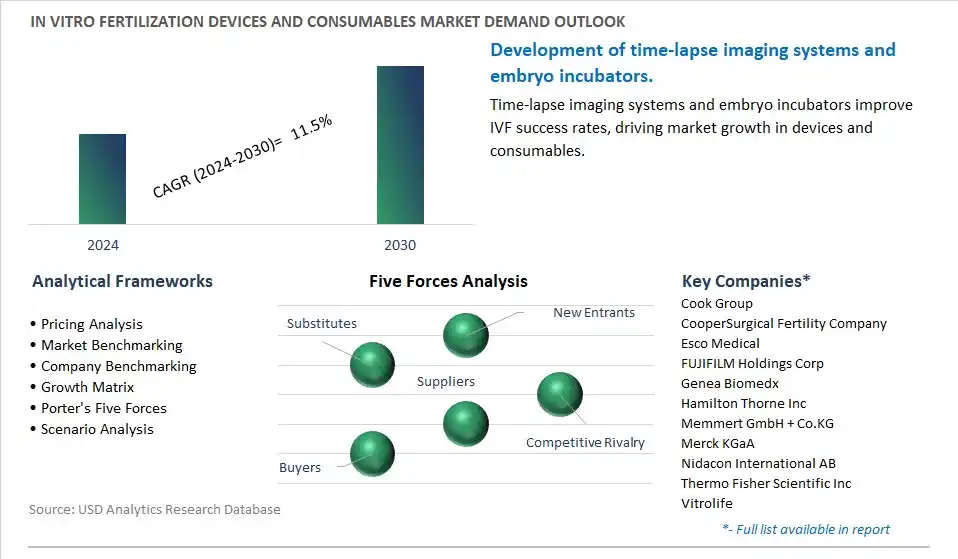
In Vitro Fertilization Devices and Consumables Market is estimated to increase at a growth rate of 11.5% CAGR over the forecast period from 2024 to 2030.
The global In Vitro Fertilization Devices and Consumables Market Study analyzes and forecasts the market size across 6 regions and 24 countries for diverse segments including By Type (Instrument (Sperm Separation System, Incubator, Cryosystem), Reagents and Media (Cryopreservation Media, Semen Processing Media), Accessories and Disposable), By Technology (Fresh Embryo IVF, Frozen Embryo IVF, Donor Egg IVF), By End-User (Hospitals, Fertility Clinics, Others).
An Introduction to In Vitro Fertilization Devices and Consumables Market in 2024
The In Vitro Fertilization (IVF) Devices and Consumables Market comprises medical devices, equipment, culture media, and consumables used in assisted reproductive technology procedures such as in vitro fertilization, embryo transfer, and gamete manipulation. This market includes IVF incubators, micromanipulation systems, cryopreservation devices, sperm analyzers, and ovulation prediction kits used in fertility clinics, reproductive laboratories, and hospitals. IVF devices and consumables play a crucial role in treating infertility, supporting conception, and facilitating successful pregnancies for couples facing reproductive challenges. Innovations in the IVF market focus on improving success rates, reducing complications, enhancing embryo viability, and optimizing treatment protocols, addressing the evolving needs of patients and healthcare providers in fertility care.
In Vitro Fertilization Devices and Consumables Market Competitive Landscape
The global In Vitro Fertilization Devices and Consumables Industry is highly competitive with a large number of companies focusing on niche market segments. Amidst intense competitive conditions, In Vitro Fertilization Devices and Consumables Companies are investing in new product launches and strengthening distribution channels. Key companies operating in the In Vitro Fertilization Devices and Consumables Industry include- Cook Group, CooperSurgical Fertility Company, Esco Medical, FUJIFILM Holdings Corp, Genea Biomedx, Hamilton Thorne Inc, Memmert GmbH + Co.KG, Merck KGaA, Nidacon International AB, Thermo Fisher Scientific Inc, Vitrolife.
In Vitro Fertilization Devices and Consumables Market Trend: Advancements in Assisted Reproductive Technologies
A significant trend in the market for in vitro fertilization (IVF) devices and consumables is the continuous advancements in assisted reproductive technologies (ART), driven by innovations in laboratory techniques, equipment, and culture media formulations. IVF has revolutionized the treatment of infertility by enabling couples to conceive through the manipulation of gametes and embryos outside the body. Recent advancements in IVF technologies include the development of time-lapse imaging systems for embryo monitoring, microfluidic devices for sperm selection, and automated culture systems for embryo incubation. These advancements aim to improve IVF success rates, minimize embryo exposure to suboptimal conditions, and enhance the selection of viable embryos for transfer, ultimately increasing the chances of successful pregnancy outcomes for individuals undergoing fertility treatment.
In Vitro Fertilization Devices and Consumables Market Driver: Increasing Prevalence of Infertility and Delayed Childbearing
The primary driver of the IVF devices and consumables market is the increasing prevalence of infertility and delayed childbearing among couples worldwide, fueled by factors such as lifestyle changes, environmental exposures, and age-related fertility decline. Infertility affects approximately 10-15% of couples of reproductive age, with female age being a significant predictor of infertility risk. As societal trends towards delayed childbearing continue, driven by factors such as educational pursuits, career advancement, and financial stability, the demand for assisted reproductive technologies, including IVF, has risen. Additionally, the growing acceptance and accessibility of fertility treatments, advancements in reproductive medicine, and improvements in IVF success rates have further contributed to the expansion of the IVF market, driving demand for devices and consumables used in IVF procedures.
In Vitro Fertilization Devices and Consumables Market Opportunity: Expansion into Emerging Markets and Affordable IVF Solutions
An opportunity in the IVF devices and consumables market lies in the expansion into emerging markets and the development of affordable IVF solutions to address the unmet needs of underserved populations. While IVF treatments have traditionally been associated with high costs and limited accessibility, particularly in developing countries, there is growing demand for more affordable and accessible fertility services worldwide. Manufacturers of IVF devices and consumables can capitalize on this opportunity by developing cost-effective IVF technologies, simplified laboratory protocols, and scalable solutions that enable fertility clinics and healthcare providers to offer IVF treatments at reduced costs without compromising treatment outcomes or safety. By expanding into emerging markets and leveraging economies of scale, stakeholders in the IVF market can broaden access to fertility care, improve patient affordability, and support the global demand for assisted reproductive technologies, ultimately helping individuals and couples achieve their dream of parenthood.
In Vitro Fertilization Devices and Consumables Market Share Analysis: Reagents and Media is the fastest growing market segment over the forecast period to 2030
Within the realm of In Vitro Fertilization (IVF) Devices and Consumables, the segment experiencing the fastest growth is "Reagents and Media." This category encompasses various essential components crucial for the success of IVF procedures, including cryopreservation media, semen processing media, and other specialized reagents and media. The rapid growth of this segment can be attributed to several factors. Firstly, advancements in reproductive biotechnology and laboratory techniques have led to the development of highly efficient and specialized media formulations optimized for gamete and embryo culture, resulting in improved success rates in IVF procedures. Additionally, the increasing prevalence of infertility worldwide has driven the demand for IVF treatments, consequently boosting the requirement for high-quality reagents and media in fertility clinics and hospitals. Furthermore, the rising trend of delayed childbearing and the growing acceptance of assisted reproductive technologies have further propelled the demand for IVF services, thereby driving the market for reagents and media. As fertility clinics and hospitals continue to invest in advanced IVF technologies and techniques to enhance success rates and address the evolving needs of patients, the Reagents and Media segment is poised to witness continued rapid growth in the foreseeable future.
In Vitro Fertilization Devices and Consumables Market Segmentation
By Type
Instrument
-Sperm Separation System
-Incubator
-Cryosystem
-Others
Reagents and Media
-Cryopreservation Media
-Semen Processing Media
-Others
Accessories and Disposable
By Technology
Fresh Embryo IVF
Frozen Embryo IVF
Donor Egg IVF
By End-User
Hospitals
Fertility Clinics
Others
Geographical Analysis
North America (United States, Canada, Mexico)
Europe (Germany, France, United Kingdom, Spain, Italy, Rest of Europe)
Asia Pacific (China, India, Japan, South Korea, Rest of Asia Pacific)
South America (Brazil, Argentina, Rest of South America)
Middle East and Africa (Saudi Arabia, UAE, Rest of Middle East, South Africa, Egypt, Rest of Africa)
In Vitro Fertilization Devices and Consumables Companies
Cook Group
CooperSurgical Fertility Company
Esco Medical
FUJIFILM Holdings Corp
Genea Biomedx
Hamilton Thorne Inc
Memmert GmbH + Co.KG
Merck KGaA
Nidacon International AB
Thermo Fisher Scientific Inc
Vitrolife
* List not Exhaustive
Reasons to Buy the In Vitro Fertilization Devices and Consumables Market Study
• Deepen your industry insights and navigate uncertainties for strategy formulation, CAPEX, and Operational decisions
• Gain access to detailed insights on the In Vitro Fertilization Devices and Consumables Market, encompassing current market size, growth trends, and forecasts till 2030.
• Access detailed competitor analysis, enabling competitive advantage through a thorough understanding of market players, strategies, and potential differentiation opportunities
• Stay ahead of the curve with insights on technological advancements, innovations, and upcoming trends
• Identify lucrative investment avenues and expansion opportunities within the In Vitro Fertilization Devices and Consumables Industry, guided by robust, data-backed analysis.
• Understand regional and global markets through country-wise analysis, regional market potential, regulatory nuances, and dynamics
• Execute strategies with confidence and speed through information, analytics, and insights on the industry value chain
• Corporate leaders, strategists, financial experts, shareholders, asset managers, and governmental representatives can make long-term planning scenarios and build an integrated and timely understanding of market dynamics
• Benefit from tailored solutions and expert consultation based on report insights, providing personalized strategies aligned with specific business needs.
TABLE OF CONTENTS
1 Introduction to 2024 In Vitro Fertilization Devices and Consumables Market
1.1 Market Overview
1.2 Quick Facts
1.3 Scope/Objective of the Study
1.4 Market Definition
1.5 Countries and Regions Analyzed
1.6 Units, Currency, and Conversions
1.7 Industry Value Chain
2 Research Methodology
2.1 Market Size Estimation
2.2 Sources and Research Methodology
2.3 Data Triangulation
2.4 Assumptions and Limitations
3 Executive Summary
3.1 Global In Vitro Fertilization Devices and Consumables Market Size Outlook, $ Million, 2021 to 2030
3.2 In Vitro Fertilization Devices and Consumables Market Outlook by Type, $ Million, 2021 to 2030
3.3 In Vitro Fertilization Devices and Consumables Market Outlook by Product, $ Million, 2021 to 2030
3.4 In Vitro Fertilization Devices and Consumables Market Outlook by Application, $ Million, 2021 to 2030
3.5 In Vitro Fertilization Devices and Consumables Market Outlook by Key Countries, $ Million, 2021 to 2030
4 Market Dynamics
4.1 Key Driving Forces of In Vitro Fertilization Devices and Consumables Industry
4.2 Key Market Trends in In Vitro Fertilization Devices and Consumables Industry
4.3 Potential Opportunities in In Vitro Fertilization Devices and Consumables Industry
4.4 Key Challenges in In Vitro Fertilization Devices and Consumables Industry
5 Market Factor Analysis
5.1 Value Chain Analysis
5.2 Competitive Landscape
5.2.1 Global In Vitro Fertilization Devices and Consumables Market Share by Company (%), 2023
5.2.2 Product Offerings by Company
5.3 Porter’s Five Forces Analysis
5.4 Pricing Analysis and Outlook
6 Growth Outlook Across Scenarios
6.1 Growth Analysis-Case Scenario Definitions
6.2 Low Growth Scenario Forecasts
6.3 Reference Growth Scenario Forecasts
6.4 High Growth Scenario Forecasts
7 Global In Vitro Fertilization Devices and Consumables Market Outlook by Segments
7.1 In Vitro Fertilization Devices and Consumables Market Outlook by Segments, $ Million, 2021- 2030
By Type
Instrument
-Sperm Separation System
-Incubator
-Cryosystem
-Others
Reagents and Media
-Cryopreservation Media
-Semen Processing Media
-Others
Accessories and Disposable
By Technology
Fresh Embryo IVF
Frozen Embryo IVF
Donor Egg IVF
By End-User
Hospitals
Fertility Clinics
Others
8 North America In Vitro Fertilization Devices and Consumables Market Analysis and Outlook To 2030
8.1 Introduction to North America In Vitro Fertilization Devices and Consumables Markets in 2024
8.2 North America In Vitro Fertilization Devices and Consumables Market Size Outlook by Country, 2021-2030
8.2.1 United States
8.2.2 Canada
8.2.3 Mexico
8.3 North America In Vitro Fertilization Devices and Consumables Market size Outlook by Segments, 2021-2030
By Type
Instrument
-Sperm Separation System
-Incubator
-Cryosystem
-Others
Reagents and Media
-Cryopreservation Media
-Semen Processing Media
-Others
Accessories and Disposable
By Technology
Fresh Embryo IVF
Frozen Embryo IVF
Donor Egg IVF
By End-User
Hospitals
Fertility Clinics
Others
9 Europe In Vitro Fertilization Devices and Consumables Market Analysis and Outlook To 2030
9.1 Introduction to Europe In Vitro Fertilization Devices and Consumables Markets in 2024
9.2 Europe In Vitro Fertilization Devices and Consumables Market Size Outlook by Country, 2021-2030
9.2.1 Germany
9.2.2 France
9.2.3 Spain
9.2.4 United Kingdom
9.2.4 Italy
9.2.5 Russia
9.2.6 Norway
9.2.7 Rest of Europe
9.3 Europe In Vitro Fertilization Devices and Consumables Market Size Outlook by Segments, 2021-2030
By Type
Instrument
-Sperm Separation System
-Incubator
-Cryosystem
-Others
Reagents and Media
-Cryopreservation Media
-Semen Processing Media
-Others
Accessories and Disposable
By Technology
Fresh Embryo IVF
Frozen Embryo IVF
Donor Egg IVF
By End-User
Hospitals
Fertility Clinics
Others
10 Asia Pacific In Vitro Fertilization Devices and Consumables Market Analysis and Outlook To 2030
10.1 Introduction to Asia Pacific In Vitro Fertilization Devices and Consumables Markets in 2024
10.2 Asia Pacific In Vitro Fertilization Devices and Consumables Market Size Outlook by Country, 2021-2030
10.2.1 China
10.2.2 India
10.2.3 Japan
10.2.4 South Korea
10.2.5 Indonesia
10.2.6 Malaysia
10.2.7 Australia
10.2.8 Rest of Asia Pacific
10.3 Asia Pacific In Vitro Fertilization Devices and Consumables Market size Outlook by Segments, 2021-2030
By Type
Instrument
-Sperm Separation System
-Incubator
-Cryosystem
-Others
Reagents and Media
-Cryopreservation Media
-Semen Processing Media
-Others
Accessories and Disposable
By Technology
Fresh Embryo IVF
Frozen Embryo IVF
Donor Egg IVF
By End-User
Hospitals
Fertility Clinics
Others
11 South America In Vitro Fertilization Devices and Consumables Market Analysis and Outlook To 2030
11.1 Introduction to South America In Vitro Fertilization Devices and Consumables Markets in 2024
11.2 South America In Vitro Fertilization Devices and Consumables Market Size Outlook by Country, 2021-2030
11.2.1 Brazil
11.2.2 Argentina
11.2.3 Rest of South America
11.3 South America In Vitro Fertilization Devices and Consumables Market size Outlook by Segments, 2021-2030
By Type
Instrument
-Sperm Separation System
-Incubator
-Cryosystem
-Others
Reagents and Media
-Cryopreservation Media
-Semen Processing Media
-Others
Accessories and Disposable
By Technology
Fresh Embryo IVF
Frozen Embryo IVF
Donor Egg IVF
By End-User
Hospitals
Fertility Clinics
Others
12 Middle East and Africa In Vitro Fertilization Devices and Consumables Market Analysis and Outlook To 2030
12.1 Introduction to Middle East and Africa In Vitro Fertilization Devices and Consumables Markets in 2024
12.2 Middle East and Africa In Vitro Fertilization Devices and Consumables Market Size Outlook by Country, 2021-2030
12.2.1 Saudi Arabia
12.2.2 UAE
12.2.3 Oman
12.2.4 Rest of Middle East
12.2.5 Egypt
12.2.6 Nigeria
12.2.7 South Africa
12.2.8 Rest of Africa
12.3 Middle East and Africa In Vitro Fertilization Devices and Consumables Market size Outlook by Segments, 2021-2030
By Type
Instrument
-Sperm Separation System
-Incubator
-Cryosystem
-Others
Reagents and Media
-Cryopreservation Media
-Semen Processing Media
-Others
Accessories and Disposable
By Technology
Fresh Embryo IVF
Frozen Embryo IVF
Donor Egg IVF
By End-User
Hospitals
Fertility Clinics
Others
13 Company Profiles
13.1 Company Snapshot
13.2 SWOT Profiles
13.3 Products and Services
13.4 Recent Developments
13.5 Financial Profile
List of Companies
Cook Group
CooperSurgical Fertility Company
Esco Medical
FUJIFILM Holdings Corp
Genea Biomedx
Hamilton Thorne Inc
Memmert GmbH + Co.KG
Merck KGaA
Nidacon International AB
Thermo Fisher Scientific Inc
Vitrolife
14 Appendix
14.1 Customization Offerings
14.2 Subscription Services
14.3 Related Reports
14.4 Publisher Expertise
