
The global Industrial Electric Vehicles Market study analyzes and forecasts the market size across 6 regions and 24 countries for diverse segments including By Product (Automated Guided Carts, Automated Tow Tractor, Autonomous Mobile Robots, Automated Guided Forklift).
The Industrial Electric Vehicles Market is experiencing robust growth and technological innovation driven by the increasing demand for clean, efficient, and versatile transportation solutions in industrial and commercial applications. Industrial electric vehicles (IEVs) encompass a wide range of electrically powered vehicles used for material handling, logistics, warehousing, and intralogistics operations in manufacturing facilities, distribution centers, and port terminals. With advancements in battery technology, electric propulsion systems, and telematics integration, industrial electric vehicle manufacturers offer a diverse range of products that provide enhanced efficiency, productivity, and sustainability compared to traditional internal combustion engine (ICE) vehicles. Moreover, the integration of features such as regenerative braking systems, modular battery packs, and autonomous navigation capabilities enhances the performance, flexibility, and safety of industrial electric vehicles, enabling seamless integration into warehouse automation systems and supply chain logistics operations. Additionally, the expansion of electrification initiatives, government incentives, and emissions regulations drives market adoption and investment in industrial electric vehicle technology as a cost-effective and environmentally friendly solution for reducing carbon emissions, noise pollution, and operating costs in industrial settings. As businesses prioritize sustainability, automation, and operational efficiency, the Industrial Electric Vehicles Market remains essential, providing innovative transportation solutions that meet the evolving needs of modern manufacturing and logistics operations.
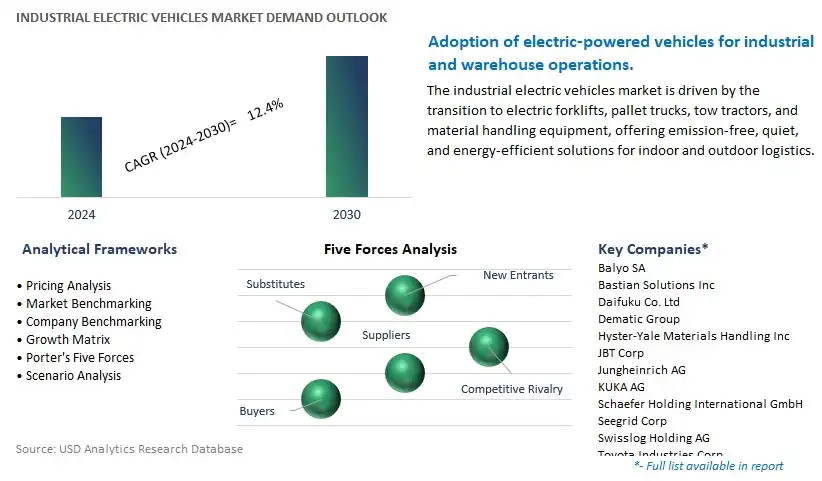
The global Industrial Electric Vehicles market is highly competitive with a large number of companies focusing on niche market segments. Amidst intense competitive conditions, Industrial Electric Vehicles Companies are investing in new product launches and strengthening distribution channels. Key companies operating in the Industrial Electric Vehicles Market Industry include- Balyo SA, Bastian Solutions Inc, Daifuku Co. Ltd, Dematic Group, Hyster-Yale Materials Handling Inc, JBT Corp, Jungheinrich AG, KUKA AG, Schaefer Holding International GmbH, Seegrid Corp, Swisslog Holding AG, Toyota Industries Corp.
The most prominent trend in the Industrial Electric Vehicles Market is the shift towards sustainable and efficient material handling solutions. With increasing emphasis on environmental sustainability and operational efficiency in industrial settings, there is a growing demand for electric vehicles for material handling tasks such as warehousing, logistics, and distribution. Industrial electric vehicles offer advantages such as zero emissions, reduced noise levels, and lower operating costs compared to traditional internal combustion engine vehicles, aligning with the sustainability goals of modern industries. This trend is driven by regulatory mandates promoting clean energy solutions, advancements in battery technology enabling longer runtime and faster charging, and the need for agile and versatile material handling equipment. As businesses prioritize sustainability and seek to optimize their operations, the market for industrial electric vehicles is witnessing significant growth and innovation, catering to the evolving needs of industrial customers worldwide.
One of the primary drivers propelling the Industrial Electric Vehicles Market is the cost savings and operational efficiency benefits offered by electric vehicles. With rising fuel costs, maintenance expenses, and regulatory compliance requirements associated with conventional internal combustion engine vehicles, industrial operators are increasingly turning to electric vehicles as a cost-effective and sustainable alternative. Electric vehicles eliminate the need for fuel and reduce maintenance requirements, resulting in lower operating costs over the vehicle's lifecycle. Additionally, electric vehicles offer advantages such as regenerative braking, precise control, and programmable performance settings, enhancing operational efficiency and productivity in material handling tasks. As businesses prioritize cost savings and seek ways to optimize their operations, the adoption of industrial electric vehicles is expected to increase, driving market growth and innovation in electric vehicle technology.
An exciting opportunity within the Industrial Electric Vehicles Market lies in the integration of autonomous driving and Internet of Things (IoT) technologies into electric vehicle designs. As industries embrace automation and digitalization to improve efficiency and safety in material handling operations, there is a growing demand for autonomous electric vehicles equipped with advanced sensing, navigation, and communication capabilities. By integrating autonomous driving technology, such as obstacle detection, path planning, and collision avoidance systems, industrial electric vehicles can operate autonomously in warehouse environments, optimizing workflow and minimizing human intervention. Moreover, leveraging IoT connectivity enables real-time monitoring, fleet management, and predictive maintenance functionalities, enhancing operational visibility and asset utilization. By embracing this opportunity, manufacturers of industrial electric vehicles can offer customers innovative solutions that improve efficiency, safety, and sustainability in material handling operations, driving market differentiation and growth in the Industrial Electric Vehicles Market.
By Product
Automated Guided Carts
Automated Tow Tractor
Autonomous Mobile Robots
Automated Guided Forklift
Geographical Analysis
North America (United States, Canada, Mexico)
Europe (Germany, France, United Kingdom, Spain, Italy, Rest of Europe)
Asia Pacific (China, India, Japan, South Korea, Rest of Asia Pacific)
South America (Brazil, Argentina, Rest of South America)
Middle East and Africa (Saudi Arabia, UAE, Rest of Middle East, South Africa, Egypt, Rest of Africa
Balyo SA
Bastian Solutions Inc
Daifuku Co. Ltd
Dematic Group
Hyster-Yale Materials Handling Inc
JBT Corp
Jungheinrich AG
KUKA AG
Schaefer Holding International GmbH
Seegrid Corp
Swisslog Holding AG
Toyota Industries Corp
*- List not Exhaustive
TABLE OF CONTENTS
1 Introduction to 2024 Industrial Electric Vehicles Market
1.1 Market Overview
1.2 Quick Facts
1.3 Scope/Objective of the Study
1.4 Market Definition
1.5 Countries and Regions Analyzed
1.6 Units, Currency, and Conversions
1.7 Industry Value Chain
2 Research Methodology
2.1 Market Size Estimation
2.2 Sources and Research Methodology
2.3 Data Triangulation
2.4 Assumptions and Limitations
3 Executive Summary
3.1 Global Industrial Electric Vehicles Market Size Outlook, $ Million, 2021 to 2030
3.2 Industrial Electric Vehicles Market Outlook by Type, $ Million, 2021 to 2030
3.3 Industrial Electric Vehicles Market Outlook by Product, $ Million, 2021 to 2030
3.4 Industrial Electric Vehicles Market Outlook by Application, $ Million, 2021 to 2030
3.5 Industrial Electric Vehicles Market Outlook by Key Countries, $ Million, 2021 to 2030
4 Market Dynamics
4.1 Key Driving Forces of Industrial Electric Vehicles Industry
4.2 Key Market Trends in Industrial Electric Vehicles Industry
4.3 Potential Opportunities in Industrial Electric Vehicles Industry
4.4 Key Challenges in Industrial Electric Vehicles Industry
5 Market Factor Analysis
5.1 Value Chain Analysis
5.2 Competitive Landscape
5.2.1 Global Industrial Electric Vehicles Market Share by Company (%), 2023
5.2.2 Product Offerings by Company
5.3 Porter’s Five Forces Analysis
5.4 Pricing Analysis and Outlook
6 Growth Outlook Across Scenarios
6.1 Growth Analysis-Case Scenario Definitions
6.2 Low Growth Scenario Forecasts
6.3 Reference Growth Scenario Forecasts
6.4 High Growth Scenario Forecasts
7 Global Industrial Electric Vehicles Market Outlook by Segments
7.1 Industrial Electric Vehicles Market Outlook by Segments, $ Million, 2021- 2030
By Product
Automated Guided Carts
Automated Tow Tractor
Autonomous Mobile Robots
Automated Guided Forklift
8 North America Industrial Electric Vehicles Market Analysis and Outlook To 2030
8.1 Introduction to North America Industrial Electric Vehicles Markets in 2024
8.2 North America Industrial Electric Vehicles Market Size Outlook by Country, 2021-2030
8.2.1 United States
8.2.2 Canada
8.2.3 Mexico
8.3 North America Industrial Electric Vehicles Market size Outlook by Segments, 2021-2030
By Product
Automated Guided Carts
Automated Tow Tractor
Autonomous Mobile Robots
Automated Guided Forklift
9 Europe Industrial Electric Vehicles Market Analysis and Outlook To 2030
9.1 Introduction to Europe Industrial Electric Vehicles Markets in 2024
9.2 Europe Industrial Electric Vehicles Market Size Outlook by Country, 2021-2030
9.2.1 Germany
9.2.2 France
9.2.3 Spain
9.2.4 United Kingdom
9.2.4 Italy
9.2.5 Russia
9.2.6 Norway
9.2.7 Rest of Europe
9.3 Europe Industrial Electric Vehicles Market Size Outlook by Segments, 2021-2030
By Product
Automated Guided Carts
Automated Tow Tractor
Autonomous Mobile Robots
Automated Guided Forklift
10 Asia Pacific Industrial Electric Vehicles Market Analysis and Outlook To 2030
10.1 Introduction to Asia Pacific Industrial Electric Vehicles Markets in 2024
10.2 Asia Pacific Industrial Electric Vehicles Market Size Outlook by Country, 2021-2030
10.2.1 China
10.2.2 India
10.2.3 Japan
10.2.4 South Korea
10.2.5 Indonesia
10.2.6 Malaysia
10.2.7 Australia
10.2.8 Rest of Asia Pacific
10.3 Asia Pacific Industrial Electric Vehicles Market size Outlook by Segments, 2021-2030
By Product
Automated Guided Carts
Automated Tow Tractor
Autonomous Mobile Robots
Automated Guided Forklift
11 South America Industrial Electric Vehicles Market Analysis and Outlook To 2030
11.1 Introduction to South America Industrial Electric Vehicles Markets in 2024
11.2 South America Industrial Electric Vehicles Market Size Outlook by Country, 2021-2030
11.2.1 Brazil
11.2.2 Argentina
11.2.3 Rest of South America
11.3 South America Industrial Electric Vehicles Market size Outlook by Segments, 2021-2030
By Product
Automated Guided Carts
Automated Tow Tractor
Autonomous Mobile Robots
Automated Guided Forklift
12 Middle East and Africa Industrial Electric Vehicles Market Analysis and Outlook To 2030
12.1 Introduction to Middle East and Africa Industrial Electric Vehicles Markets in 2024
12.2 Middle East and Africa Industrial Electric Vehicles Market Size Outlook by Country, 2021-2030
12.2.1 Saudi Arabia
12.2.2 UAE
12.2.3 Oman
12.2.4 Rest of Middle East
12.2.5 Egypt
12.2.6 Nigeria
12.2.7 South Africa
12.2.8 Rest of Africa
12.3 Middle East and Africa Industrial Electric Vehicles Market size Outlook by Segments, 2021-2030
By Product
Automated Guided Carts
Automated Tow Tractor
Autonomous Mobile Robots
Automated Guided Forklift
13 Company Profiles
13.1 Company Snapshot
13.2 SWOT Profiles
13.3 Products and Services
13.4 Recent Developments
13.5 Financial Profile
List of Companies
Balyo SA
Bastian Solutions Inc
Daifuku Co. Ltd
Dematic Group
Hyster-Yale Materials Handling Inc
JBT Corp
Jungheinrich AG
KUKA AG
Schaefer Holding International GmbH
Seegrid Corp
Swisslog Holding AG
Toyota Industries Corp
14 Appendix
14.1 Customization Offerings
14.2 Subscription Services
14.3 Related Reports
14.4 Publisher Expertise
By Product
Automated Guided Carts
Automated Tow Tractor
Autonomous Mobile Robots
Automated Guided Forklift
The global Industrial Electric Vehicles Market is one of the lucrative growth markets, poised to register a 12.4% growth (CAGR) between 2024 and 2030.
Emerging Markets across Asia Pacific, Europe, and Americas present robust growth prospects.
Balyo SA, Bastian Solutions Inc, Daifuku Co. Ltd, Dematic Group, Hyster-Yale Materials Handling Inc, JBT Corp, Jungheinrich AG, KUKA AG, Schaefer Holding International GmbH, Seegrid Corp, Swisslog Holding AG, Toyota Industries Corp
Base Year- 2023; Estimated Year- 2024; Historic Period- 2018-2023; Forecast period- 2024 to 2030; Currency: USD; Volume