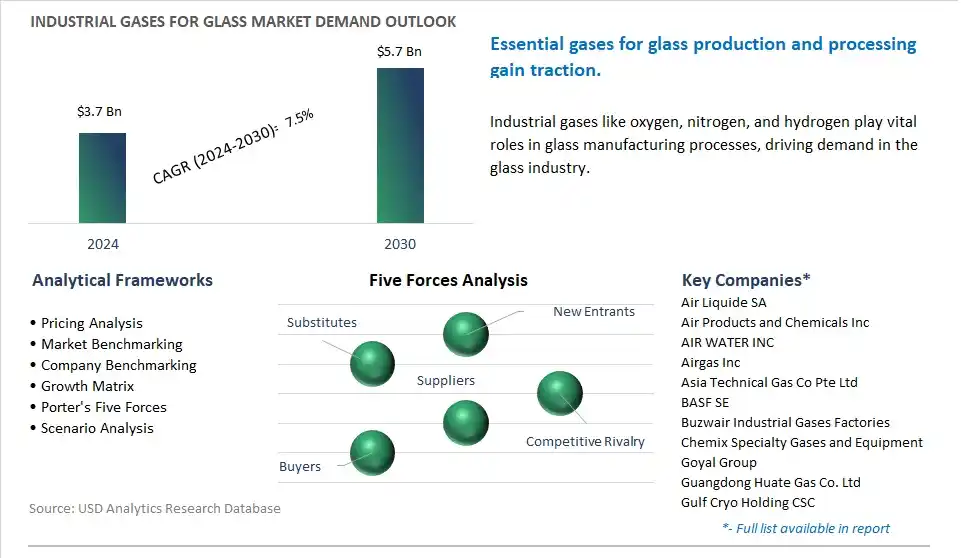
The global Industrial Gases for Glass Market is poised to register a 7.5% CAGR from $3.7 Billion in 2024 to $5.7 Billion in 2030.
The global Industrial Gases for Glass Market Study analyzes and forecasts the market size across 6 regions and 24 countries for diverse segments -By End-User (Manufacturing, Chemical processing, Metal fabrication, Energy, Others), By Type (Hydrogen, Oxygen, Nitrogen, Carbon dioxide, Others).
An Introduction to Global Industrial Gases for Glass Market in 2024
The future of industrial gases for the glass industry is shaped by several key trends, including increasing demand for specialty gases in glass manufacturing processes such as melting, forming, and annealing, advancements in gas production and delivery technologies, and growing emphasis on energy efficiency, product quality, and environmental sustainability. Industrial gases play a critical role in various stages of glass production, including oxygen for combustion and melting, nitrogen for inert atmosphere and annealing, and hydrogen for fuel substitution and glass forming. With the rise of energy costs, emission regulations, and product performance requirements, there's a growing need for industrial gases that offer precise composition control, high purity, and consistency while minimizing environmental impact and operational costs. Moreover, advancements in gas purification methods, cryogenic distillation, and gas blending techniques are driving the development of next-generation gas products with improved efficiency, safety, and reliability. Additionally, the integration of gas management systems, process optimization tools, and predictive analytics is enhancing gas utilization and production efficiency in glass manufacturing operations. Collaboration between gas suppliers, glass manufacturers, equipment vendors, and research institutions is essential to drive innovation, ensure gas quality, and address evolving industry needs in the industrial gases for glass market.
Industrial Gases for Glass Market Competitive Landscape
The market report analyses the leading companies in the industry including Air Liquide SA, Air Products and Chemicals Inc, AIR WATER INC, Airgas Inc, Asia Technical Gas Co Pte Ltd, BASF SE, Buzwair Industrial Gases Factories, Chemix Specialty Gases and Equipment, Goyal Group, Guangdong Huate Gas Co. Ltd, Gulf Cryo Holding CSC, Iwatani Corp, Linde Plc, Messer SE and Co. KGaA, Norco Inc, Praxair Technology Inc, SOL Spa, Taiyo Nippon Sanso Corp, Wesfarmers Ltd, Yingde Gas Group Co. Ltd.
Industrial Gases for Glass Market Dynamics
Industrial Gases for Glass Market Trend: Growing Demand for Specialty Gases for Glass Manufacturing
One prominent market trend in the industrial gases for glass industry is the growing demand for specialty gases tailored to glass manufacturing processes. As glass production techniques become more advanced and specialized, there's an increasing need for precise gas compositions and purities to achieve desired glass properties such as clarity, strength, and thermal resistance. Specialty gases such as oxygen, nitrogen, hydrogen, and argon play critical roles in various stages of glass production, including melting, forming, annealing, and coating. Additionally, the glass industry's shift towards environmentally friendly and energy-efficient manufacturing processes has led to increased demand for industrial gases that enable cleaner combustion and reduced emissions. This trend is driving market growth and innovation in specialty gas formulations and delivery systems optimized for glass manufacturing applications.
Industrial Gases for Glass Market Driver: Advancements in Glass Manufacturing Technologies and Processes
A significant driver propelling the growth of the industrial gases for glass market is the advancements in glass manufacturing technologies and processes. The glass industry is continuously evolving to meet the demands of diverse applications such as automotive, construction, electronics, and packaging, driving the need for innovative manufacturing techniques that offer improved product quality, efficiency, and sustainability. Advanced glass manufacturing processes such as float glass, glass fiber production, and specialty glass fabrication require precise control of gas atmospheres and temperatures to achieve desired glass properties and performance characteristics. Industrial gases play a vital role in these processes by providing heat transfer, inerting, oxidation control, and atmosphere modification functions. The continuous development of glass manufacturing technologies creates opportunities for industrial gas suppliers to collaborate with glass manufacturers, optimize gas usage, and develop customized gas solutions that meet the evolving needs of the glass industry.
Industrial Gases for Glass Market Opportunity: Integration of Digitalization and IoT for Gas Monitoring and Control
An emerging opportunity for the industrial gases for glass market lies in the integration of digitalization and Internet of Things (IoT) technologies for gas monitoring and control. With the rise of Industry 4.0 and smart manufacturing concepts, there's increasing interest in leveraging digital technologies to enhance process automation, efficiency, and safety in industrial gas applications. Manufacturers of industrial gases can seize this opportunity by developing IoT-enabled gas monitoring and control systems that provide real-time data on gas usage, quality, and emissions. These systems can offer predictive maintenance capabilities, remote monitoring, and automatic adjustments to gas flow rates and compositions based on process conditions and quality requirements. By offering digital solutions that improve process visibility, optimize gas utilization, and enhance safety in glass manufacturing operations, industrial gas suppliers can add value to their offerings, differentiate themselves in the market, and strengthen customer relationships. This opportunity enables industrial gas suppliers to position themselves as technology partners to glass manufacturers, driving market growth and competitiveness in the digital era.
Industrial Gases for Glass Market Share Analysis: The manufacturing segment generated the highest revenue in 2024
The largest segment in the Industrial Gases for Glass Market is the manufacturing sector. The manufacturing sector encompasses a wide range of industries, including glass manufacturing, which relies heavily on industrial gases for various processes such as melting, refining, forming, and annealing. Glass manufacturing involves the use of industrial gases such as oxygen, nitrogen, hydrogen, and argon in furnaces and annealing lehrs to control temperature, atmosphere, and chemical reactions during glass production. Additionally, industrial gases play a crucial role in ensuring product quality, consistency, and efficiency in glass manufacturing processes. Further, the increasing demand for glass products in construction, automotive, packaging, and consumer electronics industries drives the growth of the manufacturing sector and, consequently, the demand for industrial gases for glass production. Furthermore, advancements in glass manufacturing technologies and increasing emphasis on energy efficiency and sustainability further fuel the adoption of industrial gases to optimize process efficiency, reduce emissions, and minimize environmental impact in the manufacturing sector. Over the forecast period, the manufacturing sector represents the largest segment in the Industrial Gases for Glass Market due to its significant and diverse applications in glass production processes.
Industrial Gases for Glass Market Share Analysis: The oxygen segment is poised to register the fastest growth rate (CAGR) over the forecast period to 2030
The fastest-growing segment in the Industrial Gases for Glass Market is the oxygen segment. oxygen plays a crucial role in the glass manufacturing process, particularly in the melting and refining stages. Oxygen-enriched combustion in glass furnaces enhances combustion efficiency, increases melting rates, and reduces fuel consumption, leading to energy savings and improved productivity. Additionally, oxygen is used in the oxy-fuel combustion process, where it replaces air as the oxidizer, resulting in higher flame temperatures and improved heat transfer, which is beneficial for melting glass batch materials. Further, the use of oxygen in glass manufacturing helps to achieve higher quality glass with reduced impurities and improved optical properties. Furthermore, advancements in oxygen production technologies, such as cryogenic distillation and pressure swing adsorption, have made oxygen more readily available and cost-effective for industrial applications, further driving its adoption in the glass manufacturing industry. Over the forecast period, the oxygen segment presents significant growth opportunities in the Industrial Gases for Glass Market due to its critical role in optimizing glass production processes, enhancing efficiency, and improving product quality.
Industrial Gases for Glass Market Report Segmentation
By End-User
Manufacturing
Chemical processing
Metal fabrication
Energy
Others
By Type
Hydrogen
Oxygen
Nitrogen
Carbon dioxide
Others
Regions Included
North America (US, Canada, Mexico)
Europe (Germany, UK, France, Spain, Italy, Russia, Rest of Europe)
Asia Pacific (China, India, Japan, South Korea, Australia, South East Asia, Rest of Asia)
South America (Brazil, Argentina, Rest of South America)
Middle East and Africa (Saudi Arabia, UAE, Rest of Middle East, South Africa, Egypt, Rest of Africa)
Industrial Gases for Glass Companies Profiled in the Market Study
Air Liquide SA
Air Products and Chemicals Inc
AIR WATER INC
Airgas Inc
Asia Technical Gas Co Pte Ltd
BASF SE
Buzwair Industrial Gases Factories
Chemix Specialty Gases and Equipment
Goyal Group
Guangdong Huate Gas Co. Ltd
Gulf Cryo Holding CSC
Iwatani Corp
Linde Plc
Messer SE and Co. KGaA
Norco Inc
Praxair Technology Inc
SOL Spa
Taiyo Nippon Sanso Corp
Wesfarmers Ltd
Yingde Gas Group Co. Ltd
*- List Not Exhaustive
TABLE OF CONTENTS
1 Introduction to 2024 Industrial Gases for Glass Market
1.1 Market Overview
1.2 Quick Facts
1.3 Scope/Objective of the Study
1.4 Market Definition
1.5 Countries and Regions Covered
1.6 Units, Currency, and Conversions
1.7 Industry Value Chain
2 Research Methodology
2.1 Market Size Estimation
2.2 Sources and Research Methodology
2.3 Data Triangulation
2.4 Assumptions and Limitations
3 Executive Summary
3.1 Global Industrial Gases for Glass Market Size Outlook, $ Million, 2021 to 2030
3.2 Industrial Gases for Glass Market Outlook by Type, $ Million, 2021 to 2030
3.3 Industrial Gases for Glass Market Outlook by Product, $ Million, 2021 to 2030
3.4 Industrial Gases for Glass Market Outlook by Application, $ Million, 2021 to 2030
3.5 Industrial Gases for Glass Market Outlook by Key Countries, $ Million, 2021 to 2030
4 Market Dynamics
4.1 Key Driving Forces of Industrial Gases for Glass Industry
4.2 Key Market Trends in Industrial Gases for Glass Industry
4.3 Potential Opportunities in Industrial Gases for Glass Industry
4.4 Key Challenges in Industrial Gases for Glass Industry
5 Market Factor Analysis
5.1 Value Chain Analysis
5.2 Competitive Landscape
5.2.1 Global Industrial Gases for Glass Market Share by Company (%), 2023
5.2.2 Product Offerings by Company
5.3 Porter’s Five Forces Analysis
5.4 Pricing Analysis and Outlook
6 Growth Outlook Across Scenarios
6.1 Growth Analysis-Case Scenario Definitions
6.2 Low Growth Scenario Forecasts
6.3 Reference Growth Scenario Forecasts
6.4 High Growth Scenario Forecasts
7 Global Industrial Gases for Glass Market Outlook by Segments
7.1 Industrial Gases for Glass Market Outlook by Segments, $ Million, 2021- 2030
By End-User
Manufacturing
Chemical processing
Metal fabrication
Energy
Others
By Type
Hydrogen
Oxygen
Nitrogen
Carbon dioxide
Others
8 North America Industrial Gases for Glass Market Analysis and Outlook To 2030
8.1 Introduction to North America Industrial Gases for Glass Markets in 2024
8.2 North America Industrial Gases for Glass Market Size Outlook by Country, 2021-2030
8.2.1 United States
8.2.2 Canada
8.2.3 Mexico
8.3 North America Industrial Gases for Glass Market size Outlook by Segments, 2021-2030
By End-User
Manufacturing
Chemical processing
Metal fabrication
Energy
Others
By Type
Hydrogen
Oxygen
Nitrogen
Carbon dioxide
Others
9 Europe Industrial Gases for Glass Market Analysis and Outlook To 2030
9.1 Introduction to Europe Industrial Gases for Glass Markets in 2024
9.2 Europe Industrial Gases for Glass Market Size Outlook by Country, 2021-2030
9.2.1 Germany
9.2.2 France
9.2.3 Spain
9.2.4 United Kingdom
9.2.4 Italy
9.2.5 Russia
9.2.6 Norway
9.2.7 Rest of Europe
9.3 Europe Industrial Gases for Glass Market Size Outlook by Segments, 2021-2030
By End-User
Manufacturing
Chemical processing
Metal fabrication
Energy
Others
By Type
Hydrogen
Oxygen
Nitrogen
Carbon dioxide
Others
10 Asia Pacific Industrial Gases for Glass Market Analysis and Outlook To 2030
10.1 Introduction to Asia Pacific Industrial Gases for Glass Markets in 2024
10.2 Asia Pacific Industrial Gases for Glass Market Size Outlook by Country, 2021-2030
10.2.1 China
10.2.2 India
10.2.3 Japan
10.2.4 South Korea
10.2.5 Indonesia
10.2.6 Malaysia
10.2.7 Australia
10.2.8 Rest of Asia Pacific
10.3 Asia Pacific Industrial Gases for Glass Market size Outlook by Segments, 2021-2030
By End-User
Manufacturing
Chemical processing
Metal fabrication
Energy
Others
By Type
Hydrogen
Oxygen
Nitrogen
Carbon dioxide
Others
11 South America Industrial Gases for Glass Market Analysis and Outlook To 2030
11.1 Introduction to South America Industrial Gases for Glass Markets in 2024
11.2 South America Industrial Gases for Glass Market Size Outlook by Country, 2021-2030
11.2.1 Brazil
11.2.2 Argentina
11.2.3 Rest of South America
11.3 South America Industrial Gases for Glass Market size Outlook by Segments, 2021-2030
By End-User
Manufacturing
Chemical processing
Metal fabrication
Energy
Others
By Type
Hydrogen
Oxygen
Nitrogen
Carbon dioxide
Others
12 Middle East and Africa Industrial Gases for Glass Market Analysis and Outlook To 2030
12.1 Introduction to Middle East and Africa Industrial Gases for Glass Markets in 2024
12.2 Middle East and Africa Industrial Gases for Glass Market Size Outlook by Country, 2021-2030
12.2.1 Saudi Arabia
12.2.2 UAE
12.2.3 Oman
12.2.4 Rest of Middle East
12.2.5 Egypt
12.2.6 Nigeria
12.2.7 South Africa
12.2.8 Rest of Africa
12.3 Middle East and Africa Industrial Gases for Glass Market size Outlook by Segments, 2021-2030
By End-User
Manufacturing
Chemical processing
Metal fabrication
Energy
Others
By Type
Hydrogen
Oxygen
Nitrogen
Carbon dioxide
Others
13 Company Profiles
13.1 Company Snapshot
13.2 SWOT Profiles
13.3 Products and Services
13.4 Recent Developments
13.5 Financial Profile
Air Liquide SA
Air Products and Chemicals Inc
AIR WATER INC
Airgas Inc
Asia Technical Gas Co Pte Ltd
BASF SE
Buzwair Industrial Gases Factories
Chemix Specialty Gases and Equipment
Goyal Group
Guangdong Huate Gas Co. Ltd
Gulf Cryo Holding CSC
Iwatani Corp
Linde Plc
Messer SE and Co. KGaA
Norco Inc
Praxair Technology Inc
SOL Spa
Taiyo Nippon Sanso Corp
Wesfarmers Ltd
Yingde Gas Group Co. Ltd
14 Appendix
14.1 Customization Offerings
14.2 Subscription Services
14.3 Related Reports
14.4 Publisher Expertise
By End-User
Manufacturing
Chemical processing
Metal fabrication
Energy
Others
By Type
Hydrogen
Oxygen
Nitrogen
Carbon dioxide
Others
Countries Analyzed
North America (US, Canada, Mexico)
Europe (Germany, UK, France, Spain, Italy, Russia, Rest of Europe)
Asia Pacific (China, India, Japan, South Korea, Australia, South East Asia, Rest of Asia)
South America (Brazil, Argentina, Rest of South America)
Middle East and Africa (Saudi Arabia, UAE, Rest of Middle East, South Africa, Egypt, Rest of Africa)
