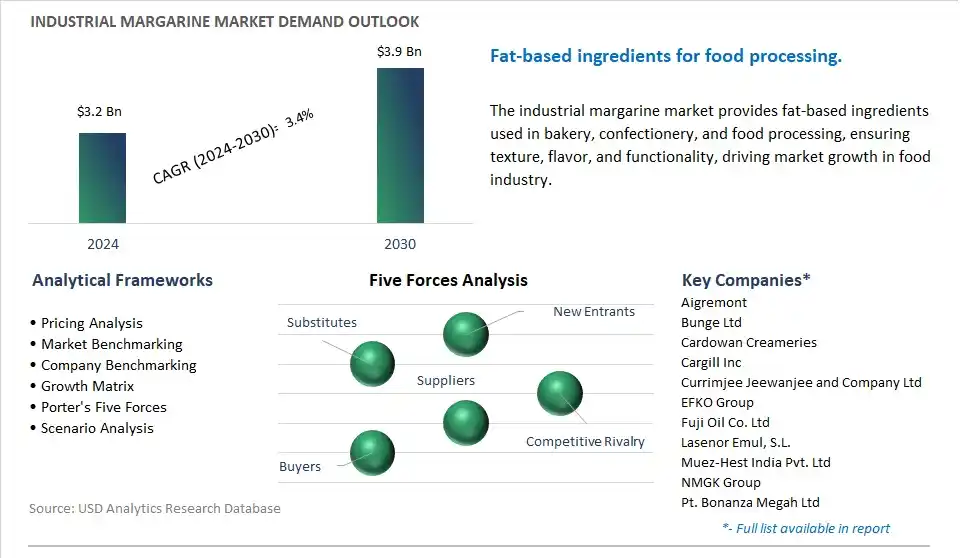
The global Industrial Margarine Market is poised to register a 3.4% CAGR from $3.2 Billion in 2024 to $3.9 Billion in 2030.
The global Industrial Margarine Market Study analyzes and forecasts the market size across 6 regions and 24 countries for diverse segments -By Type (Spreadable, All-Purpose, Butter Blend), By Form (Hard, Soft), By Source (Animal Source, Plant Source), By Application (Bakery, Spreads, Sauces, Toppings, Confectionery, Convenience Food, Others).
An Introduction to Global Industrial Margarine Market in 2024
Industrial margarine is a versatile fat-based product used in food processing and manufacturing industries for its functionality, versatility, and cost-effectiveness in various applications such as baking, confectionery, and foodservice. One key trend shaping the future of industrial margarine is the demand for healthier and sustainable alternatives to traditional margarine formulations, driven by consumer preferences for clean-label, plant-based, and reduced-fat products. Margarine manufacturers are reformulating their products with healthier oils, such as olive oil, sunflower oil, and coconut oil, to reduce saturated fat content and improve nutritional profiles, meeting regulatory requirements and consumer expectations for healthier food options. Additionally, advancements in margarine processing technologies, such as enzymatic interesterification, microencapsulation, and emulsion stabilization, are improving product texture, spreadability, and shelf stability, enhancing functionality and performance in various food applications while minimizing trans-fat content and processing-related contaminants. Moreover, the integration of sustainable sourcing practices, such as certified palm oil, RSPO (Roundtable on Sustainable Palm Oil) certification, and traceability systems, is ensuring ethical and environmentally responsible production of margarine ingredients, supporting sustainable agriculture and biodiversity conservation initiatives. As food manufacturers seek to innovate and adapt to changing consumer preferences and regulatory landscapes, the industrial margarine industry is poised for innovation and growth, with opportunities for collaboration, research, and market expansion to meet the evolving needs of manufacturers, foodservice providers, and consumers.
Industrial Margarine Market Competitive Landscape
The market report analyses the leading companies in the industry including Aigremont, Bunge Ltd, Cardowan Creameries, Cargill Inc, Currimjee Jeewanjee and Company Ltd, EFKO Group, Fuji Oil Co. Ltd, Lasenor Emul, S.L., Muez-Hest India Pvt. Ltd, NMGK Group, Pt. Bonanza Megah Ltd, Puratos NV, Richardson International Ltd, Royale Lacroix Sa, Silverson Machines Ltd, Sime Darby Oils Zwijndrecht Refinery B.V., Vandemoortele NV, Wilmar International Ltd.
Industrial Margarine Market Dynamics
Industrial Margarine Market Trend: Shift Towards Plant-Based and Health-Conscious Products
A significant trend shaping the industrial margarine market is the increasing consumer preference for plant-based and health-conscious products. As awareness of the environmental impact of animal agriculture grows, along with concerns about health and wellness, consumers are seeking alternatives to traditional animal-derived margarine. This shift is driving manufacturers to innovate and develop plant-based margarine formulations using ingredients such as vegetable oils, nuts, and seeds. Additionally, there is a growing demand for margarine products that are free from trans fats, hydrogenated oils, and other unhealthy additives, reflecting the evolving dietary preferences of health-conscious consumers. Manufacturers who can adapt to The trend by offering healthier, plant-based alternatives are poised to gain a competitive advantage in the industrial margarine market.
Industrial Margarine Market Driver: Expansion in the Food Processing Industry
A key driver fueling the industrial margarine market is the expansion of the food processing industry, particularly in emerging economies. As urbanization and disposable incomes rise, there is a growing demand for processed food products, including baked goods, confectionery, and convenience foods, which rely heavily on margarine as a key ingredient. Furthermore, the increasing prevalence of bakery chains, fast-food outlets, and foodservice establishments worldwide is driving the demand for industrial margarine for commercial baking and cooking applications. This surge in demand from the food processing sector is incentivizing margarine manufacturers to expand their production capacities, enhance their product portfolios, and explore new market opportunities, driving the overall growth of the industrial margarine market.
Industrial Margarine Market Opportunity: Innovation in Functional and Specialty Margarine Products
An emerging opportunity in the industrial margarine market lies in the innovation and development of functional and specialty margarine products. With changing consumer preferences and evolving dietary trends, there is a growing demand for margarine formulations that offer additional functional benefits beyond basic fat content. This includes margarines enriched with vitamins, omega-3 fatty acids, and other nutritional additives to cater to specific health needs. Moreover, there is a rising demand for specialty margarine products tailored for specific applications, such as pastry margarine for laminated doughs or sprayable margarine for industrial food processing. By investing in research and development to create innovative and differentiated margarine products that meet the evolving needs of consumers and food manufacturers, companies can unlock new market segments and drive growth in the industrial margarine industry.
Industrial Margarine Market Ecosystem
The industrial margarine market operates through distinct stages involving various companies specialized in different aspects of the Market Ecosystem. Raw material acquisition begins with sourcing and refining vegetable oils including palm oil, soybean oil, or canola oil, led by vegetable oil refiners including Archer Daniels Midland Company and Cargill. Dairy processors including Fonterra Co-operative Group and Dairy Farmers of America Inc. also supply milk fat or buttermilk for specific margarine formulations. Processing and manufacturing are characterized by the presence of industrial margarine producers including Upfield and Bunge Limited, which manufacture various types of margarine with specific functionalities for different food applications. Shortening and fat blending companies including Ingredion Incorporated and Fuji Oil Co., Ltd. also produce industrial margarine as part of their broader fat product portfolio.
Distribution channels include food ingredient distributors including Ingram Foodservice Holdings Inc. and Sysco Corporation, distributing industrial margarine and other food ingredients to food manufacturers and bakeries. Large industrial margarine producers manage direct sales through dedicated sales teams targeting specific food industry segments, offering customized solutions. End-users across various industries benefit from industrial margarine's functional properties, including the bakery industry, where margarine is used in cakes, cookies, pastries, and bread to improve dough handling, texture, and shelf life.
Industrial Margarine Market Share Analysis: All-Purpose held the dominant revenue share in 2024
The all-purpose segment is the largest sector in the Industrial Margarine Market, driven by diverse pivotal factors contributing to its dominance. All-purpose margarine offers versatility and flexibility in various culinary and industrial applications, making it a preferred choice for manufacturers in the food processing industry. With its ability to mimic the taste and texture of butter while offering superior shelf stability and cost-effectiveness, all-purpose margarine finds extensive use in bakery, confectionery, and foodservice sectors. In addition, the growing consumer demand for healthier alternatives to traditional butter and the increasing adoption of plant-based diets further drive the demand for all-purpose margarine, which often contains plant-based oils as key ingredients. Additionally, the all-purpose margarine segment benefits from technological advancements in margarine production, such as the development of trans-fat-free formulations and innovative packaging solutions, catering to changing consumer preferences and regulatory requirements. As food manufacturers seek versatile ingredients that enhance product quality and reduce costs, the all-purpose margarine segment of the industrial market is expected to maintain its leading position and witness sustained growth in the coming years.
Industrial Margarine Market Share Analysis: Soft is the fastest growing market segment over the forecast period to 2030
The soft margarine segment is the fastest-growing sector in the Industrial Margarine Market, driven by diverse critical factors propelling its rapid expansion. Soft margarine offers diverse advantages over hard margarine, including easier spreadability, enhanced versatility in culinary applications, and a more appealing texture. With the increasing consumer demand for convenience and healthier food options, soft margarine finds extensive use in bakery products, spreads, and cooking applications. In addition, the growing preference for plant-based and dairy-free alternatives fuels the demand for soft margarine formulations made from vegetable oils, catering to the needs of health-conscious consumers. Additionally, advancements in food processing technology have led to the development of soft margarine formulations with improved taste, texture, and nutritional profiles, further driving their adoption in the food industry. Further, the expanding global foodservice sector and the rising popularity of ready-to-eat and convenience foods contribute to the growing demand for soft margarine as a versatile ingredient in food manufacturing. As consumer preferences continue to evolve toward healthier and more convenient options, the soft margarine segment of the industrial market is poised for significant growth, presenting lucrative opportunities for industry stakeholders.
Industrial Margarine Market Share Analysis: Plant Source is the fastest growing market segment over the forecast period to 2030
The plant source segment is the fastest-growing sector in the Industrial Margarine Market, driven by diverse pivotal factors contributing to its rapid expansion. Plant-based margarine offers numerous advantages over animal-based counterparts, including environmental sustainability, health benefits, and ethical considerations. With the increasing consumer awareness of sustainability issues and the environmental impact of food production, there's a rising demand for plant-based alternatives to traditional animal-derived ingredients. Plant-based margarine, derived from oils such as soybean, palm, and sunflower, aligns with the growing trend toward plant-based diets and vegan lifestyles. In addition, plant-based margarine offers health benefits such as lower cholesterol levels and reduced saturated fat content, appealing to health-conscious consumers seeking healthier alternatives to traditional butter and margarine. Additionally, the expanding market for plant-based products in the food industry, including dairy alternatives and meat substitutes, drives the demand for plant-based margarine formulations as a versatile ingredient in various food applications. Further, advancements in plant-based technology and ingredient sourcing further enhance the taste, texture, and nutritional profiles of plant-based margarine products, contributing to their growing popularity among consumers. As the shift toward plant-based eating continues to accelerate, driven by environmental, health, and ethical considerations, the plant source segment of the industrial margarine market is expected to witness significant growth, presenting lucrative opportunities for industry stakeholders.
Industrial Margarine Market Report Scope-
By Type
Spreadable
All-Purpose
Butter Blend
By Form
Hard
Soft
By Source
Animal Source
Plant Source
By Application
Bakery
Spreads
Sauces
Toppings
Confectionery
Convenience Food
Others
Industrial Margarine Market Companies Profiled
Aigremont
Bunge Ltd
Cardowan Creameries
Cargill Inc
Currimjee Jeewanjee and Company Ltd
EFKO Group
Fuji Oil Co. Ltd
Lasenor Emul, S.L.
Muez-Hest India Pvt. Ltd
NMGK Group
Pt. Bonanza Megah Ltd
Puratos NV
Richardson International Ltd
Royale Lacroix Sa
Silverson Machines Ltd
Sime Darby Oils Zwijndrecht Refinery B.V.
Vandemoortele NV
Wilmar International Ltd
*- List Not Exhaustive
TABLE OF CONTENTS
1 Introduction to 2024 Industrial Margarine Market
1.1 Market Overview
1.2 Quick Facts
1.3 Scope/Objective of the Study
1.4 Market Definition
1.5 Countries and Regions Covered
1.6 Units, Currency, and Conversions
1.7 Industry Value Chain
2 Research Methodology
2.1 Market Size Estimation
2.2 Sources and Research Methodology
2.3 Data Triangulation
2.4 Assumptions and Limitations
3 Executive Summary
3.1 Global Industrial Margarine Market Size Outlook, $ Million, 2021 to 2030
3.2 Industrial Margarine Market Outlook by Type, $ Million, 2021 to 2030
3.3 Industrial Margarine Market Outlook by Product, $ Million, 2021 to 2030
3.4 Industrial Margarine Market Outlook by Application, $ Million, 2021 to 2030
3.5 Industrial Margarine Market Outlook by Key Countries, $ Million, 2021 to 2030
4 Market Dynamics
4.1 Key Driving Forces of Industrial Margarine Industry
4.2 Key Market Trends in Industrial Margarine Industry
4.3 Potential Opportunities in Industrial Margarine Industry
4.4 Key Challenges in Industrial Margarine Industry
5 Market Factor Analysis
5.1 Value Chain Analysis
5.2 Competitive Landscape
5.2.1 Global Industrial Margarine Market Share by Company (%), 2023
5.2.2 Product Offerings by Company
5.3 Porter’s Five Forces Analysis
5.4 Pricing Analysis and Outlook
6 Growth Outlook Across Scenarios
6.1 Growth Analysis-Case Scenario Definitions
6.2 Low Growth Scenario Forecasts
6.3 Reference Growth Scenario Forecasts
6.4 High Growth Scenario Forecasts
7 Global Industrial Margarine Market Outlook by Segments
7.1 Industrial Margarine Market Outlook by Segments, $ Million, 2021- 2030
By Type
Spreadable
All-Purpose
Butter Blend
By Form
Hard
Soft
By Source
Animal Source
Plant Source
By Application
Bakery
Spreads
Sauces
Toppings
Confectionery
Convenience Food
Others
8 North America Industrial Margarine Market Analysis and Outlook To 2030
8.1 Introduction to North America Industrial Margarine Markets in 2024
8.2 North America Industrial Margarine Market Size Outlook by Country, 2021-2030
8.2.1 United States
8.2.2 Canada
8.2.3 Mexico
8.3 North America Industrial Margarine Market size Outlook by Segments, 2021-2030
By Type
Spreadable
All-Purpose
Butter Blend
By Form
Hard
Soft
By Source
Animal Source
Plant Source
By Application
Bakery
Spreads
Sauces
Toppings
Confectionery
Convenience Food
Others
9 Europe Industrial Margarine Market Analysis and Outlook To 2030
9.1 Introduction to Europe Industrial Margarine Markets in 2024
9.2 Europe Industrial Margarine Market Size Outlook by Country, 2021-2030
9.2.1 Germany
9.2.2 France
9.2.3 Spain
9.2.4 United Kingdom
9.2.4 Italy
9.2.5 Russia
9.2.6 Norway
9.2.7 Rest of Europe
9.3 Europe Industrial Margarine Market Size Outlook by Segments, 2021-2030
By Type
Spreadable
All-Purpose
Butter Blend
By Form
Hard
Soft
By Source
Animal Source
Plant Source
By Application
Bakery
Spreads
Sauces
Toppings
Confectionery
Convenience Food
Others
10 Asia Pacific Industrial Margarine Market Analysis and Outlook To 2030
10.1 Introduction to Asia Pacific Industrial Margarine Markets in 2024
10.2 Asia Pacific Industrial Margarine Market Size Outlook by Country, 2021-2030
10.2.1 China
10.2.2 India
10.2.3 Japan
10.2.4 South Korea
10.2.5 Indonesia
10.2.6 Malaysia
10.2.7 Australia
10.2.8 Rest of Asia Pacific
10.3 Asia Pacific Industrial Margarine Market size Outlook by Segments, 2021-2030
By Type
Spreadable
All-Purpose
Butter Blend
By Form
Hard
Soft
By Source
Animal Source
Plant Source
By Application
Bakery
Spreads
Sauces
Toppings
Confectionery
Convenience Food
Others
11 South America Industrial Margarine Market Analysis and Outlook To 2030
11.1 Introduction to South America Industrial Margarine Markets in 2024
11.2 South America Industrial Margarine Market Size Outlook by Country, 2021-2030
11.2.1 Brazil
11.2.2 Argentina
11.2.3 Rest of South America
11.3 South America Industrial Margarine Market size Outlook by Segments, 2021-2030
By Type
Spreadable
All-Purpose
Butter Blend
By Form
Hard
Soft
By Source
Animal Source
Plant Source
By Application
Bakery
Spreads
Sauces
Toppings
Confectionery
Convenience Food
Others
12 Middle East and Africa Industrial Margarine Market Analysis and Outlook To 2030
12.1 Introduction to Middle East and Africa Industrial Margarine Markets in 2024
12.2 Middle East and Africa Industrial Margarine Market Size Outlook by Country, 2021-2030
12.2.1 Saudi Arabia
12.2.2 UAE
12.2.3 Oman
12.2.4 Rest of Middle East
12.2.5 Egypt
12.2.6 Nigeria
12.2.7 South Africa
12.2.8 Rest of Africa
12.3 Middle East and Africa Industrial Margarine Market size Outlook by Segments, 2021-2030
By Type
Spreadable
All-Purpose
Butter Blend
By Form
Hard
Soft
By Source
Animal Source
Plant Source
By Application
Bakery
Spreads
Sauces
Toppings
Confectionery
Convenience Food
Others
13 Company Profiles
13.1 Company Snapshot
13.2 SWOT Profiles
13.3 Products and Services
13.4 Recent Developments
13.5 Financial Profile
Aigremont
Bunge Ltd
Cardowan Creameries
Cargill Inc
Currimjee Jeewanjee and Company Ltd
EFKO Group
Fuji Oil Co. Ltd
Lasenor Emul, S.L.
Muez-Hest India Pvt. Ltd
NMGK Group
Pt. Bonanza Megah Ltd
Puratos NV
Richardson International Ltd
Royale Lacroix Sa
Silverson Machines Ltd
Sime Darby Oils Zwijndrecht Refinery B.V.
Vandemoortele NV
Wilmar International Ltd
14 Appendix
14.1 Customization Offerings
14.2 Subscription Services
14.3 Related Reports
14.4 Publisher Expertise
By Type
Spreadable
All-Purpose
Butter Blend
By Form
Hard
Soft
By Source
Animal Source
Plant Source
By Application
Bakery
Spreads
Sauces
Toppings
Confectionery
Convenience Food
Others
Countries Analyzed
North America (US, Canada, Mexico)
Europe (Germany, UK, France, Spain, Italy, Russia, Rest of Europe)
Asia Pacific (China, India, Japan, South Korea, Australia, South East Asia, Rest of Asia)
South America (Brazil, Argentina, Rest of South America)
Middle East and Africa (Saudi Arabia, UAE, Rest of Middle East, South Africa, Egypt, Rest of Africa)
