Industrial OT Cybersecurity Market Overview: ICS Protection, Industrial Network Security and Commercial Demand
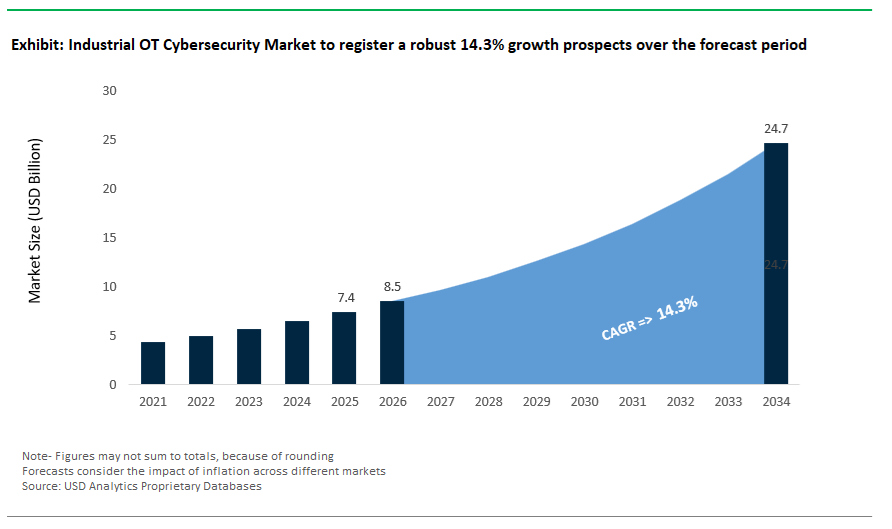
The global Industrial OT Cybersecurity Market is valued at USD 8,506.0 million in 2026 and is projected to reach USD 24,799.1 million by 2034, registering a CAGR of 14.3% during the forecast period. The market supplies cybersecurity hardware, software platforms, managed security services, and engineering support for protecting operational technology (OT), industrial control systems (ICS), and connected production infrastructure. Core solutions include OT asset discovery, industrial network monitoring, intrusion detection, network segmentation, secure remote access, vulnerability management, and incident-response services. Demand is concentrated among manufacturing plants, electric utilities, oil and gas operators, chemical processing facilities, water infrastructure, and other industrial enterprises where a cyber incident can interrupt physical operations, compromise process integrity, or affect critical equipment availability.
Commercial demand is converting into revenue through industrial cybersecurity platform subscriptions, network-security appliance purchases, software licensing, site-level integration contracts, and recurring managed detection and response services. Large industrial operators increasingly require coverage across multiple production facilities, remote engineering stations, programmable logic controllers (PLCs), distributed control systems (DCS), supervisory control and data acquisition (SCADA) networks, and industrial IoT endpoints. These requirements create purchasing opportunities for specialized OT cybersecurity vendors, industrial automation manufacturers, network-security providers, and system integrators. Multi-site deployments generate expenditure on asset identification, passive network monitoring, security architecture implementation, threat intelligence, vulnerability assessments, and continuing technical support, while managed OT security contracts introduce recurring revenue beyond initial system deployment.
Commercial value in the Industrial OT Cybersecurity Market is determined by the scope of protected industrial assets, operational compatibility, detection accuracy, deployment complexity, and continuity of cybersecurity coverage throughout equipment lifecycles. Buyers assess solutions against production downtime exposure, integration with legacy automation systems, engineering-resource requirements, and the ability to distinguish malicious activity from legitimate industrial communications. OT-specific protocol visibility, vendor-neutral asset monitoring, risk prioritization based on physical process criticality, and controlled third-party maintenance access are important differentiators. Procurement economics also vary between enterprise-wide security platforms, facility-specific monitoring systems, and outsourced OT security operations, with the total cost of ownership influenced by the number of industrial sites, network architecture, licensing structure, and ongoing incident-response capabilities.
Key Insights
- Market Size and Growth: Valued at USD 8,506.0 million in 2026, the market is projected to reach USD 24,799.1 million by 2034, expanding at a CAGR of 14.3%.
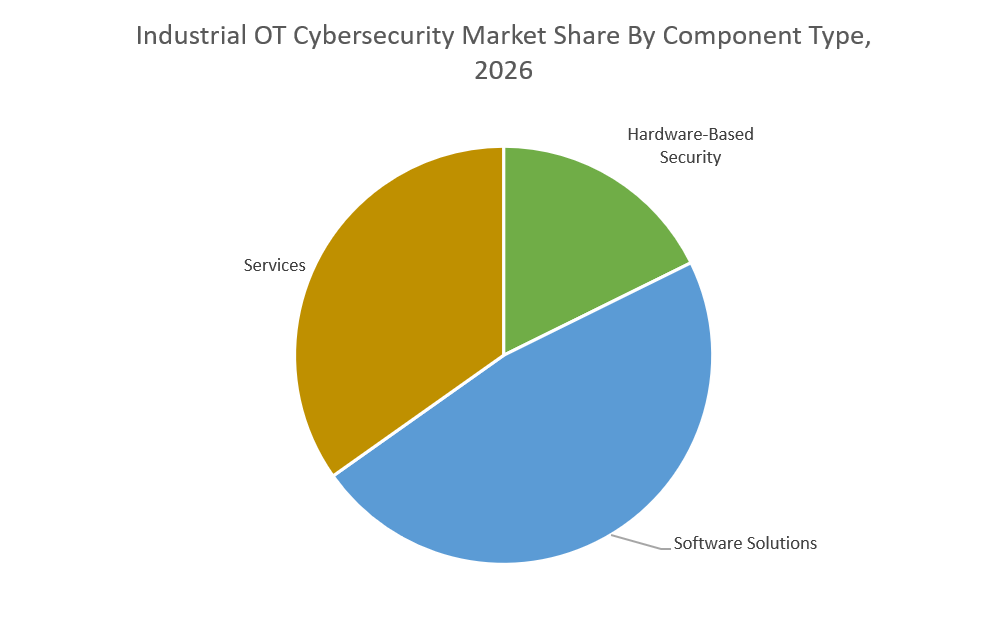
- Leading Component: Software Solutions dominate with a 47.5% market share in 2026, supported by OT asset discovery, industrial threat detection, and network security platforms.
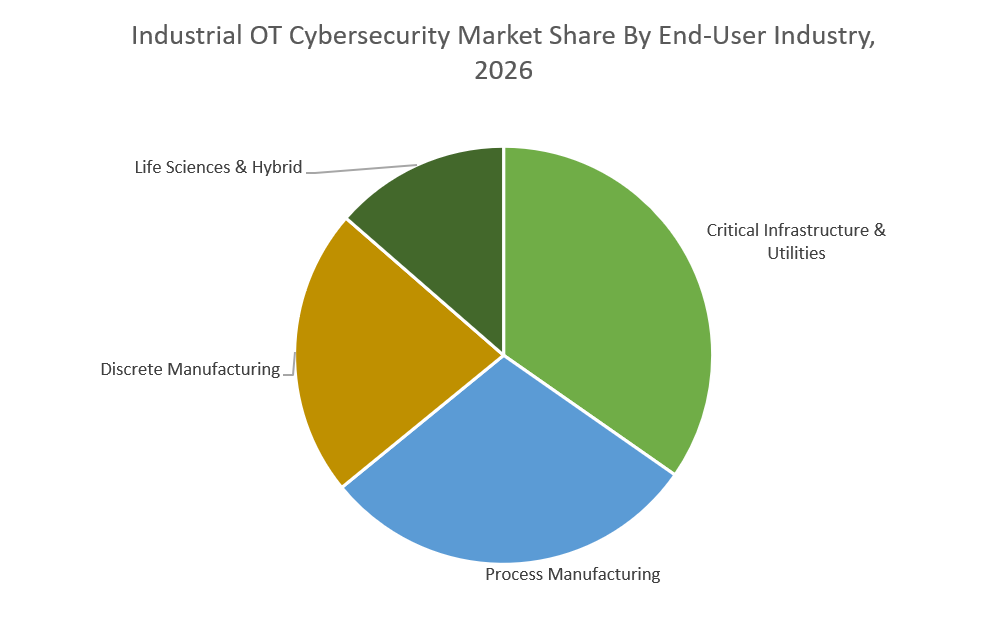
- Largest End-User: Critical Infrastructure & Utilities account for 34.7% of the market, driven by cybersecurity requirements across power, water, and essential industrial networks.
- Key Market Dynamics: Industrial ransomware exposure, IT/OT convergence, Zero Trust architectures, and regulatory compliance are shaping cybersecurity expenditure.
- Emerging Opportunities: Legacy PLC/SCADA security modernization and managed OT security services are expanding recurring revenue across industrial operations.
Recent Developments in Industrial OT Cybersecurity: Acquisitions, AI Threat Detection and Asset Visibility Platforms
Industrial OT cybersecurity competition is moving toward broader coverage of connected industrial assets, embedded software, and operational networks. In September 2026, Dragos completed the acquisitions of runZero and NetRise, following the closure of Accenture's majority investment in Dragos. The acquired capabilities extend the Dragos platform into IT/OT asset discovery, exposure management, firmware analysis, and software supply-chain risk identification. Dragos had also acquired Phosphorus earlier in 2026 to extend device-level protection across connected operational environments. These transactions expand the scope of specialized industrial cybersecurity platforms beyond passive network threat detection, particularly for customers operating heterogeneous infrastructure containing legacy controllers, industrial IoT devices, and equipment from multiple manufacturers.
AI-assisted security operations are becoming more closely integrated with cyber-physical system protection. In May 2026, Claroty introduced Claroty Claire, a CPS-native AI security agent, designed to support asset visibility, contextual exposure assessment, and security workflows across industrial and other critical operating environments. Claroty's announced capabilities include mapping device-level security information to regulatory frameworks and manufacturer-approved patch levels. The development illustrates growing product differentiation around operationally contextualized security analytics, where remediation priorities depend on device functions, production criticality, and the potential consequences of interrupting industrial processes.
Industrial automation manufacturers are also expanding their presence in dedicated cybersecurity software. Mitsubishi Electric completed its full acquisition of Nozomi Networks in January 2026, following the original transaction announcement in September 2025. Mitsubishi disclosed Nozomi Networks' 2025 net revenue of approximately USD 101.7 million, demonstrating the commercial scale achieved by a specialized OT security provider before integration into a major industrial automation group. The acquisition brings industrial network visibility and threat-detection software into Mitsubishi Electric's broader industrial technology portfolio, strengthening the competitive intersection between automation equipment suppliers and independent OT cybersecurity platform vendors.
Industrial OT Cybersecurity Regulations, IEC 62443 Standards and Critical Infrastructure Security Requirements
Industrial cybersecurity purchasing and deployment are influenced by sector-specific regulatory obligations, international security standards, and requirements for protecting critical infrastructure. The European Union's NIS2 Directive expands cybersecurity risk-management and incident-reporting obligations across designated sectors, including energy, drinking water, wastewater, chemicals, food production, and specified manufacturing activities. Member States were required to transpose NIS2 by October 17, 2024, with national implementation determining the applicable supervisory and enforcement arrangements. Covered entities face requirements addressing incident handling, supply-chain security, vulnerability management, and governance.
The EU Cyber Resilience Act introduces product-level cybersecurity obligations relevant to connected industrial equipment and software within its scope. Reporting requirements for actively exploited vulnerabilities and severe security incidents became applicable on September 11, 2026, while the Act's principal product-security requirements apply from December 11, 2027. Manufacturers subject to the reporting provisions must provide an initial warning within 24 hours and a fuller notification within 72 hours of awareness. These provisions affect industrial equipment cybersecurity assurance, vulnerability handling, and product lifecycle support.
At the technical level, IEC PAS 62443-2-2:2025 provides guidance on security protection schemes for industrial automation and control systems, covering technical, physical, and procedural controls. The IEC 62443 framework also addresses industrial IoT integration through IEC PAS 62443-1-6:2025. These publications support the evaluation of industrial cybersecurity architectures but do not independently establish universal legal certification obligations. In the United States, CISA's 2025 OT asset-inventory guidance provides additional technical reference material for identifying connected operational assets and understanding industrial system exposure.
Key Market Trends Reshaping Industrial OT Cybersecurity
AI-Powered OT Threat Detection and Integrated IT/OT Security Operations
Industrial cybersecurity platforms are increasingly combining machine learning-based anomaly detection, industrial network traffic analysis, and centralized security operations to monitor threats across interconnected IT and operational technology environments. Unlike conventional endpoint security, OT threat detection involves interpreting industrial communication protocols, controller command sequences, process variables, and normal machine operating behavior without interfering with production systems. According to the SANS 2025 State of ICS/OT Security Survey, only 49% of surveyed organizations had ICS/OT-specific detection capabilities, and just 26% of that group considered their detection highly effective. These limitations are supporting demand for industrial network detection and response (NDR), behavioral analytics, OT-native threat intelligence, and integrated security information and event management (SIEM) platforms. Commercial differentiation increasingly depends on detection precision, industrial protocol coverage, contextual alert prioritization, and the ability to correlate enterprise security events with potentially disruptive activity inside production networks.
Zero Trust Network Segmentation and Secure Industrial Remote Access
Zero Trust security architectures are gaining relevance as industrial facilities connect manufacturing execution systems, plant-floor controllers, cloud applications, and third-party engineering services. Traditional perimeter security provides limited protection where contractors, original equipment manufacturers (OEMs), and maintenance teams require access to operational networks. Industrial security deployments are consequently incorporating identity-based authentication, privileged access management (PAM), network segmentation, and time-restricted remote sessions. The SANS 2025 ICS/OT survey identified unauthorized external access as the starting point for 50% of reported industrial security incidents, highlighting the exposure associated with inadequately controlled connections. Zero Trust adoption in industrial environments differs from enterprise IT because access policies must accommodate legacy protocols, deterministic communications, and continuous process availability. Commercial demand is extending toward industrial demilitarized zone (DMZ) infrastructure, secure remote-access gateways, session monitoring, and identity-aware network-security solutions supporting geographically distributed production and maintenance operations.
Key Drivers Accelerating Industrial OT Cybersecurity Market Growth
Rising Industrial Ransomware Exposure and Production Downtime Costs
The financial consequences of industrial cyber incidents are strengthening demand for dedicated OT ransomware protection, network monitoring, and operational recovery capabilities. Manufacturing and critical infrastructure operators face exposure beyond data loss, including interrupted production schedules, unavailable engineering workstations, disrupted plant coordination, and delayed equipment restoration. IBM's 2025 X-Force Threat Intelligence Index identified manufacturing as the most attacked industry for the fourth consecutive year, with ransomware activity remaining particularly relevant to production environments. The SANS 2025 industrial security survey additionally found that 40% of reported ICS/OT incidents caused operational disruption, while nearly one in five required more than a month for complete remediation. Cybersecurity expenditure is increasingly connected to production downtime exposure, incident containment time, recovery complexity, and the availability of validated restoration procedures. These factors sustain demand for industrial intrusion detection, OT incident-response services, secure recovery capabilities, and continuous monitoring across business-critical production assets.
Expanding Critical Infrastructure Cybersecurity Compliance and Product Security Requirements
Increasing cybersecurity governance requirements across essential services and industrial supply chains are creating sustained demand for OT compliance monitoring, security assurance, and technical assessment services. Industrial operators must demonstrate appropriate control over network access, system vulnerabilities, third-party connectivity, cybersecurity documentation, and incident-management processes within their applicable operating environments. The European Union Agency for Cybersecurity reported in its 2025 NIS Investments study that 70% of surveyed organizations identified compliance as a principal driver of cybersecurity expenditure, with reported benefits extending into risk management, detection, and response. Although the survey encompasses multiple critical sectors rather than OT environments exclusively, it demonstrates the commercial influence of cybersecurity assurance requirements. Industrial cybersecurity suppliers are addressing this demand through continuous control monitoring, vulnerability assessment, audit documentation, supplier-risk assessment, and security lifecycle services, with recurring revenue linked to periodic assessments and ongoing verification of industrial security controls.
Emerging Opportunities in Industrial OT Cybersecurity
Legacy PLC, SCADA and DCS Cybersecurity Modernization
Aging programmable logic controllers, SCADA platforms, distributed control systems, and industrial communication networks represent a significant addressable segment for OT cybersecurity modernization. Many brownfield facilities operate automation equipment originally designed for reliability and long operating lifecycles, with limited authentication capabilities, restricted processing capacity, or compatibility constraints affecting conventional endpoint-security installations. Fortinet's 2026 operational technology security survey found that only 14% of respondents reported complete visibility into their OT systems, while approximately 23% could observe only half their operational environment. This coverage gap supports demand for passive asset discovery, agentless monitoring, deep packet inspection of industrial protocols, and security appliances compatible with legacy infrastructure. Retrofit projects typically involve network traffic collection, industrial asset identification, controller communication mapping, and integration with existing security management systems. Supplier revenue encompasses monitoring software, industrial networking hardware, engineering integration, and lifecycle support, with project complexity influenced by equipment age, protocol diversity, facility layout, and allowable maintenance windows.
Expansion of Managed OT Security Services and Industrial SOC Operations
Managed OT cybersecurity services are becoming commercially significant as industrial operators confront shortages of specialists capable of interpreting cyber threats within physical production environments. Industrial security operations require expertise spanning cybersecurity monitoring, network engineering, industrial protocols, process-control dependencies, and coordinated incident response. ENISA's 2025 research found that 76% of surveyed organizations experienced difficulty attracting cybersecurity professionals, while cybersecurity expenditure was increasingly directed toward technology and outsourced services. This operating environment supports demand for specialized managed detection and response (MDR), industrial security operations centers (SOCs), remote threat monitoring, incident investigation, and OT security engineering services. Commercial arrangements range from individual site-monitoring contracts to enterprise-wide managed security agreements covering multiple manufacturing plants, utilities, and industrial infrastructure networks. Recurring service revenue is influenced by protected asset counts, monitoring coverage, incident-response availability, reporting requirements, and the division of responsibilities between external security providers and internal plant engineering teams.
Industrial OT Cybersecurity Market Share Analysis, 2026
Software Solutions Dominate Industrial OT Cybersecurity Market by Component Type
Software Solutions accounted for the largest share of the Industrial OT Cybersecurity Market at 47.5% in 2026, supported by demand for industrial asset discovery, vulnerability management, threat detection, network segmentation, and identity and access management platforms. Software-based security enables centralized monitoring across distributed production networks, including legacy PLCs, SCADA systems, and industrial IoT infrastructure. Subscription licensing, enterprise-wide platform deployments, and continuous security monitoring contribute to recurring software revenue. Services represent the second-largest component, reflecting requirements for OT security integration, managed detection and response, and industrial security assessments. Hardware-based security maintains a smaller share, primarily associated with industrial firewalls, network monitoring appliances, and secure communication gateways.
Critical Infrastructure and Utilities Lead Industrial OT Cybersecurity Market by End-User Industry
Critical Infrastructure & Utilities held the largest share of the Industrial OT Cybersecurity Market at 34.7% in 2026, reflecting cybersecurity expenditure across electric power networks, water and wastewater utilities, energy infrastructure, and essential industrial services. These environments require continuous monitoring of operational networks, secure remote connectivity, and protection of geographically distributed control systems where service interruptions carry significant operational consequences. Process Manufacturing represents the second-largest end-user segment, driven by cybersecurity requirements in chemicals, refining, and continuous production facilities. Discrete Manufacturing contributes through connected factory automation and industrial robotics, while Life Sciences & Hybrid applications involve security requirements across pharmaceutical production, biotechnology facilities, and integrated manufacturing operations.
Competitive Landscape of Industrial OT Cybersecurity Solutions and Services
The Industrial OT Cybersecurity Market features a diverse competitive structure comprising specialized industrial security vendors, enterprise cybersecurity providers, and established industrial automation manufacturers. Dragos, Claroty, Nozomi Networks, and Forescout maintain differentiated positions through dedicated industrial security platforms, while Cisco, Fortinet, Palo Alto Networks, and Microsoft compete through broader enterprise security ecosystems. Supplier positioning varies according to protected asset coverage, industrial protocol compatibility, deployment architecture, sector specialization, and the ability to support cybersecurity operations across geographically distributed facilities.
Specialized providers such as Dragos, Claroty, Tenable, and TXOne Networks compete across industrial cybersecurity software categories with different levels of emphasis on control-system intelligence, security analytics, device protection, and operational risk assessment. TXOne Networks' industrial cybersecurity portfolio illustrates the product breadth available from specialist suppliers, spanning endpoint protection, industrial network appliances, and centralized security management. Vendor differentiation also reflects compatibility with existing automation equipment, supported industrial communication protocols, software deployment requirements, and the depth of technical expertise available for specific industrial sectors.
Industrial automation manufacturers, including Siemens, Honeywell, Rockwell Automation, and Schneider Electric, hold competitive advantages associated with established customer relationships, automation engineering expertise, and installed control-system infrastructure. Their cybersecurity businesses operate alongside broader industrial technology and lifecycle-service portfolios, creating opportunities to integrate security capabilities into automation modernization and plant-support contracts. Siemens' SINEC industrial security portfolio demonstrates the connection between automation asset information and industrial cybersecurity software. Commercial coverage extends across direct enterprise accounts, industrial distributors, automation integrators, and specialized engineering-service providers.
Competition also depends on licensing flexibility, system integration costs, multi-site support capabilities, and the availability of long-term maintenance and technical assistance. Specialized vendors generally compete through industrial security expertise and focused software functionality, while diversified technology companies benefit from established networking infrastructure, enterprise software relationships, and international service organizations. Contract structures range from product-specific software subscriptions and security appliance sales to integrated industrial cybersecurity programs and managed service agreements. Supplier selection is influenced by technology interoperability, industrial asset coverage, service responsiveness, and the total ownership costs associated with maintaining cybersecurity protection across complex operational environments.
Industrial OT Cybersecurity Market Geographical Analysis: Leading Countries and Industrial Security Demand
United States Industrial OT Cybersecurity Market: Manufacturing, Energy and Utility Network Protection
The United States represents a major market for industrial OT cybersecurity solutions, supported by extensive manufacturing operations, energy infrastructure, industrial automation networks, and distributed utility control systems. In July 2026, the Cybersecurity and Infrastructure Security Agency (CISA) reported increased malicious activity targeting programmable logic controllers within water and wastewater systems, including unauthorized configuration changes that disrupted operations. The country's industrial cybersecurity demand encompasses SCADA network protection, industrial intrusion detection, secure remote access, and operational asset monitoring across electricity networks, manufacturing plants, pipelines, and municipal infrastructure. Commercial activity spans specialized OT security providers, industrial automation manufacturers, managed security service companies, and system integrators. The diversity of industrial facilities creates requirements for cybersecurity platforms supporting legacy controller communications, geographically distributed assets, and continuously operating industrial processes.
Germany Industrial OT Cybersecurity Market: Industry 4.0 and Factory Network Security
Germany's industrial OT cybersecurity market is supported by its automotive, machinery, chemicals, pharmaceuticals, and industrial engineering sectors, where digitalized production systems operate alongside established automation infrastructure. The Bitkom Economic Security 2025 study found that 87% of surveyed German companies had experienced data theft, espionage, or sabotage during the preceding twelve months, although this finding covers broader corporate security incidents rather than OT systems exclusively. Industrial cybersecurity applications include PLC network protection, industrial firewall deployment, machine-level access management, and manufacturing system monitoring. Siemens' electronic factory in Amberg provides an example of secure OT connectivity using centralized access management and encrypted communication across an existing production network. Germany's engineering-intensive industrial environment supports demand for cybersecurity software, industrial network infrastructure, and specialized security integration associated with factory modernization and multi-vendor automation systems.
Japan Industrial OT Cybersecurity Market: Semiconductor and Automotive Production Security
Japan's Industrial OT Cybersecurity Market is closely associated with high-value semiconductor fabrication, automotive manufacturing, electronics production, and precision industrial machinery. In October 2025, Japan's Ministry of Economy, Trade and Industry published OT Security Guidelines for Semiconductor Device Factories, establishing a technical reference specifically addressing cybersecurity risks in semiconductor production environments. Industrial security requirements extend across equipment-control networks, semiconductor manufacturing tools, factory supervisory systems, and interconnected production engineering infrastructure. Japan also maintains a specialized industrial cybersecurity capability through METI and the Information-technology Promotion Agency's Industrial Cyber Security Center of Excellence, which conducted international ICS security exercises in November 2025. Commercial demand includes industrial asset discovery, controller-level security monitoring, network isolation, and secure equipment maintenance capabilities compatible with highly automated manufacturing processes and stringent production availability requirements.
United Kingdom Industrial OT Cybersecurity Market: Energy Infrastructure and Industrial Security Services
The United Kingdom maintains an established market for industrial OT cybersecurity across power generation, electricity distribution, water utilities, transportation infrastructure, engineering, and manufacturing. The UK government's Cyber Security Breaches Survey 2025/2026 found that 49% of surveyed businesses in the utilities and production category identified cybersecurity breaches or attacks during the preceding twelve months. This category includes manufacturing and utilities but does not measure OT incidents separately. The country's cybersecurity supplier ecosystem also provides a commercial foundation for industrial security services: the government's 2026 sectoral analysis identified 2,603 active cybersecurity firms, with industrial and OT security represented among their documented capabilities. Industrial buyers generate demand for operational network monitoring, vulnerability assessment, secure engineering access, incident-response support, and integration services covering both modern and legacy industrial control environments.
Singapore Industrial OT Cybersecurity Market: Critical Infrastructure and Process Industry Security
Singapore's Industrial OT Cybersecurity Market is concentrated around critical infrastructure, advanced electronics manufacturing, petrochemical processing, water services, and highly connected industrial facilities. The Cyber Security Agency of Singapore's OT Cybersecurity Masterplan was developed with participation from more than 60 organizations, including critical infrastructure operators, equipment manufacturers, cybersecurity suppliers, cloud service providers, and system integrators. This institutional and commercial ecosystem supports specialized OT security implementation across industrial sites where operational availability, remote connectivity, and coordination between technology providers are important purchasing considerations. Singapore's concentration of multinational industrial operations creates requirements for industrial network monitoring, secure third-party access, OT security assessments, and managed security services. Supplier participation includes international cybersecurity platforms, regional engineering companies, and specialized service providers supporting geographically concentrated but operationally complex industrial infrastructure.
India Industrial OT Cybersecurity Market: Power Systems and Industrial Automation Security
India's Industrial OT Cybersecurity Market is supported by expanding electricity infrastructure, process manufacturing, automotive production, pharmaceuticals, and connected industrial automation. Government reporting for FY2024–25 documented 1,579 CERT-In cybersecurity audits in the power and energy sector, alongside 46 audits conducted by the National Critical Information Infrastructure Protection Centre. These figures concern cybersecurity and vulnerability assessments across the sector and are not limited to OT equipment. Power transmission and distribution networks, industrial process-control facilities, and manufacturing automation systems constitute important application areas for industrial cybersecurity technologies. Demand includes SCADA security, remote terminal unit protection, industrial network segmentation, and monitoring of distributed control infrastructure. India's industrial cybersecurity supplier ecosystem comprises multinational automation vendors, cybersecurity software providers, engineering contractors, and domestic security service companies, with project requirements varying across public infrastructure operators and privately owned manufacturing facilities.
Industrial OT Cybersecurity Market Report Scope
Industrial OT Cybersecurity Market Report Scope, Segmentation and Regional Coverage, 2026–2034
|
Parameter
|
Details
|
|
Market Size (2026)
|
USD 8,506.0 Million
|
|
Market Size (2034)
|
USD 24,799.1 Million
|
|
Market Growth Rate
|
CAGR of 14.3%
|
|
Segments
|
By Component / Solution Type: Hardware-Based Security, Software Solutions (Asset Discovery & Inventory Mapping, Vulnerability Management & Threat Detection, IAM/PAM, Network Segmentation & Micro-segmentation, Endpoint & Firmware Protection), Services. By Architecture Layer (Purdue Model): Level 0/1 (Field & Process Level), Level 2 (Control Level), Level 3 (Site Manufacturing / Operations Level), Level 3.5 / DMZ (Industrial Demilitarized Zone). By Deployment Model: On-Premises / Air-Gapped, Cloud-Native / Cloud-Managed OT Security, Hybrid Deployments. By End-User Industry: Critical Infrastructure & Utilities, Process Manufacturing, Discrete Manufacturing, Life Sciences & Hybrid.
|
|
Study Period
|
Historical: 2021–2025; Base Year: 2026; Forecast: 2026–2034
|
|
Units
|
Revenue (USD Million)
|
|
Technology Coverage
|
Industrial Control System (ICS) Security, SCADA and DCS Protection, PLC and RTU Security, OT Asset Discovery, Industrial Network Detection and Response (NDR), SIEM/SOAR for OT, AI-Based Threat Detection, Zero Trust Architecture, Industrial Network Segmentation, Industrial Firewalls, Secure Remote Access, IAM/PAM, Endpoint and Firmware Security, Managed OT Security Services, Industrial SOC and OT Incident Response
|
|
Qualitative Analysis
|
Porter's Five Forces, SWOT Analysis, Market Share Analysis, Market Drivers, Trends and Opportunities, Industry Benchmarking, Competitive Landscape, Market Ecosystem, Industrial Cybersecurity Value Chain, Technology Adoption, Security Deployment Models, Regulatory Analysis, Regional and Country Market Outlook
|
|
Regulatory & Standards Coverage
|
ISA/IEC 62443 Industrial Automation and Control System Security Standards, NIST SP 800-82 Rev. 3, EU NIS2 Directive, EU Cyber Resilience Act, CISA Industrial Control System Security Guidance, National Critical Infrastructure Cybersecurity Frameworks, Industrial Product Security and Vulnerability Management Requirements
|
|
Companies
|
Dragos, Claroty, Mitsubishi Electric (Nozomi Networks), ServiceNow (Armis), Tenable, Forescout Technologies, TXOne Networks, Cisco Systems, Fortinet, Palo Alto Networks, Microsoft, Honeywell, Siemens, Rockwell Automation, Schneider Electric
|
|
Countries
|
North America: United States, Canada, Mexico. Europe: Germany, United Kingdom, France, Italy, Spain, Russia. Asia Pacific: China, India, Japan, South Korea, Australia, Singapore. South America: Brazil, Argentina. Middle East & Africa: United Arab Emirates, South Africa. Additional Rest of Region coverage. Total: 19 individually analyzed countries across five regions.
|
Industrial OT Cybersecurity Market Segmentation
By Component / Solution Type
- Hardware-Based Security
- Software Solutions:
- Asset Discovery & Inventory Mapping
- Vulnerability Management & Threat Detection (SIEM/SOAR for OT)
- Identity & Access Management (IAM) / Privileged Access Management (PAM)
- Network Segmentation & Micro-segmentation Tools
- Endpoint & Firmware Protection (PLC/DCS level protection)
- Services
By Architecture Layer (Purdue Model Level)
- Level 0/1 (Field & Process Level)
- Level 2 (Control Level)
- Level 3 (Site Manufacturing / Operations Level)
- Level 3.5 / DMZ (Industrial Demilitarized Zone)
By Deployment Model
- On-Premises / Air-Gapped
- Cloud-Native / Cloud-Managed OT Security:
- Hybrid Deployments
By End-User Industry
- Critical Infrastructure & Utilities
- Process Manufacturing
- Discrete Manufacturing
- Life Sciences & Hybrid
Countries Analyzed
- North America (US, Canada, Mexico)
- Europe (Germany, UK, France, Spain, Italy, Russia, Rest of Europe)
- Asia Pacific (China, India, Japan, South Korea, Australia, South East Asia, Rest of Asia)
- South America (Brazil, Argentina, Rest of South America)
- Middle East and Africa (Saudi Arabia, UAE, Rest of Middle East, South Africa, Egypt, Rest of Africa)
Leading Industrial OT Cybersecurity Companies
- Dragos, Inc.
- Claroty
- Mitsubishi Electric Corporation (Nozomi Networks)
- ServiceNow, Inc. (Armis)
- Tenable Holdings, Inc.
- Forescout Technologies
- TXOne Networks
- Cisco Systems, Inc.
- Fortinet, Inc.
- Palo Alto Networks, Inc.
- Microsoft Corporation
- Honeywell International Inc.
- Siemens AG
- Rockwell Automation, Inc.
- Schneider Electric SE
*List not Exhaustive
Industrial OT Cybersecurity Market Research Methodology
The Industrial OT Cybersecurity Market research methodology combines bottom-up and top-down market assessment, supported by secondary research across industrial cybersecurity vendors, automation manufacturers, and critical infrastructure operators. Research inputs include company annual reports, investor disclosures, product portfolios, government cybersecurity publications, and technical frameworks such as IEC 62443 and NIST SP 800-82. Market assessment covers hardware-based security, software solutions, and services, with demand evaluated across critical infrastructure, process manufacturing, discrete manufacturing, and life sciences industries.
Market sizing and forecasting examine industrial cybersecurity expenditure, connected OT asset deployment, software licensing, managed security services, and industrial network modernization. Revenue estimates are assessed through supplier-level analysis, end-user industry demand, and geographic market conditions, with adjustments for overlapping hardware, software, and service revenues. The 2026 base-year market value and 2034 forecast are presented alongside segment-level market shares, technology adoption patterns, competitive positioning, and country-specific industrial cybersecurity activity.
Table of Contents: Industrial OT Cybersecurity Market
1. Executive Summary
1.1. Global Industrial OT Cybersecurity Market Highlights
1.2. Market Size, Growth and Forecast Summary, 2026–2034
1.3. Key Findings by Component, Deployment Model and End-User Industry
1.4. Regional and Country Market Share Highlights
1.5. Industrial Cybersecurity Technology and Competitive Landscape Snapshot
1.6. Principal Industry Developments and Market Outlook
2. Industrial OT Cybersecurity Market Introduction and Research Scope
2.1. Industrial OT Cybersecurity Market Definition and Coverage
2.2. Operational Technology (OT) and Industrial Control Systems (ICS) Security Ecosystem
2.3. Market Revenue Structure: Hardware, Software and Services
2.4. Industrial Cybersecurity Value Chain and Distribution Channels
2.5. Market Scope, Inclusions and Exclusions
2.6. Market Segmentation Framework
2.7. Historical Period, Base Year and Forecast Period
3. Global Industrial OT Cybersecurity Market Size and Forecast, 2026–2034
3.1. Historical Industrial OT Cybersecurity Market Development, 2021–2025
3.2. Global Market Size and Revenue Analysis, 2026
3.3. Industrial OT Cybersecurity Market Revenue Forecast, 2027–2034
3.4. Global Market CAGR and Year-on-Year Growth Analysis
3.5. Revenue Distribution by Component and Solution Type
3.6. Revenue Distribution by Deployment Model
3.7. Revenue Distribution by End-User Industry
3.8. Regional Market Revenue and Share Comparison
3.9. Industrial Cybersecurity Revenue Models and Lifecycle Cost Analysis
3.10. Base-Case, High-Growth and Low-Growth Market Forecast Scenarios
4. Industrial OT Cybersecurity Market Dynamics
4.1. Key Market Trends
4.1.1. AI-Powered OT Threat Detection and Integrated IT/OT Security Operations
4.1.2. Zero Trust Network Segmentation and Secure Industrial Remote Access
4.1.3. Industrial Asset Visibility and Security Platform Integration
4.2. Key Market Growth Drivers
4.2.1. Rising Industrial Ransomware Exposure and Production Downtime Costs
4.2.2. Expanding Critical Infrastructure Cybersecurity and Product Security Requirements
4.2.3. Industrial Connectivity and Cyber-Physical System Security Demand
4.3. Emerging Market Opportunities
4.3.1. Legacy PLC, SCADA and DCS Cybersecurity Modernization
4.3.2. Expansion of Managed OT Security Services and Industrial SOC Operations
4.3.3. Multi-Site Industrial Cybersecurity Platform Deployments
4.4. Market Restraints and Industry Challenges
4.4.1. Integration Costs Across Legacy Industrial Control Infrastructure
4.4.2. Industrial Cybersecurity Skills Availability
4.4.3. Operational Compatibility and Production Downtime Constraints
4.4.4. Industrial Network Visibility and Vendor Interoperability Limitations
5. Industrial OT Cybersecurity Technology Landscape and Regulatory Framework
5.1. Industrial Control System Architecture and Cybersecurity Requirements
5.2. Purdue Model Security Architecture and Industrial Network Zones
5.3. PLC, RTU, SCADA and DCS Security Technologies
5.4. Industrial Network Detection and Response Technologies
5.5. OT Asset Discovery, Vulnerability Intelligence and Threat Analytics
5.6. Industrial Firewalls, Secure Gateways and Microsegmentation
5.7. OT Security Operations, Incident Response and Recovery Technologies
5.8. Global Industrial Cybersecurity Regulations and Standards
5.8.1. ISA/IEC 62443 Industrial Automation and Control System Security
5.8.2. NIST Industrial Control System Security Framework
5.8.3. European Union NIS2 Directive
5.8.4. EU Cyber Resilience Act and Industrial Product Security
5.8.5. National Critical Infrastructure Cybersecurity Requirements
5.9. Industrial Cybersecurity Certifications and Product Security Assurance
6. Global Industrial OT Cybersecurity Market Segmentation Analysis, 2026–2034
6.1. By Component / Solution Type
6.1.1. Hardware-Based Security
6.1.2. Software Solutions
6.1.2.1. Asset Discovery and Inventory Mapping
6.1.2.2. Vulnerability Management and Threat Detection (SIEM/SOAR for OT)
6.1.2.3. Identity and Access Management (IAM) / Privileged Access Management (PAM)
6.1.2.4. Network Segmentation and Microsegmentation Tools
6.1.2.5. Endpoint and Firmware Protection
6.1.3. Services
6.1.4. Component Market Size and Revenue Forecast, 2026–2034
6.1.5. Component Market Share Analysis, 2026 and 2034
6.2. By Architecture Layer (Purdue Model Level)
6.2.1. Level 0/1 – Field and Process Level
6.2.2. Level 2 – Control Level
6.2.3. Level 3 – Site Manufacturing / Operations Level
6.2.4. Level 3.5 / DMZ – Industrial Demilitarized Zone
6.2.5. Architecture-Layer Security Demand and Deployment Analysis
6.3. By Deployment Model
6.3.1. On-Premises / Air-Gapped
6.3.2. Cloud-Native / Cloud-Managed OT Security
6.3.3. Hybrid Deployments
6.3.4. Deployment Model Revenue Forecast, 2026–2034
6.3.5. Deployment Model Market Share Analysis, 2026 and 2034
6.4. By End-User Industry
6.4.1. Critical Infrastructure & Utilities
6.4.2. Process Manufacturing
6.4.3. Discrete Manufacturing
6.4.4. Life Sciences & Hybrid
6.4.5. End-User Industry Revenue Forecast, 2026–2034
6.4.6. End-User Industry Market Share Analysis, 2026 and 2034
6.5. Cross-Segment Market Analysis
6.5.1. Component Demand by End-User Industry
6.5.2. Deployment Model Adoption by Industrial Application
6.5.3. Industrial Cybersecurity Revenue and Application Benchmarking
7. Industrial OT Cybersecurity Market Size and Share by Region and Country, 2026–2034
7.1. North America Industrial OT Cybersecurity Market
7.1.1. North America Market Size, CAGR and Global Market Share
7.1.2. United States Market Size, Share and Forecast
7.1.3. Canada Market Size, Share and Forecast
7.1.4. Mexico Market Size, Share and Forecast
7.1.5. Rest of North America
7.1.6. North America Country Market Share Comparison
7.1.7. North America Market Outlook by Component and End-User Industry
7.2. Europe Industrial OT Cybersecurity Market
7.2.1. Europe Market Size, CAGR and Global Market Share
7.2.2. Germany Market Size, Share and Forecast
7.2.3. United Kingdom Market Size, Share and Forecast
7.2.4. France Market Size, Share and Forecast
7.2.5. Italy Market Size, Share and Forecast
7.2.6. Spain Market Size, Share and Forecast
7.2.7. Russia Market Size, Share and Forecast
7.2.8. Rest of Europe
7.2.9. Europe Country Market Share Comparison
7.2.10. Europe Market Outlook by Component and End-User Industry
7.3. Asia Pacific Industrial OT Cybersecurity Market
7.3.1. Asia Pacific Market Size, CAGR and Global Market Share
7.3.2. China Market Size, Share and Forecast
7.3.3. India Market Size, Share and Forecast
7.3.4. Japan Market Size, Share and Forecast
7.3.5. South Korea Market Size, Share and Forecast
7.3.6. Australia Market Size, Share and Forecast
7.3.7. Singapore Market Size, Share and Forecast
7.3.8. Rest of Asia Pacific
7.3.9. Asia Pacific Country Market Share Comparison
7.3.10. Asia Pacific Market Outlook by Component and End-User Industry
7.4. South America Industrial OT Cybersecurity Market
7.4.1. South America Market Size, CAGR and Global Market Share
7.4.2. Brazil Market Size, Share and Forecast
7.4.3. Argentina Market Size, Share and Forecast
7.4.4. Rest of South America
7.4.5. South America Country Market Share Comparison
7.4.6. South America Market Outlook by Component and End-User Industry
7.5. Middle East and Africa Industrial OT Cybersecurity Market
7.5.1. Middle East and Africa Market Size, CAGR and Global Market Share
7.5.2. United Arab Emirates Market Size, Share and Forecast
7.5.3. South Africa Market Size, Share and Forecast
7.5.4. Rest of Middle East
7.5.5. Rest of Africa
7.5.6. Middle East and Africa Country Market Share Comparison
7.5.7. Regional Market Outlook by Component and End-User Industry
7.6. Global Regional Market Share Comparison
7.6.1. Market Share by Five Major Regions, 2026
7.6.2. Forecast Regional Market Share, 2034
7.6.3. Regional CAGR Comparison, 2026–2034
7.6.4. Regional Revenue Contribution to Global Market Growth
8. Comparative Analysis of 19 Industrial OT Cybersecurity Country Markets
8.1. Country-Level Revenue and Global Market Share, 2026
8.2. Country-Level Market Revenue Forecasts, 2027–2034
8.3. Country-Level Market Share Outlook, 2034
8.4. Country CAGR Comparison, 2026–2034
8.5. Industrial Infrastructure and Cybersecurity Demand by Country
8.6. Country-Level Security Technology and Deployment Analysis
8.7. Leading Industrial Cybersecurity Suppliers by Country
8.8. Global and Regional Market Share Reconciliation
9. Industrial OT Cybersecurity Competitive Landscape
9.1. Global Competitive Structure and Supplier Ecosystem
9.2. Industrial Cybersecurity Vendor Categories and Business Models
9.3. Competitive Benchmarking by Technology Portfolio
9.4. Hardware, Software and Managed Service Provider Comparison
9.5. Industrial Cybersecurity Pricing and Licensing Models
9.6. Distribution Channels, Integrators and Industrial Service Partnerships
9.7. Competitive Positioning by Industrial End-User
9.8. Company Market Presence and Ranking Analysis
9.9. Porter’s Five Forces Analysis
9.10. SWOT Analysis of the Industrial OT Cybersecurity Industry
10. Industrial OT Cybersecurity Recent Developments and Industry Transactions
10.1. Industrial Cybersecurity Product and Software Developments
10.2. AI-Enabled OT Threat Detection and Security Analytics
10.3. Industrial Security Platform Acquisitions and Consolidation
10.4. Cybersecurity Technology Partnerships and Integrations
10.5. Industrial Security Service Portfolio Developments
10.6. Regional Commercial Expansion and Industrial Customer Deployments
10.7. Industrial Cybersecurity Innovation and Development Timeline, 2024–2026
11. Company Profiles of Leading Industrial OT Cybersecurity Market Players
11.1. Dragos, Inc.
11.2. Claroty
11.3. Mitsubishi Electric Corporation (Nozomi Networks)
11.4. ServiceNow, Inc. (Armis)
11.5. Tenable Holdings, Inc.
11.6. Forescout Technologies
11.7. TXOne Networks
11.8. Cisco Systems, Inc.
11.9. Fortinet, Inc.
11.10. Palo Alto Networks, Inc.
11.11. Microsoft Corporation
11.12. Honeywell International Inc.
11.13. Siemens AG
11.14. Rockwell Automation, Inc.
11.15. Schneider Electric SE
Standard Company Profile Coverage
- Company Overview and Industrial Cybersecurity Business
- Product and Solution Portfolio
- Industrial Application and End-User Coverage
- Geographic Operations and Distribution Presence
- Financial and Business Performance, Where Disclosed
- Competitive Positioning and Recent Company Developments
12. Industrial OT Cybersecurity Market Research Methodology
12.1. Research Objectives and Market Scope
12.2. Primary Research Framework
12.3. Secondary Research Sources
12.4. Bottom-Up Market Sizing
12.5. Top-Down Market Validation
12.6. Revenue Attribution and Segment Classification
12.7. Regional and Country Market Estimation
12.8. Market Share Calculation and Validation
12.9. Historical Data Assessment
12.10. Forecasting Assumptions and Scenario Analysis
12.11. Data Triangulation and Quality Assurance
12.12. Research Limitations and Market Definitions
13. Appendix
13.1. List of Tables
13.2. List of Figures and Charts
13.3. Industrial OT Cybersecurity Acronyms and Abbreviations
13.4. Market Segmentation Definitions
13.5. Regional and Country Classification
13.6. Revenue Units, Exchange-Rate Conventions and Calculation Notes
13.7. Company and Technology Reference Directory
13.8. Research Data Tables and Supplementary Forecasts