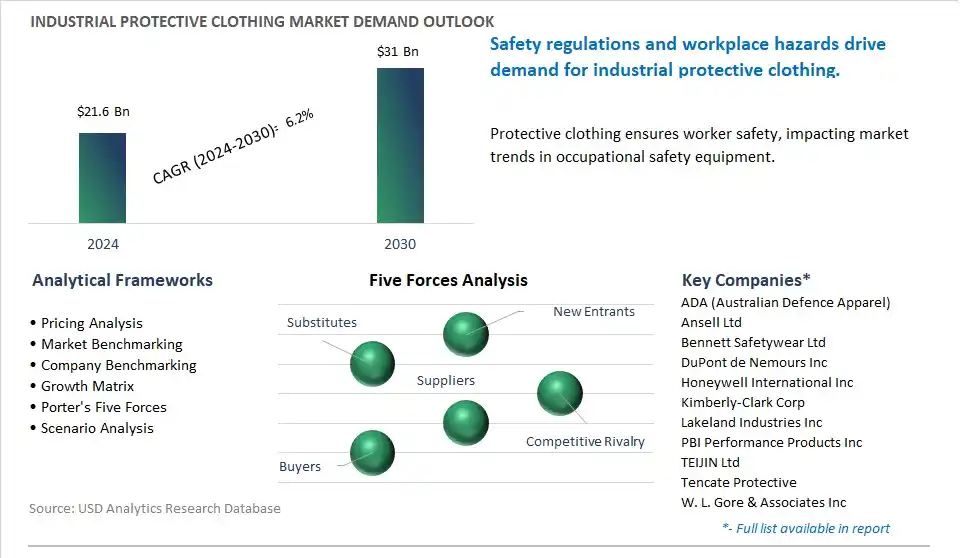
The global Industrial Protective Clothing Market is poised to register a 6.2% CAGR from $21.6 Billion in 2024 to $31 Billion in 2030.
The global Industrial Protective Clothing Market Study analyzes and forecasts the market size across 6 regions and 24 countries for diverse segments -By Product (Heat & Flame Protection, Chemical Defending, Clean Room Clothing, Mechanical Protective Clothing, Ltd General Use, Others), By End-User (Construction, Manufacturing, Oil & Gas, Chemicals, Food, Pharmaceuticals, Healthcare, Transportation, Mining, Others).
An Introduction to Global Industrial Protective Clothing Market in 2024
The market for industrial protective clothing is evolving in response to heightened awareness of workplace safety and stringent regulatory standards across industries such as manufacturing, construction, and healthcare. One key trend shaping the future of the industry is the integration of advanced materials and technologies to enhance the protective properties and comfort of protective clothing. Innovations such as flame-resistant fabrics, chemical-resistant coatings, and breathable membranes are enabling the development of garments that offer superior protection against various workplace hazards while ensuring wearer comfort and mobility. Additionally, the increasing focus on sustainability and environmental responsibility is driving the adoption of eco-friendly and recyclable materials in protective clothing manufacturing, fostering the development of greener alternatives to traditional synthetic fibers. Furthermore, advancements in smart textile technologies, including embedded sensors and monitoring systems, are revolutionizing the functionality of protective clothing by providing real-time data on environmental conditions and wearer health, thereby improving safety outcomes and reducing workplace accidents.
Industrial Protective Clothing Market Competitive Landscape
The market report analyses the leading companies in the industry including ADA (Australian Defence Apparel), Ansell Ltd, Bennett Safetywear Ltd, DuPont de Nemours Inc, Honeywell International Inc, Kimberly-Clark Corp, Lakeland Industries Inc, PBI Performance Products Inc, TEIJIN Ltd, Tencate Protective, W. L. Gore & Associates Inc, Workwear Outfitters LLC.
Industrial Protective Clothing Market Dynamics
Industrial Protective Clothing Market Trend: Increasing Focus on Worker Safety and Occupational Health
A significant trend in the industrial protective clothing market is the increasing focus on worker safety and occupational health driven by stringent regulations, heightened awareness of workplace hazards, and the prioritization of employee well-being by employers. With a growing emphasis on workplace safety and risk mitigation across industries such as manufacturing, construction, oil and gas, and healthcare, there is a rising demand for high-quality protective clothing and personal protective equipment (PPE) to safeguard workers from physical, chemical, biological, and thermal hazards. Manufacturers are responding to this trend by developing innovative protective clothing solutions that offer enhanced comfort, functionality, and protection levels while complying with industry standards and regulations. Additionally, advancements in material science, textile engineering, and garment design enable the development of lightweight, breathable, and ergonomic protective clothing that improves wearer comfort and productivity without compromising safety performance. This trend is reshaping the industrial protective clothing market towards increased adoption of technologically advanced PPE solutions that prioritize worker safety and well-being in hazardous work environments.
Industrial Protective Clothing Market Driver: Regulatory Compliance and Workplace Safety Mandates
A key driver propelling the industrial protective clothing market is regulatory compliance and workplace safety mandates imposed by government agencies, industry associations, and occupational health organizations to ensure the protection of workers from workplace hazards and occupational risks. Regulations such as OSHA (Occupational Safety and Health Administration) standards in the United States, EU Directives on PPE in Europe, and national safety guidelines in other regions set forth requirements for employers to assess workplace hazards, provide appropriate PPE, and implement safety programs to protect workers from injuries and illnesses. Non-compliance with these regulations can result in penalties, fines, and legal liabilities, compelling employers to invest in suitable protective clothing solutions that meet or exceed regulatory requirements. Additionally, heightened awareness of occupational health issues, increased insurance premiums for workplace injuries, and public scrutiny of corporate safety practices further drive market demand for industrial protective clothing as a vital component of workplace safety programs. The imperative to comply with regulatory mandates and ensure employee safety creates opportunities for manufacturers and suppliers of protective clothing to provide innovative, compliant solutions that meet the evolving needs of industries and end-users.
Industrial Protective Clothing Market Opportunity: Expansion into Emerging Sectors and Specialized Applications
An opportunity for market expansion lies in the expansion into emerging sectors and specialized applications that require tailored protective clothing solutions to address unique hazards and performance requirements. While traditional industries such as manufacturing, construction, and mining are key markets for industrial protective clothing, there are opportunities to penetrate emerging sectors such as renewable energy, nanotechnology, biotechnology, and advanced manufacturing, where new hazards and risks may necessitate specialized PPE solutions. Additionally, specialized applications such as cleanroom environments, chemical processing, healthcare facilities, and emergency response teams require protective clothing with specific features such as chemical resistance, antimicrobial properties, flame retardancy, and particulate filtration. By leveraging their expertise in material science, garment design, and safety engineering, manufacturers of protective clothing can develop customized solutions tailored to the needs of emerging sectors and specialized applications, expanding their market reach and addressing niche market segments. Furthermore, strategic partnerships, collaborations, and investments in R&D can facilitate market entry into new sectors and drive innovation in protective clothing technologies, positioning manufacturers for growth and success in the dynamic industrial protective clothing market landscape.
Industrial Protective Clothing Market Share Analysis: Heat & Flame Protection segment generated the highest revenue in the industry
The heat & flame protection segment is the largest segment in the industrial protective clothing market, primarily due to diverse factors. The industries such as manufacturing, construction, oil and gas, and firefighting require protective clothing that can withstand high temperatures, flames, and thermal hazards. Workers in these industries are exposed to various heat sources, including hot surfaces, open flames, molten metals, and arc flash hazards, which pose risks of burns, injuries, and fatalities. Therefore, there is a critical need for specialized protective clothing designed to provide effective heat and flame protection to workers in high-risk environments. Secondly, stringent safety regulations and standards mandate the use of flame-resistant (FR) clothing in hazardous work environments to minimize the risk of thermal injuries and comply with occupational safety requirements. Industries such as petrochemicals, utilities, and firefighting agencies have implemented FR clothing programs to ensure worker safety and mitigate the consequences of thermal incidents. Additionally, advancements in textile technology and materials science have led to the development of innovative heat-resistant fabrics and flame-retardant treatments that enhance the protective performance of garments while maintaining comfort and mobility for workers. These specialized fabrics incorporate aramid fibers, modacrylic fibers, and flame-resistant coatings to provide reliable protection against heat and flame exposures. In addition, increasing awareness of workplace safety and the importance of personal protective equipment (PPE) among employers and workers has driven investments in heat & flame protection garments. Companies prioritize employee safety and risk mitigation by equipping workers with high-quality protective clothing that meets industry standards and regulatory requirements. Further, the rise in industrial accidents and injuries underscores the significance of proactive safety measures, including the adoption of appropriate protective clothing, further driving the demand for heat & flame protection garments in the industrial sector. Over the forecast period, the combination of regulatory compliance, industry standards, technological advancements, and safety consciousness positions the heat & flame protection segment as the largest segment in the industrial protective clothing market.
Industrial Protective Clothing Market Share Analysis: Healthcare Segment is poised to register the fastest growth rate (CAGR) over the forecast period to 2030
The healthcare segment is the fastest-growing segment in the industrial protective clothing market, driven by diverse key factors. The the COVID-19 pandemic has significantly heightened awareness of infection control and personal protective measures in healthcare settings. Healthcare workers, including doctors, nurses, and frontline staff, require specialized protective clothing to minimize the risk of exposure to infectious agents, including viruses, bacteria, and other pathogens. As healthcare facilities prioritize the safety of their personnel and patients, there has been a surge in demand for protective clothing such as gowns, cOver the forecast periods, gloves, and masks designed to provide barrier protection against biological hazards. Secondly, the ongoing threat of emerging infectious diseases and healthcare-associated infections (HAIs) underscores the importance of robust infection prevention and control protocols in healthcare settings. Regulatory agencies and healthcare organizations worldwide have implemented guidelines and standards mandating the use of appropriate personal protective equipment (PPE) to prevent the transmission of infections and ensure the safety of healthcare workers and patients. Consequently, there is a growing need for high-quality protective clothing that meets stringent performance criteria for barrier protection, breathability, and comfort in healthcare environments. Additionally, advancements in textile technology and material science have led to the development of innovative protective clothing solutions tailored to the unique requirements of healthcare professionals. These include breathable and moisture-resistant fabrics, antiviral coatings, and ergonomic designs that enhance comfort and mobility while ensuring effective protection against infectious agents. In addition, the expansion of healthcare infrastructure, including hospitals, clinics, and diagnostic laboratories, further drives the demand for protective clothing among healthcare workers globally. As healthcare systems invest in preparedness and response measures to address public health crises and pandemics, the need for reliable and versatile protective clothing solutions continues to grow. Over the forecast period, the combination of increased awareness of infection control, regulatory mandates, technological advancements, and healthcare infrastructure development positions the healthcare segment as the fastest-growing segment in the industrial protective clothing market.
Industrial Protective Clothing Market Share Analysis: Healthcare Segment is poised to register the fastest growth rate (CAGR) over the forecast period to 2030
The healthcare segment is experiencing the fastest growth in the industrial protective clothing market for diverse reasons. The with the COVID-19 pandemic, there has been an unprecedented demand for protective clothing in healthcare settings to ensure the safety of frontline workers and patients. Healthcare professionals, including doctors, nurses, and medical staff, require specialized protective garments such as gowns, cOver the forecast periods, masks, and gloves to minimize the risk of exposure to infectious agents like viruses and bacteria. As hospitals and healthcare facilities prioritize infection control measures, the demand for high-quality protective clothing in the healthcare sector has surged significantly. Secondly, beyond the pandemic, there is a growing emphasis on infection prevention and control in healthcare settings globally. Regulatory bodies and healthcare organizations are increasingly mandating the use of appropriate personal protective equipment (PPE) to prevent the spread of infections and ensure the safety of healthcare workers and patients. This heightened focus on infection control measures further drives the adoption of protective clothing in the healthcare sector. Additionally, advancements in textile technology have led to the development of innovative protective clothing solutions tailored to the specific needs of healthcare professionals. These include breathable, moisture-resistant fabrics, antiviral coatings, and ergonomic designs that provide both comfort and effective protection against infectious agents. Further, the expansion of healthcare infrastructure, including the construction of new hospitals, clinics, and diagnostic laboratories, contributes to the increased demand for protective clothing in the healthcare industry. As healthcare systems invest in preparedness and response measures to address public health challenges, the need for reliable and versatile protective clothing solutions continues to grow, positioning the healthcare segment as the fastest-growing segment in the industrial protective clothing market.
Industrial Protective Clothing Market Report Segmentation
By Product
Heat & Flame Protection
Chemical Defending
Clean Room Clothing
Mechanical Protective Clothing
Ltd General Use
Others
By End-User
Construction
Manufacturing
Oil & Gas
Chemicals
Food
Pharmaceuticals
Healthcare
Transportation
Mining
Others
Regions Included
North America (US, Canada, Mexico)
Europe (Germany, UK, France, Spain, Italy, Russia, Rest of Europe)
Asia Pacific (China, India, Japan, South Korea, Australia, South East Asia, Rest of Asia)
South America (Brazil, Argentina, Rest of South America)
Middle East and Africa (Saudi Arabia, UAE, Rest of Middle East, South Africa, Egypt, Rest of Africa)
Industrial Protective Clothing Companies Profiled in the Market Study
ADA (Australian Defence Apparel)
Ansell Ltd
Bennett Safetywear Ltd
DuPont de Nemours Inc
Honeywell International Inc
Kimberly-Clark Corp
Lakeland Industries Inc
PBI Performance Products Inc
TEIJIN Ltd
Tencate Protective
W. L. Gore & Associates Inc
Workwear Outfitters LLC
*- List Not Exhaustive
TABLE OF CONTENTS
1 Introduction to 2024 Industrial Protective Clothing Market
1.1 Market Overview
1.2 Quick Facts
1.3 Scope/Objective of the Study
1.4 Market Definition
1.5 Countries and Regions Covered
1.6 Units, Currency, and Conversions
1.7 Industry Value Chain
2 Research Methodology
2.1 Market Size Estimation
2.2 Sources and Research Methodology
2.3 Data Triangulation
2.4 Assumptions and Limitations
3 Executive Summary
3.1 Global Industrial Protective Clothing Market Size Outlook, $ Million, 2021 to 2030
3.2 Industrial Protective Clothing Market Outlook by Type, $ Million, 2021 to 2030
3.3 Industrial Protective Clothing Market Outlook by Product, $ Million, 2021 to 2030
3.4 Industrial Protective Clothing Market Outlook by Application, $ Million, 2021 to 2030
3.5 Industrial Protective Clothing Market Outlook by Key Countries, $ Million, 2021 to 2030
4 Market Dynamics
4.1 Key Driving Forces of Industrial Protective Clothing Industry
4.2 Key Market Trends in Industrial Protective Clothing Industry
4.3 Potential Opportunities in Industrial Protective Clothing Industry
4.4 Key Challenges in Industrial Protective Clothing Industry
5 Market Factor Analysis
5.1 Value Chain Analysis
5.2 Competitive Landscape
5.2.1 Global Industrial Protective Clothing Market Share by Company (%), 2023
5.2.2 Product Offerings by Company
5.3 Porter’s Five Forces Analysis
5.4 Pricing Analysis and Outlook
6 Growth Outlook Across Scenarios
6.1 Growth Analysis-Case Scenario Definitions
6.2 Low Growth Scenario Forecasts
6.3 Reference Growth Scenario Forecasts
6.4 High Growth Scenario Forecasts
7 Global Industrial Protective Clothing Market Outlook by Segments
7.1 Industrial Protective Clothing Market Outlook by Segments, $ Million, 2021- 2030
By Product
Heat & Flame Protection
Chemical Defending
Clean Room Clothing
Mechanical Protective Clothing
Ltd General Use
Others
By End-User
Construction
Manufacturing
Oil & Gas
Chemicals
Food
Pharmaceuticals
Healthcare
Transportation
Mining
Others
8 North America Industrial Protective Clothing Market Analysis and Outlook To 2030
8.1 Introduction to North America Industrial Protective Clothing Markets in 2024
8.2 North America Industrial Protective Clothing Market Size Outlook by Country, 2021-2030
8.2.1 United States
8.2.2 Canada
8.2.3 Mexico
8.3 North America Industrial Protective Clothing Market size Outlook by Segments, 2021-2030
By Product
Heat & Flame Protection
Chemical Defending
Clean Room Clothing
Mechanical Protective Clothing
Ltd General Use
Others
By End-User
Construction
Manufacturing
Oil & Gas
Chemicals
Food
Pharmaceuticals
Healthcare
Transportation
Mining
Others
9 Europe Industrial Protective Clothing Market Analysis and Outlook To 2030
9.1 Introduction to Europe Industrial Protective Clothing Markets in 2024
9.2 Europe Industrial Protective Clothing Market Size Outlook by Country, 2021-2030
9.2.1 Germany
9.2.2 France
9.2.3 Spain
9.2.4 United Kingdom
9.2.4 Italy
9.2.5 Russia
9.2.6 Norway
9.2.7 Rest of Europe
9.3 Europe Industrial Protective Clothing Market Size Outlook by Segments, 2021-2030
By Product
Heat & Flame Protection
Chemical Defending
Clean Room Clothing
Mechanical Protective Clothing
Ltd General Use
Others
By End-User
Construction
Manufacturing
Oil & Gas
Chemicals
Food
Pharmaceuticals
Healthcare
Transportation
Mining
Others
10 Asia Pacific Industrial Protective Clothing Market Analysis and Outlook To 2030
10.1 Introduction to Asia Pacific Industrial Protective Clothing Markets in 2024
10.2 Asia Pacific Industrial Protective Clothing Market Size Outlook by Country, 2021-2030
10.2.1 China
10.2.2 India
10.2.3 Japan
10.2.4 South Korea
10.2.5 Indonesia
10.2.6 Malaysia
10.2.7 Australia
10.2.8 Rest of Asia Pacific
10.3 Asia Pacific Industrial Protective Clothing Market size Outlook by Segments, 2021-2030
By Product
Heat & Flame Protection
Chemical Defending
Clean Room Clothing
Mechanical Protective Clothing
Ltd General Use
Others
By End-User
Construction
Manufacturing
Oil & Gas
Chemicals
Food
Pharmaceuticals
Healthcare
Transportation
Mining
Others
11 South America Industrial Protective Clothing Market Analysis and Outlook To 2030
11.1 Introduction to South America Industrial Protective Clothing Markets in 2024
11.2 South America Industrial Protective Clothing Market Size Outlook by Country, 2021-2030
11.2.1 Brazil
11.2.2 Argentina
11.2.3 Rest of South America
11.3 South America Industrial Protective Clothing Market size Outlook by Segments, 2021-2030
By Product
Heat & Flame Protection
Chemical Defending
Clean Room Clothing
Mechanical Protective Clothing
Ltd General Use
Others
By End-User
Construction
Manufacturing
Oil & Gas
Chemicals
Food
Pharmaceuticals
Healthcare
Transportation
Mining
Others
12 Middle East and Africa Industrial Protective Clothing Market Analysis and Outlook To 2030
12.1 Introduction to Middle East and Africa Industrial Protective Clothing Markets in 2024
12.2 Middle East and Africa Industrial Protective Clothing Market Size Outlook by Country, 2021-2030
12.2.1 Saudi Arabia
12.2.2 UAE
12.2.3 Oman
12.2.4 Rest of Middle East
12.2.5 Egypt
12.2.6 Nigeria
12.2.7 South Africa
12.2.8 Rest of Africa
12.3 Middle East and Africa Industrial Protective Clothing Market size Outlook by Segments, 2021-2030
By Product
Heat & Flame Protection
Chemical Defending
Clean Room Clothing
Mechanical Protective Clothing
Ltd General Use
Others
By End-User
Construction
Manufacturing
Oil & Gas
Chemicals
Food
Pharmaceuticals
Healthcare
Transportation
Mining
Others
13 Company Profiles
13.1 Company Snapshot
13.2 SWOT Profiles
13.3 Products and Services
13.4 Recent Developments
13.5 Financial Profile
ADA (Australian Defence Apparel)
Ansell Ltd
Bennett Safetywear Ltd
DuPont de Nemours Inc
Honeywell International Inc
Kimberly-Clark Corp
Lakeland Industries Inc
PBI Performance Products Inc
TEIJIN Ltd
Tencate Protective
W. L. Gore & Associates Inc
Workwear Outfitters LLC
14 Appendix
14.1 Customization Offerings
14.2 Subscription Services
14.3 Related Reports
14.4 Publisher Expertise
By Product
Heat & Flame Protection
Chemical Defending
Clean Room Clothing
Mechanical Protective Clothing
Ltd General Use
Others
By End-User
Construction
Manufacturing
Oil & Gas
Chemicals
Food
Pharmaceuticals
Healthcare
Transportation
Mining
Others
Countries Analyzed
North America (US, Canada, Mexico)
Europe (Germany, UK, France, Spain, Italy, Russia, Rest of Europe)
Asia Pacific (China, India, Japan, South Korea, Australia, South East Asia, Rest of Asia)
South America (Brazil, Argentina, Rest of South America)
Middle East and Africa (Saudi Arabia, UAE, Rest of Middle East, South Africa, Egypt, Rest of Africa)
