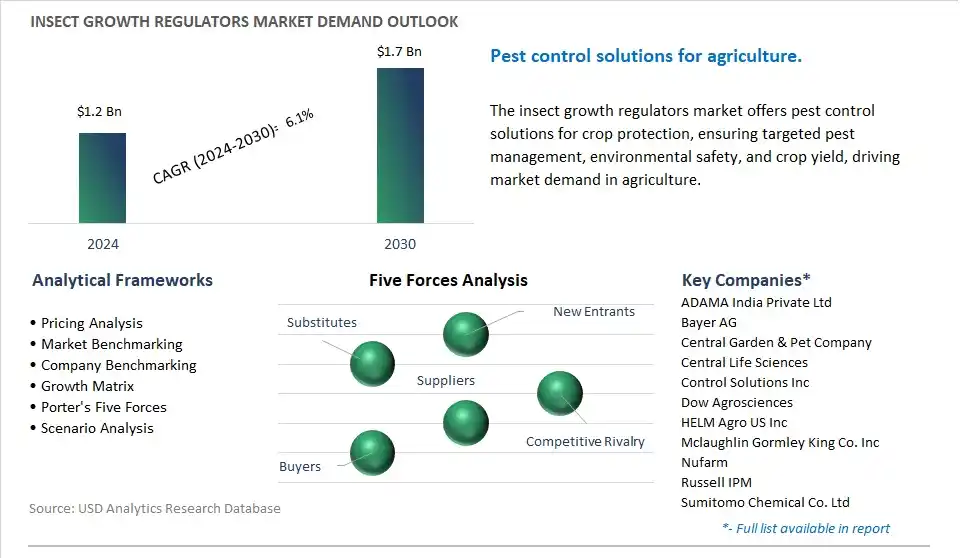
The global Insect Growth Regulators Market is poised to register a 6.1% CAGR from $1.2 Billion in 2024 to $1.7 Billion in 2030.
The global Insect Growth Regulators Market Study analyzes and forecasts the market size across 6 regions and 24 countries for diverse segments -By Product (Chitin Synthesis Inhibitors, Juvenile Hormone Analogy, Anti-Juvenile Hormone Agents), By Form (Aerosol, Liquid, Bait), By Application (Agriculture, Livestock Pest, Commercial Pest Control).
An Introduction to Global Insect Growth Regulators Market in 2024
Insect growth regulators (IGRs) are chemical compounds that disrupt the growth and development of insects by interfering with their hormonal regulation, metamorphosis, or reproduction, used in pest management programs in agriculture, forestry, public health, and urban pest control. One key trend shaping the future of insect growth regulators is the development of novel compounds and formulations with improved efficacy, selectivity, and safety profiles for targeted pest control while minimizing adverse effects on non-target organisms and the environment. Pesticide manufacturers and researchers are innovating new IGR chemistries, such as juvenile hormone analogs, chitin synthesis inhibitors, and ecdysone agonists, with enhanced stability, bioavailability, and insecticidal activity, enabling effective pest suppression with lower application rates and reduced environmental impact compared to conventional pesticides. Additionally, advancements in formulation technologies, such as microencapsulation, nanotechnology, and biopesticides, are improving IGR delivery, persistence, and compatibility with integrated pest management (IPM) strategies, promoting sustainable pest control practices and reducing reliance on broad-spectrum chemical pesticides. Moreover, the integration of precision agriculture technologies, such as remote sensing, geographic information systems (GIS), and drone-based applications, is enabling targeted application of IGRs and real-time monitoring of pest populations, optimizing pest control efficacy while minimizing pesticide residues and off-target effects in agricultural ecosystems. As agriculture seeks to balance crop protection with environmental sustainability and regulatory compliance, the market for insect growth regulators is poised for innovation and growth, with opportunities for collaboration, research, and market expansion to meet the evolving needs of pest control professionals, growers, and regulatory authorities.
Insect Growth Regulators Market Competitive Landscape
The market report analyses the leading companies in the industry including ADAMA India Private Ltd, Bayer AG, Central Garden & Pet Company, Central Life Sciences, Control Solutions Inc, Dow Agrosciences, HELM Agro US Inc, Mclaughlin Gormley King Co. Inc, Nufarm, Russell IPM, Sumitomo Chemical Co. Ltd, Syngenta AG, Valent U.S.A. LLC.
Insect Growth Regulators Market Dynamics
Insect Growth Regulators Market Trend: Increased Adoption in Integrated Pest Management Programs
A prominent trend in the market for insect growth regulators (IGRs) is the increased adoption of IGRs in integrated pest management (IPM) programs. IPM emphasizes the use of multiple pest control strategies, including biological, cultural, physical, and chemical methods, to manage pest populations effectively while minimizing environmental impact. IGRs, which disrupt the development and reproduction of insects without harming non-target organisms, are gaining popularity as sustainable alternatives to traditional insecticides in IPM programs. The trend towards integrated pest management reflects the industry's shift towards environmentally friendly pest control solutions and the growing awareness of the need for sustainable agriculture practices to address pest resistance, minimize pesticide residues, and protect ecosystem health.
Insect Growth Regulators Market Driver: Growing Demand for Safer and Environmentally Friendly Pest Control Solutions
A key driver propelling the market for insect growth regulators (IGRs) is the growing demand for safer and environmentally friendly pest control solutions. With increasing concerns over pesticide residues, human health risks, and environmental pollution associated with conventional insecticides, there is a rising need for alternative pest control products that offer effective control of insect pests while minimizing adverse effects on non-target organisms and ecosystems. IGRs, which target specific stages of insect development such as egg hatch, larval growth, and pupation, provide targeted control with reduced toxicity to beneficial insects, birds, and mammals, making them an attractive option for environmentally conscious growers, pest control operators, and consumers.
Insect Growth Regulators Market Opportunity: Expansion into Urban Pest Control and Public Health Applications
An opportunity for growth in the market for insect growth regulators (IGRs) lies in the expansion into urban pest control and public health applications. While IGRs are commonly used in agricultural settings to manage insect pests in crops, there is potential for their application in urban environments to control pests such as mosquitoes, flies, cockroaches, and ants. Urban pest control, including vector control for disease prevention and management of nuisance pests in residential, commercial, and public areas, presents a significant market opportunity for IGR products. By targeting insect pests at their developmental stages and disrupting their reproduction, IGRs can offer effective and sustainable pest control solutions for urban environments, contributing to public health, sanitation, and quality of life in urban communities. Additionally, partnerships with public health agencies, pest control companies, and municipalities can facilitate the adoption and implementation of IGR-based pest control programs in urban settings, further driving market growth and expansion.
Insect Growth Regulators Market Ecosystem
In the Insect Growth Regulator (IGR) market, research and development are conducted by various entities including government research institutions including the USDA Agricultural Research Service, chemical companies including BASF SE and Bayer CropScience AG, as well as universities and private research firms. These efforts focus on developing new IGR molecules with improved efficacy and target specificity. Chemical manufacturers including Syngenta Crop Protection AG and Sumitomo Chemical Co., Ltd. are responsible for producing the core IGR molecules through various chemical synthesis processes. Formulators, including Adama Agricultural Solutions Ltd., then take these active ingredients and develop different formulations suitable for various application methods including sprays, baits, and emulsifiable concentrates.
Manufacturing of formulated IGR products can be conducted by companies with their facilities or through external manufacturers. Distribution channels include direct sales teams, agricultural supply stores, distributors specializing in pest control products, and online retailers. End-users of IGRs include farmers for agricultural pest control, public health departments for vector control, and homeowners and gardeners for pest control in residential areas.
Insect Growth Regulators Market Share Analysis: Chitin Synthesis Inhibitors held the dominant revenue share in 2024
The Chitin Synthesis Inhibitors segment stands as the largest sector in the Insect Growth Regulators Market, driven by diverse pivotal factors contributing to its dominance. Chitin synthesis inhibitors (CSIs) are compounds that disrupt the formation of chitin, a crucial component of the insect exoskeleton, during the molting process, leading to abnormal growth and development in insects. CSIs are widely used in pest management programs to control a broad spectrum of insect pests in agriculture, horticulture, and public health. One of the primary advantages of CSIs is their specificity to insects, making them effective against a wide range of insect pests while posing minimal risk to non-target organisms, including humans, animals, and beneficial insects. Additionally, CSIs exhibit long-lasting residual activity, providing extended protection against insect pests even after application. Further, CSIs offer versatility in application methods, including foliar sprays, soil drenches, seed treatments, and trunk injections, allowing for flexible and targeted pest control strategies. In addition, CSIs are compatible with integrated pest management (IPM) approaches, where they can be used in combination with other pest control tactics, such as biological control agents, cultural practices, and insecticides, to achieve synergistic effects and reduce reliance on conventional chemical pesticides. Additionally, CSIs contribute to sustainable pest management by minimizing environmental impact, reducing pesticide residues in food and the environment, and preserving beneficial insect populations. Further, the growing demand for safe and environmentally friendly pest control solutions, coupled with regulatory restrictions on conventional insecticides, drives the adoption of CSIs in agriculture and public health programs. As farmers, growers, and pest control professionals seek effective and sustainable alternatives to conventional pesticides, the chitin synthesis inhibitors segment of the insect growth regulators market is expected to maintain its leading position and witness sustained growth in the foreseeable future.
Insect Growth Regulators Market Share Analysis: Bait is the fastest growing market segment over the forecast period to 2030
The bait segment is the fastest-growing sector in the Insect Growth Regulators Market, driven by diverse critical factors propelling its rapid expansion. Insect growth regulators (IGRs) formulated as baits offer a highly effective and targeted approach to pest management, particularly in urban and residential settings. Baits are designed to attract and be ingested by target pests, such as ants, cockroaches, and termites, delivering the active ingredient directly to the pest population. One of the primary advantages of bait formulations is their ability to target specific pest species while minimizing exposure to non-target organisms, including humans, pets, and beneficial insects. Additionally, bait formulations containing insect growth regulators disrupt the growth and development of insects by interfering with key physiological processes, such as molting, metamorphosis, and reproduction, leading to population suppression and control. In addition, bait formulations provide residual activity, as the active ingredient remains effective even after application, ensuring prolonged control of pest populations. Further, bait formulations offer convenience and ease of application, allowing for targeted placement in areas frequented by pests, such as kitchens, bathrooms, and entry points. Additionally, bait formulations are compatible with integrated pest management (IPM) strategies, where they can be used in combination with other pest control tactics, such as sanitation, exclusion, and monitoring, to achieve long-term pest control solutions. In addition, the growing demand for sustainable and environmentally friendly pest control methods, coupled with regulatory restrictions on conventional pesticides, drives the adoption of bait formulations containing insect growth regulators. As consumers and pest management professionals seek safe, effective, and eco-friendly alternatives to conventional insecticides, the bait segment of the insect growth regulators market is expected to experience robust growth, presenting lucrative opportunities for manufacturers and suppliers of bait formulations containing insect growth regulators.
Insect Growth Regulators Market Share Analysis: Livestock Pest is the fastest growing market segment over the forecast period to 2030
The livestock pest segment is the fastest-growing sector in the Insect Growth Regulators Market, driven by diverse critical factors propelling its rapid expansion. Livestock pests, such as flies, ticks, mites, and fleas, pose significant challenges to animal health, welfare, and productivity in livestock production systems worldwide. Insect growth regulators (IGRs) play a crucial role in livestock pest management by disrupting the growth and development of insect pests, thereby reducing their populations and the associated economic losses and health risks to livestock. One of the primary advantages of using IGRs in livestock pest control is their targeted action against specific pest species while minimizing harm to non-target organisms, including livestock, humans, and beneficial insects. Additionally, IGRs formulated for livestock pest control offer versatility in application methods, including topical sprays, dips, dusts, and feed additives, allowing for flexible and integrated pest management strategies tailored to specific livestock species and production systems. In addition, IGRs provide residual activity, as they continue to inhibit insect growth and development even after application, providing prolonged protection against pest infestations. Further, the growing demand for sustainable and environmentally friendly pest control solutions in livestock production, coupled with regulatory restrictions on conventional pesticides, drives the adoption of IGRs in livestock pest management programs. Additionally, the increasing awareness of zoonotic diseases and the importance of biosecurity measures in livestock production systems further underscore the need for effective and safe pest control solutions, such as IGRs. As livestock producers and animal health professionals prioritize the health, welfare, and productivity of livestock while minimizing environmental impact, the livestock pest segment of the insect growth regulators market is expected to experience robust growth, presenting lucrative opportunities for manufacturers and suppliers of IGRs formulated for livestock pest control applications.
Insect Growth Regulators Market Report Scope-
By Product
Chitin Synthesis Inhibitors
Juvenile Hormone Analogy
Anti-Juvenile Hormone Agents
By Form
Aerosol
Liquid
Bait
By Application
Agriculture
Livestock Pest
Commercial Pest Control
Insect Growth Regulators Market Companies Profiled
ADAMA India Private Ltd
Bayer AG
Central Garden & Pet Company
Central Life Sciences
Control Solutions Inc
Dow Agrosciences
HELM Agro US Inc
Mclaughlin Gormley King Co. Inc
Nufarm
Russell IPM
Sumitomo Chemical Co. Ltd
Syngenta AG
Valent U.S.A. LLC
*- List Not Exhaustive
TABLE OF CONTENTS
1 Introduction to 2024 Insect Growth Regulators Market
1.1 Market Overview
1.2 Quick Facts
1.3 Scope/Objective of the Study
1.4 Market Definition
1.5 Countries and Regions Covered
1.6 Units, Currency, and Conversions
1.7 Industry Value Chain
2 Research Methodology
2.1 Market Size Estimation
2.2 Sources and Research Methodology
2.3 Data Triangulation
2.4 Assumptions and Limitations
3 Executive Summary
3.1 Global Insect Growth Regulators Market Size Outlook, $ Million, 2021 to 2030
3.2 Insect Growth Regulators Market Outlook by Type, $ Million, 2021 to 2030
3.3 Insect Growth Regulators Market Outlook by Product, $ Million, 2021 to 2030
3.4 Insect Growth Regulators Market Outlook by Application, $ Million, 2021 to 2030
3.5 Insect Growth Regulators Market Outlook by Key Countries, $ Million, 2021 to 2030
4 Market Dynamics
4.1 Key Driving Forces of Insect Growth Regulators Industry
4.2 Key Market Trends in Insect Growth Regulators Industry
4.3 Potential Opportunities in Insect Growth Regulators Industry
4.4 Key Challenges in Insect Growth Regulators Industry
5 Market Factor Analysis
5.1 Value Chain Analysis
5.2 Competitive Landscape
5.2.1 Global Insect Growth Regulators Market Share by Company (%), 2023
5.2.2 Product Offerings by Company
5.3 Porter’s Five Forces Analysis
5.4 Pricing Analysis and Outlook
6 Growth Outlook Across Scenarios
6.1 Growth Analysis-Case Scenario Definitions
6.2 Low Growth Scenario Forecasts
6.3 Reference Growth Scenario Forecasts
6.4 High Growth Scenario Forecasts
7 Global Insect Growth Regulators Market Outlook by Segments
7.1 Insect Growth Regulators Market Outlook by Segments, $ Million, 2021- 2030
By Product
Chitin Synthesis Inhibitors
Juvenile Hormone Analogy
Anti-Juvenile Hormone Agents
By Form
Aerosol
Liquid
Bait
By Application
Agriculture
Livestock Pest
Commercial Pest Control
8 North America Insect Growth Regulators Market Analysis and Outlook To 2030
8.1 Introduction to North America Insect Growth Regulators Markets in 2024
8.2 North America Insect Growth Regulators Market Size Outlook by Country, 2021-2030
8.2.1 United States
8.2.2 Canada
8.2.3 Mexico
8.3 North America Insect Growth Regulators Market size Outlook by Segments, 2021-2030
By Product
Chitin Synthesis Inhibitors
Juvenile Hormone Analogy
Anti-Juvenile Hormone Agents
By Form
Aerosol
Liquid
Bait
By Application
Agriculture
Livestock Pest
Commercial Pest Control
9 Europe Insect Growth Regulators Market Analysis and Outlook To 2030
9.1 Introduction to Europe Insect Growth Regulators Markets in 2024
9.2 Europe Insect Growth Regulators Market Size Outlook by Country, 2021-2030
9.2.1 Germany
9.2.2 France
9.2.3 Spain
9.2.4 United Kingdom
9.2.4 Italy
9.2.5 Russia
9.2.6 Norway
9.2.7 Rest of Europe
9.3 Europe Insect Growth Regulators Market Size Outlook by Segments, 2021-2030
By Product
Chitin Synthesis Inhibitors
Juvenile Hormone Analogy
Anti-Juvenile Hormone Agents
By Form
Aerosol
Liquid
Bait
By Application
Agriculture
Livestock Pest
Commercial Pest Control
10 Asia Pacific Insect Growth Regulators Market Analysis and Outlook To 2030
10.1 Introduction to Asia Pacific Insect Growth Regulators Markets in 2024
10.2 Asia Pacific Insect Growth Regulators Market Size Outlook by Country, 2021-2030
10.2.1 China
10.2.2 India
10.2.3 Japan
10.2.4 South Korea
10.2.5 Indonesia
10.2.6 Malaysia
10.2.7 Australia
10.2.8 Rest of Asia Pacific
10.3 Asia Pacific Insect Growth Regulators Market size Outlook by Segments, 2021-2030
By Product
Chitin Synthesis Inhibitors
Juvenile Hormone Analogy
Anti-Juvenile Hormone Agents
By Form
Aerosol
Liquid
Bait
By Application
Agriculture
Livestock Pest
Commercial Pest Control
11 South America Insect Growth Regulators Market Analysis and Outlook To 2030
11.1 Introduction to South America Insect Growth Regulators Markets in 2024
11.2 South America Insect Growth Regulators Market Size Outlook by Country, 2021-2030
11.2.1 Brazil
11.2.2 Argentina
11.2.3 Rest of South America
11.3 South America Insect Growth Regulators Market size Outlook by Segments, 2021-2030
By Product
Chitin Synthesis Inhibitors
Juvenile Hormone Analogy
Anti-Juvenile Hormone Agents
By Form
Aerosol
Liquid
Bait
By Application
Agriculture
Livestock Pest
Commercial Pest Control
12 Middle East and Africa Insect Growth Regulators Market Analysis and Outlook To 2030
12.1 Introduction to Middle East and Africa Insect Growth Regulators Markets in 2024
12.2 Middle East and Africa Insect Growth Regulators Market Size Outlook by Country, 2021-2030
12.2.1 Saudi Arabia
12.2.2 UAE
12.2.3 Oman
12.2.4 Rest of Middle East
12.2.5 Egypt
12.2.6 Nigeria
12.2.7 South Africa
12.2.8 Rest of Africa
12.3 Middle East and Africa Insect Growth Regulators Market size Outlook by Segments, 2021-2030
By Product
Chitin Synthesis Inhibitors
Juvenile Hormone Analogy
Anti-Juvenile Hormone Agents
By Form
Aerosol
Liquid
Bait
By Application
Agriculture
Livestock Pest
Commercial Pest Control
13 Company Profiles
13.1 Company Snapshot
13.2 SWOT Profiles
13.3 Products and Services
13.4 Recent Developments
13.5 Financial Profile
ADAMA India Private Ltd
Bayer AG
Central Garden & Pet Company
Central Life Sciences
Control Solutions Inc
Dow Agrosciences
HELM Agro US Inc
Mclaughlin Gormley King Co. Inc
Nufarm
Russell IPM
Sumitomo Chemical Co. Ltd
Syngenta AG
Valent U.S.A. LLC
14 Appendix
14.1 Customization Offerings
14.2 Subscription Services
14.3 Related Reports
14.4 Publisher Expertise
