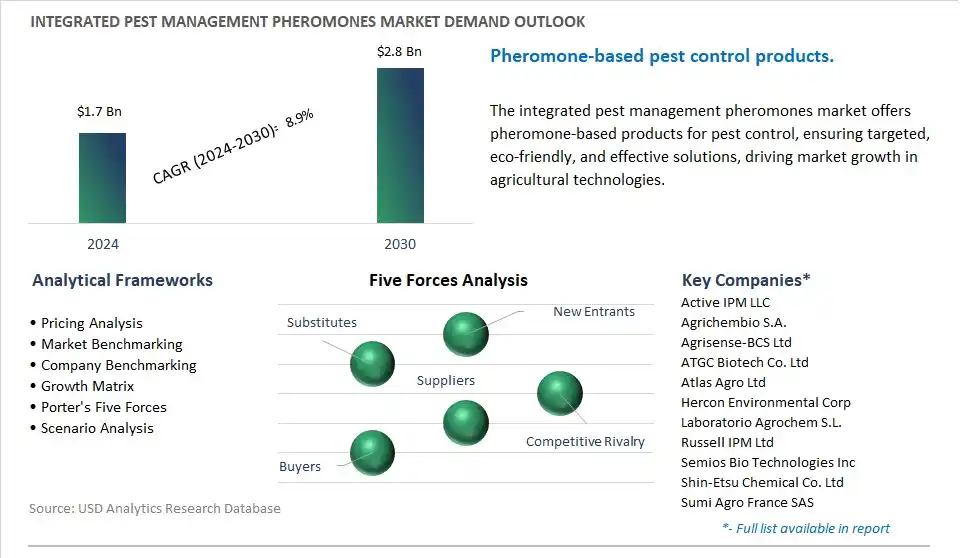
The global Integrated Pest Management Pheromones Market is poised to register a 8.9% CAGR from $1.7 Billion in 2024 to $2.8 Billion in 2030.
The global Integrated Pest Management Pheromones Market Study analyzes and forecasts the market size across 6 regions and 24 countries for diverse segments -By Product (Sex Pheromones, Aggregation Pheromones, Alarm Pheromones, Others), By Application (Monitoring & Detection, Mating Disruption, Mass Trapping, Others).
An Introduction to Global Integrated Pest Management Pheromones Market in 2024
Integrated Pest Management (IPM) pheromones are chemical compounds produced by insects to communicate with each other for mating, aggregation, or alarm signaling, used in pest management programs to monitor, attract, or disrupt pest behavior and reproduction. One key trend shaping the future of IPM pheromones is the development of novel pheromone formulations and delivery systems to enhance efficacy, specificity, and sustainability in pest control while minimizing non-target effects and environmental impact. Pheromone manufacturers and researchers are innovating new pheromone blends, lure designs, and dispensing technologies tailored to the behavior and biology of target pests, optimizing attraction, mating disruption, or mass trapping strategies for effective population control and pest suppression. Additionally, advancements in pheromone synthesis, purification, and formulation techniques are improving pheromone stability, longevity, and release kinetics, ensuring reliable performance and cost-effectiveness in diverse agricultural, forestry, and urban pest management applications. Moreover, the integration of pheromone-based monitoring and control systems with digital agriculture platforms, sensor networks, and data analytics is enabling real-time decision support, remote monitoring, and predictive modeling of pest dynamics, facilitating proactive pest management strategies and reducing reliance on chemical pesticides. As agriculture and pest control industries seek to transition to more sustainable and environmentally friendly pest management practices, the market for IPM pheromones is poised for innovation and growth, with opportunities for collaboration, research, and market expansion to meet the evolving needs of growers, pest control professionals, and regulatory authorities.
Integrated Pest Management Pheromones Market Competitive Landscape
The market report analyses the leading companies in the industry including Active IPM LLC, Agrichembio S.A., Agrisense-BCS Ltd, ATGC Biotech Co. Ltd, Atlas Agro Ltd, Hercon Environmental Corp, Laboratorio Agrochem S.L., Russell IPM Ltd, Semios Bio Technologies Inc, Shin-Etsu Chemical Co. Ltd, Sumi Agro France SAS, Syngenta Bioline Ltd, Trécé Inc.
Integrated Pest Management Pheromones Market Dynamics
Integrated Pest Management Pheromones Market Trend: Adoption of Environmentally Friendly Pest Control Solutions
A prominent trend in the market for integrated pest management (IPM) pheromones is the widespread adoption of environmentally friendly pest control solutions. With increasing awareness of the environmental impact of chemical pesticides and the rise of sustainable agriculture practices, there is a growing preference for pest management strategies that minimize reliance on conventional insecticides. Integrated pest management (IPM) pheromones, which utilize natural insect communication signals to disrupt mating patterns and control pest populations, are gaining popularity as eco-friendly alternatives to chemical pesticides. The shift towards environmentally friendly pest control solutions, biodiversity conservation, and the protection of beneficial insects is driving the adoption of IPM pheromones across various agricultural, horticultural, and forestry sectors.
Integrated Pest Management Pheromones Market Driver: Regulatory Restrictions on Synthetic Pesticides
A key driver propelling the market for integrated pest management (IPM) pheromones is regulatory restrictions on synthetic pesticides. Governments, regulatory agencies, and food safety standards organizations worldwide are imposing stringent regulations and restrictions on the use of chemical pesticides to minimize environmental contamination, protect human health, and ensure food safety. Regulatory measures such as pesticide bans, usage restrictions, and residue limits are driving the need for alternative pest control solutions that offer effective control while minimizing adverse effects on non-target organisms and ecosystems. Integrated pest management (IPM) pheromones provide a sustainable and targeted approach to pest control that aligns with regulatory requirements, driving the demand for pheromone-based solutions as essential components of integrated pest management programs.
Integrated Pest Management Pheromones Market Opportunity: Expansion into New Crop Types and Geographies
An opportunity for growth in the market for integrated pest management (IPM) pheromones lies in the expansion into new crop types and geographies. While IPM pheromones have traditionally been used in certain crops such as fruits, vegetables, and specialty crops, there is potential to extend their application to a wider range of crop types and geographic regions. By developing pheromone formulations tailored to specific pest species and crop pests, manufacturers can address the unique pest control challenges faced by different agricultural sectors and regions. Additionally, there is an opportunity to expand into new geographic markets where pest pressures, regulatory environments, and agricultural practices vary, providing potential for market growth and diversification. By leveraging advancements in pheromone chemistry, formulation technologies, and delivery systems, companies can capitalize on the opportunity to expand their product portfolios and capture new market opportunities in the global integrated pest management (IPM) pheromones market.
Integrated Pest Management Pheromones Market Ecosystem
The Integrated Pest Management (IPM) pheromones market is a multifaceted industry involving various stages and companies. Research and development conducted by institutions including the USDA Agricultural Research Service and pheromone manufacturers including Trécé Incorporated focus on identifying and synthesizing new pheromones tailored to target specific pest species. Further, pheromone production by companies including Shin-Etsu Chemical Co., Ltd., and biotechnology firms including Pheromone Biosciences Ltd. involves large-scale manufacturing of synthetic or biologically derived pheromones. Formulation developers including Suterra LLC play a crucial role in creating pheromone formulations suitable for different application methods, ensuring controlled release and effectiveness in the field.
The manufacturing stage involves companies including PheroTech Inc. specializing in producing pheromone traps and dispensers, either independently or through contract manufacturers. Distribution and sales channels cater to diverse end-users, including farmers, homeowners & gardeners, and forestry & conservation departments, which utilize IPM pheromones for pest management across agricultural, residential, and environmental applications.
Integrated Pest Management Pheromones Market Share Analysis: Sex Pheromones held the dominant revenue share in 2024
The Sex Pheromones segment is the largest in the Integrated Pest Management (IPM) Pheromones Market due to diverse compelling reasons. Firstly, sex pheromones play a crucial role in pest control by disrupting the mating behavior of target pests, thereby reducing their reproductive rates and population growth. This method offers a highly targeted and environmentally friendly approach to pest management, as it specifically targets the reproductive behavior of pests without harming beneficial organisms or polluting the environment with chemical residues. Additionally, sex pheromone-based products are widely adopted in agriculture, forestry, and urban pest management due to their effectiveness, safety, and compatibility with integrated pest management practices. Further, advancements in pheromone synthesis and formulation technologies have led to the development of more efficient and cost-effective sex pheromone products, further driving their widespread adoption across various pest management applications. With their proven efficacy and versatility, sex pheromones continue to dominate the Integrated Pest Management Pheromones Market, offering sustainable solutions to pest control challenges worldwide.
Integrated Pest Management Pheromones Market Share Analysis: Mating Disruption is the fastest growing market segment over the forecast period to 2030
The Mating Disruption segment is the fastest-growing segment in the Integrated Pest Management (IPM) Pheromones Market due to diverse pivotal factors. Firstly, mating disruption offers a highly effective and environmentally friendly method for controlling pest populations by interfering with the mating behavior of target insects. By releasing synthetic pheromones that mimic those emitted by female insects, mating disruption confuses male insects, preventing them from locating and mating with females successfully. This disrupts the reproductive cycle of pests, leading to a decline in population numbers over time. Additionally, mating disruption is widely applicable across various pest management scenarios, including agriculture, forestry, and urban environments, making it a versatile and sought-after solution for pest control challenges. In addition, growing concerns about the environmental and health impacts of chemical pesticides have spurred increased adoption of sustainable pest management practices like mating disruption. With its proven efficacy, safety, and applicability, the Mating Disruption segment is poised for rapid growth in the IPM Pheromones Market, offering a promising solution to pest management needs worldwide.
Integrated Pest Management Pheromones Market Report Scope-
By Product
Sex Pheromones
Aggregation Pheromones
Alarm Pheromones
Others
By Application
Monitoring & Detection
Mating Disruption
Mass Trapping
Others
Integrated Pest Management Pheromones Market Companies Profiled
Active IPM LLC
Agrichembio S.A.
Agrisense-BCS Ltd
ATGC Biotech Co. Ltd
Atlas Agro Ltd
Hercon Environmental Corp
Laboratorio Agrochem S.L.
Russell IPM Ltd
Semios Bio Technologies Inc
Shin-Etsu Chemical Co. Ltd
Sumi Agro France SAS
Syngenta Bioline Ltd
Trécé Inc
*- List Not Exhaustive
TABLE OF CONTENTS
1 Introduction to 2024 Integrated Pest Management Pheromones Market
1.1 Market Overview
1.2 Quick Facts
1.3 Scope/Objective of the Study
1.4 Market Definition
1.5 Countries and Regions Covered
1.6 Units, Currency, and Conversions
1.7 Industry Value Chain
2 Research Methodology
2.1 Market Size Estimation
2.2 Sources and Research Methodology
2.3 Data Triangulation
2.4 Assumptions and Limitations
3 Executive Summary
3.1 Global Integrated Pest Management Pheromones Market Size Outlook, $ Million, 2021 to 2030
3.2 Integrated Pest Management Pheromones Market Outlook by Type, $ Million, 2021 to 2030
3.3 Integrated Pest Management Pheromones Market Outlook by Product, $ Million, 2021 to 2030
3.4 Integrated Pest Management Pheromones Market Outlook by Application, $ Million, 2021 to 2030
3.5 Integrated Pest Management Pheromones Market Outlook by Key Countries, $ Million, 2021 to 2030
4 Market Dynamics
4.1 Key Driving Forces of Integrated Pest Management Pheromones Industry
4.2 Key Market Trends in Integrated Pest Management Pheromones Industry
4.3 Potential Opportunities in Integrated Pest Management Pheromones Industry
4.4 Key Challenges in Integrated Pest Management Pheromones Industry
5 Market Factor Analysis
5.1 Value Chain Analysis
5.2 Competitive Landscape
5.2.1 Global Integrated Pest Management Pheromones Market Share by Company (%), 2023
5.2.2 Product Offerings by Company
5.3 Porter’s Five Forces Analysis
5.4 Pricing Analysis and Outlook
6 Growth Outlook Across Scenarios
6.1 Growth Analysis-Case Scenario Definitions
6.2 Low Growth Scenario Forecasts
6.3 Reference Growth Scenario Forecasts
6.4 High Growth Scenario Forecasts
7 Global Integrated Pest Management Pheromones Market Outlook by Segments
7.1 Integrated Pest Management Pheromones Market Outlook by Segments, $ Million, 2021- 2030
By Product
Sex Pheromones
Aggregation Pheromones
Alarm Pheromones
Others
By Application
Monitoring & Detection
Mating Disruption
Mass Trapping
Others
8 North America Integrated Pest Management Pheromones Market Analysis and Outlook To 2030
8.1 Introduction to North America Integrated Pest Management Pheromones Markets in 2024
8.2 North America Integrated Pest Management Pheromones Market Size Outlook by Country, 2021-2030
8.2.1 United States
8.2.2 Canada
8.2.3 Mexico
8.3 North America Integrated Pest Management Pheromones Market size Outlook by Segments, 2021-2030
By Product
Sex Pheromones
Aggregation Pheromones
Alarm Pheromones
Others
By Application
Monitoring & Detection
Mating Disruption
Mass Trapping
Others
9 Europe Integrated Pest Management Pheromones Market Analysis and Outlook To 2030
9.1 Introduction to Europe Integrated Pest Management Pheromones Markets in 2024
9.2 Europe Integrated Pest Management Pheromones Market Size Outlook by Country, 2021-2030
9.2.1 Germany
9.2.2 France
9.2.3 Spain
9.2.4 United Kingdom
9.2.4 Italy
9.2.5 Russia
9.2.6 Norway
9.2.7 Rest of Europe
9.3 Europe Integrated Pest Management Pheromones Market Size Outlook by Segments, 2021-2030
By Product
Sex Pheromones
Aggregation Pheromones
Alarm Pheromones
Others
By Application
Monitoring & Detection
Mating Disruption
Mass Trapping
Others
10 Asia Pacific Integrated Pest Management Pheromones Market Analysis and Outlook To 2030
10.1 Introduction to Asia Pacific Integrated Pest Management Pheromones Markets in 2024
10.2 Asia Pacific Integrated Pest Management Pheromones Market Size Outlook by Country, 2021-2030
10.2.1 China
10.2.2 India
10.2.3 Japan
10.2.4 South Korea
10.2.5 Indonesia
10.2.6 Malaysia
10.2.7 Australia
10.2.8 Rest of Asia Pacific
10.3 Asia Pacific Integrated Pest Management Pheromones Market size Outlook by Segments, 2021-2030
By Product
Sex Pheromones
Aggregation Pheromones
Alarm Pheromones
Others
By Application
Monitoring & Detection
Mating Disruption
Mass Trapping
Others
11 South America Integrated Pest Management Pheromones Market Analysis and Outlook To 2030
11.1 Introduction to South America Integrated Pest Management Pheromones Markets in 2024
11.2 South America Integrated Pest Management Pheromones Market Size Outlook by Country, 2021-2030
11.2.1 Brazil
11.2.2 Argentina
11.2.3 Rest of South America
11.3 South America Integrated Pest Management Pheromones Market size Outlook by Segments, 2021-2030
By Product
Sex Pheromones
Aggregation Pheromones
Alarm Pheromones
Others
By Application
Monitoring & Detection
Mating Disruption
Mass Trapping
Others
12 Middle East and Africa Integrated Pest Management Pheromones Market Analysis and Outlook To 2030
12.1 Introduction to Middle East and Africa Integrated Pest Management Pheromones Markets in 2024
12.2 Middle East and Africa Integrated Pest Management Pheromones Market Size Outlook by Country, 2021-2030
12.2.1 Saudi Arabia
12.2.2 UAE
12.2.3 Oman
12.2.4 Rest of Middle East
12.2.5 Egypt
12.2.6 Nigeria
12.2.7 South Africa
12.2.8 Rest of Africa
12.3 Middle East and Africa Integrated Pest Management Pheromones Market size Outlook by Segments, 2021-2030
By Product
Sex Pheromones
Aggregation Pheromones
Alarm Pheromones
Others
By Application
Monitoring & Detection
Mating Disruption
Mass Trapping
Others
13 Company Profiles
13.1 Company Snapshot
13.2 SWOT Profiles
13.3 Products and Services
13.4 Recent Developments
13.5 Financial Profile
Active IPM LLC
Agrichembio S.A.
Agrisense-BCS Ltd
ATGC Biotech Co. Ltd
Atlas Agro Ltd
Hercon Environmental Corp
Laboratorio Agrochem S.L.
Russell IPM Ltd
Semios Bio Technologies Inc
Shin-Etsu Chemical Co. Ltd
Sumi Agro France SAS
Syngenta Bioline Ltd
Trécé Inc
14 Appendix
14.1 Customization Offerings
14.2 Subscription Services
14.3 Related Reports
14.4 Publisher Expertise
By Product
Sex Pheromones
Aggregation Pheromones
Alarm Pheromones
Others
By Application
Monitoring & Detection
Mating Disruption
Mass Trapping
Others
Countries Analyzed
North America (US, Canada, Mexico)
Europe (Germany, UK, France, Spain, Italy, Russia, Rest of Europe)
Asia Pacific (China, India, Japan, South Korea, Australia, South East Asia, Rest of Asia)
South America (Brazil, Argentina, Rest of South America)
Middle East and Africa (Saudi Arabia, UAE, Rest of Middle East, South Africa, Egypt, Rest of Africa)
