<h3><Strong><i>Internal Urinary Catheters Market is estimated to increase at a growth rate of 5.9% CAGR over the forecast period from 2024 to 2030.</h3></Strong></i>The global Internal Urinary Catheters Market Study analyzes and forecasts the market size across 6 regions and 24 countries for diverse segments including By Product (Indwelling catheters, Intermittent catheters), By End-User (Healthcare centers, Hospitals, Home care).
<h2>An Introduction to Internal Urinary Catheters Market in 2024</h2>The Internal Urinary Catheters Market encompasses a range of medical devices designed for managing urinary retention or incontinence by draining urine from the bladder. These catheters are inserted into the urethra and may include intermittent catheters, indwelling catheters (Foley catheters), and external catheters (condom catheters). Innovations in internal urinary catheters focus on materials, coatings, and designs that promote comfort, reduce the risk of infection, and provide effective drainage for patients with urinary dysfunction, contributing to improved quality of life and urinary care management.
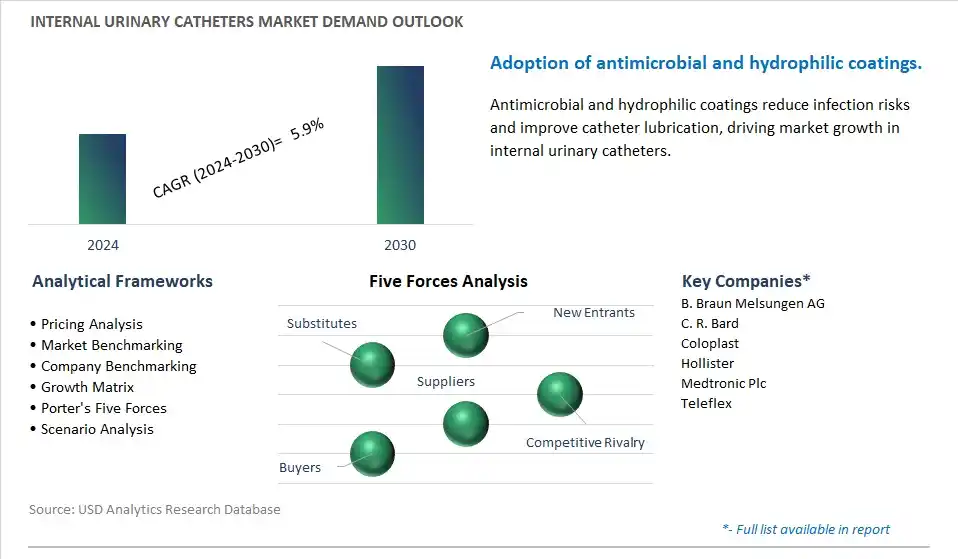
<h3>Internal Urinary Catheters Market Competitive Landscape</h3>The global Internal Urinary Catheters Industry is highly competitive with a large number of companies focusing on niche market segments. Amidst intense competitive conditions, Internal Urinary Catheters Companies are investing in new product launches and strengthening distribution channels. Key companies operating in the Internal Urinary Catheters Industry include- B. Braun Melsungen AG, C. R. Bard, Coloplast, Hollister, Medtronic Plc, Teleflex.<h3>Internal Urinary Catheters Market Trend: Development of Hydrophilic and Antimicrobial Coatings for Enhanced Comfort and Infection Control</h3>A notable trend in the market for internal urinary catheters is the development of catheters with hydrophilic and antimicrobial coatings. These coatings improve patient comfort during catheterization by reducing friction and irritation, while also helping to prevent urinary tract infections (UTIs) by inhibiting bacterial growth on the catheter surface. This trend reflects the growing emphasis on infection control and patient-centered care in urinary catheterization, driving innovation and product differentiation in the market.<h3>Internal Urinary Catheters Market Driver: Increasing Prevalence of Urinary Incontinence and Urinary Retention</h3>The primary driver of the internal urinary catheters market is the increasing prevalence of urinary incontinence and urinary retention, particularly among aging populations and individuals with neurological conditions. Urinary catheters are essential medical devices for managing these conditions by draining urine from the bladder, relieving discomfort, and preventing complications such as urinary tract infections and bladder overdistension. As the global burden of urinary disorders rises, so does the demand for internal urinary catheters, fueling market growth and innovation.<h3>Internal Urinary Catheters Market Opportunity: Focus on Compact and Disposable Catheter Designs for Home Use</h3>An opportunity in the internal urinary catheters market lies in the focus on compact and disposable catheter designs for home use. With the growing trend towards self-catheterization and home healthcare, there is increasing demand for catheters that are convenient, portable, and hygienic. Manufacturers can capitalize on this opportunity by developing compact, discreet, and easy-to-use catheters suitable for home use, as well as disposable options that minimize infection risk and eliminate the need for catheter maintenance, enhancing patient autonomy and quality of life.<h3>Internal Urinary Catheters Market Share Analysis: Intermittent Catheters is the fastest growing market segment over the forecast period to 2030</h3>Among the different types of internal urinary catheters, the Intermittent Catheters segment is experiencing the fastest growth. Intermittent catheters are designed for short-term catheterization, typically used to empty the bladder intermittently rather than remaining in place continuously like indwelling catheters. These catheters are commonly used by patients with various urinary conditions, including urinary retention, neurogenic bladder dysfunction, and urinary incontinence. The increasing preference for intermittent catheters can be attributed to several factors, including their lower risk of complications such as urinary tract infections (UTIs) and bladder irritation compared to indwelling catheters. Moreover, intermittent catheters offer greater mobility and independence to patients, allowing them to manage their urinary needs more discreetly and comfortably. As healthcare providers and patients recognize the benefits of intermittent catheterization, particularly in home care settings, the demand for these catheters is expected to continue growing rapidly, driving innovation and advancements in urinary catheter technology.<h2>Internal Urinary Catheters Market Segmentation</h2><Strong>By Product</Strong>
Indwelling catheters
Intermittent catheters
<Strong>By End-User</Strong>
Healthcare centers
Hospitals
Home care
<Strong>Geographical Analysis</Strong>
North America (United States, Canada, Mexico)
Europe (Germany, France, United Kingdom, Spain, Italy, Rest of Europe)
Asia Pacific (China, India, Japan, South Korea, Rest of Asia Pacific)
South America (Brazil, Argentina, Rest of South America)
Middle East and Africa (Saudi Arabia, UAE, Rest of Middle East, South Africa, Egypt, Rest of Africa)<h2>Internal Urinary Catheters Companies</h2>B. Braun Melsungen AG
C. R. Bard
Coloplast
Hollister
Medtronic Plc
Teleflex
* List not Exhaustive
<h3>Reasons to Buy the Internal Urinary Catheters Market Study</h3>• Deepen your industry insights and navigate uncertainties for strategy formulation, CAPEX, and Operational decisions
• Gain access to detailed insights on the Internal Urinary Catheters Market, encompassing current market size, growth trends, and forecasts till 2030.
• Access detailed competitor analysis, enabling competitive advantage through a thorough understanding of market players, strategies, and potential differentiation opportunities
• Stay ahead of the curve with insights on technological advancements, innovations, and upcoming trends
• Identify lucrative investment avenues and expansion opportunities within the Internal Urinary Catheters Industry, guided by robust, data-backed analysis.
• Understand regional and global markets through country-wise analysis, regional market potential, regulatory nuances, and dynamics
• Execute strategies with confidence and speed through information, analytics, and insights on the industry value chain
• Corporate leaders, strategists, financial experts, shareholders, asset managers, and governmental representatives can make long-term planning scenarios and build an integrated and timely understanding of market dynamics
• Benefit from tailored solutions and expert consultation based on report insights, providing personalized strategies aligned with specific business needs.
