
The Intravenous Equipment Market study analyzes and forecasts the market size across 6 regions and 24 countries for diverse segments- By Product (IV catheters, Infusion pumps, Administration sets, Needleless connectors, Others), By End-User (Hospitals and clinics, Homecare settings, Others).
In 2024, the market for intravenous (IV) equipment remains essential in healthcare settings, providing the necessary tools and devices for the safe and effective administration of fluids, medications, and blood products via the intravenous route. Intravenous therapy plays a crucial role in patient care, delivering therapeutic agents directly into the bloodstream for rapid absorption and distribution throughout the body. Intravenous equipment includes a wide range of components such as IV catheters, infusion sets, administration sets, IV pumps, and accessories designed to ensure accurate dosing, minimize contamination, and prevent complications such as infection and infiltration. Technological advancements in IV equipment, including the development of safety-engineered devices, smart infusion pumps with dose error reduction systems, and integrated infusion management systems, enhance patient safety, streamline workflow efficiency, and improve medication administration practices. With the increasing demand for intravenous therapy across various clinical specialties and care settings, the market for IV equipment is poised for continued growth and innovation, supporting optimal patient outcomes and healthcare delivery.
A prominent trend in the intravenous equipment market is the shift towards disposable and single-use devices. With increasing emphasis on infection control and patient safety in healthcare settings, there is a growing preference for intravenous equipment that can be used once and then discarded. Disposable IV sets, catheters, and infusion pumps reduce the risk of cross-contamination between patients and minimize the need for sterilization, leading to improved infection control practices and reduced healthcare-associated infections. Healthcare facilities are increasingly adopting disposable intravenous equipment to enhance patient care and safety, driving the demand for single-use devices in the intravenous equipment market.
A key driver for the intravenous equipment market is the rising incidence of chronic diseases and hospitalizations. Conditions such as cancer, diabetes, and cardiovascular diseases require intravenous therapies for medication administration, fluid resuscitation, and nutritional support. Additionally, an aging population and increasing healthcare utilization contribute to a higher number of hospitalizations, where intravenous equipment plays a crucial role in delivering essential treatments and therapies to patients. The growing prevalence of chronic diseases and hospital admissions drives the demand for intravenous equipment, including IV catheters, infusion pumps, and IV administration sets, to support the delivery of intravenous therapies and ensure optimal patient care outcomes.
An emerging opportunity in the intravenous equipment market lies in the innovation of wireless and smart intravenous devices. As healthcare technology continues to evolve, there is a demand for intravenous equipment that offers greater flexibility, connectivity, and automation to improve workflow efficiency and patient care delivery. Wireless IV pumps, smart infusion sets, and integrated monitoring systems enable healthcare providers to remotely monitor infusion therapy, adjust medication dosages, and receive real-time alerts for potential complications. By investing in the development of wireless and smart intravenous devices, manufacturers can meet the evolving needs of healthcare providers, enhance patient safety and comfort, and differentiate their offerings in the competitive intravenous equipment market. Additionally, the integration of advanced features such as dose tracking, drug libraries, and electronic health record (EHR) connectivity offers opportunities to optimize medication management practices and improve clinical outcomes in intravenous therapy administration.
In the Intravenous (IV) Equipment Market, the segment experiencing the fastest growth is Needleless Connectors. Needleless connectors are essential components used in intravenous therapy to facilitate the connection between IV catheters, administration sets, and infusion tubing without the need for needles. These connectors play a crucial role in reducing the risk of needlestick injuries, bloodstream infections, and other complications associated with traditional needle-based IV systems. Needleless connectors offer benefits such as improved safety, ease of use, and enhanced patient comfort during IV therapy. With healthcare facilities increasingly prioritizing patient safety and infection control measures, there is a growing demand for needleless connectors in hospitals, clinics, and homecare settings. Additionally, ongoing advancements in needleless connector technology, such as antimicrobial coatings, positive displacement designs, and integrated valve systems, further contribute to the segment's rapid growth in the IV equipment market. Consequently, the needleless connectors segment is poised for significant expansion in the Intravenous (IV) Equipment Market.
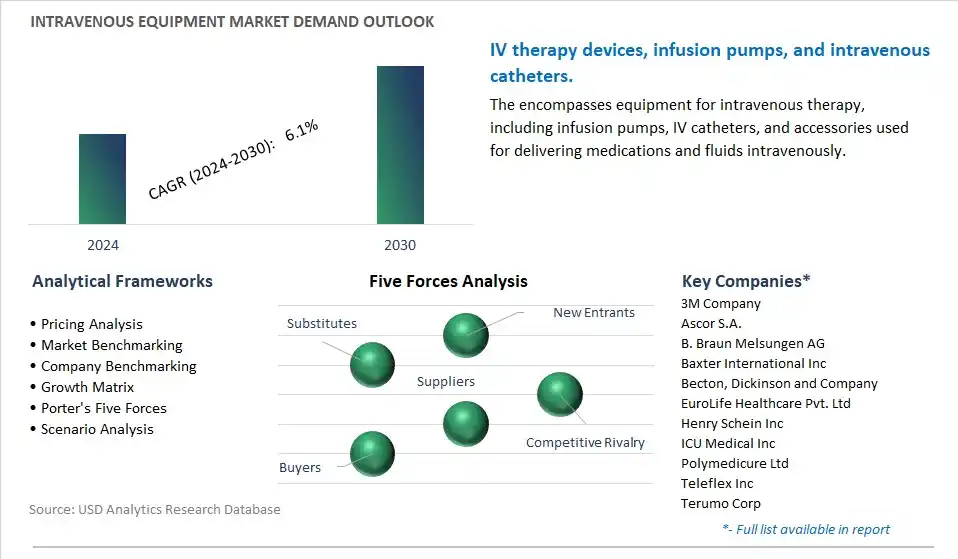
The market research study provides in-depth insights into leading companies including the SWOT analyses, product profile, financial details, and recent developments across3M Company, Ascor S.A., B. Braun Melsungen AG, Baxter International Inc, Becton, Dickinson and Company, EuroLife Healthcare Pvt. Ltd, Henry Schein Inc, ICU Medical Inc, Polymedicure Ltd, Teleflex Inc, Terumo Corp
By Product
IV catheters
Infusion pumps
Administration sets
Needleless connectors
Others
By End-User
Hospitals and clinics
Homecare settings
Others
Geographical Analysis
North America (United States, Canada, Mexico)
Europe (Germany, France, United Kingdom, Spain, Italy, Rest of Europe)
Asia Pacific (China, India, Japan, South Korea, Rest of Asia Pacific)
South America (Brazil, Argentina, Rest of South America)
Middle East and Africa (Saudi Arabia, UAE, Rest of Middle East, South Africa, Egypt, Rest of Africa)
3M Company
Ascor S.A.
B. Braun Melsungen AG
Baxter International Inc
Becton, Dickinson and Company
EuroLife Healthcare Pvt. Ltd
Henry Schein Inc
ICU Medical Inc
Polymedicure Ltd
Teleflex Inc
Terumo Corp
• Deepen your industry insights and navigate uncertainties for strategy formulation, CAPEX, and Operational decisions
• Gain access to detailed insights on the Intravenous Equipment Market, encompassing current market size, growth trends, and forecasts till 2030.
• Access detailed competitor analysis, enabling competitive advantage through a thorough understanding of market players, strategies, and potential differentiation opportunities
• Stay ahead of the curve with insights on technological advancements, innovations, and upcoming trends
• Identify lucrative investment avenues and expansion opportunities within the Intravenous Equipment Market industry, guided by robust, data-backed analysis.
• Understand regional and global markets through country-wise analysis, regional market potential, regulatory nuances, and dynamics
• Execute strategies with confidence and speed through information, analytics, and insights on the industry value chain
• Corporate leaders, strategists, financial experts, shareholders, asset managers, and governmental representatives can make long-term planning scenarios and build an integrated and timely understanding of market dynamics
• Benefit from tailored solutions and expert consultation based on report insights, providing personalized strategies aligned with specific business needs.
TABLE OF CONTENTS
1 Introduction to 2024 Intravenous Equipment Market
1.1 Market Overview
1.2 Quick Facts
1.3 Scope/Objective of the Study
1.4 Market Definition
1.5 Countries and Regions Covered
1.6 Units, Currency, and Conversions
1.7 Industry Value Chain
2 Research Methodology
2.1 Market Size Estimation
2.2 Sources and Research Methodology
2.3 Data Triangulation
2.4 Assumptions and Limitations
3 Executive Summary
3.1 Global Intravenous Equipment Market Size Outlook, $ Million, 2021 to 2030
3.2 Intravenous Equipment Market Outlook by Type, $ Million, 2021 to 2030
3.3 Intravenous Equipment Market Outlook by Product, $ Million, 2021 to 2030
3.4 Intravenous Equipment Market Outlook by Application, $ Million, 2021 to 2030
3.5 Intravenous Equipment Market Outlook by Key Countries, $ Million, 2021 to 2030
4 Market Dynamics
4.1 Key Driving Forces of Intravenous Equipment Industry
4.2 Key Market Trends in Intravenous Equipment Industry
4.3 Potential Opportunities in Intravenous Equipment Industry
4.4 Key Challenges in Intravenous Equipment Industry
5 Market Factor Analysis
5.1 Value Chain Analysis
5.2 Competitive Landscape
5.2.1 Global Intravenous Equipment Market Share by Company (%), 2023
5.2.2 Product Offerings by Company
5.3 Porter’s Five Forces Analysis
5.4 Pricing Analysis and Outlook
6 Growth Outlook Across Scenarios
6.1 Growth Analysis-Case Scenario Definitions
6.2 Low Growth Scenario Forecasts
6.3 Reference Growth Scenario Forecasts
6.4 High Growth Scenario Forecasts
7 Global Intravenous Equipment Market Outlook by Segments
7.1 Intravenous Equipment Market Outlook by Segments, $ Million, 2021- 2030
By Product
IV catheters
Infusion pumps
Administration sets
Needleless connectors
Others
By End-User
Hospitals and clinics
Homecare settings
Others
8 North America Intravenous Equipment Market Analysis and Outlook To 2030
8.1 Introduction to North America Intravenous Equipment Markets in 2024
8.2 North America Intravenous Equipment Market Size Outlook by Country, 2021-2030
8.2.1 United States
8.2.2 Canada
8.2.3 Mexico
8.3 North America Intravenous Equipment Market size Outlook by Segments, 2021-2030
By Product
IV catheters
Infusion pumps
Administration sets
Needleless connectors
Others
By End-User
Hospitals and clinics
Homecare settings
Others
9 Europe Intravenous Equipment Market Analysis and Outlook To 2030
9.1 Introduction to Europe Intravenous Equipment Markets in 2024
9.2 Europe Intravenous Equipment Market Size Outlook by Country, 2021-2030
9.2.1 Germany
9.2.2 France
9.2.3 Spain
9.2.4 United Kingdom
9.2.4 Italy
9.2.5 Russia
9.2.6 Norway
9.2.7 Rest of Europe
9.3 Europe Intravenous Equipment Market Size Outlook by Segments, 2021-2030
By Product
IV catheters
Infusion pumps
Administration sets
Needleless connectors
Others
By End-User
Hospitals and clinics
Homecare settings
Others
10 Asia Pacific Intravenous Equipment Market Analysis and Outlook To 2030
10.1 Introduction to Asia Pacific Intravenous Equipment Markets in 2024
10.2 Asia Pacific Intravenous Equipment Market Size Outlook by Country, 2021-2030
10.2.1 China
10.2.2 India
10.2.3 Japan
10.2.4 South Korea
10.2.5 Indonesia
10.2.6 Malaysia
10.2.7 Australia
10.2.8 Rest of Asia Pacific
10.3 Asia Pacific Intravenous Equipment Market size Outlook by Segments, 2021-2030
By Product
IV catheters
Infusion pumps
Administration sets
Needleless connectors
Others
By End-User
Hospitals and clinics
Homecare settings
Others
11 South America Intravenous Equipment Market Analysis and Outlook To 2030
11.1 Introduction to South America Intravenous Equipment Markets in 2024
11.2 South America Intravenous Equipment Market Size Outlook by Country, 2021-2030
11.2.1 Brazil
11.2.2 Argentina
11.2.3 Rest of South America
11.3 South America Intravenous Equipment Market size Outlook by Segments, 2021-2030
By Product
IV catheters
Infusion pumps
Administration sets
Needleless connectors
Others
By End-User
Hospitals and clinics
Homecare settings
Others
12 Middle East and Africa Intravenous Equipment Market Analysis and Outlook To 2030
12.1 Introduction to Middle East and Africa Intravenous Equipment Markets in 2024
12.2 Middle East and Africa Intravenous Equipment Market Size Outlook by Country, 2021-2030
12.2.1 Saudi Arabia
12.2.2 UAE
12.2.3 Oman
12.2.4 Rest of Middle East
12.2.5 Egypt
12.2.6 Nigeria
12.2.7 South Africa
12.2.8 Rest of Africa
12.3 Middle East and Africa Intravenous Equipment Market size Outlook by Segments, 2021-2030
By Product
IV catheters
Infusion pumps
Administration sets
Needleless connectors
Others
By End-User
Hospitals and clinics
Homecare settings
Others
13 Company Profiles
13.1 Company Snapshot
13.2 SWOT Profiles
13.3 Products and Services
13.4 Recent Developments
13.5 Financial Profile
List of Companies
3M Company
Ascor S.A.
B. Braun Melsungen AG
Baxter International Inc
Becton, Dickinson and Company
EuroLife Healthcare Pvt. Ltd
Henry Schein Inc
ICU Medical Inc
Polymedicure Ltd
Teleflex Inc
Terumo Corp
14 Appendix
14.1 Customization Offerings
14.2 Subscription Services
14.3 Related Reports
14.4 Publisher Expertise
By Product
IV catheters
Infusion pumps
Administration sets
Needleless connectors
Others
By End-User
Hospitals and clinics
Homecare settings
Others
Countries Analyzed
North America (United States, Canada, Mexico)
Europe (Germany, France, United Kingdom, Spain, Italy, Rest of Europe)
Asia Pacific (China, India, Japan, South Korea, Rest of Asia Pacific)
South America (Brazil, Argentina, Rest of South America)
Middle East and Africa (Saudi Arabia, UAE, Rest of Middle East, South Africa, Egypt, Rest of Africa)
The global Intravenous Equipment Market is one of the lucrative growth markets, poised to register a 6.1% growth (CAGR) between 2024 and 2030.
Emerging Markets across Asia Pacific, Europe, and Americas present robust growth prospects.
3M Company, Ascor S.A., B. Braun Melsungen AG, Baxter International Inc, Becton, Dickinson and Company, EuroLife Healthcare Pvt. Ltd, Henry Schein Inc, ICU Medical Inc, Polymedicure Ltd, Teleflex Inc, Terumo Corp
Base Year- 2023; Estimated Year- 2024; Historic Period- 2018-2023; Forecast period- 2024 to 2030; Currency: USD; Volume