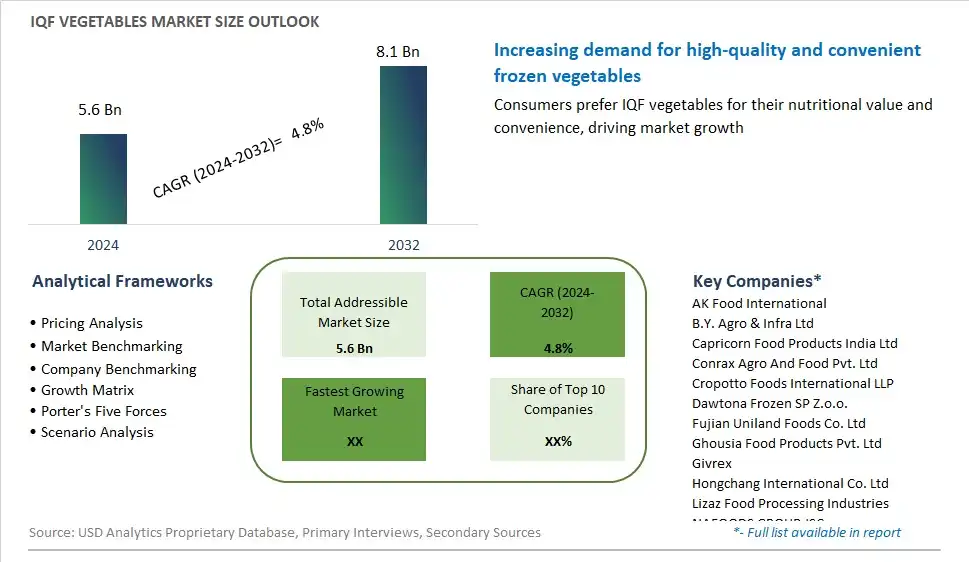
Global IQF Vegetables Market Size is valued at $5.6 Billion in 2024 and is forecast to register a growth rate (CAGR) of 4.8% to reach $8.1 Billion by 2032.
The global IQF Vegetables Market Comprehensive Study analyzes and forecasts the market size across 6 regions and 24 countries for diverse segments -By Nature (Conventional, Organic), By End-User (Commercial, Residential), By Distribution Channel (Online, Offline)
An Introduction to IQF Vegetables Market
In 2024, the market for individually quick frozen (IQF) vegetables continues to grow as consumers prioritize convenience, nutrition, and food safety in their diets. IQF vegetables are fresh vegetables that have been rapidly frozen individually, preserving their texture, flavor, color, and nutritional content without the need for preservatives or additives. With increasing demand for minimally processed and convenient food options, consumers are turning to IQF vegetables as versatile ingredients for cooking, meal preparation, and snacking. Moreover, the perception of frozen vegetables as nutritious and convenient alternatives to fresh produce has shifted, driven by advancements in freezing technology and packaging that maintain quality and freshness. As consumers seek convenient solutions for incorporating more fruits and vegetables into their diets, the market for IQF vegetables is poised for continued growth and innovation, offering opportunities for product diversification, packaging innovation, and partnerships between food manufacturers and retailers to meet evolving consumer preferences and lifestyle needs.
IQF Vegetables Competitive Landscape
The market report analyses the leading companies in the industry including AK Food International, B.Y. Agro & Infra Ltd, Capricorn Food Products India Ltd, Conrax Agro And Food Pvt. Ltd, Cropotto Foods International LLP, Dawtona Frozen SP Z.o.o., Fujian Uniland Foods Co. Ltd, Ghousia Food Products Pvt. Ltd, Givrex, Hongchang International Co. Ltd, Lizaz Food Processing Industries, NAFOODS GROUP JSC, Qingdao Elite Foods Co. Ltd, Relish Agro Food India Pvt. Ltd, Royal Foodstuffs Pvt. Ltd, Shimla Hills Offerings Pvt. Ltd, Sonderjansen BV, Varun Agro Processing Foods Pvt. Ltd, Vimo Foods Pvt. Ltd, Xiamen Sinocharm Co. Ltd, and Others.
IQF Vegetables Market Dynamics
IQF Vegetables Market Trend: Growing Preference for Convenience and Quality in Food
The market for IQF (Individually Quick Frozen) vegetables is experiencing a prominent trend towards the growing preference for convenience and quality in food, driven by factors such as busy lifestyles, increasing urbanization, and rising demand for healthy and easy-to-prepare meal options. As consumers seek convenient solutions that save time without compromising on nutritional value or taste, there is a rising demand for IQF vegetables that offer freshness, flavor, and convenience in meal preparation. This trend is fueled by changing consumer behaviors, dietary preferences, and the availability of a wide variety of IQF vegetable options in the market, driving market growth and adoption of IQF vegetables as a staple ingredient in home cooking, foodservice, and food manufacturing.
Market Driver: Demand for Extended Shelf Life and Food Safety
A key driver propelling the market for IQF vegetables is the demand for extended shelf life and food safety in the food industry, driven by factors such as globalization of supply chains, food safety regulations, and the need to reduce food waste. As food manufacturers, retailers, and consumers prioritize food safety and quality assurance, there is an increased preference for IQF vegetables that undergo rapid freezing processes to preserve freshness, nutrients, and flavor while minimizing the risk of microbial contamination and spoilage. This driver is further fueled by advancements in freezing technologies, packaging innovations, and cold chain logistics that ensure the integrity and safety of IQF vegetables throughout the supply chain, driving market growth and adoption of IQF vegetables as a reliable and versatile ingredient in food products.
Market Opportunity: Expansion into Plant-Based and Ready-to-Eat Meal Solutions
An opportunity exists for manufacturers of IQF vegetables to expand their product offerings and capitalize on the growing demand for plant-based and ready-to-eat meal solutions that cater to health-conscious consumers seeking convenient and nutritious options. By developing innovative blends, mixes, and meal kits featuring IQF vegetables as primary ingredients, manufacturers can offer convenient meal solutions that appeal to busy individuals, families, and foodservice operators looking for quick and healthy meal options. Moreover, leveraging trends such as vegetarianism, flexitarianism, and plant-forward diets can help position IQF vegetables as versatile ingredients that add color, texture, and nutritional value to a wide range of dishes, creating opportunities for market differentiation and growth in the competitive food industry landscape. This opportunity allows manufacturers to tap into emerging consumer trends, meet the evolving needs of modern consumers, and drive adoption of IQF vegetables as a convenient and healthy choice for meal preparation and consumption.
IQF Vegetables Market Share Analysis: Conventional IQF Vegetables held the dominant market share in 2024
In the IQF Vegetables Market, the Conventional segment is the largest, primarily due to its wide accessibility and affordability. Conventional IQF vegetables cater to a broad consumer base, offering convenient and cost-effective options that are readily available in supermarkets, grocery stores, and foodservice establishments worldwide. The affordability of conventional options makes them appealing to budget-conscious consumers, while their widespread availability ensures accessibility across various regions and demographics. Additionally, conventional IQF vegetables often come in a variety of types and packaging sizes, further expanding their appeal and versatility in various culinary applications. As a result, the conventional segment dominates the IQF vegetables market, reflecting its ability to meet the diverse demands of consumers seeking convenient and high-quality vegetable products.
IQF Vegetables Market Share Analysis: Commercial End-User market is poised to register the fastest growth rae over the forecast period to 2032
In the IQF Vegetables Market, the segment focused on Commercial End-Users is the fastest-growing, fueled by increasing demand from foodservice establishments, catering companies, and industrial kitchens. Commercial end-users rely on IQF vegetables for their convenience, versatility, and extended shelf life, allowing for efficient meal preparation and cost-effective inventory management. The rise in busy lifestyles and the growing preference for fresh-tasting and nutritious ingredients in commercial food operations contribute to the surge in demand for IQF vegetables. Additionally, the versatility of IQF vegetables, which can be used in a wide range of culinary applications, further drives their adoption in commercial settings. Further, advancements in freezing technology and packaging solutions enhance the quality and preservation of IQF vegetables, making them increasingly appealing to commercial buyers. As foodservice operators strive to meet consumer demand for convenience and quality, the commercial segment of the IQF vegetables market experiences rapid growth, reshaping the landscape of the industry.
IQF Vegetables Market Share Analysis: Offline Distribution Channels held the dominant market share in 2024
In the IQF Vegetables Market, the segment focused on Offline Distribution Channels is the largest, driven by established retail networks and consumer preferences for in-person shopping experiences. Offline channels, comprising supermarkets, grocery stores, specialty food stores, and wholesale markets, offer a physical presence where consumers can browse, inspect, and purchase IQF vegetables with confidence. Additionally, the immediacy of offline purchases provides consumers with instant access to a wide variety of products, eliminating the wait associated with online orders and shipping times. Furthermore, offline retailers often provide personalized assistance and recommendations from knowledgeable staff, enhancing the shopping experience and fostering consumer trust. As a result, the convenience, accessibility, and reliability associated with offline distribution channels solidify their dominance in the IQF vegetables market.
IQF Vegetables Market Segmentation
By Nature
Conventional
Organic
By End-User
Commercial
Residential
By Distribution Channel
Online
Offline
Countries Analyzed
North America (US, Canada, Mexico)
Europe (Germany, UK, France, Spain, Italy, Russia, Rest of Europe)
Asia Pacific (China, India, Japan, South Korea, Australia, South East Asia, Rest of Asia)
South America (Brazil, Argentina, Rest of South America)
Middle East and Africa (Saudi Arabia, UAE, Rest of Middle East, South Africa, Egypt, Rest of Africa)
IQF Vegetables Companies Profiled in the Study
AK Food International
B.Y. Agro & Infra Ltd
Capricorn Food Products India Ltd
Conrax Agro And Food Pvt. Ltd
Cropotto Foods International LLP
Dawtona Frozen SP Z.o.o.
Fujian Uniland Foods Co. Ltd
Ghousia Food Products Pvt. Ltd
Givrex
Hongchang International Co. Ltd
Lizaz Food Processing Industries
NAFOODS GROUP JSC
Qingdao Elite Foods Co. Ltd
Relish Agro Food India Pvt. Ltd
Royal Foodstuffs Pvt. Ltd
Shimla Hills Offerings Pvt. Ltd
Sonderjansen BV
Varun Agro Processing Foods Pvt. Ltd
Vimo Foods Pvt. Ltd
Xiamen Sinocharm Co. Ltd
*- List Not Exhaustive
Chapter 1. TABLE OF CONTENTS
Chapter 2. Introduction to IQF Vegetables Market
2.1. Market Overview
2.2. Key Statistics and Report Highlights
2.3. Scope of the Comprehensive Study
2.3.1. Market Definition
2.3.2 Countries and Regions Covered
2.3.3 Research Objective
2.3.4 Units, Currency, and Conversions
2.3.5 Industry Value Chain
2.4. Key Market Segments
2.5. Key Companies
2.6. Study Period
Chapter 3. Strategic Analysis Review
3.1. IQF Vegetables Pricing Analysis and Forecast
3.2. Porter’s Five Forces
3.3. Market Ecosystem
3.4. SWOT Analysis
3.5. Regulatory Scenario
3.3. Effects of Inflation, Russia-Ukraine War, moderating economic growth, and other macroeconomic factors
Chapter 4. Competitive Landscape
4.1. Market Share Analysis
4.1.1. Global IQF Vegetables Market Share by Company, 2023
4.1.2. Product Offerings of Leading IQF Vegetables Companies
4.2. Market Entropy
4.2.1. New Product Launches in the Industry
4.2.2. Mergers, Acquisitions, Joint ventures, and Partnerships
4.3. Key Strategies and Best Practices
Chapter 5. Global Market Projections: Best, Reference, and Low Case Scenarios
5.1. Growth Analysis- Case Scenario Definitions
5.2. Low Growth Case Scenario Forecasts
5.3. Reference Growth Case Scenario Forecasts
5.4. High Growth Case Scenario Forecasts
Chapter 6. Market Dynamics
6.1. IQF Vegetables Market Drivers
6.2. IQF Vegetables Market Challenges
6.6. IQF Vegetables Market Opportunities
6.4. IQF Vegetables Market Trends
Chapter 7. Global IQF Vegetables Market Outlook Trends
7.1. Global IQF Vegetables Revenue (USD Million) and CAGR (%) by Type (2021-2032)
7.2. Global IQF Vegetables Revenue (USD Million) and CAGR (%) by Application (2021-2032)
7.3. Global IQF Vegetables Revenue (USD Million) and CAGR (%) by Product (2021-2032)
By Nature
Conventional
Organic
By End-User
Commercial
Residential
By Distribution Channel
Online
Offline
Chapter 8. Global IQF Vegetables Regional Analysis and Outlook
8.1. Global IQF Vegetables Revenue (USD Million) By Regions (2021- 2032)
8.2. North America IQF Vegetables Revenue (USD Million) by Country (2021-2032)
8.2.1. United States IQF Vegetables Regional Analysis and Outlook
8.2.2. Canada IQF Vegetables Regional Analysis and Outlook
8.2.3. Mexico IQF Vegetables Regional Analysis and Outlook
8.3. Europe IQF Vegetables Revenue (USD Million), by Country (2021-2032)
8.3.1. Germany IQF Vegetables Regional Analysis and Outlook
8.3.2. France IQF Vegetables Regional Analysis and Outlook
8.3.3. United Kingdom IQF Vegetables Regional Analysis and Outlook
8.3.4. Spain IQF Vegetables Regional Analysis and Outlook
8.3.5. Italy IQF Vegetables Regional Analysis and Outlook
8.3.6. Russia IQF Vegetables Regional Analysis and Outlook
8.3.7. Rest of Europe IQF Vegetables Regional Analysis and Outlook
8.4. Asia Pacific IQF Vegetables Revenue (USD Million) by Country (2021-2032)
8.4.1. China IQF Vegetables Regional Analysis and Outlook
8.4.2. Japan IQF Vegetables Regional Analysis and Outlook
8.4.3. India IQF Vegetables Regional Analysis and Outlook
8.4.4. South Korea IQF Vegetables Regional Analysis and Outlook
8.4.5. Australia IQF Vegetables Regional Analysis and Outlook
8.4.6. South East Asia IQF Vegetables Regional Analysis and Outlook
8.4.7. Rest of Asia Pacific IQF Vegetables Regional Analysis and Outlook
8.5. South America IQF Vegetables Revenue (USD Million), by Country (2021-2032)
8.5.1. Brazil IQF Vegetables Regional Analysis and Outlook
8.5.2. Argentina IQF Vegetables Regional Analysis and Outlook
8.5.3. Rest of South America IQF Vegetables Regional Analysis and Outlook
8.6. Middle East and Africa IQF Vegetables Revenue (USD Million) by Country (2021-2032)
8.6.1. Middle East IQF Vegetables Regional Analysis and Outlook
8.6.2. Africa IQF Vegetables Regional Analysis and Outlook
Chapter 9. North America IQF Vegetables Analysis and Outlook
9.1. North America IQF Vegetables Revenue (USD Million) by Segments (2021-2032)
9.1.1. North America IQF Vegetables Revenue (USD Million) by Type (2021-2032)
9.1.2. North America IQF Vegetables Revenue (USD Million) by Application (2021-2032)
9.1.3. North America IQF Vegetables Revenue (USD Million) by Product (2021-2032)
By Nature
Conventional
Organic
By End-User
Commercial
Residential
By Distribution Channel
Online
Offline
Chapter 10. Europe IQF Vegetables Analysis and Outlook
10.1. Europe IQF Vegetables Revenue (USD Million), by Segments (USD Million) (2021-2032)
10.1.1. Europe IQF Vegetables Revenue (USD Million) by Type (2021-2032)
10.1.2. Europe IQF Vegetables Revenue (USD Million) by Application (2021-2032)
10.1.3. Europe IQF Vegetables Revenue (USD Million) by Product (2021-2032)
By Nature
Conventional
Organic
By End-User
Commercial
Residential
By Distribution Channel
Online
Offline
Chapter 11. Asia Pacific IQF Vegetables Analysis and Outlook
11.1. Asia Pacific IQF Vegetables Revenue (USD Million), and Revenue (USD Million) by Segments (2021-2032)
11.1.1. Asia Pacific IQF Vegetables Revenue (USD Million) by Type (2021-2032)
11.1.2. Asia Pacific IQF Vegetables Revenue (USD Million) by Application (2021-2032)
11.1.3. Asia Pacific IQF Vegetables Revenue (USD Million) by Product (2021-2032)
By Nature
Conventional
Organic
By End-User
Commercial
Residential
By Distribution Channel
Online
Offline
Chapter 12. South America IQF Vegetables Analysis and Outlook
12.1. South America IQF Vegetables Revenue (USD Million), by Segments (2021-2032)
12.1.1. South America IQF Vegetables Revenue (USD Million) by Type (2021-2032)
12.1.2. South America IQF Vegetables Revenue (USD Million) by Application (2021-2032)
12.1.3. South America IQF Vegetables Revenue (USD Million) by Product (2021-2032)
By Nature
Conventional
Organic
By End-User
Commercial
Residential
By Distribution Channel
Online
Offline
Chapter 13. Middle East and Africa IQF Vegetables Analysis and Outlook
13.1. Middle East and Africa IQF Vegetables Revenue (USD Million), by Segments (2021-2032)
13.1.1. Middle East and Africa IQF Vegetables Revenue (USD Million) by Type (2021-2032)
13.1.2. Middle East and Africa IQF Vegetables Revenue (USD Million) by Application (2021-2032)
13.1.3. Middle East and Africa IQF Vegetables Revenue (USD Million) by Product (2021-2032)
By Nature
Conventional
Organic
By End-User
Commercial
Residential
By Distribution Channel
Online
Offline
Chapter 14. IQF Vegetables Company Profiles
14.1 Business Overview
14.2 Product Profiles
14.3 SWOT Profiles
14.5 Recent Developments
14.6 Financial Profile
List of Companies
AK Food International
B.Y. Agro & Infra Ltd
Capricorn Food Products India Ltd
Conrax Agro And Food Pvt. Ltd
Cropotto Foods International LLP
Dawtona Frozen SP Z.o.o.
Fujian Uniland Foods Co. Ltd
Ghousia Food Products Pvt. Ltd
Givrex
Hongchang International Co. Ltd
Lizaz Food Processing Industries
NAFOODS GROUP JSC
Qingdao Elite Foods Co. Ltd
Relish Agro Food India Pvt. Ltd
Royal Foodstuffs Pvt. Ltd
Shimla Hills Offerings Pvt. Ltd
Sonderjansen BV
Varun Agro Processing Foods Pvt. Ltd
Vimo Foods Pvt. Ltd
Xiamen Sinocharm Co. Ltd
15. Methodology and Data Sources
15.1 Customization Offerings
15.2 Subscription Services
15.3 Related Reports
15.4 Publisher Expertise
LIST OF TABLES
Table 1 Market Segmentation Analysis
Table 2 Global IQF Vegetables Market Share of Leading Companies, 2023
Table 3 Product Offerings of Leading Companies
Table 4 Low Growth Scenario Forecasts
Table 5 Reference Case Growth Scenario
Table 6 High Growth Case Scenario
Table 7 Global IQF Vegetables Revenue (USD Million) And CAGR (%) By Type (2021-2032)
Table 8 Global IQF Vegetables Revenue (USD Million) And CAGR (%) By Application (2021-2032)
Table 9 Global IQF Vegetables Revenue (USD Million) And CAGR (%) By Product (2021-2032)
Table 10 Global IQF Vegetables Market Revenue (USD Million) By Regions (2021-2032)
Table 11 Global IQF Vegetables Market Share (%) By Regions (2021-2032)
Table 12 North America IQF Vegetables Revenue (USD Million) By Country (2021-2032)
Table 13 Europe IQF Vegetables Revenue (USD Million) By Country (2021-2032)
Table 14 Asia Pacific IQF Vegetables Revenue (USD Million) By Country (2021-2032)
Table 15 South America IQF Vegetables Revenue (USD Million) By Country (2021-2032)
Table 16 Middle East and Africa IQF Vegetables Revenue (USD Million) By Region (2021-2032)
Table 17 North America IQF Vegetables Revenue (USD Million) By Type (2021-2032)
Table 18 North America IQF Vegetables Revenue (USD Million) By Application (2021-2032)
Table 19 North America IQF Vegetables Revenue (USD Million) By Product (2021-2032)
Table 20 Europe IQF Vegetables Revenue (USD Million) By Type (2021-2032)
Table 21 Europe IQF Vegetables Revenue (USD Million) By Application (2021-2032)
Table 22 Europe IQF Vegetables Revenue (USD Million) By Product (2021-2032)
Table 23 Asia Pacific IQF Vegetables Revenue (USD Million) By Type (2021-2032)
Table 24 Asia Pacific IQF Vegetables Revenue (USD Million) By Application (2021-2032)
Table 25 Asia Pacific IQF Vegetables Revenue (USD Million) By Product (2021-2032)
Table 26 South America IQF Vegetables Revenue (USD Million) By Type (2021-2032)
Table 27 South America IQF Vegetables Revenue (USD Million) By Application (2021-2032)
Table 28 South America IQF Vegetables Revenue (USD Million) By Product (2021-2032)
Table 29 Middle East and Africa IQF Vegetables Revenue (USD Million) By Type (2021-2032)
Table 30 Middle East and Africa IQF Vegetables Revenue (USD Million) By Application (2021-2032)
Table 31 Middle East and Africa IQF Vegetables Revenue (USD Million) By Product (2021-2032)
LIST OF FIGURES
Figure 1. Market Scope
Figure 2. Pricing Forecasts Per Unit, 2023- 2032
Figure 3. Porter’s Five Forces
Figure 4. Global IQF Vegetables Market Revenue (USD Million) By Regions (2021-2032)
Figure 5. Global IQF Vegetables Market Share (%) By Regions (2023)
Figure 6. North America IQF Vegetables Revenue (USD Million) By Country (2021-2032)
Figure 7. United States IQF Vegetables Revenue (USD Million) By Country (2021-2032)
Figure 8. Canada IQF Vegetables Revenue (USD Million) By Country (2021-2032)
Figure 9. Mexico IQF Vegetables Revenue (USD Million) By Country (2021-2032)
Figure 10. Europe IQF Vegetables Revenue (USD Million) By Country (2021-2032)
Figure 11. Germany IQF Vegetables Revenue (USD Million) By Country (2021-2032)
Figure 12. France IQF Vegetables Revenue (USD Million) By Country (2021-2032)
Figure 13. United Kingdom IQF Vegetables Revenue (USD Million) By Country (2021-2032)
Figure 14. Spain IQF Vegetables Revenue (USD Million) By Country (2021-2032)
Figure 15. Italy IQF Vegetables Revenue (USD Million) By Country (2021-2032)
Figure 16. Russia IQF Vegetables Revenue (USD Million) By Country (2021-2032)
Figure 17. Rest of Europe IQF Vegetables Revenue (USD Million) By Country (2021-2032)
Figure 11. Asia Pacific IQF Vegetables Revenue (USD Million) By Country (2021-2032)
Figure 12. China IQF Vegetables Revenue (USD Million) By Country (2021-2032)
Figure 13. Japan IQF Vegetables Revenue (USD Million) By Country (2021-2032)
Figure 14. India IQF Vegetables Revenue (USD Million) By Country (2021-2032)
Figure 15. South Korea IQF Vegetables Revenue (USD Million) By Country (2021-2032)
Figure 16. Australia IQF Vegetables Revenue (USD Million) By Country (2021-2032)
Figure 17. South East Asia IQF Vegetables Revenue (USD Million) By Country (2021-2032)
Figure 18. South America IQF Vegetables Revenue (USD Million) By Country (2021-2032)
Figure 19. Brazil IQF Vegetables Revenue (USD Million) By Country (2021-2032)
Figure 20. Argentina IQF Vegetables Revenue (USD Million) By Country (2021-2032)
Figure 21. Rest of Asia Pacific IQF Vegetables Revenue (USD Million) By Country (2021-2032)
Figure 22. Middle East and Africa IQF Vegetables Revenue (USD Million) By Region (2021-2032)
Figure 23. Saudi Arabia IQF Vegetables Revenue (USD Million) By Region (2021-2032)
Figure 24. The UAE IQF Vegetables Revenue (USD Million) By Region (2021-2032)
Figure 25. Rest of Middle East IQF Vegetables Revenue (USD Million) By Region (2021-2032)
Figure 26. South Africa IQF Vegetables Revenue (USD Million) By Region (2021-2032)
Figure 27. Africa IQF Vegetables Revenue (USD Million) By Region (2021-2032)
Figure 28. North America IQF Vegetables Revenue (USD Million) By Type (2021-2032)
Figure 29. North America IQF Vegetables Revenue (USD Million) By Application (2021-2032)
Figure 30. North America IQF Vegetables Revenue (USD Million) By Product (2021-2032)
Figure 31. Europe IQF Vegetables Revenue (USD Million) By Type (2021-2032)
Figure 32. Europe IQF Vegetables Revenue (USD Million) By Application (2021-2032)
Figure 33. Europe IQF Vegetables Revenue (USD Million) By Product (2021-2032)
Figure 34. Asia Pacific IQF Vegetables Revenue (USD Million) By Type (2021-2032)
Figure 35. Asia Pacific IQF Vegetables Revenue (USD Million) By Application (2021-2032)
Figure 36. Asia Pacific IQF Vegetables Revenue (USD Million) By Product (2021-2032)
Figure 37. South America IQF Vegetables Revenue (USD Million) By Type (2021-2032)
Figure 38. South America IQF Vegetables Revenue (USD Million) By Application (2021-2032)
Figure 39. South America IQF Vegetables Revenue (USD Million) By Product (2021-2032)
Figure 40. Middle East and Africa IQF Vegetables Revenue (USD Million) By Type (2021-2032)
Figure 41. Middle East and Africa IQF Vegetables Revenue (USD Million) By Application (2021-2032)
Figure 42. Middle East and Africa IQF Vegetables Revenue (USD Million) By Product (2021-2032)
By Nature
Conventional
Organic
By End-User
Commercial
Residential
By Distribution Channel
Online
Offline
Countries Analyzed
North America (US, Canada, Mexico)
Europe (Germany, UK, France, Spain, Italy, Russia, Rest of Europe)
Asia Pacific (China, India, Japan, South Korea, Australia, South East Asia, Rest of Asia)
South America (Brazil, Argentina, Rest of South America)
Middle East and Africa (Saudi Arabia, UAE, Rest of Middle East, South Africa, Egypt, Rest of Africa)
