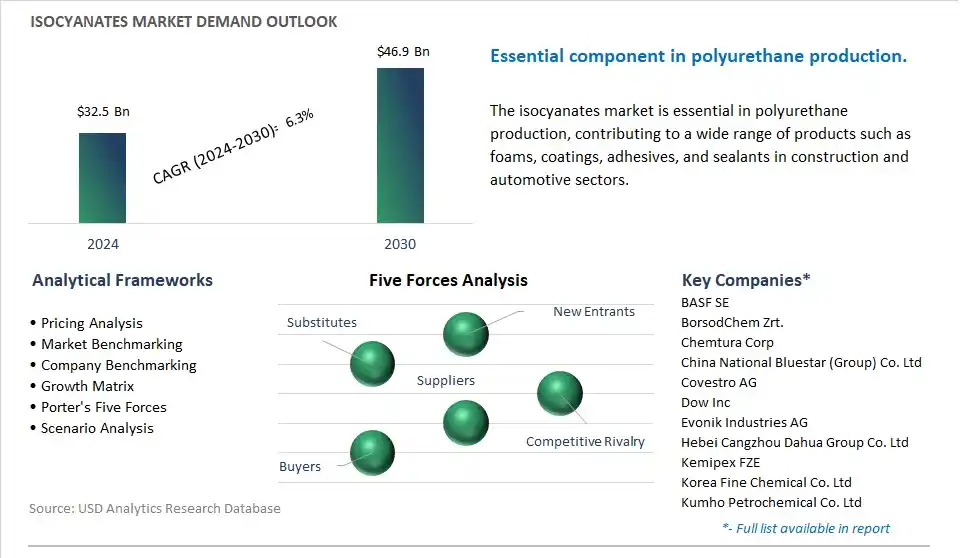
The global Isocyanates Market is poised to register a 6.3% CAGR from $32.5 Billion in 2024 to $46.9 Billion in 2030.
The global Isocyanates Market Study analyzes and forecasts the market size across 6 regions and 24 countries for diverse segments -By Type (MDI, TDI, Aliphatic, Others), By Application (Rigid Foam, Flexible Foam, Paints & Coatings, Adhesives & Sealants, Elastomers, Binders, Others), By End-User (Building & Construction, Automotive, Healthcare, Furniture, Others).
An Introduction to Global Isocyanates Market in 2024
Isocyanates are highly reactive chemicals used primarily in the production of polyurethane foams, coatings, adhesives, and elastomers, with applications in industries such as construction, automotive, and furniture manufacturing. One key trend shaping the future of isocyanates is the focus on enhancing workplace safety, environmental sustainability, and product stewardship throughout the supply chain to mitigate health risks and environmental impact associated with isocyanate exposure and use. Isocyanate manufacturers and downstream users are implementing stringent safety measures, engineering controls, and personal protective equipment to minimize worker exposure to airborne isocyanate vapors and aerosols, reducing the risk of respiratory sensitization, asthma, and other health effects associated with occupational exposure. Additionally, advancements in process technologies, such as closed-loop production systems, solvent-free formulations, and green chemistry principles, are reducing emissions, waste generation, and environmental footprint of isocyanate manufacturing and processing operations, ensuring compliance with regulatory requirements and sustainability goals. Moreover, the development of alternative chemistries, such as non-isocyanate polyurethane (NIPU) technologies, bio-based polyols, and waterborne coatings, is providing safer and more sustainable alternatives to conventional isocyanate-based products, reducing reliance on hazardous raw materials and minimizing environmental impact throughout the product lifecycle. As industries and regulators increasingly prioritize occupational health and safety, environmental protection, and sustainable manufacturing practices, the market for isocyanates is undergoing transformation, with opportunities for collaboration, research, and market expansion to meet the evolving needs of chemical producers, downstream users, and regulatory authorities seeking safer and more sustainable solutions for polyurethane applications.
Isocyanates Market Competitive Landscape
The market report analyses the leading companies in the industry including BASF SE, BorsodChem Zrt., Chemtura Corp, China National Bluestar (Group) Co. Ltd, Covestro AG, Dow Inc, Evonik Industries AG, Hebei Cangzhou Dahua Group Co. Ltd, Kemipex FZE, Korea Fine Chemical Co. Ltd, Kumho Petrochemical Co. Ltd, Mitsui Chemicals America Inc, Perstorp Holding AB, Tosoh Corp, Vencorex Holding SAS, Yantai Sanjiang Chemical Industry Material Co. Ltd.
Isocyanates Market Dynamics
Isocyanates Market Trend: Shift Towards Low-VOC and Sustainable Formulations
A prominent trend in the isocyanates market is the shift towards low-VOC (volatile organic compound) and sustainable formulations. Isocyanates are key raw materials used in the production of polyurethane coatings, adhesives, sealants, and foams, which find applications in various industries such as construction, automotive, and furniture manufacturing. With increasing regulatory pressure and growing environmental concerns, there is a rising demand for isocyanate-based products that offer reduced emissions, improved indoor air quality, and enhanced sustainability. This is driving the commitment to environmentally friendly solutions and drives the development of innovative low-VOC formulations and sustainable manufacturing processes in the isocyanates market.
Isocyanates Market Driver: Growth in Construction and Automotive Industries
A key driver propelling the isocyanates market is the growth in the construction and automotive industries. Isocyanates are essential components in the production of polyurethane-based materials used in building insulation, coatings, adhesives, and automotive parts such as seating foams, bumpers, and interior trim. The expansion of construction activities, infrastructure projects, and automotive manufacturing worldwide drives the demand for isocyanates as key raw materials for producing high-performance and durable materials. Additionally, the increasing demand for energy-efficient buildings, lightweight vehicles, and innovative product designs further stimulates the growth of the isocyanates market as industries seek to meet evolving consumer preferences and regulatory requirements.
Isocyanates Market Opportunity: Development of Green Alternatives and Recycling Technologies
An opportunity for growth in the isocyanates market lies in the development of green alternatives and recycling technologies. With increasing emphasis on sustainability and circular economy principles, there is growing interest in bio-based, renewable, and recyclable alternatives to traditional isocyanates. Manufacturers can invest in research and development to explore novel raw materials, green chemistry processes, and bio-based feedstocks for producing isocyanates with reduced environmental impact. Additionally, there is an opportunity to develop recycling technologies that enable the recovery and reuse of isocyanate-containing materials, reducing waste generation and resource consumption. By addressing environmental concerns and offering sustainable solutions, companies can capitalize on the opportunity to differentiate their products, meet market demand, and drive growth in the isocyanates market.
Isocyanates Market Ecosystem
In the Isobutene market, production begins with oil and gas companies including Exxon Mobil and Royal Dutch Shell, as well as refineries including Marathon Petroleum and Valero Energy, extracting crude oil and employing cracking processes to generate isobutene as a by-product. Alternatively, chemical firms including BASF and LyondellBasell utilize dehydrogenation methods to convert isobutane into isobutene. Further, Dow Chemical and LyondellBasell, among others, oversee purification and separation processes to obtain high-purity isobutene.
Distribution channels are managed by chemical distributors including Brenntag AG and Ashland Global Holdings, ensuring efficient delivery to industrial users. The chemical industry remains the primary end-user, utilizing isobutene as a crucial feedstock for products including polybutylene rubber, MTBE, BHT, and isooctane. Furthermore, the fuels sector shows promise as a future application, considering isobutene's potential as a feedstock for high-performance biofuels.
Isocyanates Market Share Analysis: MDI (Methylene Diphenyl Diisocyanate) held the dominant revenue share in 2024
The MDI (Methylene Diphenyl Diisocyanate) segment is the largest in the Isocyanates Market due to diverse key reasons. Firstly, MDI is widely used in the production of polyurethane foams, coatings, adhesives, sealants, and elastomers, making it a versatile and essential raw material for numerous industries such as construction, automotive, furniture, and insulation. This broad range of applications accounts for a significant portion of the overall demand for isocyanates globally. Additionally, MDI offers diverse advantages, including high strength, durability, insulation properties, and resistance to chemicals and abrasion, making it suitable for a wide variety of end-use applications. In addition, the growing construction and automotive sectors, particularly in emerging economies, drive the demand for polyurethane-based products, further boosting the consumption of MDI. Further, advancements in MDI production technology and increasing investments in research and development contribute to its dominant position in the Isocyanates Market. With its versatility, performance characteristics, and widespread application across diverse industries, MDI remains the largest segment in the Isocyanates Market, shaping the landscape of polyurethane-based products worldwide.
Isocyanates Market Share Analysis: Rigid Foam is the fastest growing market segment over the forecast period to 2030
The Rigid Foam segment is the fastest-growing in the Isocyanates Market due to diverse compelling reasons. Firstly, rigid foam, primarily made from isocyanates, is widely used as insulation material in various industries, including construction, refrigeration, and appliances. With increasing awareness of energy efficiency and sustainability, there is a growing demand for high-performance insulation materials to reduce energy consumption and greenhouse gas emissions. Rigid foam meets these requirements by providing excellent thermal insulation properties, thereby driving its adoption in building construction, cold chain logistics, and appliance manufacturing. Additionally, stringent building codes and regulations mandating the use of energy-efficient building materials further fuel the demand for rigid foam insulation. In addition, the construction industry's recovery and expansion, particularly in developing regions, contribute to the growth of the Rigid Foam segment as infrastructure projects drive the demand for insulation materials. Further, advancements in foam formulation technology and the development of eco-friendly and fire-retardant foam solutions further stimulate the growth of the Rigid Foam segment in the Isocyanates Market. With its essential role in energy-efficient building construction and insulation applications, the Rigid Foam segment is poised to experience rapid growth, meeting the evolving needs of industries worldwide.
Isocyanates Market Share Analysis: Building and Construction is the fastest growing market segment over the forecast period to 2030
The Building and Construction segment is the fastest-growing in the Isocyanates Market due to diverse compelling reasons. Firstly, the global building and construction industry is experiencing significant growth driven by urbanization, population growth, and infrastructure development projects worldwide. This growth translates into increased demand for isocyanates, primarily used in the production of polyurethane foams for insulation, sealants, adhesives, and coatings in construction applications. Additionally, stringent energy efficiency regulations and sustainability initiatives drive the adoption of high-performance insulation materials, such as polyurethane foam, to enhance building energy efficiency and reduce greenhouse gas emissions. In addition, the recovery and expansion of the construction sector, particularly in emerging economies, further boost the demand for isocyanates in building and construction applications. Further, technological advancements in foam formulation, manufacturing processes, and product innovation contribute to the growth of the Building and Construction segment by offering improved performance, durability, and eco-friendly solutions. With its essential role in energy-efficient building construction and infrastructure development, the Building and Construction segment is poised to experience rapid growth, meeting the evolving needs of the construction industry worldwide.
Isocyanates Market Report Scope-
By Type
MDI
TDI
Aliphatic
Others
By Application
Rigid Foam
Flexible Foam
Paints & Coatings
Adhesives & Sealants
Elastomers
Binders
Others
By End-User
Building & Construction
Automotive
Healthcare
Furniture
Others
Isocyanates Market Companies Profiled
BASF SE
BorsodChem Zrt.
Chemtura Corp
China National Bluestar (Group) Co. Ltd
Covestro AG
Dow Inc
Evonik Industries AG
Hebei Cangzhou Dahua Group Co. Ltd
Kemipex FZE
Korea Fine Chemical Co. Ltd
Kumho Petrochemical Co. Ltd
Mitsui Chemicals America Inc
Perstorp Holding AB
Tosoh Corp
Vencorex Holding SAS
Yantai Sanjiang Chemical Industry Material Co. Ltd
*- List Not Exhaustive
TABLE OF CONTENTS
1 Introduction to 2024 Isocyanates Market
1.1 Market Overview
1.2 Quick Facts
1.3 Scope/Objective of the Study
1.4 Market Definition
1.5 Countries and Regions Covered
1.6 Units, Currency, and Conversions
1.7 Industry Value Chain
2 Research Methodology
2.1 Market Size Estimation
2.2 Sources and Research Methodology
2.3 Data Triangulation
2.4 Assumptions and Limitations
3 Executive Summary
3.1 Global Isocyanates Market Size Outlook, $ Million, 2021 to 2030
3.2 Isocyanates Market Outlook by Type, $ Million, 2021 to 2030
3.3 Isocyanates Market Outlook by Product, $ Million, 2021 to 2030
3.4 Isocyanates Market Outlook by Application, $ Million, 2021 to 2030
3.5 Isocyanates Market Outlook by Key Countries, $ Million, 2021 to 2030
4 Market Dynamics
4.1 Key Driving Forces of Isocyanates Industry
4.2 Key Market Trends in Isocyanates Industry
4.3 Potential Opportunities in Isocyanates Industry
4.4 Key Challenges in Isocyanates Industry
5 Market Factor Analysis
5.1 Value Chain Analysis
5.2 Competitive Landscape
5.2.1 Global Isocyanates Market Share by Company (%), 2023
5.2.2 Product Offerings by Company
5.3 Porter’s Five Forces Analysis
5.4 Pricing Analysis and Outlook
6 Growth Outlook Across Scenarios
6.1 Growth Analysis-Case Scenario Definitions
6.2 Low Growth Scenario Forecasts
6.3 Reference Growth Scenario Forecasts
6.4 High Growth Scenario Forecasts
7 Global Isocyanates Market Outlook by Segments
7.1 Isocyanates Market Outlook by Segments, $ Million, 2021- 2030
By Type
MDI
TDI
Aliphatic
Others
By Application
Rigid Foam
Flexible Foam
Paints & Coatings
Adhesives & Sealants
Elastomers
Binders
Others
By End-User
Building & Construction
Automotive
Healthcare
Furniture
Others
8 North America Isocyanates Market Analysis and Outlook To 2030
8.1 Introduction to North America Isocyanates Markets in 2024
8.2 North America Isocyanates Market Size Outlook by Country, 2021-2030
8.2.1 United States
8.2.2 Canada
8.2.3 Mexico
8.3 North America Isocyanates Market size Outlook by Segments, 2021-2030
By Type
MDI
TDI
Aliphatic
Others
By Application
Rigid Foam
Flexible Foam
Paints & Coatings
Adhesives & Sealants
Elastomers
Binders
Others
By End-User
Building & Construction
Automotive
Healthcare
Furniture
Others
9 Europe Isocyanates Market Analysis and Outlook To 2030
9.1 Introduction to Europe Isocyanates Markets in 2024
9.2 Europe Isocyanates Market Size Outlook by Country, 2021-2030
9.2.1 Germany
9.2.2 France
9.2.3 Spain
9.2.4 United Kingdom
9.2.4 Italy
9.2.5 Russia
9.2.6 Norway
9.2.7 Rest of Europe
9.3 Europe Isocyanates Market Size Outlook by Segments, 2021-2030
By Type
MDI
TDI
Aliphatic
Others
By Application
Rigid Foam
Flexible Foam
Paints & Coatings
Adhesives & Sealants
Elastomers
Binders
Others
By End-User
Building & Construction
Automotive
Healthcare
Furniture
Others
10 Asia Pacific Isocyanates Market Analysis and Outlook To 2030
10.1 Introduction to Asia Pacific Isocyanates Markets in 2024
10.2 Asia Pacific Isocyanates Market Size Outlook by Country, 2021-2030
10.2.1 China
10.2.2 India
10.2.3 Japan
10.2.4 South Korea
10.2.5 Indonesia
10.2.6 Malaysia
10.2.7 Australia
10.2.8 Rest of Asia Pacific
10.3 Asia Pacific Isocyanates Market size Outlook by Segments, 2021-2030
By Type
MDI
TDI
Aliphatic
Others
By Application
Rigid Foam
Flexible Foam
Paints & Coatings
Adhesives & Sealants
Elastomers
Binders
Others
By End-User
Building & Construction
Automotive
Healthcare
Furniture
Others
11 South America Isocyanates Market Analysis and Outlook To 2030
11.1 Introduction to South America Isocyanates Markets in 2024
11.2 South America Isocyanates Market Size Outlook by Country, 2021-2030
11.2.1 Brazil
11.2.2 Argentina
11.2.3 Rest of South America
11.3 South America Isocyanates Market size Outlook by Segments, 2021-2030
By Type
MDI
TDI
Aliphatic
Others
By Application
Rigid Foam
Flexible Foam
Paints & Coatings
Adhesives & Sealants
Elastomers
Binders
Others
By End-User
Building & Construction
Automotive
Healthcare
Furniture
Others
12 Middle East and Africa Isocyanates Market Analysis and Outlook To 2030
12.1 Introduction to Middle East and Africa Isocyanates Markets in 2024
12.2 Middle East and Africa Isocyanates Market Size Outlook by Country, 2021-2030
12.2.1 Saudi Arabia
12.2.2 UAE
12.2.3 Oman
12.2.4 Rest of Middle East
12.2.5 Egypt
12.2.6 Nigeria
12.2.7 South Africa
12.2.8 Rest of Africa
12.3 Middle East and Africa Isocyanates Market size Outlook by Segments, 2021-2030
By Type
MDI
TDI
Aliphatic
Others
By Application
Rigid Foam
Flexible Foam
Paints & Coatings
Adhesives & Sealants
Elastomers
Binders
Others
By End-User
Building & Construction
Automotive
Healthcare
Furniture
Others
13 Company Profiles
13.1 Company Snapshot
13.2 SWOT Profiles
13.3 Products and Services
13.4 Recent Developments
13.5 Financial Profile
BASF SE
BorsodChem Zrt.
Chemtura Corp
China National Bluestar (Group) Co. Ltd
Covestro AG
Dow Inc
Evonik Industries AG
Hebei Cangzhou Dahua Group Co. Ltd
Kemipex FZE
Korea Fine Chemical Co. Ltd
Kumho Petrochemical Co. Ltd
Mitsui Chemicals America Inc
Perstorp Holding AB
Tosoh Corp
Vencorex Holding SAS
Yantai Sanjiang Chemical Industry Material Co. Ltd
14 Appendix
14.1 Customization Offerings
14.2 Subscription Services
14.3 Related Reports
14.4 Publisher Expertise
By Type
MDI
TDI
Aliphatic
Others
By Application
Rigid Foam
Flexible Foam
Paints & Coatings
Adhesives & Sealants
Elastomers
Binders
Others
By End-User
Building & Construction
Automotive
Healthcare
Furniture
Others
Countries Analyzed
North America (US, Canada, Mexico)
Europe (Germany, UK, France, Spain, Italy, Russia, Rest of Europe)
Asia Pacific (China, India, Japan, South Korea, Australia, South East Asia, Rest of Asia)
South America (Brazil, Argentina, Rest of South America)
Middle East and Africa (Saudi Arabia, UAE, Rest of Middle East, South Africa, Egypt, Rest of Africa)
