The global Isoprene Rubber Market is poised to register a 5.1% CAGR from $1.75 Billion in 2024 to $2.4 Billion in 2030.
The global Isoprene Rubber Market Study analyzes and forecasts the market size across 6 regions and 24 countries for diverse segments -By Application (Medical Products, Tires Production, Conveyor Belts, Belts For Automotive, Others), By Type (Medical Grade, Industrial Grade).
An Introduction to Global Isoprene Rubber Market in 2024
The market for isoprene rubber is undergoing significant transformation driven by the increasing demand for high-performance elastomers in industries such as automotive, construction, and healthcare. One key trend shaping the future of the industry is the development of bio-based isoprene rubber derived from renewable feedstocks, such as biomass and agricultural residues, in response to growing environmental concerns and the need for sustainable alternatives to petroleum-based rubber. This trend is driving investments in bio-refining technologies and process optimization to commercialize bio-based isoprene rubber with comparable performance and cost-effectiveness to its synthetic counterparts. Moreover, advancements in polymer science and material engineering are leading to the development of novel formulations with enhanced properties, such as improved elasticity, tear resistance, and durability, making isoprene rubber an ideal choice for demanding applications in tire manufacturing, automotive seals, and medical devices. Additionally, the expanding automotive industry and the growing trend towards electric vehicles are driving the demand for lightweight and fuel-efficient materials, further fueling the adoption of isoprene rubber in automotive components and insulation materials.
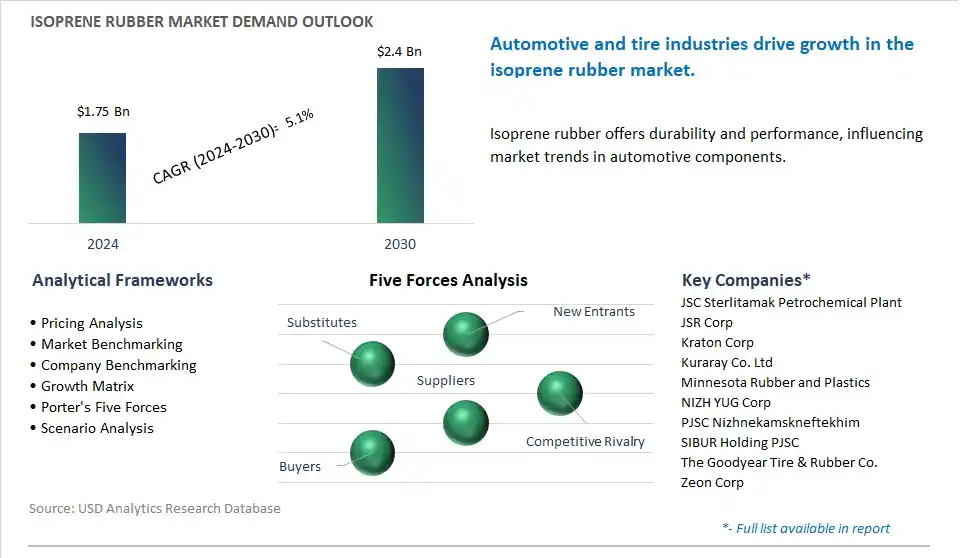
Isoprene Rubber Market Competitive Landscape
The market report analyses the leading companies in the industry including JSC Sterlitamak Petrochemical Plant, JSR Corp, Kraton Corp, Kuraray Co. Ltd, Minnesota Rubber and Plastics, NIZH YUG Corp, PJSC Nizhnekamskneftekhim, SIBUR Holding PJSC, The Goodyear Tire & Rubber Co., Zeon Corp.
Isoprene Rubber Market Dynamics
Isoprene Rubber Market Trend: Growing Demand for Eco-Friendly and Sustainable Rubber Products
A significant trend in the isoprene rubber market is the growing demand for eco-friendly and sustainable rubber products driven by increasing environmental awareness, regulatory mandates, and consumer preferences for green alternatives. Isoprene rubber, also known as synthetic polyisoprene, offers properties similar to natural rubber while providing greater consistency and uniformity in performance. As concerns over deforestation, biodiversity loss, and carbon emissions associated with natural rubber production escalate, there is a rising interest in isoprene rubber as a sustainable alternative for various applications including tires, adhesives, medical devices, and consumer goods. Manufacturers are leveraging the inherent properties of isoprene rubber, such as biodegradability, recyclability, and lower carbon footprint, to develop environmentally responsible products that meet stringent sustainability criteria and address market demand for eco-friendly rubber materials. This trend is reshaping the isoprene rubber market towards increased adoption of sustainable rubber solutions, positioning isoprene rubber as a key enabler of green manufacturing practices and circular economy principles in the rubber industry.
Isoprene Rubber Market Driver: Growth in Automotive and Tire Manufacturing
A key driver propelling the isoprene rubber market is the growth in automotive and tire manufacturing driven by increasing vehicle production, urbanization, and infrastructure development worldwide. Isoprene rubber, known for its high resilience, abrasion resistance, and performance stability, is widely used in tire manufacturing to improve tire grip, traction, and durability under various road conditions. With the automotive industry's shift towards electric vehicles (EVs), autonomous driving technologies, and sustainable mobility solutions, there is a growing demand for high-performance tires that offer enhanced fuel efficiency, safety, and environmental sustainability. Isoprene rubber plays a critical role in tire compounding, contributing to the development of low-rolling resistance tires, all-season tires, and specialty tire formulations tailored to meet the evolving needs of modern vehicles and drivers. The growth in automotive and tire manufacturing presents opportunities for isoprene rubber producers to collaborate with tire manufacturers, automotive OEMs, and rubber compounders to supply high-quality rubber materials and support innovation in tire technology, driving market growth and expansion in the isoprene rubber segment.
Isoprene Rubber Market Opportunity: Development of Bio-Based Isoprene Rubber
An opportunity for market expansion lies in the development of bio-based isoprene rubber derived from renewable feedstocks such as biomass, agricultural residues, and industrial by-products. With increasing emphasis on sustainability, carbon neutrality, and resource efficiency, there is growing interest in bio-based alternatives to petroleum-based rubber materials. Bio-based isoprene rubber offers advantages such as reduced reliance on fossil fuels, lower greenhouse gas emissions, and enhanced environmental performance, making it an attractive option for sustainable rubber applications. By investing in research and development, process optimization, and biorefinery infrastructure, manufacturers can explore new pathways for producing bio-based isoprene rubber at commercial scale, addressing market demand for renewable and eco-friendly rubber materials. Additionally, partnerships, collaborations, and investments in bioeconomy initiatives can facilitate market entry and accelerate the commercialization of bio-based isoprene rubber, positioning manufacturers for growth and success in the evolving green rubber market landscape.
Isoprene Rubber Market Share Analysis: Tires Production segment generated the highest revenue in the industry
The largest segment in the isoprene rubber market is tires production, and diverse factors contribute to its dominance. Isoprene rubber, also known as synthetic polyisoprene, is a key raw material used in the manufacturing of tires. Tires represent one of the largest applications for isoprene rubber due to the extensive global demand for automotive tires. Isoprene rubber offers excellent properties such as high elasticity, resilience, abrasion resistance, and low rolling resistance, making it ideal for tire compounds. These properties are crucial for ensuring safety, performance, and longevity in automotive tires, which are subjected to various road conditions, temperatures, and loads. Additionally, the automotive industry is one of the largest consumers of rubber materials, and tires constitute a significant portion of the Over the forecast period rubber consumption. As the automotive sector continues to grow globally, driven by increasing vehicle production, rising disposable incomes, and urbanization, the demand for tires also increases correspondingly, leading to a higher demand for isoprene rubber. Further, advancements in tire technology, such as the development of high-performance tires, green tires, and electric vehicle tires, further drive the demand for specialized isoprene rubber formulations tailored to meet specific performance requirements. The tires production segment benefits from the ongoing investments in automotive research and development, tire manufacturing technology, and tire labeling regulations aimed at improving safety, fuel efficiency, and environmental sustainability. In addition, tires represent a recurring replacement market, as tires have a limited lifespan and need to be replaced periodically due to wear and tear, punctures, and aging. This continuous demand for new tires and replacement tires sustains the consumption of isoprene rubber in the tires production segment. Over the forecast period, the combination of the automotive industry's size, the critical role of tires in vehicle performance and safety, and the unique properties of isoprene rubber position tires production as the largest segment in the isoprene rubber market.
Isoprene Rubber Market Share Analysis: Medical Grade Segment is poised to register the fastest growth rate (CAGR) over the forecast period to 2030
The medical grade segment is the fastest-growing segment in the isoprene rubber market, driven by diverse key factors. The there is an increasing demand for medical-grade isoprene rubber in the healthcare industry, particularly for the production of medical devices, equipment, and supplies. Isoprene rubber offers excellent biocompatibility, sterilizability, and chemical resistance, making it suitable for a wide range of medical applications such as surgical gloves, catheters, tubing, seals, and stoppers. With the global focus on healthcare infrastructure development, advancements in medical technology, and the rising prevalence of chronic diseases, there is a growing need for high-quality medical-grade materials that meet stringent regulatory standards and ensure patient safety and comfort. Secondly, the COVID-19 pandemic has further underscored the importance of medical-grade materials in infection prevention and control. The pandemic has led to increased demand for medical devices and personal protective equipment (PPE), including gloves, masks, gowns, and medical equipment, driving the consumption of medical-grade isoprene rubber. Additionally, as healthcare systems worldwide prioritize preparedness and response measures to address public health emergencies, there is a heightened emphasis on the production of essential medical supplies and equipment, further fueling the demand for medical-grade isoprene rubber. In addition, technological advancements in polymer science and manufacturing processes have led to the development of specialized medical-grade isoprene rubber formulations with enhanced properties such as tear resistance, elasticity, and tactile sensitivity. These advanced materials enable the production of high-performance medical devices and PPE that meet the evolving needs of healthcare professionals and patients. Further, regulatory initiatives and quality standards governing medical device manufacturing drive the adoption of medical-grade isoprene rubber as a preferred material choice for healthcare applications. The stringent regulatory requirements ensure product safety, efficacy, and compliance with healthcare industry standards, fostering trust and confidence among healthcare providers and patients. Over the forecast period, the combination of healthcare industry trends, pandemic-driven demand, technological innovations, and regulatory compliance positions the medical grade segment as the fastest-growing segment in the isoprene rubber market.
Isoprene Rubber Market Report Segmentation
By Application
Medical Products
Tires Production
Conveyor Belts
Belts For Automotive
Others
By Type
Medical Grade
Industrial Grade
Regions Included
North America (US, Canada, Mexico)
Europe (Germany, UK, France, Spain, Italy, Russia, Rest of Europe)
Asia Pacific (China, India, Japan, South Korea, Australia, South East Asia, Rest of Asia)
South America (Brazil, Argentina, Rest of South America)
Middle East and Africa (Saudi Arabia, UAE, Rest of Middle East, South Africa, Egypt, Rest of Africa)
Isoprene Rubber Companies Profiled in the Market Study
JSC Sterlitamak Petrochemical Plant
JSR Corp
Kraton Corp
Kuraray Co. Ltd
Minnesota Rubber and Plastics
NIZH YUG Corp
PJSC Nizhnekamskneftekhim
SIBUR Holding PJSC
The Goodyear Tire & Rubber Co.
Zeon Corp
*- List Not Exhaustive
TABLE OF CONTENTS
1 Introduction to 2024 Isoprene Rubber Market
1.1 Market Overview
1.2 Quick Facts
1.3 Scope/Objective of the Study
1.4 Market Definition
1.5 Countries and Regions Covered
1.6 Units, Currency, and Conversions
1.7 Industry Value Chain
2 Research Methodology
2.1 Market Size Estimation
2.2 Sources and Research Methodology
2.3 Data Triangulation
2.4 Assumptions and Limitations
3 Executive Summary
3.1 Global Isoprene Rubber Market Size Outlook, $ Million, 2021 to 2030
3.2 Isoprene Rubber Market Outlook by Type, $ Million, 2021 to 2030
3.3 Isoprene Rubber Market Outlook by Product, $ Million, 2021 to 2030
3.4 Isoprene Rubber Market Outlook by Application, $ Million, 2021 to 2030
3.5 Isoprene Rubber Market Outlook by Key Countries, $ Million, 2021 to 2030
4 Market Dynamics
4.1 Key Driving Forces of Isoprene Rubber Industry
4.2 Key Market Trends in Isoprene Rubber Industry
4.3 Potential Opportunities in Isoprene Rubber Industry
4.4 Key Challenges in Isoprene Rubber Industry
5 Market Factor Analysis
5.1 Value Chain Analysis
5.2 Competitive Landscape
5.2.1 Global Isoprene Rubber Market Share by Company (%), 2023
5.2.2 Product Offerings by Company
5.3 Porter’s Five Forces Analysis
5.4 Pricing Analysis and Outlook
6 Growth Outlook Across Scenarios
6.1 Growth Analysis-Case Scenario Definitions
6.2 Low Growth Scenario Forecasts
6.3 Reference Growth Scenario Forecasts
6.4 High Growth Scenario Forecasts
7 Global Isoprene Rubber Market Outlook by Segments
7.1 Isoprene Rubber Market Outlook by Segments, $ Million, 2021- 2030
By Application
Medical Products
Tires Production
Conveyor Belts
Belts For Automotive
Others
By Type
Medical Grade
Industrial Grade
8 North America Isoprene Rubber Market Analysis and Outlook To 2030
8.1 Introduction to North America Isoprene Rubber Markets in 2024
8.2 North America Isoprene Rubber Market Size Outlook by Country, 2021-2030
8.2.1 United States
8.2.2 Canada
8.2.3 Mexico
8.3 North America Isoprene Rubber Market size Outlook by Segments, 2021-2030
By Application
Medical Products
Tires Production
Conveyor Belts
Belts For Automotive
Others
By Type
Medical Grade
Industrial Grade
9 Europe Isoprene Rubber Market Analysis and Outlook To 2030
9.1 Introduction to Europe Isoprene Rubber Markets in 2024
9.2 Europe Isoprene Rubber Market Size Outlook by Country, 2021-2030
9.2.1 Germany
9.2.2 France
9.2.3 Spain
9.2.4 United Kingdom
9.2.4 Italy
9.2.5 Russia
9.2.6 Norway
9.2.7 Rest of Europe
9.3 Europe Isoprene Rubber Market Size Outlook by Segments, 2021-2030
By Application
Medical Products
Tires Production
Conveyor Belts
Belts For Automotive
Others
By Type
Medical Grade
Industrial Grade
10 Asia Pacific Isoprene Rubber Market Analysis and Outlook To 2030
10.1 Introduction to Asia Pacific Isoprene Rubber Markets in 2024
10.2 Asia Pacific Isoprene Rubber Market Size Outlook by Country, 2021-2030
10.2.1 China
10.2.2 India
10.2.3 Japan
10.2.4 South Korea
10.2.5 Indonesia
10.2.6 Malaysia
10.2.7 Australia
10.2.8 Rest of Asia Pacific
10.3 Asia Pacific Isoprene Rubber Market size Outlook by Segments, 2021-2030
By Application
Medical Products
Tires Production
Conveyor Belts
Belts For Automotive
Others
By Type
Medical Grade
Industrial Grade
11 South America Isoprene Rubber Market Analysis and Outlook To 2030
11.1 Introduction to South America Isoprene Rubber Markets in 2024
11.2 South America Isoprene Rubber Market Size Outlook by Country, 2021-2030
11.2.1 Brazil
11.2.2 Argentina
11.2.3 Rest of South America
11.3 South America Isoprene Rubber Market size Outlook by Segments, 2021-2030
By Application
Medical Products
Tires Production
Conveyor Belts
Belts For Automotive
Others
By Type
Medical Grade
Industrial Grade
12 Middle East and Africa Isoprene Rubber Market Analysis and Outlook To 2030
12.1 Introduction to Middle East and Africa Isoprene Rubber Markets in 2024
12.2 Middle East and Africa Isoprene Rubber Market Size Outlook by Country, 2021-2030
12.2.1 Saudi Arabia
12.2.2 UAE
12.2.3 Oman
12.2.4 Rest of Middle East
12.2.5 Egypt
12.2.6 Nigeria
12.2.7 South Africa
12.2.8 Rest of Africa
12.3 Middle East and Africa Isoprene Rubber Market size Outlook by Segments, 2021-2030
By Application
Medical Products
Tires Production
Conveyor Belts
Belts For Automotive
Others
By Type
Medical Grade
Industrial Grade
13 Company Profiles
13.1 Company Snapshot
13.2 SWOT Profiles
13.3 Products and Services
13.4 Recent Developments
13.5 Financial Profile
JSC Sterlitamak Petrochemical Plant
JSR Corp
Kraton Corp
Kuraray Co. Ltd
Minnesota Rubber and Plastics
NIZH YUG Corp
PJSC Nizhnekamskneftekhim
SIBUR Holding PJSC
The Goodyear Tire & Rubber Co.
Zeon Corp
14 Appendix
14.1 Customization Offerings
14.2 Subscription Services
14.3 Related Reports
14.4 Publisher Expertise
By Application
Medical Products
Tires Production
Conveyor Belts
Belts For Automotive
Others
By Type
Medical Grade
Industrial Grade
Countries Analyzed
North America (US, Canada, Mexico)
Europe (Germany, UK, France, Spain, Italy, Russia, Rest of Europe)
Asia Pacific (China, India, Japan, South Korea, Australia, South East Asia, Rest of Asia)
South America (Brazil, Argentina, Rest of South America)
Middle East and Africa (Saudi Arabia, UAE, Rest of Middle East, South Africa, Egypt, Rest of Africa)
