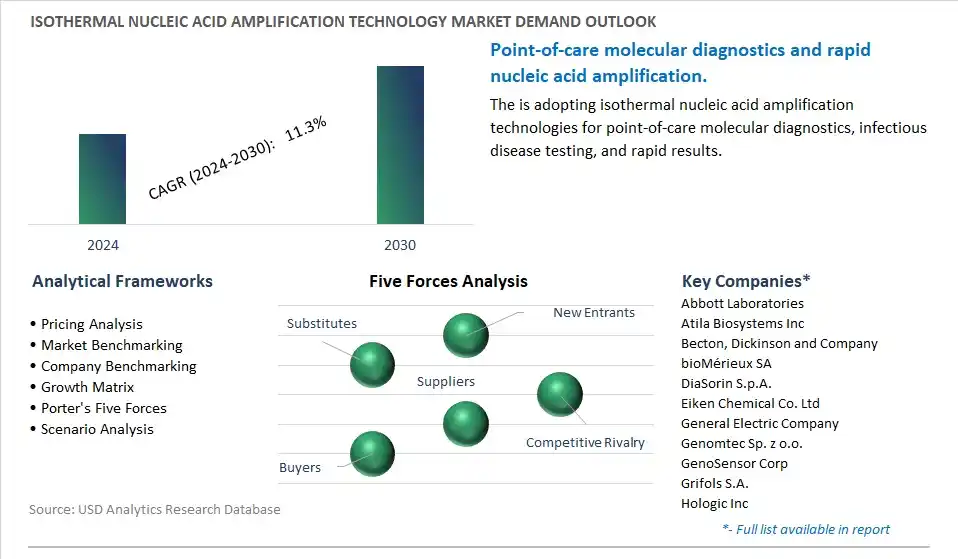
Isothermal Nucleic Acid Amplification Technology Market is estimated to increase at a Compounded Annual Growth Rate of 11.3% CAGR over the forecast period from 2024 to 2030
The Isothermal Nucleic Acid Amplification Technology Market study analyzes and forecasts the market size across 6 regions and 24 countries for diverse segments- By Product (Assays, Kits, & Reagents, Systems), By Technology (Transcription Mediated Amplification (TMA), Loop-mediated Isothermal Amplification (LAMP), Strand Displacement Amplification (SDA), Helicase-dependent Amplification (HDA), Nucleic Acid Sequence-based Amplification (NASBA), Nicking Enzyme Amplification Reaction (NEAR), Single Primer Isothermal Amplification (SPIA), Others), By Application (Disease Diagnosis, Blood Screening, Others), By End-User (Hospitals, Reference Laboratories, Academic & Research Institutes, Others).
An Introduction to Isothermal Nucleic Acid Amplification Technology Market in 2024
Isothermal nucleic acid amplification technology (iNAAT) is a molecular biology technique used to amplify specific DNA or RNA sequences at a constant temperature, typically between 37°C and 65°C, without the need for thermal cycling equipment such as polymerase chain reaction (PCR) machines. In 2024, isothermal nucleic acid amplification technology continues to revolutionize molecular diagnostics, offering rapid, sensitive, and user-friendly alternatives to traditional PCR-based methods for detecting infectious diseases, genetic disorders, and other nucleic acid targets. iNAAT methods, such as loop-mediated isothermal amplification (LAMP), nucleic acid sequence-based amplification (NASBA), and recombinase polymerase amplification (RPA), utilize unique enzymatic reactions and primer designs to achieve target amplification under isothermal conditions. These methods offer several advantages over PCR, including shorter turnaround times, reduced equipment and infrastructure requirements, and greater tolerance to inhibitors present in complex biological samples. iNAAT assays are widely used in point-of-care settings, resource-limited environments, and field-based applications for rapid and on-site detection of pathogens such as bacteria, viruses, and parasites. Moreover, with the emergence of portable and handheld isothermal amplification devices, such as LAMP-based assays, iNAAT technology has expanded access to molecular diagnostics in remote or underserved regions, enabling timely diagnosis and surveillance of infectious diseases, outbreak detection, and monitoring of antimicrobial resistance. Additionally, iNAAT methods are being increasingly integrated into multiplexed assays and lab-on-a-chip platforms, allowing for simultaneous detection of multiple targets and streamlining laboratory workflows. By providing sensitive, rapid, and accessible molecular diagnostics solutions, isothermal nucleic acid amplification technology contributes to improved disease management, infection control, and public health surveillance efforts worldwide.
Market Trend: Increasing Demand for Point-of-Care Testing Solutions
A significant trend in the isothermal nucleic acid amplification technology market is the increasing demand for point-of-care testing solutions. With the growing need for rapid and accurate diagnostics, especially in resource-limited settings and during public health emergencies, there is a rising interest in isothermal nucleic acid amplification technologies that enable rapid on-site detection of infectious diseases and genetic conditions. These technologies offer advantages such as simplicity, speed, and portability, making them well-suited for decentralized testing outside of traditional laboratory settings. As healthcare systems and regulatory agencies emphasize the importance of early diagnosis and prompt treatment, the adoption of isothermal nucleic acid amplification technologies for point-of-care testing is expected to increase, driving market growth and innovation in portable molecular diagnostics.
Market Driver: Expansion of Molecular Diagnostics and Infectious Disease Testing
A key driver fueling the isothermal nucleic acid amplification technology market is the expansion of molecular diagnostics and infectious disease testing. Molecular diagnostic techniques, including nucleic acid amplification, play a critical role in the detection and characterization of pathogens, genetic mutations, and biomarkers associated with various diseases. Isothermal amplification technologies offer advantages such as rapid turnaround time, high sensitivity, and specificity, making them valuable tools for infectious disease testing, pathogen surveillance, and genetic screening. Additionally, the emergence of new infectious diseases, antimicrobial resistance, and the need for early detection of outbreaks highlight the importance of accurate and timely molecular diagnostics. As healthcare providers and public health authorities prioritize infectious disease surveillance and control efforts, the demand for isothermal nucleic acid amplification technologies for molecular diagnostics is expected to grow, driving market expansion and adoption of advanced molecular testing solutions.
Market Opportunity: Integration with Portable Diagnostic Devices
A potential opportunity in the isothermal nucleic acid amplification technology market lies in the integration with portable diagnostic devices. As the demand for point-of-care testing continues to rise, there is an opportunity to develop compact and user-friendly diagnostic platforms that incorporate isothermal nucleic acid amplification technologies. By integrating isothermal amplification assays with handheld or battery-operated devices, manufacturers can offer convenient and affordable solutions for on-site molecular testing in various healthcare settings, including clinics, community health centers, and field hospitals. Portable diagnostic devices equipped with isothermal nucleic acid amplification technology can enable rapid detection of infectious diseases, genetic disorders, and environmental contaminants, facilitating timely diagnosis and treatment decisions. Furthermore, the integration of connectivity features and data management capabilities allows for remote monitoring, result reporting, and real-time surveillance of disease outbreaks. By capitalizing on the opportunity to develop integrated portable diagnostic devices, stakeholders can address unmet needs in point-of-care testing, expand access to molecular diagnostics, and improve healthcare delivery in diverse settings. Expanding into portable diagnostic devices presents a strategic opportunity for innovation and market growth in the isothermal nucleic acid amplification technology market.
Isothermal Nucleic Acid Amplification Technology Market Share Analysis: Loop-mediated Isothermal Amplification (LAMP) is the fastest growing segment over the forecast period to 2030
Among the segments of the Isothermal Nucleic Acid Amplification Technology Market, Loop-mediated Isothermal Amplification (LAMP) technology emerges as the fastest-growing category. This accelerated growth is propelled by several factors. LAMP technology offers significant advantages such as rapid amplification, simplicity, and robustness, making it ideal for point-of-care diagnostics and resource-limited settings. The isothermal nature of LAMP reactions eliminates the need for complex thermal cycling equipment, reducing the overall cost and time required for nucleic acid amplification. Additionally, LAMP assays demonstrate high specificity and sensitivity, enabling accurate detection of target nucleic acids in various applications, including disease diagnosis and blood screening. The growing demand for rapid and accurate molecular diagnostics, particularly in hospitals, reference laboratories, and academic research institutes, further drives the adoption of LAMP technology. Moreover, the versatility of LAMP assays in detecting a wide range of pathogens and genetic markers positions it as a valuable tool in infectious disease surveillance and outbreak management. As healthcare systems and researchers seek efficient and accessible molecular diagnostic solutions, LAMP technology experiences rapid growth, shaping the landscape of the Isothermal Nucleic Acid Amplification Technology Market.
Isothermal Nucleic Acid Amplification Technology Competitive Analysis
The market research study provides in-depth insights into leading companies including the SWOT analyses, product profile, financial details, and recent developments acrossAbbott Laboratories, Atila Biosystems Inc, Becton, Dickinson and Company, bioMérieux SA, DiaSorin S.p.A., Eiken Chemical Co. Ltd, General Electric Company, Genomtec Sp. z o.o., GenoSensor Corp, Grifols S.A., Hologic Inc, Jena Bioscience GmbH, LGC Ltd, Life Sciences Advanced Technologies Inc, Mast Group Ltd, Meridian Bioscience Inc, New England Biolabs Inc, OptiGene Ltd, PCR Biosystems Ltd, QIAGEN N.V., Quidel Corp, Tecan Trading AG, Thermo Fisher Scientific Inc, TwistDx Ltd, Ustar Biotechnologies (Hangzhou) Ltd
Isothermal Nucleic Acid Amplification Technology Market Segmentation
By Product
Assays, Kits, & Reagents
Systems
By Technology
Transcription Mediated Amplification (TMA)
Loop-mediated Isothermal Amplification (LAMP)
Strand Displacement Amplification (SDA)
Helicase-dependent Amplification (HDA)
Nucleic Acid Sequence-based Amplification (NASBA)
Nicking Enzyme Amplification Reaction (NEAR)
Single Primer Isothermal Amplification (SPIA)
Others
By Application
Disease Diagnosis
Blood Screening
Others
By End-User
Hospitals
Reference Laboratories
Academic & Research Institutes
Others
Geographical Analysis
North America (United States, Canada, Mexico)
Europe (Germany, France, United Kingdom, Spain, Italy, Rest of Europe)
Asia Pacific (China, India, Japan, South Korea, Rest of Asia Pacific)
South America (Brazil, Argentina, Rest of South America)
Middle East and Africa (Saudi Arabia, UAE, Rest of Middle East, South Africa, Egypt, Rest of Africa)
Isothermal Nucleic Acid Amplification Technology Market Companies
Abbott Laboratories
Atila Biosystems Inc
Becton, Dickinson and Company
bioMérieux SA
DiaSorin S.p.A.
Eiken Chemical Co. Ltd
General Electric Company
Genomtec Sp. z o.o.
GenoSensor Corp
Grifols S.A.
Hologic Inc
Jena Bioscience GmbH
LGC Ltd
Life Sciences Advanced Technologies Inc
Mast Group Ltd
Meridian Bioscience Inc
New England Biolabs Inc
OptiGene Ltd
PCR Biosystems Ltd
QIAGEN N.V.
Quidel Corp
Tecan Trading AG
Thermo Fisher Scientific Inc
TwistDx Ltd
Ustar Biotechnologies (Hangzhou) Ltd
Reasons to Buy the Isothermal Nucleic Acid Amplification Technology Market Study
• Deepen your industry insights and navigate uncertainties for strategy formulation, CAPEX, and Operational decisions
• Gain access to detailed insights on the Isothermal Nucleic Acid Amplification Technology Market, encompassing current market size, growth trends, and forecasts till 2030.
• Access detailed competitor analysis, enabling competitive advantage through a thorough understanding of market players, strategies, and potential differentiation opportunities
• Stay ahead of the curve with insights on technological advancements, innovations, and upcoming trends
• Identify lucrative investment avenues and expansion opportunities within the Isothermal Nucleic Acid Amplification Technology Market industry, guided by robust, data-backed analysis.
• Understand regional and global markets through country-wise analysis, regional market potential, regulatory nuances, and dynamics
• Execute strategies with confidence and speed through information, analytics, and insights on the industry value chain
• Corporate leaders, strategists, financial experts, shareholders, asset managers, and governmental representatives can make long-term planning scenarios and build an integrated and timely understanding of market dynamics
• Benefit from tailored solutions and expert consultation based on report insights, providing personalized strategies aligned with specific business needs.
TABLE OF CONTENTS
1 Introduction to 2024 Isothermal Nucleic Acid Amplification Technology Market
1.1 Market Overview
1.2 Quick Facts
1.3 Scope/Objective of the Study
1.4 Market Definition
1.5 Countries and Regions Covered
1.6 Units, Currency, and Conversions
1.7 Industry Value Chain
2 Research Methodology
2.1 Market Size Estimation
2.2 Sources and Research Methodology
2.3 Data Triangulation
2.4 Assumptions and Limitations
3 Executive Summary
3.1 Global Isothermal Nucleic Acid Amplification Technology Market Size Outlook, $ Million, 2021 to 2030
3.2 Isothermal Nucleic Acid Amplification Technology Market Outlook by Type, $ Million, 2021 to 2030
3.3 Isothermal Nucleic Acid Amplification Technology Market Outlook by Product, $ Million, 2021 to 2030
3.4 Isothermal Nucleic Acid Amplification Technology Market Outlook by Application, $ Million, 2021 to 2030
3.5 Isothermal Nucleic Acid Amplification Technology Market Outlook by Key Countries, $ Million, 2021 to 2030
4 Market Dynamics
4.1 Key Driving Forces of Isothermal Nucleic Acid Amplification Technology Industry
4.2 Key Market Trends in Isothermal Nucleic Acid Amplification Technology Industry
4.3 Potential Opportunities in Isothermal Nucleic Acid Amplification Technology Industry
4.4 Key Challenges in Isothermal Nucleic Acid Amplification Technology Industry
5 Market Factor Analysis
5.1 Value Chain Analysis
5.2 Competitive Landscape
5.2.1 Global Isothermal Nucleic Acid Amplification Technology Market Share by Company (%), 2023
5.2.2 Product Offerings by Company
5.3 Porter’s Five Forces Analysis
5.4 Pricing Analysis and Outlook
6 Growth Outlook Across Scenarios
6.1 Growth Analysis-Case Scenario Definitions
6.2 Low Growth Scenario Forecasts
6.3 Reference Growth Scenario Forecasts
6.4 High Growth Scenario Forecasts
7 Global Isothermal Nucleic Acid Amplification Technology Market Outlook by Segments
7.1 Isothermal Nucleic Acid Amplification Technology Market Outlook by Segments, $ Million, 2021- 2030
By Product
Assays, Kits, & Reagents
Systems
By Technology
Transcription Mediated Amplification (TMA)
Loop-mediated Isothermal Amplification (LAMP)
Strand Displacement Amplification (SDA)
Helicase-dependent Amplification (HDA)
Nucleic Acid Sequence-based Amplification (NASBA)
Nicking Enzyme Amplification Reaction (NEAR)
Single Primer Isothermal Amplification (SPIA)
Others
By Application
Disease Diagnosis
Blood Screening
Others
By End-User
Hospitals
Reference Laboratories
Academic & Research Institutes
Others
8 North America Isothermal Nucleic Acid Amplification Technology Market Analysis and Outlook To 2030
8.1 Introduction to North America Isothermal Nucleic Acid Amplification Technology Markets in 2024
8.2 North America Isothermal Nucleic Acid Amplification Technology Market Size Outlook by Country, 2021-2030
8.2.1 United States
8.2.2 Canada
8.2.3 Mexico
8.3 North America Isothermal Nucleic Acid Amplification Technology Market size Outlook by Segments, 2021-2030
By Product
Assays, Kits, & Reagents
Systems
By Technology
Transcription Mediated Amplification (TMA)
Loop-mediated Isothermal Amplification (LAMP)
Strand Displacement Amplification (SDA)
Helicase-dependent Amplification (HDA)
Nucleic Acid Sequence-based Amplification (NASBA)
Nicking Enzyme Amplification Reaction (NEAR)
Single Primer Isothermal Amplification (SPIA)
Others
By Application
Disease Diagnosis
Blood Screening
Others
By End-User
Hospitals
Reference Laboratories
Academic & Research Institutes
Others
9 Europe Isothermal Nucleic Acid Amplification Technology Market Analysis and Outlook To 2030
9.1 Introduction to Europe Isothermal Nucleic Acid Amplification Technology Markets in 2024
9.2 Europe Isothermal Nucleic Acid Amplification Technology Market Size Outlook by Country, 2021-2030
9.2.1 Germany
9.2.2 France
9.2.3 Spain
9.2.4 United Kingdom
9.2.4 Italy
9.2.5 Russia
9.2.6 Norway
9.2.7 Rest of Europe
9.3 Europe Isothermal Nucleic Acid Amplification Technology Market Size Outlook by Segments, 2021-2030
By Product
Assays, Kits, & Reagents
Systems
By Technology
Transcription Mediated Amplification (TMA)
Loop-mediated Isothermal Amplification (LAMP)
Strand Displacement Amplification (SDA)
Helicase-dependent Amplification (HDA)
Nucleic Acid Sequence-based Amplification (NASBA)
Nicking Enzyme Amplification Reaction (NEAR)
Single Primer Isothermal Amplification (SPIA)
Others
By Application
Disease Diagnosis
Blood Screening
Others
By End-User
Hospitals
Reference Laboratories
Academic & Research Institutes
Others
10 Asia Pacific Isothermal Nucleic Acid Amplification Technology Market Analysis and Outlook To 2030
10.1 Introduction to Asia Pacific Isothermal Nucleic Acid Amplification Technology Markets in 2024
10.2 Asia Pacific Isothermal Nucleic Acid Amplification Technology Market Size Outlook by Country, 2021-2030
10.2.1 China
10.2.2 India
10.2.3 Japan
10.2.4 South Korea
10.2.5 Indonesia
10.2.6 Malaysia
10.2.7 Australia
10.2.8 Rest of Asia Pacific
10.3 Asia Pacific Isothermal Nucleic Acid Amplification Technology Market size Outlook by Segments, 2021-2030
By Product
Assays, Kits, & Reagents
Systems
By Technology
Transcription Mediated Amplification (TMA)
Loop-mediated Isothermal Amplification (LAMP)
Strand Displacement Amplification (SDA)
Helicase-dependent Amplification (HDA)
Nucleic Acid Sequence-based Amplification (NASBA)
Nicking Enzyme Amplification Reaction (NEAR)
Single Primer Isothermal Amplification (SPIA)
Others
By Application
Disease Diagnosis
Blood Screening
Others
By End-User
Hospitals
Reference Laboratories
Academic & Research Institutes
Others
11 South America Isothermal Nucleic Acid Amplification Technology Market Analysis and Outlook To 2030
11.1 Introduction to South America Isothermal Nucleic Acid Amplification Technology Markets in 2024
11.2 South America Isothermal Nucleic Acid Amplification Technology Market Size Outlook by Country, 2021-2030
11.2.1 Brazil
11.2.2 Argentina
11.2.3 Rest of South America
11.3 South America Isothermal Nucleic Acid Amplification Technology Market size Outlook by Segments, 2021-2030
By Product
Assays, Kits, & Reagents
Systems
By Technology
Transcription Mediated Amplification (TMA)
Loop-mediated Isothermal Amplification (LAMP)
Strand Displacement Amplification (SDA)
Helicase-dependent Amplification (HDA)
Nucleic Acid Sequence-based Amplification (NASBA)
Nicking Enzyme Amplification Reaction (NEAR)
Single Primer Isothermal Amplification (SPIA)
Others
By Application
Disease Diagnosis
Blood Screening
Others
By End-User
Hospitals
Reference Laboratories
Academic & Research Institutes
Others
12 Middle East and Africa Isothermal Nucleic Acid Amplification Technology Market Analysis and Outlook To 2030
12.1 Introduction to Middle East and Africa Isothermal Nucleic Acid Amplification Technology Markets in 2024
12.2 Middle East and Africa Isothermal Nucleic Acid Amplification Technology Market Size Outlook by Country, 2021-2030
12.2.1 Saudi Arabia
12.2.2 UAE
12.2.3 Oman
12.2.4 Rest of Middle East
12.2.5 Egypt
12.2.6 Nigeria
12.2.7 South Africa
12.2.8 Rest of Africa
12.3 Middle East and Africa Isothermal Nucleic Acid Amplification Technology Market size Outlook by Segments, 2021-2030
By Product
Assays, Kits, & Reagents
Systems
By Technology
Transcription Mediated Amplification (TMA)
Loop-mediated Isothermal Amplification (LAMP)
Strand Displacement Amplification (SDA)
Helicase-dependent Amplification (HDA)
Nucleic Acid Sequence-based Amplification (NASBA)
Nicking Enzyme Amplification Reaction (NEAR)
Single Primer Isothermal Amplification (SPIA)
Others
By Application
Disease Diagnosis
Blood Screening
Others
By End-User
Hospitals
Reference Laboratories
Academic & Research Institutes
Others
13 Company Profiles
13.1 Company Snapshot
13.2 SWOT Profiles
13.3 Products and Services
13.4 Recent Developments
13.5 Financial Profile
List of Companies
Abbott Laboratories
Atila Biosystems Inc
Becton, Dickinson and Company
bioMérieux SA
DiaSorin S.p.A.
Eiken Chemical Co. Ltd
General Electric Company
Genomtec Sp. z o.o.
GenoSensor Corp
Grifols S.A.
Hologic Inc
Jena Bioscience GmbH
LGC Ltd
Life Sciences Advanced Technologies Inc
Mast Group Ltd
Meridian Bioscience Inc
New England Biolabs Inc
OptiGene Ltd
PCR Biosystems Ltd
QIAGEN N.V.
Quidel Corp
Tecan Trading AG
Thermo Fisher Scientific Inc
TwistDx Ltd
Ustar Biotechnologies (Hangzhou) Ltd
14 Appendix
14.1 Customization Offerings
14.2 Subscription Services
14.3 Related Reports
14.4 Publisher Expertise
By Product
Assays, Kits, & Reagents
Systems
By Technology
Transcription Mediated Amplification (TMA)
Loop-mediated Isothermal Amplification (LAMP)
Strand Displacement Amplification (SDA)
Helicase-dependent Amplification (HDA)
Nucleic Acid Sequence-based Amplification (NASBA)
Nicking Enzyme Amplification Reaction (NEAR)
Single Primer Isothermal Amplification (SPIA)
Others
By Application
Disease Diagnosis
Blood Screening
Others
By End-User
Hospitals
Reference Laboratories
Academic & Research Institutes
Others
Countries Analyzed
North America (United States, Canada, Mexico)
Europe (Germany, France, United Kingdom, Spain, Italy, Rest of Europe)
Asia Pacific (China, India, Japan, South Korea, Rest of Asia Pacific)
South America (Brazil, Argentina, Rest of South America)
Middle East and Africa (Saudi Arabia, UAE, Rest of Middle East, South Africa, Egypt, Rest of Africa)
