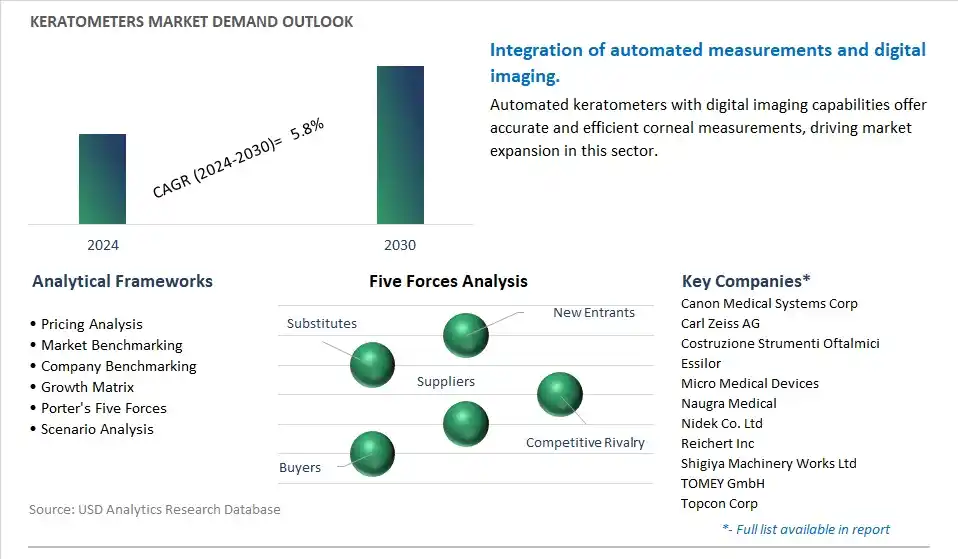
Keratometers Market is estimated to increase at a growth rate of 5.8% CAGR over the forecast period from 2024 to 2030.
The global Keratometers Market Study analyzes and forecasts the market size across 6 regions and 24 countries for diverse segments including By Type (Stationary Type Keratometers, Portable Type Keratometers), By End-User (Hospitals, Eye Clinics, Others).
An Introduction to Keratometers Market in 2024
The Keratometers Market encompasses medical devices used to measure the curvature of the cornea, aiding in the diagnosis and treatment of refractive errors and assessing the fit of contact lenses. These instruments play a crucial role in ophthalmology and optometry clinics, helping healthcare professionals determine the corneal power and astigmatism of patients for accurate vision correction. Keratometers are utilized in preoperative evaluations for procedures like cataract surgery, LASIK, and corneal transplants. Innovations in keratometers focus on automated measurements, digital interfaces, enhanced accuracy, and integration with other diagnostic technologies, contributing to improved eye care outcomes and patient satisfaction.
Keratometers Market Competitive Landscape
The global Keratometers Industry is highly competitive with a large number of companies focusing on niche market segments. Amidst intense competitive conditions, Keratometers Companies are investing in new product launches and strengthening distribution channels. Key companies operating in the Keratometers Industry include- Canon Medical Systems Corp, Carl Zeiss AG, Costruzione Strumenti Oftalmici, Essilor, Micro Medical Devices, Naugra Medical, Nidek Co. Ltd, Reichert Inc, Shigiya Machinery Works Ltd, TOMEY GmbH, Topcon Corp, Visionix.
Keratometers Market Trend: Integration of Digital Imaging and Measurement Technologies
A significant trend in the market for keratometers is the integration of digital imaging and measurement technologies, driven by advancements in ophthalmic diagnostics and the demand for more precise and efficient corneal measurements. Traditional keratometers have relied on manual techniques and analog measurement scales to assess corneal curvature and refractive power, which may be subject to variability and user error. However, the integration of digital imaging systems, such as Scheimpflug imaging, optical coherence tomography (OCT), and Placido disc topography, allows for high-resolution visualization of the cornea and accurate measurement of its curvature, thickness, and optical properties. These digital imaging technologies enable ophthalmologists and optometrists to obtain comprehensive corneal data, identify irregularities or abnormalities, and customize treatment plans for refractive surgeries, contact lens fittings, and corneal disease management with greater precision and confidence.
Keratometers Market Driver: Growing Demand for Refractive Surgery and Contact Lens Services
The primary driver of the keratometers market is the growing demand for refractive surgery and contact lens services worldwide, fueled by increasing rates of myopia, hyperopia, astigmatism, and presbyopia, as well as the desire for vision correction and enhancement among patients seeking alternatives to glasses. Refractive surgery procedures, such as LASIK (laser-assisted in situ keratomileusis), PRK (photorefractive keratectomy), and SMILE (small incision lenticule extraction), rely on accurate corneal measurements to determine surgical candidacy, plan treatment parameters, and achieve optimal visual outcomes. Similarly, contact lens fitting and evaluation require precise corneal measurements to ensure proper lens fit, alignment, and vision correction. As advancements in refractive surgery techniques and contact lens designs continue to expand the range of available treatment options, there is growing demand for keratometers that offer advanced imaging capabilities, automated measurements, and seamless integration with digital platforms to support comprehensive ophthalmic assessments and enhance patient care.
Keratometers Market Opportunity: Development of Portable and Point-of-Care Devices
An opportunity in the keratometers market lies in the development of portable and point-of-care devices that offer convenience, accessibility, and versatility for ophthalmic practitioners and patients in diverse clinical settings. Traditional keratometers are often bulky, stationary instruments found in specialized ophthalmology clinics or refractive surgery centers, limiting their accessibility and utility in primary care settings, mobile eye clinics, or remote locations with limited infrastructure. Portable keratometers that are lightweight, compact, and easy to use can expand the reach of corneal diagnostics and vision assessments to underserved populations, improve patient access to refractive services, and support telemedicine consultations and outreach programs. Additionally, point-of-care keratometers that provide rapid, on-the-spot corneal measurements enable immediate decision-making for refractive surgery candidates, contact lens wearers, and patients with corneal conditions, enhancing workflow efficiency, patient satisfaction, and clinical outcomes.
Keratometers Market Share Analysis: Portable Type Keratometers is the fastest growing market segment over the forecast period to 2030
The Portable Type Keratometers segment is experiencing the fastest growth within the keratometers market. This surge in demand can be attributed to several key factors. Firstly, advancements in technology have led to the development of highly accurate and user-friendly portable keratometers, making them increasingly popular among healthcare professionals for on-the-go measurements. These portable devices offer convenience and flexibility, allowing eye clinics and healthcare providers to perform keratometry measurements efficiently in various settings, including remote locations and outreach programs. Moreover, the rising prevalence of eye disorders and the growing demand for ophthalmic diagnostic equipment in emerging markets are driving the adoption of portable keratometers. Additionally, the COVID-19 pandemic has emphasized the importance of portable diagnostic tools, as they offer reduced risk of cross-contamination and enable safer patient care practices. As a result, the Portable Type Keratometers segment stands out as the fastest-growing category in the keratometers market, presenting significant opportunities for manufacturers and eye care professionals to meet the evolving needs of patients and expand their service offerings.
Keratometers Market Segmentation
By Type
Stationary Type Keratometers
Portable Type Keratometers
By End-User
Hospitals
Eye Clinics
Others
Geographical Analysis
North America (United States, Canada, Mexico)
Europe (Germany, France, United Kingdom, Spain, Italy, Rest of Europe)
Asia Pacific (China, India, Japan, South Korea, Rest of Asia Pacific)
South America (Brazil, Argentina, Rest of South America)
Middle East and Africa (Saudi Arabia, UAE, Rest of Middle East, South Africa, Egypt, Rest of Africa)
Keratometers Companies
Canon Medical Systems Corp
Carl Zeiss AG
Costruzione Strumenti Oftalmici
Essilor
Micro Medical Devices
Naugra Medical
Nidek Co. Ltd
Reichert Inc
Shigiya Machinery Works Ltd
TOMEY GmbH
Topcon Corp
Visionix
* List not Exhaustive
Reasons to Buy the Keratometers Market Study
• Deepen your industry insights and navigate uncertainties for strategy formulation, CAPEX, and Operational decisions
• Gain access to detailed insights on the Keratometers Market, encompassing current market size, growth trends, and forecasts till 2030.
• Access detailed competitor analysis, enabling competitive advantage through a thorough understanding of market players, strategies, and potential differentiation opportunities
• Stay ahead of the curve with insights on technological advancements, innovations, and upcoming trends
• Identify lucrative investment avenues and expansion opportunities within the Keratometers Industry, guided by robust, data-backed analysis.
• Understand regional and global markets through country-wise analysis, regional market potential, regulatory nuances, and dynamics
• Execute strategies with confidence and speed through information, analytics, and insights on the industry value chain
• Corporate leaders, strategists, financial experts, shareholders, asset managers, and governmental representatives can make long-term planning scenarios and build an integrated and timely understanding of market dynamics
• Benefit from tailored solutions and expert consultation based on report insights, providing personalized strategies aligned with specific business needs.
TABLE OF CONTENTS
1 Introduction to 2024 Keratometers Market
1.1 Market Overview
1.2 Quick Facts
1.3 Scope/Objective of the Study
1.4 Market Definition
1.5 Countries and Regions Analyzed
1.6 Units, Currency, and Conversions
1.7 Industry Value Chain
2 Research Methodology
2.1 Market Size Estimation
2.2 Sources and Research Methodology
2.3 Data Triangulation
2.4 Assumptions and Limitations
3 Executive Summary
3.1 Global Keratometers Market Size Outlook, $ Million, 2021 to 2030
3.2 Keratometers Market Outlook by Type, $ Million, 2021 to 2030
3.3 Keratometers Market Outlook by Product, $ Million, 2021 to 2030
3.4 Keratometers Market Outlook by Application, $ Million, 2021 to 2030
3.5 Keratometers Market Outlook by Key Countries, $ Million, 2021 to 2030
4 Market Dynamics
4.1 Key Driving Forces of Keratometers Industry
4.2 Key Market Trends in Keratometers Industry
4.3 Potential Opportunities in Keratometers Industry
4.4 Key Challenges in Keratometers Industry
5 Market Factor Analysis
5.1 Value Chain Analysis
5.2 Competitive Landscape
5.2.1 Global Keratometers Market Share by Company (%), 2023
5.2.2 Product Offerings by Company
5.3 Porter’s Five Forces Analysis
5.4 Pricing Analysis and Outlook
6 Growth Outlook Across Scenarios
6.1 Growth Analysis-Case Scenario Definitions
6.2 Low Growth Scenario Forecasts
6.3 Reference Growth Scenario Forecasts
6.4 High Growth Scenario Forecasts
7 Global Keratometers Market Outlook by Segments
7.1 Keratometers Market Outlook by Segments, $ Million, 2021- 2030
By Type
Stationary Type Keratometers
Portable Type Keratometers
By End-User
Hospitals
Eye Clinics
Others
8 North America Keratometers Market Analysis and Outlook To 2030
8.1 Introduction to North America Keratometers Markets in 2024
8.2 North America Keratometers Market Size Outlook by Country, 2021-2030
8.2.1 United States
8.2.2 Canada
8.2.3 Mexico
8.3 North America Keratometers Market size Outlook by Segments, 2021-2030
By Type
Stationary Type Keratometers
Portable Type Keratometers
By End-User
Hospitals
Eye Clinics
Others
9 Europe Keratometers Market Analysis and Outlook To 2030
9.1 Introduction to Europe Keratometers Markets in 2024
9.2 Europe Keratometers Market Size Outlook by Country, 2021-2030
9.2.1 Germany
9.2.2 France
9.2.3 Spain
9.2.4 United Kingdom
9.2.4 Italy
9.2.5 Russia
9.2.6 Norway
9.2.7 Rest of Europe
9.3 Europe Keratometers Market Size Outlook by Segments, 2021-2030
By Type
Stationary Type Keratometers
Portable Type Keratometers
By End-User
Hospitals
Eye Clinics
Others
10 Asia Pacific Keratometers Market Analysis and Outlook To 2030
10.1 Introduction to Asia Pacific Keratometers Markets in 2024
10.2 Asia Pacific Keratometers Market Size Outlook by Country, 2021-2030
10.2.1 China
10.2.2 India
10.2.3 Japan
10.2.4 South Korea
10.2.5 Indonesia
10.2.6 Malaysia
10.2.7 Australia
10.2.8 Rest of Asia Pacific
10.3 Asia Pacific Keratometers Market size Outlook by Segments, 2021-2030
By Type
Stationary Type Keratometers
Portable Type Keratometers
By End-User
Hospitals
Eye Clinics
Others
11 South America Keratometers Market Analysis and Outlook To 2030
11.1 Introduction to South America Keratometers Markets in 2024
11.2 South America Keratometers Market Size Outlook by Country, 2021-2030
11.2.1 Brazil
11.2.2 Argentina
11.2.3 Rest of South America
11.3 South America Keratometers Market size Outlook by Segments, 2021-2030
By Type
Stationary Type Keratometers
Portable Type Keratometers
By End-User
Hospitals
Eye Clinics
Others
12 Middle East and Africa Keratometers Market Analysis and Outlook To 2030
12.1 Introduction to Middle East and Africa Keratometers Markets in 2024
12.2 Middle East and Africa Keratometers Market Size Outlook by Country, 2021-2030
12.2.1 Saudi Arabia
12.2.2 UAE
12.2.3 Oman
12.2.4 Rest of Middle East
12.2.5 Egypt
12.2.6 Nigeria
12.2.7 South Africa
12.2.8 Rest of Africa
12.3 Middle East and Africa Keratometers Market size Outlook by Segments, 2021-2030
By Type
Stationary Type Keratometers
Portable Type Keratometers
By End-User
Hospitals
Eye Clinics
Others
13 Company Profiles
13.1 Company Snapshot
13.2 SWOT Profiles
13.3 Products and Services
13.4 Recent Developments
13.5 Financial Profile
List of Companies
Canon Medical Systems Corp
Carl Zeiss AG
Costruzione Strumenti Oftalmici
Essilor
Micro Medical Devices
Naugra Medical
Nidek Co. Ltd
Reichert Inc
Shigiya Machinery Works Ltd
TOMEY GmbH
Topcon Corp
Visionix
14 Appendix
14.1 Customization Offerings
14.2 Subscription Services
14.3 Related Reports
14.4 Publisher Expertise
