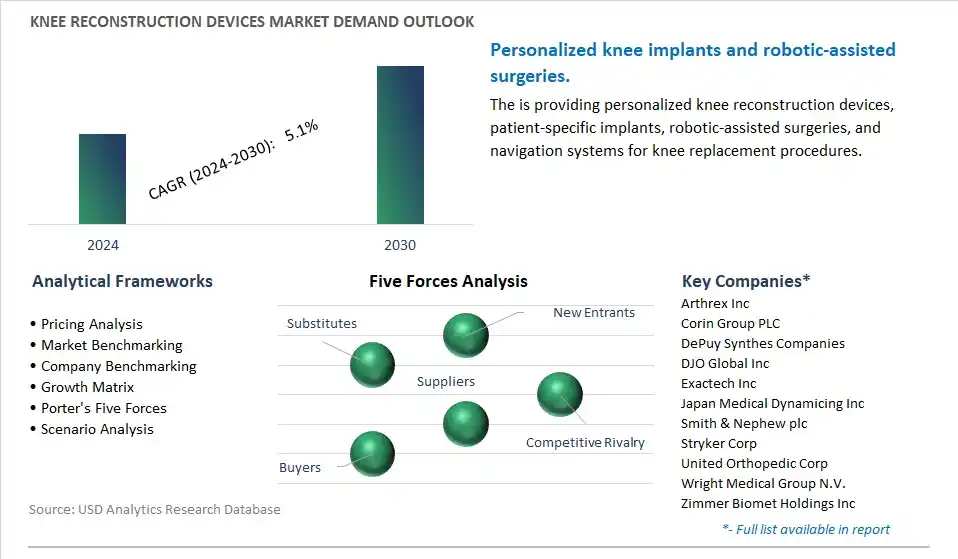
Knee Reconstruction Devices Market is estimated to increase at a Compounded Annual Growth Rate of 5.1% CAGR over the forecast period from 2024 to 2030
The Knee Reconstruction Devices Market study analyzes and forecasts the market size across 6 regions and 24 countries for diverse segments- By Product (Primary Cemented, Primary Cementless, Partial, Revision), By Indication (Osteoarthritis, Rheumatoid Arthritis, Trauma, Others), By End-User (Hospitals, Orthopedic Clinics, ASCs).
An Introduction to Knee Reconstruction Devices Market in 2024
Knee reconstruction devices are instrumental in restoring mobility and function to individuals suffering from knee injuries or degenerative joint conditions. In 2024, knee reconstruction devices continue to evolve, offering innovative solutions for total knee arthroplasty (TKA), partial knee replacement, and ligament reconstruction procedures. These devices include knee implants, surgical instrumentation, and bone fixation systems designed to optimize implant fit, alignment, and stability while preserving bone stock and soft tissue integrity. Advanced materials such as highly cross-linked polyethylene, titanium alloys, and ceramic composites enhance implant durability, wear resistance, and biocompatibility, improving long-term implant survivorship and patient satisfaction. Furthermore, patient-specific implant designs and computer-assisted surgical techniques enable personalized treatment approaches and improved clinical outcomes. As the prevalence of knee osteoarthritis and sports-related knee injuries rises globally, the demand for knee reconstruction devices continues to grow, driving innovation in implant design, surgical techniques, and rehabilitation strategies aimed at restoring mobility and quality of life for patients with knee disorders.
Market Trend: Shift Towards Personalized and Patient-Specific Knee Reconstruction
A prominent trend in the knee reconstruction devices market is the shift towards personalized and patient-specific knee reconstruction solutions. As the demand for improved outcomes and patient satisfaction continues to grow, there is increasing interest in customized knee implants and surgical techniques tailored to individual patient anatomy and pathology. Advances in imaging technology, computer-assisted design (CAD), and 3D printing enable orthopedic surgeons to create patient-specific implants and surgical guides that optimize fit, alignment, and stability, leading to better functional outcomes and reduced risk of complications. This trend reflects the industry's focus on precision medicine and personalized healthcare, driving innovation in knee reconstruction devices towards solutions that offer greater customization and patient-tailored care.
Market Driver: Aging Population and High Prevalence of Osteoarthritis
A key driver propelling the knee reconstruction devices market is the aging population and the high prevalence of osteoarthritis. With the global population aging rapidly, the incidence of age-related musculoskeletal conditions such as osteoarthritis of the knee is on the rise, driving the demand for knee replacement surgeries and reconstructive procedures. Knee reconstruction devices such as total knee arthroplasty (TKA) implants, partial knee replacement systems, and knee osteotomy plates play a critical role in restoring mobility, reducing pain, and improving quality of life for patients with degenerative knee conditions. The increasing prevalence of osteoarthritis, coupled with the desire for active lifestyles and longer life expectancy, fuels the demand for knee reconstruction devices and drives innovation in implant design, materials, and surgical techniques to address the diverse needs of patients with knee joint disorders.
Market Opportunity: Integration of Digital Health Technologies and Wearable Devices
An opportunity for growth in the knee reconstruction devices market lies in the integration of digital health technologies and wearable devices to enhance patient outcomes and postoperative rehabilitation. By incorporating sensors, accelerometers, and wireless connectivity into knee implants and orthopedic devices, manufacturers can enable real-time monitoring of patient activity, joint kinematics, and rehabilitation progress following knee surgery. Additionally, wearable devices such as smart knee braces and activity trackers offer patients tools for self-monitoring, exercise guidance, and adherence to postoperative protocols, facilitating faster recovery and improved functional outcomes. By embracing digital health innovations and partnering with technology companies, knee reconstruction device manufacturers can differentiate their products, add value to healthcare providers and patients, and capitalize on opportunities to improve patient care and satisfaction in the rapidly evolving landscape of orthopedic surgery and rehabilitation.
Knee Reconstruction Devices Market Share Analysis: Primary Cementless Knee Reconstruction Devices is the fastest growing segment over the forecast period to 2030
Among the segments listed, Primary Cementless Knee Reconstruction Devices are experiencing the most rapid growth in the market. This growth is primarily driven by several key factors. Firstly, advancements in implant materials and design have led to the development of cementless knee implants that offer improved biocompatibility, durability, and longevity compared to traditional cemented implants. Cementless implants promote osseointegration, whereby the implant fuses with the surrounding bone tissue, providing long-term stability and reducing the risk of loosening or implant failure over time. This enhanced implant performance translates into improved patient outcomes and satisfaction. Secondly, the growing trend towards minimally invasive surgery and rapid recovery protocols has increased the demand for cementless knee implants, as they allow for less invasive surgical techniques and shorter recovery times compared to cemented implants. Cementless implants are typically inserted without the need for bone cement, simplifying the surgical procedure and reducing the risk of cement-related complications. Thirdly, the expanding indications for knee reconstruction surgery, including osteoarthritis, rheumatoid arthritis, and trauma, have broadened the market for primary cementless knee implants. These implants offer versatility and adaptability to accommodate a wide range of patient anatomies and pathologies, making them suitable for various clinical scenarios. Additionally, the shift towards outpatient orthopedic procedures and the growing number of ambulatory surgical centers (ASCs) performing knee reconstruction surgeries have further fueled the demand for cementless knee implants, given their suitability for minimally invasive techniques and shorter hospital stays. With ongoing technological advancements and increasing adoption of cementless knee implants by orthopedic surgeons and patients alike, this segment is poised for continued rapid growth in the Knee Reconstruction Devices market.
Knee Reconstruction Devices Competitive Analysis
The market research study provides in-depth insights into leading companies including the SWOT analyses, product profile, financial details, and recent developments acrossArthrex Inc, Corin Group PLC, DePuy Synthes Companies, DJO Global Inc, Exactech Inc, Japan Medical Dynamic Marketing Inc, Smith & Nephew plc, Stryker Corp, United Orthopedic Corp, Wright Medical Group N.V., Zimmer Biomet Holdings Inc
Knee Reconstruction Devices Market Segmentation
By Product
Primary Cemented
Primary Cementless
Partial
Revision
By Indication
Osteoarthritis
Rheumatoid Arthritis
Trauma
Others
By End-User
Hospitals
Orthopedic Clinics
ASCs
Geographical Analysis
North America (United States, Canada, Mexico)
Europe (Germany, France, United Kingdom, Spain, Italy, Rest of Europe)
Asia Pacific (China, India, Japan, South Korea, Rest of Asia Pacific)
South America (Brazil, Argentina, Rest of South America)
Middle East and Africa (Saudi Arabia, UAE, Rest of Middle East, South Africa, Egypt, Rest of Africa)
Knee Reconstruction Devices Market Companies
Arthrex Inc
Corin Group PLC
DePuy Synthes Companies
DJO Global Inc
Exactech Inc
Japan Medical Dynamic Marketing Inc
Smith & Nephew plc
Stryker Corp
United Orthopedic Corp
Wright Medical Group N.V.
Zimmer Biomet Holdings Inc
Reasons to Buy the Knee Reconstruction Devices Market Study
• Deepen your industry insights and navigate uncertainties for strategy formulation, CAPEX, and Operational decisions
• Gain access to detailed insights on the Knee Reconstruction Devices Market, encompassing current market size, growth trends, and forecasts till 2030.
• Access detailed competitor analysis, enabling competitive advantage through a thorough understanding of market players, strategies, and potential differentiation opportunities
• Stay ahead of the curve with insights on technological advancements, innovations, and upcoming trends
• Identify lucrative investment avenues and expansion opportunities within the Knee Reconstruction Devices Market industry, guided by robust, data-backed analysis.
• Understand regional and global markets through country-wise analysis, regional market potential, regulatory nuances, and dynamics
• Execute strategies with confidence and speed through information, analytics, and insights on the industry value chain
• Corporate leaders, strategists, financial experts, shareholders, asset managers, and governmental representatives can make long-term planning scenarios and build an integrated and timely understanding of market dynamics
• Benefit from tailored solutions and expert consultation based on report insights, providing personalized strategies aligned with specific business needs.
TABLE OF CONTENTS
1 Introduction to 2024 Knee Reconstruction Devices Market
1.1 Market Overview
1.2 Quick Facts
1.3 Scope/Objective of the Study
1.4 Market Definition
1.5 Countries and Regions Covered
1.6 Units, Currency, and Conversions
1.7 Industry Value Chain
2 Research Methodology
2.1 Market Size Estimation
2.2 Sources and Research Methodology
2.3 Data Triangulation
2.4 Assumptions and Limitations
3 Executive Summary
3.1 Global Knee Reconstruction Devices Market Size Outlook, $ Million, 2021 to 2030
3.2 Knee Reconstruction Devices Market Outlook by Type, $ Million, 2021 to 2030
3.3 Knee Reconstruction Devices Market Outlook by Product, $ Million, 2021 to 2030
3.4 Knee Reconstruction Devices Market Outlook by Application, $ Million, 2021 to 2030
3.5 Knee Reconstruction Devices Market Outlook by Key Countries, $ Million, 2021 to 2030
4 Market Dynamics
4.1 Key Driving Forces of Knee Reconstruction Devices Industry
4.2 Key Market Trends in Knee Reconstruction Devices Industry
4.3 Potential Opportunities in Knee Reconstruction Devices Industry
4.4 Key Challenges in Knee Reconstruction Devices Industry
5 Market Factor Analysis
5.1 Value Chain Analysis
5.2 Competitive Landscape
5.2.1 Global Knee Reconstruction Devices Market Share by Company (%), 2023
5.2.2 Product Offerings by Company
5.3 Porter’s Five Forces Analysis
5.4 Pricing Analysis and Outlook
6 Growth Outlook Across Scenarios
6.1 Growth Analysis-Case Scenario Definitions
6.2 Low Growth Scenario Forecasts
6.3 Reference Growth Scenario Forecasts
6.4 High Growth Scenario Forecasts
7 Global Knee Reconstruction Devices Market Outlook by Segments
7.1 Knee Reconstruction Devices Market Outlook by Segments, $ Million, 2021- 2030
By Product
Primary Cemented
Primary Cementless
Partial
Revision
By Indication
Osteoarthritis
Rheumatoid Arthritis
Trauma
Others
By End-User
Hospitals
Orthopedic Clinics
ASCs
8 North America Knee Reconstruction Devices Market Analysis and Outlook To 2030
8.1 Introduction to North America Knee Reconstruction Devices Markets in 2024
8.2 North America Knee Reconstruction Devices Market Size Outlook by Country, 2021-2030
8.2.1 United States
8.2.2 Canada
8.2.3 Mexico
8.3 North America Knee Reconstruction Devices Market size Outlook by Segments, 2021-2030
By Product
Primary Cemented
Primary Cementless
Partial
Revision
By Indication
Osteoarthritis
Rheumatoid Arthritis
Trauma
Others
By End-User
Hospitals
Orthopedic Clinics
ASCs
9 Europe Knee Reconstruction Devices Market Analysis and Outlook To 2030
9.1 Introduction to Europe Knee Reconstruction Devices Markets in 2024
9.2 Europe Knee Reconstruction Devices Market Size Outlook by Country, 2021-2030
9.2.1 Germany
9.2.2 France
9.2.3 Spain
9.2.4 United Kingdom
9.2.4 Italy
9.2.5 Russia
9.2.6 Norway
9.2.7 Rest of Europe
9.3 Europe Knee Reconstruction Devices Market Size Outlook by Segments, 2021-2030
By Product
Primary Cemented
Primary Cementless
Partial
Revision
By Indication
Osteoarthritis
Rheumatoid Arthritis
Trauma
Others
By End-User
Hospitals
Orthopedic Clinics
ASCs
10 Asia Pacific Knee Reconstruction Devices Market Analysis and Outlook To 2030
10.1 Introduction to Asia Pacific Knee Reconstruction Devices Markets in 2024
10.2 Asia Pacific Knee Reconstruction Devices Market Size Outlook by Country, 2021-2030
10.2.1 China
10.2.2 India
10.2.3 Japan
10.2.4 South Korea
10.2.5 Indonesia
10.2.6 Malaysia
10.2.7 Australia
10.2.8 Rest of Asia Pacific
10.3 Asia Pacific Knee Reconstruction Devices Market size Outlook by Segments, 2021-2030
By Product
Primary Cemented
Primary Cementless
Partial
Revision
By Indication
Osteoarthritis
Rheumatoid Arthritis
Trauma
Others
By End-User
Hospitals
Orthopedic Clinics
ASCs
11 South America Knee Reconstruction Devices Market Analysis and Outlook To 2030
11.1 Introduction to South America Knee Reconstruction Devices Markets in 2024
11.2 South America Knee Reconstruction Devices Market Size Outlook by Country, 2021-2030
11.2.1 Brazil
11.2.2 Argentina
11.2.3 Rest of South America
11.3 South America Knee Reconstruction Devices Market size Outlook by Segments, 2021-2030
By Product
Primary Cemented
Primary Cementless
Partial
Revision
By Indication
Osteoarthritis
Rheumatoid Arthritis
Trauma
Others
By End-User
Hospitals
Orthopedic Clinics
ASCs
12 Middle East and Africa Knee Reconstruction Devices Market Analysis and Outlook To 2030
12.1 Introduction to Middle East and Africa Knee Reconstruction Devices Markets in 2024
12.2 Middle East and Africa Knee Reconstruction Devices Market Size Outlook by Country, 2021-2030
12.2.1 Saudi Arabia
12.2.2 UAE
12.2.3 Oman
12.2.4 Rest of Middle East
12.2.5 Egypt
12.2.6 Nigeria
12.2.7 South Africa
12.2.8 Rest of Africa
12.3 Middle East and Africa Knee Reconstruction Devices Market size Outlook by Segments, 2021-2030
By Product
Primary Cemented
Primary Cementless
Partial
Revision
By Indication
Osteoarthritis
Rheumatoid Arthritis
Trauma
Others
By End-User
Hospitals
Orthopedic Clinics
ASCs
13 Company Profiles
13.1 Company Snapshot
13.2 SWOT Profiles
13.3 Products and Services
13.4 Recent Developments
13.5 Financial Profile
List of Companies
Arthrex Inc
Corin Group PLC
DePuy Synthes Companies
DJO Global Inc
Exactech Inc
Japan Medical Dynamic Marketing Inc
Smith & Nephew plc
Stryker Corp
United Orthopedic Corp
Wright Medical Group N.V.
Zimmer Biomet Holdings Inc
14 Appendix
14.1 Customization Offerings
14.2 Subscription Services
14.3 Related Reports
14.4 Publisher Expertise
By Product
Primary Cemented
Primary Cementless
Partial
Revision
By Indication
Osteoarthritis
Rheumatoid Arthritis
Trauma
Others
By End-User
Hospitals
Orthopedic Clinics
ASCs
Countries Analyzed
North America (United States, Canada, Mexico)
Europe (Germany, France, United Kingdom, Spain, Italy, Rest of Europe)
Asia Pacific (China, India, Japan, South Korea, Rest of Asia Pacific)
South America (Brazil, Argentina, Rest of South America)
Middle East and Africa (Saudi Arabia, UAE, Rest of Middle East, South Africa, Egypt, Rest of Africa)
