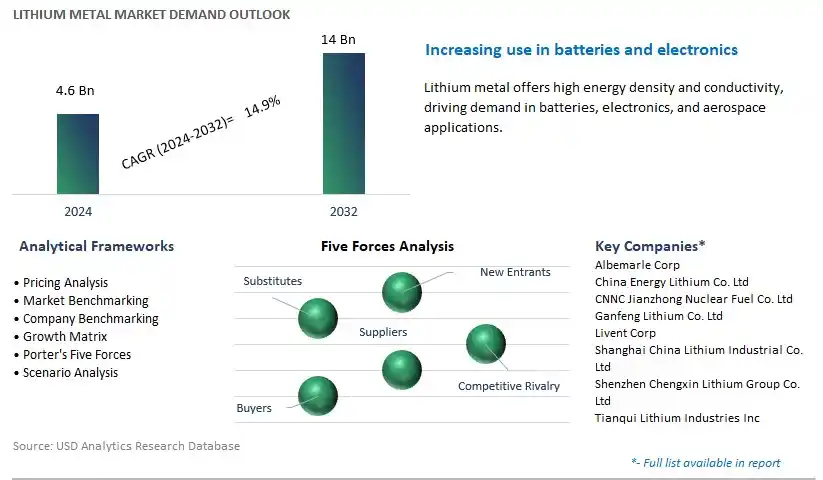
Global Lithium Metal Market Size is valued at $4.6 Billion in 2024 and is forecast to register a growth rate (CAGR) of 14.9% to reach $14 Billion by 2032.
The global Lithium Metal Market Study analyzes and forecasts the market size across 6 regions and 24 countries for diverse segments -By Source (Salt Lake Brine, Lithium Ores), By Application (Lithium-ion Anode Material, Alloy, Intermediates, Others), By End-User (Batteries, Metal Processing, Pharmaceutical, Others).
An Introduction to Lithium Metal Market in 2024
Lithium metal serves as a crucial component in the production of advanced lithium-ion batteries, which power various applications ranging from electric vehicles to portable electronics and grid-scale energy storage systems. In 2024, the demand for lithium metal s to escalate due to the exponential growth of the electric mobility sector and the increasing need for energy storage solutions. Lithium metal is employed as the anode material in lithium-metal batteries, offering the highest theoretical specific capacity among all anode materials. Its lightweight nature and high electrochemical reactivity make it an ideal candidate for achieving higher energy densities and longer driving ranges in electric vehicles. However, challenges such as dendrite formation, safety concerns, and limited lithium resources necessitate ongoing research and development efforts to address these issues and unlock the full potential of lithium metal batteries. With advancements in battery chemistry, electrolyte formulations, and manufacturing processes, the market for lithium metal is expected to witness significant growth, driven by the demand for next-generation energy storage technologies that offer increased energy density, faster charging rates, and enhanced safety features.
Lithium Metal Market Competitive Landscape
The market report analyses the leading companies in the industry including Albemarle Corp, China Energy Lithium Co. Ltd, CNNC Jianzhong Nuclear Fuel Co. Ltd, Ganfeng Lithium Co. Ltd, Livent Corp, Shanghai China Lithium Industrial Co. Ltd, Shenzhen Chengxin Lithium Group Co. Ltd, Tianqui Lithium Industries Inc, and others.
Lithium Metal Market Dynamics
Market Trend: Rising Demand for High-Energy-Density Battery Solutions
The most prominent market trend in lithium metal is the rising demand for high-energy-density battery solutions. With the increasing adoption of electric vehicles (EVs), portable electronics, and grid-scale energy storage systems, there is a growing need for lithium metal batteries that offer superior energy storage capacity and longer cycle life compared to traditional lithium-ion batteries. Lithium metal, with its high theoretical specific capacity, is gaining traction as a promising anode material for next-generation batteries. This trend is driving research and development efforts to overcome the challenges associated with lithium metal, such as dendrite formation and safety concerns, in order to commercialize high-performance lithium metal batteries that can meet the demands of various applications.
Market Driver: Technological Advancements in Battery Research
A key market driver for lithium metal is the continuous technological advancements in battery research. With ongoing efforts focused on improving battery performance, reducing costs, and enhancing safety, there is significant investment in developing innovative lithium metal battery technologies. Advances in materials science, electrolyte chemistry, and battery manufacturing processes are enabling the development of lithium metal batteries with improved cycling stability, dendrite suppression, and safety features. Moreover, breakthroughs in solid-state electrolytes and advanced electrode designs are paving the way for the commercialization of solid-state lithium metal batteries, which offer even higher energy densities and enhanced safety compared to liquid electrolyte systems. Thus, technological advancements in battery research are driving the demand for lithium metal as a key component in next-generation battery technologies, fueling market growth and innovation.
Market Opportunity: Development of Solid-State Lithium Metal Batteries
An emerging opportunity within the lithium metal market lies in the development of solid-state lithium metal batteries. Solid-state electrolytes offer advantages such as improved safety, higher energy density, and wider operating temperature ranges compared to liquid electrolytes, making them an attractive option for next-generation battery applications. Lithium metal is particularly well-suited for use in solid-state batteries due to its high specific capacity and low reduction potential. Manufacturers and researchers are exploring various solid-state electrolyte materials, such as ceramics, polymers, and glassy materials, to develop stable and high-conductivity electrolyte formulations compatible with lithium metal anodes. Additionally, advancements in electrode engineering, cell architecture, and manufacturing techniques are essential to realize the full potential of solid-state lithium metal batteries. By capitalizing on the opportunity to develop solid-state lithium metal batteries, companies can unlock new markets, address safety concerns, and accelerate the transition towards higher-performance and safer energy storage solutions for a wide range of applications.
Lithium Metal Market Share Analysis: Salt Lake Brine segment generated the highest revenue in 2024
The Salt Lake Brine segment is the largest segment within the lithium metal market. Salt Lake brine, extracted from lithium-rich saline water sources, such as salt lakes or salars, serves as a primary source of lithium production globally. This method of lithium extraction offers potential advantages, including lower production costs, higher lithium concentrations, and relatively simpler extraction processes compared to traditional lithium ore mining. Salt Lake brine deposits are abundant in certain regions, such as South America's "Lithium Triangle" (Chile, Argentina, Bolivia), where vast salt flats contain significant lithium reserves. The relatively straightforward extraction process of lithium from Salt Lake brine, involving evaporation and chemical processing, makes it a preferred source for lithium production, particularly for lithium metal. Additionally, advancements in brine extraction and processing technologies further contribute to the segment's dominance within the lithium metal market. With its abundance, cost-effectiveness, and technological advancements in extraction methods, the Salt Lake Brine segment maintains its position as the largest and most significant market segment within the lithium metal market.
Lithium Metal Market Share Analysis: Lithium-ion Anode Material is poised to register the fastest CAGR over the forecast period
The Lithium-ion Anode Material segment is the fastest-growing segment within the lithium metal market. As the demand for lithium-ion batteries continues to surge across various industries, including electric vehicles, consumer electronics, and grid storage systems, there is a corresponding increase in the demand for high-quality lithium-ion anode materials. Lithium metal serves as a crucial component in the production of lithium-ion battery anodes due to its high energy density and low electrode potential, which contribute to improved battery performance and longevity. Additionally, advancements in lithium metal processing technologies, such as electrodeposition and alloying, enable the production of lithium-ion anode materials with enhanced properties, such as higher energy density, improved cycling stability, and reduced dendrite formation. Moreover, the ongoing research and development efforts aimed at optimizing lithium-ion battery chemistry and electrode formulations further drive the demand for advanced lithium-ion anode materials. With the growing emphasis on energy storage solutions and the electrification of transportation, the Lithium-ion Anode Material segment is poised for continued rapid growth within the lithium metal market.
Lithium Metal Market Share Analysis: Batteries segment generated the highest revenue in 2024
The Batteries segment is the largest segment within the lithium metal market. Lithium metal serves as a critical component in the production of various types of batteries, including lithium-ion batteries, lithium-metal batteries, and primary lithium batteries. These batteries are widely utilized across numerous industries, including electric vehicles, consumer electronics, grid storage systems, aerospace, and medical devices, to power a diverse range of applications. Lithium metal's high energy density, lightweight properties, and electrochemical reactivity make it an ideal choice for battery applications, enabling the production of compact and high-performance energy storage solutions. Additionally, the increasing demand for electric vehicles, portable electronic devices, and renewable energy systems fuels the demand for lithium batteries and, consequently, lithium metal. Moreover, advancements in battery technology and ongoing research efforts aimed at improving battery performance and longevity further bolster the demand for lithium metal in battery manufacturing. With batteries serving as the primary end-user for lithium metal, the Batteries segment maintains its position as the largest and most significant market segment within the lithium metal market.
Lithium Metal Market
By Source
Salt Lake Brine
Lithium Ores
By Application
Lithium-ion Anode Material
Alloy
Intermediates
Others
By End-User
Batteries
Metal Processing
Pharmaceutical
Others
Countries Analyzed
North America (US, Canada, Mexico)
Europe (Germany, UK, France, Spain, Italy, Russia, Rest of Europe)
Asia Pacific (China, India, Japan, South Korea, Australia, South East Asia, Rest of Asia)
South America (Brazil, Argentina, Rest of South America)
Middle East and Africa (Saudi Arabia, UAE, Rest of Middle East, South Africa, Egypt, Rest of Africa)
Lithium Metal Companies Profiled in the Study
Albemarle Corp
China Energy Lithium Co. Ltd
CNNC Jianzhong Nuclear Fuel Co. Ltd
Ganfeng Lithium Co. Ltd
Livent Corp
Shanghai China Lithium Industrial Co. Ltd
Shenzhen Chengxin Lithium Group Co. Ltd
Tianqui Lithium Industries Inc
*- List Not Exhaustive
TABLE OF CONTENTS
1 Introduction to 2024 Lithium Metal Market
1.1 Market Overview
1.2 Quick Facts
1.3 Scope/Objective of the Study
1.4 Market Definition
1.5 Countries and Regions Covered
1.6 Units, Currency, and Conversions
1.7 Industry Value Chain
2 Research Methodology
2.1 Market Size Estimation
2.2 Sources and Research Methodology
2.3 Data Triangulation
2.4 Assumptions and Limitations
3 Executive Summary
3.1 Global Lithium Metal Market Size Outlook, $ Million, 2021 to 2032
3.2 Lithium Metal Market Outlook by Type, $ Million, 2021 to 2032
3.3 Lithium Metal Market Outlook by Product, $ Million, 2021 to 2032
3.4 Lithium Metal Market Outlook by Application, $ Million, 2021 to 2032
3.5 Lithium Metal Market Outlook by Key Countries, $ Million, 2021 to 2032
4 Market Dynamics
4.1 Key Driving Forces of Lithium Metal Industry
4.2 Key Market Trends in Lithium Metal Industry
4.3 Potential Opportunities in Lithium Metal Industry
4.4 Key Challenges in Lithium Metal Industry
5 Market Factor Analysis
5.1 Value Chain Analysis
5.2 Competitive Landscape
5.2.1 Global Lithium Metal Market Share by Company (%), 2023
5.2.2 Product Offerings by Company
5.3 Porter’s Five Forces Analysis
5.4 Pricing Analysis and Outlook
6 Growth Outlook Across Scenarios
6.1 Growth Analysis-Case Scenario Definitions
6.2 Low Growth Scenario Forecasts
6.3 Reference Growth Scenario Forecasts
6.4 High Growth Scenario Forecasts
7 Global Lithium Metal Market Outlook by Segments
7.1 Lithium Metal Market Outlook by Segments, $ Million, 2021- 2032
By Source
Salt Lake Brine
Lithium Ores
By Application
Lithium-ion Anode Material
Alloy
Intermediates
Others
By End-User
Batteries
Metal Processing
Pharmaceutical
Others
8 North America Lithium Metal Market Analysis and Outlook To 2032
8.1 Introduction to North America Lithium Metal Markets in 2024
8.2 North America Lithium Metal Market Size Outlook by Country, 2021-2032
8.2.1 United States
8.2.2 Canada
8.2.3 Mexico
8.3 North America Lithium Metal Market size Outlook by Segments, 2021-2032
By Source
Salt Lake Brine
Lithium Ores
By Application
Lithium-ion Anode Material
Alloy
Intermediates
Others
By End-User
Batteries
Metal Processing
Pharmaceutical
Others
9 Europe Lithium Metal Market Analysis and Outlook To 2032
9.1 Introduction to Europe Lithium Metal Markets in 2024
9.2 Europe Lithium Metal Market Size Outlook by Country, 2021-2032
9.2.1 Germany
9.2.2 France
9.2.3 Spain
9.2.4 United Kingdom
9.2.4 Italy
9.2.5 Russia
9.2.6 Norway
9.2.7 Rest of Europe
9.3 Europe Lithium Metal Market Size Outlook by Segments, 2021-2032
By Source
Salt Lake Brine
Lithium Ores
By Application
Lithium-ion Anode Material
Alloy
Intermediates
Others
By End-User
Batteries
Metal Processing
Pharmaceutical
Others
10 Asia Pacific Lithium Metal Market Analysis and Outlook To 2032
10.1 Introduction to Asia Pacific Lithium Metal Markets in 2024
10.2 Asia Pacific Lithium Metal Market Size Outlook by Country, 2021-2032
10.2.1 China
10.2.2 India
10.2.3 Japan
10.2.4 South Korea
10.2.5 Indonesia
10.2.6 Malaysia
10.2.7 Australia
10.2.8 Rest of Asia Pacific
10.3 Asia Pacific Lithium Metal Market size Outlook by Segments, 2021-2032
By Source
Salt Lake Brine
Lithium Ores
By Application
Lithium-ion Anode Material
Alloy
Intermediates
Others
By End-User
Batteries
Metal Processing
Pharmaceutical
Others
11 South America Lithium Metal Market Analysis and Outlook To 2032
11.1 Introduction to South America Lithium Metal Markets in 2024
11.2 South America Lithium Metal Market Size Outlook by Country, 2021-2032
11.2.1 Brazil
11.2.2 Argentina
11.2.3 Rest of South America
11.3 South America Lithium Metal Market size Outlook by Segments, 2021-2032
By Source
Salt Lake Brine
Lithium Ores
By Application
Lithium-ion Anode Material
Alloy
Intermediates
Others
By End-User
Batteries
Metal Processing
Pharmaceutical
Others
12 Middle East and Africa Lithium Metal Market Analysis and Outlook To 2032
12.1 Introduction to Middle East and Africa Lithium Metal Markets in 2024
12.2 Middle East and Africa Lithium Metal Market Size Outlook by Country, 2021-2032
12.2.1 Saudi Arabia
12.2.2 UAE
12.2.3 Oman
12.2.4 Rest of Middle East
12.2.5 Egypt
12.2.6 Nigeria
12.2.7 South Africa
12.2.8 Rest of Africa
12.3 Middle East and Africa Lithium Metal Market size Outlook by Segments, 2021-2032
By Source
Salt Lake Brine
Lithium Ores
By Application
Lithium-ion Anode Material
Alloy
Intermediates
Others
By End-User
Batteries
Metal Processing
Pharmaceutical
Others
13 Company Profiles
13.1 Company Snapshot
13.2 SWOT Profiles
13.3 Products and Services
13.4 Recent Developments
13.5 Financial Profile
Albemarle Corp
China Energy Lithium Co. Ltd
CNNC Jianzhong Nuclear Fuel Co. Ltd
Ganfeng Lithium Co. Ltd
Livent Corp
Shanghai China Lithium Industrial Co. Ltd
Shenzhen Chengxin Lithium Group Co. Ltd
Tianqui Lithium Industries Inc
14 Appendix
14.1 Customization Offerings
14.2 Subscription Services
14.3 Related Reports
14.4 Publisher Expertise
By Source
Salt Lake Brine
Lithium Ores
By Application
Lithium-ion Anode Material
Alloy
Intermediates
Others
By End-User
Batteries
Metal Processing
Pharmaceutical
Others
Countries Analyzed
North America (US, Canada, Mexico)
Europe (Germany, UK, France, Spain, Italy, Russia, Rest of Europe)
Asia Pacific (China, India, Japan, South Korea, Australia, South East Asia, Rest of Asia)
South America (Brazil, Argentina, Rest of South America)
Middle East and Africa (Saudi Arabia, UAE, Rest of Middle East, South Africa, Egypt, Rest of Africa)
