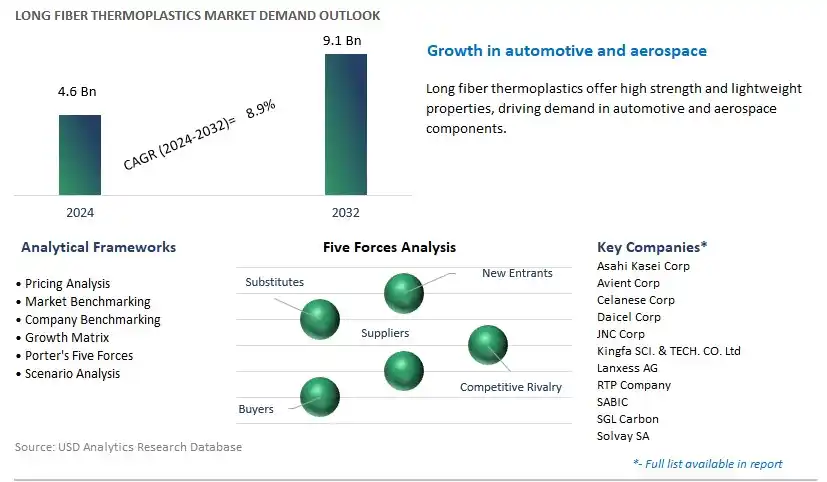
Global Long Fiber Thermoplastics Market Size is valued at $4.6 Billion in 2024 and is forecast to register a growth rate (CAGR) of 8.9% to reach $9.1 Billion by 2032.
The global Long Fiber Thermoplastics Market Study analyzes and forecasts the market size across 6 regions and 24 countries for diverse segments -By Resin (Polypropylene, Polyamide, Polyether Ether Ketone (PEEK), Others), By Manufacturing Process (Injection Molding, Pultrusion, D-LFT, Others), By Fiber (Glass Fiber, Carbon Fiber, Others), By End-User (Automotive, Aerospace, Electrical & Electronics, Buildings & Construction, Sporting Goods, Others).
An Introduction to Long Fiber Thermoplastics Market in 2024
Long fiber thermoplastics (LFTs) are composite materials consisting of thermoplastic polymers reinforced with long fibers such as glass, carbon, or natural fibers. In 2024, the demand for long fiber thermoplastics s to surge across industries such as automotive, aerospace, construction, and consumer goods due to their excellent mechanical properties, lightweight nature, and recyclability. LFTs offer advantages such as high strength-to-weight ratio, impact resistance, dimensional stability, and design flexibility, making them ideal for replacing traditional materials such as metals, wood, and thermoset composites in various applications. In the automotive sector, LFTs are used for manufacturing interior components, exterior body panels, structural reinforcements, and under-the-hood parts, contributing to weight reduction, fuel efficiency, and vehicle safety. Further, LFTs find applications in aerospace for producing lightweight aircraft components, in construction for manufacturing durable building materials, and in consumer goods for producing sporting goods, electronic enclosures, and household appliances. With ongoing advancements in material science, processing technologies, and sustainability initiatives, the market for long fiber thermoplastics is expected to expanding, driven by the demand for lightweight, durable, and eco-friendly materials in diverse end-use sectors.
Long Fiber Thermoplastics Market Competitive Landscape
The market report analyses the leading companies in the industry including Asahi Kasei Corp, Avient Corp, Celanese Corp, Daicel Corp, JNC Corp, Kingfa SCI. & TECH. CO. Ltd, Lanxess AG, RTP Company, SABIC, SGL Carbon, Solvay SA, and others.
Long Fiber Thermoplastics Market Dynamics
Market Trend: Growing Demand for Lightweight and High-Performance Materials
The most prominent market trend in long fiber thermoplastics is the growing demand for lightweight and high-performance materials across various industries. Long fiber thermoplastics (LFT) offer a unique combination of strength, stiffness, and impact resistance, making them ideal for applications where weight reduction and structural integrity are paramount. Industries such as automotive, aerospace, consumer goods, and construction are increasingly turning to LFT composites to achieve weight savings, improve fuel efficiency, and enhance product performance. As sustainability concerns continue to drive the shift towards lightweight materials, the demand for long fiber thermoplastics is expected to rise, fueling market growth and innovation in composite manufacturing technologies.
Market Driver: Increasing Emphasis on Fuel Efficiency and Emissions Reduction
A key market driver for long fiber thermoplastics is the increasing emphasis on fuel efficiency and emissions reduction in the automotive and transportation sectors. With tightening regulations on vehicle emissions and the push towards electrification and hybridization, automakers are under pressure to improve fuel efficiency and reduce vehicle weight without compromising safety or performance. Long fiber thermoplastics offer a lightweight alternative to traditional materials such as metal and short fiber composites, enabling automakers to achieve significant weight savings while maintaining structural integrity and crashworthiness. Additionally, LFT composites contribute to lower vehicle emissions by improving fuel efficiency and reducing the environmental impact over the vehicle's lifecycle. Thus, the need to meet regulatory requirements and consumer demand for more sustainable transportation solutions is driving the adoption of long fiber thermoplastics in the automotive industry and beyond.
Market Opportunity: Expansion into New Application Areas and Market Segments
An emerging opportunity within the long fiber thermoplastics market lies in the expansion into new application areas and market segments. While LFT composites have traditionally been used in automotive and industrial applications, there is growing interest in exploring their potential in other sectors such as aerospace, renewable energy, and consumer electronics. Opportunities exist to develop customized LFT solutions for specific applications, such as lightweight structural components, interior trim panels, wind turbine blades, and electronic housings, where the unique properties of long fiber thermoplastics can offer performance advantages and cost savings. Additionally, there is potential to penetrate new market segments such as marine, sports and recreation, and healthcare, where there is demand for lightweight, durable, and corrosion-resistant materials. By leveraging their expertise in composite materials and manufacturing processes, companies in the long fiber thermoplastics market can capitalize on these opportunities to expand their product portfolios, reach new customers, and drive continued growth and innovation in the industry.
Long Fiber Thermoplastics Market Share Analysis: Polypropylene segment generated the highest revenue in 2024
The Polypropylene segment is the largest segment within the long fiber thermoplastics market. Polypropylene (PP) is one of the most widely used thermoplastic resins due to its excellent balance of properties, including high strength, stiffness, chemical resistance, and low cost. These characteristics make PP a preferred choice for various applications requiring durable and lightweight materials, such as automotive components, consumer goods, and industrial equipment. Additionally, the versatility of PP allows it to be easily processed into long fiber thermoplastics, which further enhances its mechanical properties and performance. Moreover, the growing demand for lightweight materials to replace traditional metal components in automotive and aerospace industries drives the adoption of long fiber thermoplastics based on PP. With its widespread availability, cost-effectiveness, and superior mechanical properties, the Polypropylene segment maintains its position as the largest and most significant market segment within the long fiber thermoplastics market.
Long Fiber Thermoplastics Market Share Analysis: Direct Long Fiber Thermoplastics (D-LFT) is poised to register the fastest CAGR over the forecast period
The Direct Long Fiber Thermoplastics (D-LFT) segment is the fastest-growing segment within the long fiber thermoplastics market. D-LFT is a manufacturing process that involves directly impregnating long fibers with molten thermoplastic resin to produce composite materials with enhanced mechanical properties. This process allows for the production of complex shapes and parts with high strength-to-weight ratios, making D-LFT ideal for applications requiring lightweight and durable components, such as automotive parts, construction materials, and consumer goods. Additionally, advancements in D-LFT technology have led to improved process efficiency, reduced cycle times, and enhanced material performance, further driving its adoption across various industries. Moreover, the increasing demand for lightweight materials to reduce fuel consumption, improve energy efficiency, and meet stringent regulatory requirements in automotive and aerospace industries fuels the growth of the D-LFT segment. With its ability to offer high-performance composite materials with excellent mechanical properties, the Direct Long Fiber Thermoplastics (D-LFT) segment is poised for continued rapid growth within the long fiber thermoplastics market.
Long Fiber Thermoplastics Market Share Analysis: Glass Fiber segment generated the highest revenue in 2024
The Glass Fiber segment is the largest segment within the long fiber thermoplastics market. Glass fiber is one of the most commonly used reinforcing fibers in thermoplastic composites due to its affordability, availability, and excellent mechanical properties. Glass fiber offers high strength, stiffness, and impact resistance, making it suitable for a wide range of applications across various industries, including automotive, aerospace, construction, and consumer goods. Additionally, glass fiber-reinforced thermoplastics exhibit good dimensional stability, chemical resistance, and thermal properties, further enhancing their suitability for demanding applications. Moreover, advancements in glass fiber manufacturing processes and treatments have led to improved fiber-matrix adhesion, enhanced mechanical performance, and increased processing efficiency, driving the widespread adoption of glass fiber-reinforced thermoplastics. With its versatility, cost-effectiveness, and superior mechanical properties, the Glass Fiber segment maintains its position as the largest and most significant market segment within the long fiber thermoplastics market.
Long Fiber Thermoplastics Market Share Analysis: Automotive is poised to register the fastest CAGR over the forecast period
The Automotive segment is the fastest-growing segment within the long fiber thermoplastics market. Long fiber thermoplastics (LFT) offer significant advantages in automotive applications, including reduced weight, improved fuel efficiency, enhanced mechanical properties, and design flexibility. Automakers are increasingly adopting LFT composites to replace traditional materials such as metals and short fiber thermoplastics in various components, including body panels, interior trims, under-the-hood parts, and structural reinforcements. This trend is driven by the automotive industry's focus on lightweighting to meet stringent emissions regulations, improve vehicle performance, and extend driving range for electric vehicles. Additionally, advancements in LFT manufacturing processes, material formulations, and recycling technologies have improved the cost-effectiveness and sustainability of LFT composites, further fuelling their adoption in automotive applications. Moreover, the growing demand for electric and hybrid vehicles, which require lightweight materials to maximize battery efficiency and range, contributes to the increasing use of LFT composites in the automotive sector. With its ability to address the automotive industry's evolving needs for lightweighting and performance, the Automotive segment is poised for continued rapid growth within the long fiber thermoplastics market.
Long Fiber Thermoplastics Market
By Resin
Polypropylene
Polyamide
Polyether Ether Ketone (PEEK)
Others
By Manufacturing Process
Injection Molding
Pultrusion
D-LFT
Others
By Fiber
Glass Fiber
Carbon Fiber
Others
By End-User
Automotive
Aerospace
Electrical & Electronics
Buildings & Construction
Sporting Goods
Others
Countries Analyzed
North America (US, Canada, Mexico)
Europe (Germany, UK, France, Spain, Italy, Russia, Rest of Europe)
Asia Pacific (China, India, Japan, South Korea, Australia, South East Asia, Rest of Asia)
South America (Brazil, Argentina, Rest of South America)
Middle East and Africa (Saudi Arabia, UAE, Rest of Middle East, South Africa, Egypt, Rest of Africa)
Long Fiber Thermoplastics Companies Profiled in the Study
Asahi Kasei Corp
Avient Corp
Celanese Corp
Daicel Corp
JNC Corp
Kingfa SCI. & TECH. CO. Ltd
Lanxess AG
RTP Company
SABIC
SGL Carbon
Solvay SA
*- List Not Exhaustive
TABLE OF CONTENTS
1 Introduction to 2024 Long Fiber Thermoplastics Market
1.1 Market Overview
1.2 Quick Facts
1.3 Scope/Objective of the Study
1.4 Market Definition
1.5 Countries and Regions Covered
1.6 Units, Currency, and Conversions
1.7 Industry Value Chain
2 Research Methodology
2.1 Market Size Estimation
2.2 Sources and Research Methodology
2.3 Data Triangulation
2.4 Assumptions and Limitations
3 Executive Summary
3.1 Global Long Fiber Thermoplastics Market Size Outlook, $ Million, 2021 to 2032
3.2 Long Fiber Thermoplastics Market Outlook by Type, $ Million, 2021 to 2032
3.3 Long Fiber Thermoplastics Market Outlook by Product, $ Million, 2021 to 2032
3.4 Long Fiber Thermoplastics Market Outlook by Application, $ Million, 2021 to 2032
3.5 Long Fiber Thermoplastics Market Outlook by Key Countries, $ Million, 2021 to 2032
4 Market Dynamics
4.1 Key Driving Forces of Long Fiber Thermoplastics Industry
4.2 Key Market Trends in Long Fiber Thermoplastics Industry
4.3 Potential Opportunities in Long Fiber Thermoplastics Industry
4.4 Key Challenges in Long Fiber Thermoplastics Industry
5 Market Factor Analysis
5.1 Value Chain Analysis
5.2 Competitive Landscape
5.2.1 Global Long Fiber Thermoplastics Market Share by Company (%), 2023
5.2.2 Product Offerings by Company
5.3 Porter’s Five Forces Analysis
5.4 Pricing Analysis and Outlook
6 Growth Outlook Across Scenarios
6.1 Growth Analysis-Case Scenario Definitions
6.2 Low Growth Scenario Forecasts
6.3 Reference Growth Scenario Forecasts
6.4 High Growth Scenario Forecasts
7 Global Long Fiber Thermoplastics Market Outlook by Segments
7.1 Long Fiber Thermoplastics Market Outlook by Segments, $ Million, 2021- 2032
By Resin
Polypropylene
Polyamide
Polyether Ether Ketone (PEEK)
Others
By Manufacturing Process
Injection Molding
Pultrusion
D-LFT
Others
By Fiber
Glass Fiber
Carbon Fiber
Others
By End-User
Automotive
Aerospace
Electrical & Electronics
Buildings & Construction
Sporting Goods
Others
8 North America Long Fiber Thermoplastics Market Analysis and Outlook To 2032
8.1 Introduction to North America Long Fiber Thermoplastics Markets in 2024
8.2 North America Long Fiber Thermoplastics Market Size Outlook by Country, 2021-2032
8.2.1 United States
8.2.2 Canada
8.2.3 Mexico
8.3 North America Long Fiber Thermoplastics Market size Outlook by Segments, 2021-2032
By Resin
Polypropylene
Polyamide
Polyether Ether Ketone (PEEK)
Others
By Manufacturing Process
Injection Molding
Pultrusion
D-LFT
Others
By Fiber
Glass Fiber
Carbon Fiber
Others
By End-User
Automotive
Aerospace
Electrical & Electronics
Buildings & Construction
Sporting Goods
Others
9 Europe Long Fiber Thermoplastics Market Analysis and Outlook To 2032
9.1 Introduction to Europe Long Fiber Thermoplastics Markets in 2024
9.2 Europe Long Fiber Thermoplastics Market Size Outlook by Country, 2021-2032
9.2.1 Germany
9.2.2 France
9.2.3 Spain
9.2.4 United Kingdom
9.2.4 Italy
9.2.5 Russia
9.2.6 Norway
9.2.7 Rest of Europe
9.3 Europe Long Fiber Thermoplastics Market Size Outlook by Segments, 2021-2032
By Resin
Polypropylene
Polyamide
Polyether Ether Ketone (PEEK)
Others
By Manufacturing Process
Injection Molding
Pultrusion
D-LFT
Others
By Fiber
Glass Fiber
Carbon Fiber
Others
By End-User
Automotive
Aerospace
Electrical & Electronics
Buildings & Construction
Sporting Goods
Others
10 Asia Pacific Long Fiber Thermoplastics Market Analysis and Outlook To 2032
10.1 Introduction to Asia Pacific Long Fiber Thermoplastics Markets in 2024
10.2 Asia Pacific Long Fiber Thermoplastics Market Size Outlook by Country, 2021-2032
10.2.1 China
10.2.2 India
10.2.3 Japan
10.2.4 South Korea
10.2.5 Indonesia
10.2.6 Malaysia
10.2.7 Australia
10.2.8 Rest of Asia Pacific
10.3 Asia Pacific Long Fiber Thermoplastics Market size Outlook by Segments, 2021-2032
By Resin
Polypropylene
Polyamide
Polyether Ether Ketone (PEEK)
Others
By Manufacturing Process
Injection Molding
Pultrusion
D-LFT
Others
By Fiber
Glass Fiber
Carbon Fiber
Others
By End-User
Automotive
Aerospace
Electrical & Electronics
Buildings & Construction
Sporting Goods
Others
11 South America Long Fiber Thermoplastics Market Analysis and Outlook To 2032
11.1 Introduction to South America Long Fiber Thermoplastics Markets in 2024
11.2 South America Long Fiber Thermoplastics Market Size Outlook by Country, 2021-2032
11.2.1 Brazil
11.2.2 Argentina
11.2.3 Rest of South America
11.3 South America Long Fiber Thermoplastics Market size Outlook by Segments, 2021-2032
By Resin
Polypropylene
Polyamide
Polyether Ether Ketone (PEEK)
Others
By Manufacturing Process
Injection Molding
Pultrusion
D-LFT
Others
By Fiber
Glass Fiber
Carbon Fiber
Others
By End-User
Automotive
Aerospace
Electrical & Electronics
Buildings & Construction
Sporting Goods
Others
12 Middle East and Africa Long Fiber Thermoplastics Market Analysis and Outlook To 2032
12.1 Introduction to Middle East and Africa Long Fiber Thermoplastics Markets in 2024
12.2 Middle East and Africa Long Fiber Thermoplastics Market Size Outlook by Country, 2021-2032
12.2.1 Saudi Arabia
12.2.2 UAE
12.2.3 Oman
12.2.4 Rest of Middle East
12.2.5 Egypt
12.2.6 Nigeria
12.2.7 South Africa
12.2.8 Rest of Africa
12.3 Middle East and Africa Long Fiber Thermoplastics Market size Outlook by Segments, 2021-2032
By Resin
Polypropylene
Polyamide
Polyether Ether Ketone (PEEK)
Others
By Manufacturing Process
Injection Molding
Pultrusion
D-LFT
Others
By Fiber
Glass Fiber
Carbon Fiber
Others
By End-User
Automotive
Aerospace
Electrical & Electronics
Buildings & Construction
Sporting Goods
Others
13 Company Profiles
13.1 Company Snapshot
13.2 SWOT Profiles
13.3 Products and Services
13.4 Recent Developments
13.5 Financial Profile
Asahi Kasei Corp
Avient Corp
Celanese Corp
Daicel Corp
JNC Corp
Kingfa SCI. & TECH. CO. Ltd
Lanxess AG
RTP Company
SABIC
SGL Carbon
Solvay SA
14 Appendix
14.1 Customization Offerings
14.2 Subscription Services
14.3 Related Reports
14.4 Publisher Expertise
By Resin
Polypropylene
Polyamide
Polyether Ether Ketone (PEEK)
Others
By Manufacturing Process
Injection Molding
Pultrusion
D-LFT
Others
By Fiber
Glass Fiber
Carbon Fiber
Others
By End-User
Automotive
Aerospace
Electrical & Electronics
Buildings & Construction
Sporting Goods
Others
Countries Analyzed
North America (US, Canada, Mexico)
Europe (Germany, UK, France, Spain, Italy, Russia, Rest of Europe)
Asia Pacific (China, India, Japan, South Korea, Australia, South East Asia, Rest of Asia)
South America (Brazil, Argentina, Rest of South America)
Middle East and Africa (Saudi Arabia, UAE, Rest of Middle East, South Africa, Egypt, Rest of Africa)
