Low-Speed Electric Vehicle (LSEV) Market is estimated to increase at a growth rate of 14.8% CAGR over the forecast period from 2024 to 2030.
The global Low-Speed Electric Vehicle (LSEV) Market study analyzes and forecasts the market size across 6 regions and 24 countries for diverse segments including By Type (Passenger Vehicle, Off-Road Vehicle, Utility Vehicle, Heavy Duty Vehicle), By Power Supply (AC Charging, DC Charging), By Power Range (Below 10 kW, 10 to 30kW, Above 30kW), By Application (Tourist Places, Hotels & Resorts, Airports, Commercial Premises, Playgrounds, Others), By Distribution Channel (Direct, Indirect).
An Introduction to Global Low-Speed Electric Vehicle (LSEV) Market, 2024
The Low-Speed Electric Vehicle (LSEV) Market is experiencing a surge in demand as urban mobility challenges prompt a shift towards efficient and sustainable transportation solutions. LSEVs, characterized by their compact size, limited speed capabilities, and electric propulsion, are gaining popularity in congested city centers, campuses, and industrial complexes. Offering an eco-friendly alternative to traditional internal combustion engine vehicles, LSEVs are favored for short-distance commutes, last-mile deliveries, and recreational purposes. In 2024, advancements in battery technology, lightweight materials, and urban infrastructure are driving the growth of this market, catering to the evolving needs of urban dwellers seeking affordable, convenient, and environmentally responsible mobility options.
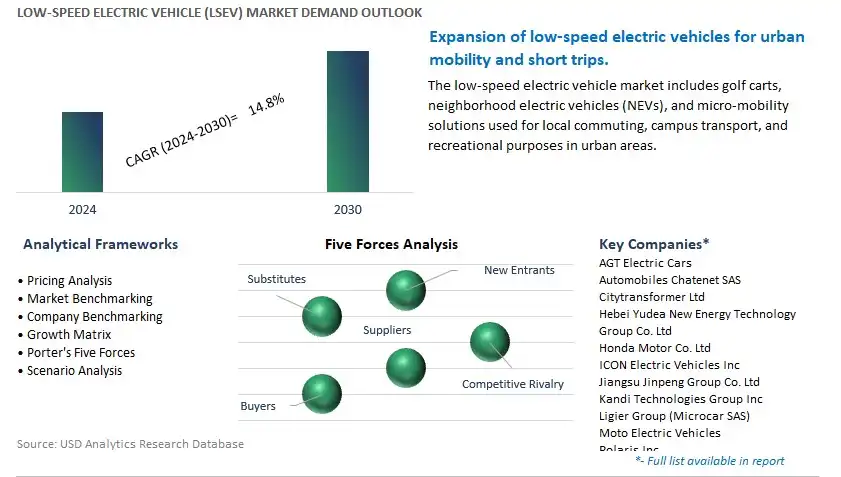
Low-Speed Electric Vehicle (LSEV) Competitive Landscape
The global Low-Speed Electric Vehicle (LSEV) market is highly competitive with a large number of companies focusing on niche market segments. Amidst intense competitive conditions, Low-Speed Electric Vehicle (LSEV) Companies are investing in new product launches and strengthening distribution channels. Key companies operating in the Low-Speed Electric Vehicle (LSEV) Market Industry include- AGT Electric Cars, Automobiles Chatenet SAS, Citytransformer Ltd, Hebei Yudea New Energy Technology Group Co. Ltd, Honda Motor Co. Ltd, ICON Electric Vehicles Inc, Jiangsu Jinpeng Group Co. Ltd, Kandi Technologies Group Inc, Ligier Group (Microcar SAS), Moto Electric Vehicles, Polaris Inc, Renault S.A.S., Shandong Shifeng Group Co. Ltd, Tata Motors Ltd, Tazzari Group S.p.A..
Low-Speed Electric Vehicle (LSEV) Market Trend: Urbanization and Micro-Mobility Solutions
The most prominent trend in the Low-Speed Electric Vehicle (LSEV) Market is the rise of urbanization and the increasing demand for micro-mobility solutions. With rapid urbanization and congestion in urban areas, there is a growing need for small, agile, and eco-friendly vehicles for short-distance transportation. This trend is driven by factors such as traffic congestion, limited parking space, and environmental concerns, prompting consumers to seek alternative modes of transportation such as low-speed electric vehicles. Additionally, the proliferation of bike-sharing programs, scooter rentals, and other micro-mobility services further accelerates the adoption of LSEVs as convenient and sustainable transportation options in urban environments. As cities prioritize initiatives to reduce carbon emissions and improve air quality, the market for low-speed electric vehicles is experiencing significant growth, presenting opportunities for manufacturers to innovate and meet the evolving needs of urban commuters and micro-mobility users.
Low-Speed Electric Vehicle (LSEV) Market Driver: Government Policies Promoting Electric Mobility
One of the primary drivers propelling the Low-Speed Electric Vehicle (LSEV) Market is government policies promoting electric mobility. Governments around the world are implementing policies, incentives, and subsidies to encourage the adoption of electric vehicles as part of efforts to mitigate climate change, reduce air pollution, and achieve energy independence. This driver is fueled by initiatives such as tax credits, rebates, and exemptions for electric vehicles, as well as mandates for automakers to meet emissions targets and electrify their vehicle fleets. Additionally, regulations such as zero-emission vehicle (ZEV) mandates and low-emission zones further drive the transition towards electric mobility and the adoption of low-speed electric vehicles in urban areas. As governments prioritize clean transportation and invest in infrastructure such as charging stations and dedicated lanes for electric vehicles, the demand for low-speed electric vehicles continues to grow, driving market expansion and investment in electric mobility solutions.
Low-Speed Electric Vehicle (LSEV) Market Opportunity: Customization and Personalization for Urban Mobility
An exciting opportunity within the Low-Speed Electric Vehicle (LSEV) Market lies in customization and personalization for urban mobility. As consumers increasingly seek vehicles that cater to their specific needs and preferences, there is potential to offer customizable LSEVs tailored for urban commuting, leisure, and micro-mobility applications. By offering options such as different seating configurations, cargo storage solutions, and connectivity features, manufacturers can appeal to a wide range of users and address the diverse requirements of urban mobility. Moreover, partnering with ride-sharing platforms, delivery services, and urban planners to tailor LSEVs for specific use cases such as last-mile delivery, shared mobility, and urban logistics can create new business opportunities and drive market growth. Additionally, integrating smart technology, app-based services, and IoT connectivity into LSEVs enables features such as remote monitoring, navigation assistance, and predictive maintenance, enhancing the overall user experience and value proposition. By embracing customization and personalization for urban mobility, manufacturers can differentiate their products, attract customers, and capitalize on the growing demand for tailored transportation solutions in urban environments.
Low-Speed Electric Vehicle (LSEV) Market Segmentation
By Type
Passenger Vehicle
Off-Road Vehicle
Utility Vehicle
Heavy Duty Vehicle
By Power Supply
AC Charging
DC Charging
By Power Range
Below 10 kW
10 to 30kW
Above 30kW
By Application
Tourist Places
Hotels & Resorts
Airports
Commercial Premises
Playgrounds
Others
By Distribution Channel
Direct
IndirectGeographical Analysis
North America (United States, Canada, Mexico)
Europe (Germany, France, United Kingdom, Spain, Italy, Rest of Europe)
Asia Pacific (China, India, Japan, South Korea, Rest of Asia Pacific)
South America (Brazil, Argentina, Rest of South America)
Middle East and Africa (Saudi Arabia, UAE, Rest of Middle East, South Africa, Egypt, Rest of Africa
Low-Speed Electric Vehicle (LSEV) Companies
AGT Electric Cars
Automobiles Chatenet SAS
Citytransformer Ltd
Hebei Yudea New Energy Technology Group Co. Ltd
Honda Motor Co. Ltd
ICON Electric Vehicles Inc
Jiangsu Jinpeng Group Co. Ltd
Kandi Technologies Group Inc
Ligier Group (Microcar SAS)
Moto Electric Vehicles
Polaris Inc
Renault S.A.S.
Shandong Shifeng Group Co. Ltd
Tata Motors Ltd
Tazzari Group S.p.A.
*- List not Exhaustive
TABLE OF CONTENTS
1 Introduction to 2024 Low-Speed Electric Vehicle (LSEV) Market
1.1 Market Overview
1.2 Quick Facts
1.3 Scope/Objective of the Study
1.4 Market Definition
1.5 Countries and Regions Analyzed
1.6 Units, Currency, and Conversions
1.7 Industry Value Chain
2 Research Methodology
2.1 Market Size Estimation
2.2 Sources and Research Methodology
2.3 Data Triangulation
2.4 Assumptions and Limitations
3 Executive Summary
3.1 Global Low-Speed Electric Vehicle (LSEV) Market Size Outlook, $ Million, 2021 to 2030
3.2 Low-Speed Electric Vehicle (LSEV) Market Outlook by Type, $ Million, 2021 to 2030
3.3 Low-Speed Electric Vehicle (LSEV) Market Outlook by Product, $ Million, 2021 to 2030
3.4 Low-Speed Electric Vehicle (LSEV) Market Outlook by Application, $ Million, 2021 to 2030
3.5 Low-Speed Electric Vehicle (LSEV) Market Outlook by Key Countries, $ Million, 2021 to 2030
4 Market Dynamics
4.1 Key Driving Forces of Low-Speed Electric Vehicle (LSEV) Industry
4.2 Key Market Trends in Low-Speed Electric Vehicle (LSEV) Industry
4.3 Potential Opportunities in Low-Speed Electric Vehicle (LSEV) Industry
4.4 Key Challenges in Low-Speed Electric Vehicle (LSEV) Industry
5 Market Factor Analysis
5.1 Value Chain Analysis
5.2 Competitive Landscape
5.2.1 Global Low-Speed Electric Vehicle (LSEV) Market Share by Company (%), 2023
5.2.2 Product Offerings by Company
5.3 Porter’s Five Forces Analysis
5.4 Pricing Analysis and Outlook
6 Growth Outlook Across Scenarios
6.1 Growth Analysis-Case Scenario Definitions
6.2 Low Growth Scenario Forecasts
6.3 Reference Growth Scenario Forecasts
6.4 High Growth Scenario Forecasts
7 Global Low-Speed Electric Vehicle (LSEV) Market Outlook by Segments
7.1 Low-Speed Electric Vehicle (LSEV) Market Outlook by Segments, $ Million, 2021- 2030
By Type
Passenger Vehicle
Off-Road Vehicle
Utility Vehicle
Heavy Duty Vehicle
By Power Supply
AC Charging
DC Charging
By Power Range
Below 10 kW
10 to 30kW
Above 30kW
By Application
Tourist Places
Hotels & Resorts
Airports
Commercial Premises
Playgrounds
Others
By Distribution Channel
Direct
Indirect
8 North America Low-Speed Electric Vehicle (LSEV) Market Analysis and Outlook To 2030
8.1 Introduction to North America Low-Speed Electric Vehicle (LSEV) Markets in 2024
8.2 North America Low-Speed Electric Vehicle (LSEV) Market Size Outlook by Country, 2021-2030
8.2.1 United States
8.2.2 Canada
8.2.3 Mexico
8.3 North America Low-Speed Electric Vehicle (LSEV) Market size Outlook by Segments, 2021-2030
By Type
Passenger Vehicle
Off-Road Vehicle
Utility Vehicle
Heavy Duty Vehicle
By Power Supply
AC Charging
DC Charging
By Power Range
Below 10 kW
10 to 30kW
Above 30kW
By Application
Tourist Places
Hotels & Resorts
Airports
Commercial Premises
Playgrounds
Others
By Distribution Channel
Direct
Indirect
9 Europe Low-Speed Electric Vehicle (LSEV) Market Analysis and Outlook To 2030
9.1 Introduction to Europe Low-Speed Electric Vehicle (LSEV) Markets in 2024
9.2 Europe Low-Speed Electric Vehicle (LSEV) Market Size Outlook by Country, 2021-2030
9.2.1 Germany
9.2.2 France
9.2.3 Spain
9.2.4 United Kingdom
9.2.4 Italy
9.2.5 Russia
9.2.6 Norway
9.2.7 Rest of Europe
9.3 Europe Low-Speed Electric Vehicle (LSEV) Market Size Outlook by Segments, 2021-2030
By Type
Passenger Vehicle
Off-Road Vehicle
Utility Vehicle
Heavy Duty Vehicle
By Power Supply
AC Charging
DC Charging
By Power Range
Below 10 kW
10 to 30kW
Above 30kW
By Application
Tourist Places
Hotels & Resorts
Airports
Commercial Premises
Playgrounds
Others
By Distribution Channel
Direct
Indirect
10 Asia Pacific Low-Speed Electric Vehicle (LSEV) Market Analysis and Outlook To 2030
10.1 Introduction to Asia Pacific Low-Speed Electric Vehicle (LSEV) Markets in 2024
10.2 Asia Pacific Low-Speed Electric Vehicle (LSEV) Market Size Outlook by Country, 2021-2030
10.2.1 China
10.2.2 India
10.2.3 Japan
10.2.4 South Korea
10.2.5 Indonesia
10.2.6 Malaysia
10.2.7 Australia
10.2.8 Rest of Asia Pacific
10.3 Asia Pacific Low-Speed Electric Vehicle (LSEV) Market size Outlook by Segments, 2021-2030
By Type
Passenger Vehicle
Off-Road Vehicle
Utility Vehicle
Heavy Duty Vehicle
By Power Supply
AC Charging
DC Charging
By Power Range
Below 10 kW
10 to 30kW
Above 30kW
By Application
Tourist Places
Hotels & Resorts
Airports
Commercial Premises
Playgrounds
Others
By Distribution Channel
Direct
Indirect
11 South America Low-Speed Electric Vehicle (LSEV) Market Analysis and Outlook To 2030
11.1 Introduction to South America Low-Speed Electric Vehicle (LSEV) Markets in 2024
11.2 South America Low-Speed Electric Vehicle (LSEV) Market Size Outlook by Country, 2021-2030
11.2.1 Brazil
11.2.2 Argentina
11.2.3 Rest of South America
11.3 South America Low-Speed Electric Vehicle (LSEV) Market size Outlook by Segments, 2021-2030
By Type
Passenger Vehicle
Off-Road Vehicle
Utility Vehicle
Heavy Duty Vehicle
By Power Supply
AC Charging
DC Charging
By Power Range
Below 10 kW
10 to 30kW
Above 30kW
By Application
Tourist Places
Hotels & Resorts
Airports
Commercial Premises
Playgrounds
Others
By Distribution Channel
Direct
Indirect
12 Middle East and Africa Low-Speed Electric Vehicle (LSEV) Market Analysis and Outlook To 2030
12.1 Introduction to Middle East and Africa Low-Speed Electric Vehicle (LSEV) Markets in 2024
12.2 Middle East and Africa Low-Speed Electric Vehicle (LSEV) Market Size Outlook by Country, 2021-2030
12.2.1 Saudi Arabia
12.2.2 UAE
12.2.3 Oman
12.2.4 Rest of Middle East
12.2.5 Egypt
12.2.6 Nigeria
12.2.7 South Africa
12.2.8 Rest of Africa
12.3 Middle East and Africa Low-Speed Electric Vehicle (LSEV) Market size Outlook by Segments, 2021-2030
By Type
Passenger Vehicle
Off-Road Vehicle
Utility Vehicle
Heavy Duty Vehicle
By Power Supply
AC Charging
DC Charging
By Power Range
Below 10 kW
10 to 30kW
Above 30kW
By Application
Tourist Places
Hotels & Resorts
Airports
Commercial Premises
Playgrounds
Others
By Distribution Channel
Direct
Indirect
13 Company Profiles
13.1 Company Snapshot
13.2 SWOT Profiles
13.3 Products and Services
13.4 Recent Developments
13.5 Financial Profile
List of Companies
AGT Electric Cars
Automobiles Chatenet SAS
Citytransformer Ltd
Hebei Yudea New Energy Technology Group Co. Ltd
Honda Motor Co. Ltd
ICON Electric Vehicles Inc
Jiangsu Jinpeng Group Co. Ltd
Kandi Technologies Group Inc
Ligier Group (Microcar SAS)
Moto Electric Vehicles
Polaris Inc
Renault S.A.S.
Shandong Shifeng Group Co. Ltd
Tata Motors Ltd
Tazzari Group S.p.A.
14 Appendix
14.1 Customization Offerings
14.2 Subscription Services
14.3 Related Reports
14.4 Publisher Expertise
By Type
Passenger Vehicle
Off-Road Vehicle
Utility Vehicle
Heavy Duty Vehicle
By Power Supply
AC Charging
DC Charging
By Power Range
Below 10 kW
10 to 30kW
Above 30kW
By Application
Tourist Places
Hotels & Resorts
Airports
Commercial Premises
Playgrounds
Others
By Distribution Channel
Direct
Indirect
