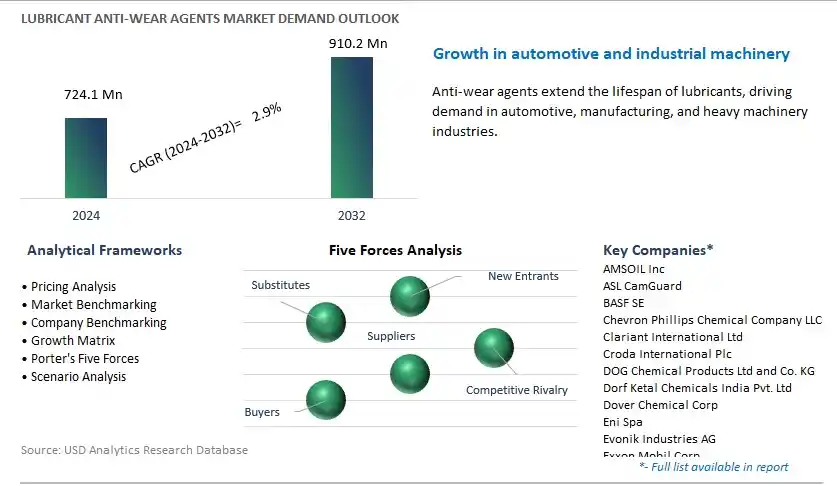
Global Lubricant Anti-wear Agents Market Size is valued at $724.1 Million in 2024 and is forecast to register a growth rate (CAGR) of 2.9% to reach $910.2 Million by 2032.
The global Lubricant Anti-wear Agents Market Study analyzes and forecasts the market size across 6 regions and 24 countries for diverse segments -By Type (Zinc Dialkldithiophosphate (ZDDP), P-Derivative), By Application (Engine Oil, Automotive Gear Oil, Automotive Transmission Fluid, Metal working Fluid, Greases, Hydraulic Oil, Others), By Sales Channel (Merchant, Captive).
An Introduction to Lubricant Anti-wear Agents Market in 2024
Lubricant antiwear agents are additives used in lubricating oils and greases to reduce friction and wear between moving surfaces, thereby extending the lifespan of machinery and equipment. In 2024, the demand for lubricant antiwear agents s to grow across industries such as automotive, manufacturing, aerospace, and mining. These additives form a protective film on metal surfaces, preventing direct contact and reducing frictional losses during operation. Common antiwear agents include zinc dialkyldithiophosphate (ZDDP), molybdenum disulfide (MoS2), and organic friction modifiers, which provide excellent lubricity and wear protection under extreme operating conditions. With the increasing demand for energy-efficient and high-performance machinery, there is a growing emphasis on developing advanced lubricant additives that offer superior protection, compatibility with modern engine designs, and reduced environmental impact. Further, the adoption of bio-based and environmentally friendly antiwear agents aligns with sustainability initiatives and regulatory requirements aimed at minimizing the use of hazardous substances in lubricants. As industries to rely on lubricants for equipment reliability, productivity, and cost savings, the market for lubricant antiwear agents is expected to witness steady growth, driven by the ongoing need for efficient friction reduction and wear protection solutions.
Lubricant Anti-wear Agents Market Competitive Landscape
The market report analyses the leading companies in the industry including AMSOIL Inc, ASL CamGuard, BASF SE, Chevron Phillips Chemical Company LLC, Clariant International Ltd, Croda International Plc, DOG Chemical Products Ltd and Co. KG, Dorf Ketal Chemicals India Pvt. Ltd, Dover Chemical Corp, Eni Spa, Evonik Industries AG, Exxon Mobil Corp, Infineum International Ltd, Italmatch Chemicals Spa, Lanxess AG, and others.
Lubricant Anti-wear Agents Market Dynamics
Market Trend: Growing Emphasis on Equipment Longevity and Maintenance
A prominent market trend for lubricant anti-wear agents is the increasing emphasis on prolonging equipment longevity and minimizing maintenance costs. Industries across sectors such as automotive, manufacturing, and aerospace are prioritizing the optimization of machinery performance and reliability. As a result, there's a growing demand for lubricants enhanced with anti-wear agents that can effectively reduce friction and prevent wear and tear on critical components. This trend is driven by the need to enhance equipment durability, minimize downtime, and improve overall operational efficiency.
Market Driver: Rising Demand for High-Performance Lubricants
A key market driver for lubricant anti-wear agents is the rising demand for high-performance lubricants in various industrial applications. As machinery and equipment operate under increasingly demanding conditions, there's a growing need for lubricants that can withstand high temperatures, heavy loads, and extreme pressures while providing effective anti-wear protection. Manufacturers and end-users are seeking lubricant formulations that offer superior performance in terms of friction reduction, wear prevention, and lubricity, driving the demand for anti-wear agents as essential additives in lubricant formulations.
Market Opportunity: Expansion into Renewable Energy and Electric Vehicle (EV) Sectors
A potential opportunity for lubricant anti-wear agents lies in expanding their application into the renewable energy and electric vehicle (EV) sectors. With the global transition towards renewable energy sources and the growing adoption of electric vehicles, there's a burgeoning market for lubricants tailored to the specific needs of wind turbines, solar panels, and EV drivetrains. Lubricant anti-wear agents play a crucial role in ensuring the efficiency, reliability, and longevity of components in these emerging sectors. By developing specialized formulations optimized for renewable energy and EV applications, manufacturers can capitalize on this opportunity to address evolving market demands and establish a foothold in rapidly growing industries.
Lubricant Anti-Wear Agents Market Share Analysis: Zinc Dialkyl Dithiophosphate (ZDDP) segment generated the highest revenue in 2024
The Zinc Dialkyl Dithiophosphate (ZDDP) segment is the largest segment within the lubricant anti-wear agents market. ZDDP is a widely used anti-wear additive in lubricants, particularly in engine oils, due to its ability to protect metal surfaces from wear, scuffing, and corrosion under high-pressure and high-temperature conditions. ZDDP forms a sacrificial film on metal surfaces, providing a protective barrier against friction and preventing metal-to-metal contact, which can lead to component failure and engine wear. Additionally, ZDDP exhibits excellent oxidative stability, thermal stability, and compatibility with other additives commonly found in lubricant formulations. Moreover, ZDDP has a proven track record of performance and reliability in various applications, including automotive, industrial, marine, and aerospace lubricants. The widespread adoption of ZDDP is further driven by its cost-effectiveness and ease of incorporation into lubricant formulations. While alternative anti-wear additives such as P-Derivatives are gaining attention due to regulatory pressures and environmental concerns, ZDDP remains the preferred choice for many lubricant manufacturers and end-users due to its unmatched performance, versatility, and cost-effectiveness. Thus, the Zinc Dialkyl Dithiophosphate (ZDDP) segment maintains its position as the largest and most significant segment within the lubricant anti-wear agents market.
Lubricant Anti-Wear Agents Market Share Analysis: Metalworking Fluid is poised to register the fastest CAGR over the forecast period
The Metalworking Fluid segment is the fastest-growing segment within the lubricant anti-wear agents market. Metalworking fluids are essential in machining operations such as cutting, drilling, milling, and grinding, where they provide lubrication, cooling, and chip removal. These fluids are subjected to high pressures, temperatures, and metal-to-metal contact, leading to wear and tool damage if not adequately protected. Lubricant anti-wear agents play a crucial role in metalworking fluids by forming a protective film on metal surfaces, reducing friction, preventing wear, and extending tool life. The increasing demand for precision machining, higher cutting speeds, and tighter tolerances in industries such as automotive, aerospace, and manufacturing drives the need for advanced metalworking fluids with superior lubricating and anti-wear properties. Additionally, stringent regulations and environmental concerns prompt manufacturers to develop metalworking fluids that are free from hazardous chemicals and comply with health, safety, and environmental standards. Lubricant anti-wear agents offer a cost-effective solution for enhancing the performance and sustainability of metalworking fluids while meeting regulatory requirements. Moreover, advancements in additive technology, including the development of more effective anti-wear agents with improved thermal stability, oxidation resistance, and compatibility with other additives, further drive their adoption in metalworking fluids. With the growing demand for high-performance metalworking fluids and the continuous innovation in lubricant additive technology, the Metalworking Fluid segment is poised for rapid growth within the lubricant anti-wear agents market.
Lubricant Anti-Wear Agents Market Share Analysis: Captive segment generated the highest revenue in 2024
The Captive segment is the largest segment within the lubricant anti-wear agents market. Captive sales channels refer to the distribution of lubricant additives by manufacturers directly to their own lubricant blending operations or customers within their supply chain. This vertical integration allows lubricant additive manufacturers to exert greater control over the distribution process, ensuring the quality, consistency, and timely delivery of their products to end-users. Moreover, captive sales channels offer potential advantages, including cost efficiencies, reduced lead times, and customized solutions tailored to specific customer requirements. Additionally, captive sales channels enable manufacturers to leverage their technical expertise, research and development capabilities, and customer relationships to provide value-added services and support to end-users, such as formulation support, technical assistance, and product customization. Furthermore, captive sales channels are common in industries with specialized lubricant requirements, such as automotive, aerospace, and industrial manufacturing, where manufacturers prefer to source additives directly from trusted suppliers with proven track records of performance and reliability. With its inherent advantages and widespread adoption in various industries, the Captive segment maintains its position as the largest and most significant segment within the lubricant anti-wear agents market.
Lubricant Anti-wear Agents Market
By Type
Zinc Dialkldithiophosphate (ZDDP)
P-Derivative
-Phosphate
-Phosphonate
-phosphite
By Application
Engine Oil
Automotive Gear Oil
Automotive Transmission Fluid
Metal working Fluid
Greases
Hydraulic Oil
Others
By Sales Channel
Merchant
CaptiveCountries Analyzed
North America (US, Canada, Mexico)
Europe (Germany, UK, France, Spain, Italy, Russia, Rest of Europe)
Asia Pacific (China, India, Japan, South Korea, Australia, South East Asia, Rest of Asia)
South America (Brazil, Argentina, Rest of South America)
Middle East and Africa (Saudi Arabia, UAE, Rest of Middle East, South Africa, Egypt, Rest of Africa)
Lubricant Anti wear Agents Companies Profiled in the Study
AMSOIL Inc
ASL CamGuard
BASF SE
Chevron Phillips Chemical Company LLC
Clariant International Ltd
Croda International Plc
DOG Chemical Products Ltd and Co. KG
Dorf Ketal Chemicals India Pvt. Ltd
Dover Chemical Corp
Eni Spa
Evonik Industries AG
Exxon Mobil Corp
Infineum International Ltd
Italmatch Chemicals Spa
Lanxess AG
*- List Not Exhaustive
TABLE OF CONTENTS
1 Introduction to 2024 Lubricant Anti wear Agents Market
1.1 Market Overview
1.2 Quick Facts
1.3 Scope/Objective of the Study
1.4 Market Definition
1.5 Countries and Regions Covered
1.6 Units, Currency, and Conversions
1.7 Industry Value Chain
2 Research Methodology
2.1 Market Size Estimation
2.2 Sources and Research Methodology
2.3 Data Triangulation
2.4 Assumptions and Limitations
3 Executive Summary
3.1 Global Lubricant Anti wear Agents Market Size Outlook, $ Million, 2021 to 2032
3.2 Lubricant Anti wear Agents Market Outlook by Type, $ Million, 2021 to 2032
3.3 Lubricant Anti wear Agents Market Outlook by Product, $ Million, 2021 to 2032
3.4 Lubricant Anti wear Agents Market Outlook by Application, $ Million, 2021 to 2032
3.5 Lubricant Anti wear Agents Market Outlook by Key Countries, $ Million, 2021 to 2032
4 Market Dynamics
4.1 Key Driving Forces of Lubricant Anti wear Agents Industry
4.2 Key Market Trends in Lubricant Anti wear Agents Industry
4.3 Potential Opportunities in Lubricant Anti wear Agents Industry
4.4 Key Challenges in Lubricant Anti wear Agents Industry
5 Market Factor Analysis
5.1 Value Chain Analysis
5.2 Competitive Landscape
5.2.1 Global Lubricant Anti wear Agents Market Share by Company (%), 2023
5.2.2 Product Offerings by Company
5.3 Porter’s Five Forces Analysis
5.4 Pricing Analysis and Outlook
6 Growth Outlook Across Scenarios
6.1 Growth Analysis-Case Scenario Definitions
6.2 Low Growth Scenario Forecasts
6.3 Reference Growth Scenario Forecasts
6.4 High Growth Scenario Forecasts
7 Global Lubricant Anti wear Agents Market Outlook by Segments
7.1 Lubricant Anti wear Agents Market Outlook by Segments, $ Million, 2021- 2032
By Type
Zinc Dialkldithiophosphate (ZDDP)
P-Derivative
-Phosphate
-Phosphonate
-phosphite
By Application
Engine Oil
Automotive Gear Oil
Automotive Transmission Fluid
Metal working Fluid
Greases
Hydraulic Oil
Others
By Sales Channel
Merchant
Captive
8 North America Lubricant Anti wear Agents Market Analysis and Outlook To 2032
8.1 Introduction to North America Lubricant Anti wear Agents Markets in 2024
8.2 North America Lubricant Anti wear Agents Market Size Outlook by Country, 2021-2032
8.2.1 United States
8.2.2 Canada
8.2.3 Mexico
8.3 North America Lubricant Anti wear Agents Market size Outlook by Segments, 2021-2032
By Type
Zinc Dialkldithiophosphate (ZDDP)
P-Derivative
-Phosphate
-Phosphonate
-phosphite
By Application
Engine Oil
Automotive Gear Oil
Automotive Transmission Fluid
Metal working Fluid
Greases
Hydraulic Oil
Others
By Sales Channel
Merchant
Captive
9 Europe Lubricant Anti wear Agents Market Analysis and Outlook To 2032
9.1 Introduction to Europe Lubricant Anti wear Agents Markets in 2024
9.2 Europe Lubricant Anti wear Agents Market Size Outlook by Country, 2021-2032
9.2.1 Germany
9.2.2 France
9.2.3 Spain
9.2.4 United Kingdom
9.2.4 Italy
9.2.5 Russia
9.2.6 Norway
9.2.7 Rest of Europe
9.3 Europe Lubricant Anti wear Agents Market Size Outlook by Segments, 2021-2032
By Type
Zinc Dialkldithiophosphate (ZDDP)
P-Derivative
-Phosphate
-Phosphonate
-phosphite
By Application
Engine Oil
Automotive Gear Oil
Automotive Transmission Fluid
Metal working Fluid
Greases
Hydraulic Oil
Others
By Sales Channel
Merchant
Captive
10 Asia Pacific Lubricant Anti wear Agents Market Analysis and Outlook To 2032
10.1 Introduction to Asia Pacific Lubricant Anti wear Agents Markets in 2024
10.2 Asia Pacific Lubricant Anti wear Agents Market Size Outlook by Country, 2021-2032
10.2.1 China
10.2.2 India
10.2.3 Japan
10.2.4 South Korea
10.2.5 Indonesia
10.2.6 Malaysia
10.2.7 Australia
10.2.8 Rest of Asia Pacific
10.3 Asia Pacific Lubricant Anti wear Agents Market size Outlook by Segments, 2021-2032
By Type
Zinc Dialkldithiophosphate (ZDDP)
P-Derivative
-Phosphate
-Phosphonate
-phosphite
By Application
Engine Oil
Automotive Gear Oil
Automotive Transmission Fluid
Metal working Fluid
Greases
Hydraulic Oil
Others
By Sales Channel
Merchant
Captive
11 South America Lubricant Anti wear Agents Market Analysis and Outlook To 2032
11.1 Introduction to South America Lubricant Anti wear Agents Markets in 2024
11.2 South America Lubricant Anti wear Agents Market Size Outlook by Country, 2021-2032
11.2.1 Brazil
11.2.2 Argentina
11.2.3 Rest of South America
11.3 South America Lubricant Anti wear Agents Market size Outlook by Segments, 2021-2032
By Type
Zinc Dialkldithiophosphate (ZDDP)
P-Derivative
-Phosphate
-Phosphonate
-phosphite
By Application
Engine Oil
Automotive Gear Oil
Automotive Transmission Fluid
Metal working Fluid
Greases
Hydraulic Oil
Others
By Sales Channel
Merchant
Captive
12 Middle East and Africa Lubricant Anti wear Agents Market Analysis and Outlook To 2032
12.1 Introduction to Middle East and Africa Lubricant Anti wear Agents Markets in 2024
12.2 Middle East and Africa Lubricant Anti wear Agents Market Size Outlook by Country, 2021-2032
12.2.1 Saudi Arabia
12.2.2 UAE
12.2.3 Oman
12.2.4 Rest of Middle East
12.2.5 Egypt
12.2.6 Nigeria
12.2.7 South Africa
12.2.8 Rest of Africa
12.3 Middle East and Africa Lubricant Anti wear Agents Market size Outlook by Segments, 2021-2032
By Type
Zinc Dialkldithiophosphate (ZDDP)
P-Derivative
-Phosphate
-Phosphonate
-phosphite
By Application
Engine Oil
Automotive Gear Oil
Automotive Transmission Fluid
Metal working Fluid
Greases
Hydraulic Oil
Others
By Sales Channel
Merchant
Captive
13 Company Profiles
13.1 Company Snapshot
13.2 SWOT Profiles
13.3 Products and Services
13.4 Recent Developments
13.5 Financial Profile
AMSOIL Inc
ASL CamGuard
BASF SE
Chevron Phillips Chemical Company LLC
Clariant International Ltd
Croda International Plc
DOG Chemical Products Ltd and Co. KG
Dorf Ketal Chemicals India Pvt. Ltd
Dover Chemical Corp
Eni Spa
Evonik Industries AG
Exxon Mobil Corp
Infineum International Ltd
Italmatch Chemicals Spa
Lanxess AG
14 Appendix
14.1 Customization Offerings
14.2 Subscription Services
14.3 Related Reports
14.4 Publisher Expertise
By Type
Zinc Dialkldithiophosphate (ZDDP)
P-Derivative
-Phosphate
-Phosphonate
-phosphite
By Application
Engine Oil
Automotive Gear Oil
Automotive Transmission Fluid
Metal working Fluid
Greases
Hydraulic Oil
Others
By Sales Channel
Merchant
Captive
Countries Analyzed
North America (US, Canada, Mexico)
Europe (Germany, UK, France, Spain, Italy, Russia, Rest of Europe)
Asia Pacific (China, India, Japan, South Korea, Australia, South East Asia, Rest of Asia)
South America (Brazil, Argentina, Rest of South America)
Middle East and Africa (Saudi Arabia, UAE, Rest of Middle East, South Africa, Egypt, Rest of Africa)
