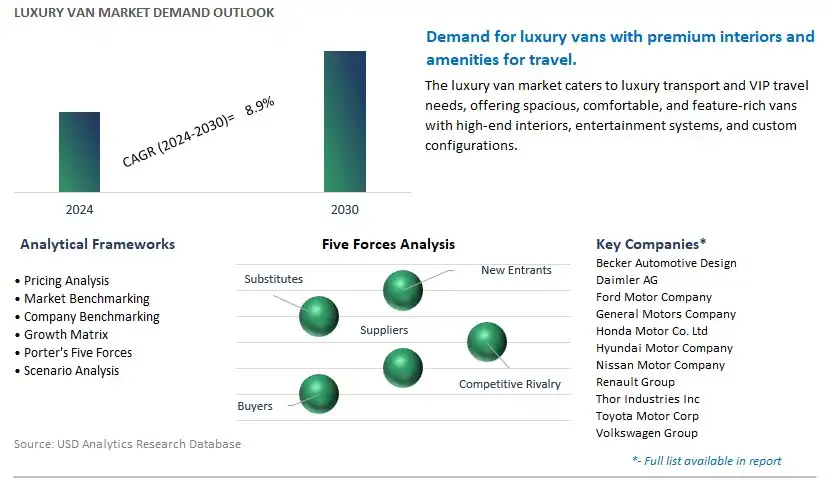
Luxury Van Market is estimated to increase at a growth rate of 8.9% CAGR over the forecast period from 2024 to 2030.
The global Luxury Van Market study analyzes and forecasts the market size across 6 regions and 24 countries for diverse segments including By Type (Cargo Van, Crew Van, Passenger Van), By Capacity (7 Seats, 9 Seats, 11 Seats), By End-User (Individuals, Fleet Operators).
An Introduction to Global Luxury Van Market, 2024
The Luxury Van Market in 2024 offers a blend of comfort, versatility, and sophistication, catering to discerning consumers who demand more from their mode of transportation. Gone are the days when vans were merely utilitarian vehicles; today's luxury vans epitomize opulence, featuring plush interiors, cutting-edge technology, and an array of amenities typically found in high-end automobiles. Whether used for executive transport, leisure travel, or luxury shuttling services, these vehicles provide a seamless fusion of practicality and extravagance. With customizable options, advanced safety features, and refined aesthetics, the luxury van market continues to thrive, appealing to affluent individuals and businesses seeking a superior travel experience.
Luxury Van Competitive Landscape
The global Luxury Van market is highly competitive with a large number of companies focusing on niche market segments. Amidst intense competitive conditions, Luxury Van Companies are investing in new product launches and strengthening distribution channels. Key companies operating in the Luxury Van Market Industry include- Becker Automotive Design, Daimler AG, Ford Motor Company, General Motors Company, Honda Motor Co. Ltd, Hyundai Motor Company, Nissan Motor Company, Renault Group, Thor Industries Inc, Toyota Motor Corp, Volkswagen Group.
Luxury Van Market Trend: Evolution towards Premium Comfort and Amenities
The most prominent trend in the Luxury Van Market is the evolution towards premium comfort and amenities. With the rising demand for upscale transportation solutions, luxury vans are increasingly incorporating high-end features and luxurious interiors typically found in luxury cars. This trend is driven by the preferences of affluent consumers for spacious and comfortable vehicles that offer a luxurious travel experience. Additionally, advancements in interior design, technology integration, and customization options have allowed luxury van manufacturers to cater to the discerning tastes of their clientele, offering amenities such as premium seating, entertainment systems, and advanced connectivity features. As luxury vans become more sophisticated and refined, the market is experiencing growth, presenting opportunities for manufacturers to meet the demand for upscale transportation solutions.
Luxury Van Market Driver: Growing Demand for Personalized and Bespoke Travel Experiences
One of the primary drivers propelling the Luxury Van Market is the growing demand for personalized and bespoke travel experiences. Affluent consumers are seeking unique and customized transportation solutions that cater to their specific needs and preferences, whether for business, leisure, or family travel. This driver is fueled by the desire for exclusivity, convenience, and luxury, as individuals seek to differentiate themselves and elevate their travel experiences. Additionally, the rise of luxury travel trends such as experiential tourism, destination weddings, and executive transportation further drive demand for upscale vans that offer comfort, style, and versatility. As consumers prioritize personalized and bespoke experiences, the demand for luxury vans with customizable features and tailored amenities continues to grow, driving market expansion and investment in bespoke luxury transportation solutions.
Luxury Van Market Opportunity: Expansion into Niche Markets and Specialized Applications
An exciting opportunity within the Luxury Van Market lies in the expansion into niche markets and specialized applications. While luxury vans traditionally cater to VIP transportation, executive shuttles, and luxury tourism, there is potential to explore new segments and applications that demand premium transportation solutions. For example, manufacturers can target niche markets such as luxury RVs, mobile offices, and specialty vehicles for medical transportation or mobile hospitality. By leveraging their expertise in luxury vehicle design, customization capabilities, and brand prestige, manufacturers can develop bespoke vans tailored to the unique needs of these specialized markets. Moreover, partnering with luxury lifestyle brands, event planners, and hospitality companies to create exclusive experiences and packages can further enhance the appeal of luxury vans in niche segments. By embracing opportunities in niche markets and specialized applications, manufacturers can diversify their product offerings, reach new customer segments, and capitalize on the growing demand for premium transportation solutions beyond traditional luxury van applications.
Luxury Van Market Segmentation
By Type
Cargo Van
Crew Van
Passenger Van
By Capacity
7 Seats
9 Seats
11 Seats
By End-User
Individuals
Fleet OperatorsGeographical Analysis
North America (United States, Canada, Mexico)
Europe (Germany, France, United Kingdom, Spain, Italy, Rest of Europe)
Asia Pacific (China, India, Japan, South Korea, Rest of Asia Pacific)
South America (Brazil, Argentina, Rest of South America)
Middle East and Africa (Saudi Arabia, UAE, Rest of Middle East, South Africa, Egypt, Rest of Africa
Luxury Van Companies
Becker Automotive Design
Daimler AG
Ford Motor Company
General Motors Company
Honda Motor Co. Ltd
Hyundai Motor Company
Nissan Motor Company
Renault Group
Thor Industries Inc
Toyota Motor Corp
Volkswagen Group
*- List not Exhaustive
TABLE OF CONTENTS
1 Introduction to 2024 Luxury Van Market
1.1 Market Overview
1.2 Quick Facts
1.3 Scope/Objective of the Study
1.4 Market Definition
1.5 Countries and Regions Analyzed
1.6 Units, Currency, and Conversions
1.7 Industry Value Chain
2 Research Methodology
2.1 Market Size Estimation
2.2 Sources and Research Methodology
2.3 Data Triangulation
2.4 Assumptions and Limitations
3 Executive Summary
3.1 Global Luxury Van Market Size Outlook, $ Million, 2021 to 2030
3.2 Luxury Van Market Outlook by Type, $ Million, 2021 to 2030
3.3 Luxury Van Market Outlook by Product, $ Million, 2021 to 2030
3.4 Luxury Van Market Outlook by Application, $ Million, 2021 to 2030
3.5 Luxury Van Market Outlook by Key Countries, $ Million, 2021 to 2030
4 Market Dynamics
4.1 Key Driving Forces of Luxury Van Industry
4.2 Key Market Trends in Luxury Van Industry
4.3 Potential Opportunities in Luxury Van Industry
4.4 Key Challenges in Luxury Van Industry
5 Market Factor Analysis
5.1 Value Chain Analysis
5.2 Competitive Landscape
5.2.1 Global Luxury Van Market Share by Company (%), 2023
5.2.2 Product Offerings by Company
5.3 Porter’s Five Forces Analysis
5.4 Pricing Analysis and Outlook
6 Growth Outlook Across Scenarios
6.1 Growth Analysis-Case Scenario Definitions
6.2 Low Growth Scenario Forecasts
6.3 Reference Growth Scenario Forecasts
6.4 High Growth Scenario Forecasts
7 Global Luxury Van Market Outlook by Segments
7.1 Luxury Van Market Outlook by Segments, $ Million, 2021- 2030
By Type
Cargo Van
Crew Van
Passenger Van
By Capacity
7 Seats
9 Seats
11 Seats
By End-User
Individuals
Fleet Operators
8 North America Luxury Van Market Analysis and Outlook To 2030
8.1 Introduction to North America Luxury Van Markets in 2024
8.2 North America Luxury Van Market Size Outlook by Country, 2021-2030
8.2.1 United States
8.2.2 Canada
8.2.3 Mexico
8.3 North America Luxury Van Market size Outlook by Segments, 2021-2030
By Type
Cargo Van
Crew Van
Passenger Van
By Capacity
7 Seats
9 Seats
11 Seats
By End-User
Individuals
Fleet Operators
9 Europe Luxury Van Market Analysis and Outlook To 2030
9.1 Introduction to Europe Luxury Van Markets in 2024
9.2 Europe Luxury Van Market Size Outlook by Country, 2021-2030
9.2.1 Germany
9.2.2 France
9.2.3 Spain
9.2.4 United Kingdom
9.2.4 Italy
9.2.5 Russia
9.2.6 Norway
9.2.7 Rest of Europe
9.3 Europe Luxury Van Market Size Outlook by Segments, 2021-2030
By Type
Cargo Van
Crew Van
Passenger Van
By Capacity
7 Seats
9 Seats
11 Seats
By End-User
Individuals
Fleet Operators
10 Asia Pacific Luxury Van Market Analysis and Outlook To 2030
10.1 Introduction to Asia Pacific Luxury Van Markets in 2024
10.2 Asia Pacific Luxury Van Market Size Outlook by Country, 2021-2030
10.2.1 China
10.2.2 India
10.2.3 Japan
10.2.4 South Korea
10.2.5 Indonesia
10.2.6 Malaysia
10.2.7 Australia
10.2.8 Rest of Asia Pacific
10.3 Asia Pacific Luxury Van Market size Outlook by Segments, 2021-2030
By Type
Cargo Van
Crew Van
Passenger Van
By Capacity
7 Seats
9 Seats
11 Seats
By End-User
Individuals
Fleet Operators
11 South America Luxury Van Market Analysis and Outlook To 2030
11.1 Introduction to South America Luxury Van Markets in 2024
11.2 South America Luxury Van Market Size Outlook by Country, 2021-2030
11.2.1 Brazil
11.2.2 Argentina
11.2.3 Rest of South America
11.3 South America Luxury Van Market size Outlook by Segments, 2021-2030
By Type
Cargo Van
Crew Van
Passenger Van
By Capacity
7 Seats
9 Seats
11 Seats
By End-User
Individuals
Fleet Operators
12 Middle East and Africa Luxury Van Market Analysis and Outlook To 2030
12.1 Introduction to Middle East and Africa Luxury Van Markets in 2024
12.2 Middle East and Africa Luxury Van Market Size Outlook by Country, 2021-2030
12.2.1 Saudi Arabia
12.2.2 UAE
12.2.3 Oman
12.2.4 Rest of Middle East
12.2.5 Egypt
12.2.6 Nigeria
12.2.7 South Africa
12.2.8 Rest of Africa
12.3 Middle East and Africa Luxury Van Market size Outlook by Segments, 2021-2030
By Type
Cargo Van
Crew Van
Passenger Van
By Capacity
7 Seats
9 Seats
11 Seats
By End-User
Individuals
Fleet Operators
13 Company Profiles
13.1 Company Snapshot
13.2 SWOT Profiles
13.3 Products and Services
13.4 Recent Developments
13.5 Financial Profile
List of Companies
Becker Automotive Design
Daimler AG
Ford Motor Company
General Motors Company
Honda Motor Co. Ltd
Hyundai Motor Company
Nissan Motor Company
Renault Group
Thor Industries Inc
Toyota Motor Corp
Volkswagen Group
14 Appendix
14.1 Customization Offerings
14.2 Subscription Services
14.3 Related Reports
14.4 Publisher Expertise
By Type
Cargo Van
Crew Van
Passenger Van
By Capacity
7 Seats
9 Seats
11 Seats
By End-User
Individuals
Fleet Operators
