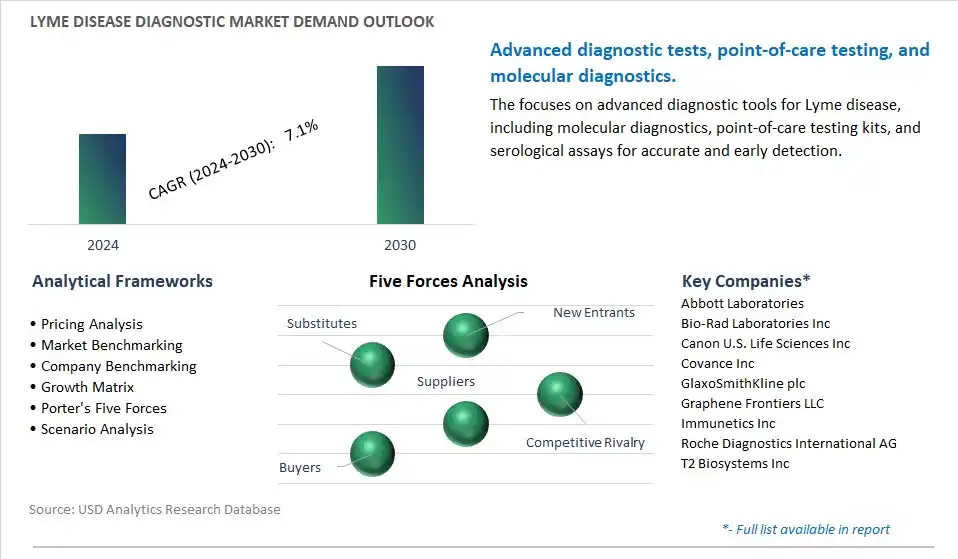
Lyme Disease Diagnostic Market is estimated to increase at a Compounded Annual Growth Rate of 7.1% CAGR over the forecast period from 2024 to 2030
The Lyme Disease Diagnostic Market study analyzes and forecasts the market size across 6 regions and 24 countries for diverse segments- By Emerging Diagnostic Technology (Serological Test, Urine Antigen Tests, Lymphocytic Transformation Test, Immunofluorescent Staining, Nucleic acid Test), By End-User (Hospitals, Diagnostic Laboratories, Others).
An Introduction to Lyme Disease Diagnostic Market in 2024
In 2024, the market for Lyme disease diagnostics continues to address the challenges posed by this tick-borne infectious disease, which is caused by the bacterium Borrelia burgdorferi and transmitted to humans through the bite of infected ticks. Lyme disease presents a wide spectrum of clinical manifestations, including erythema migrans, flu-like symptoms, neurological complications, and musculoskeletal involvement, making accurate and timely diagnosis crucial for effective management and prevention of complications. Diagnostic tests for Lyme disease include serological assays such as enzyme-linked immunosorbent assays (ELISA), Western blot tests, and polymerase chain reaction (PCR) assays for detecting B. burgdorferi antibodies or DNA in patient samples. However, the interpretation of serological tests can be challenging due to variations in antibody responses and the potential for cross-reactivity with other pathogens. Technological advancements in Lyme disease diagnostics, including multiplex assays, recombinant antigen panels, and point-of-care testing platforms, enhance sensitivity, specificity, and turnaround times, enabling rapid and accurate diagnosis in various clinical settings. With the increasing incidence and geographic expansion of Lyme disease, coupled with the emergence of new Borrelia species and strains, the market for Lyme disease diagnostics is poised for continued growth and innovation, supporting early detection and improved patient outcomes in affected populations.
Market Trend: Adoption of Multiplex Testing and Point-of-Care Technologies
A prominent trend in the Lyme disease diagnostic market is the adoption of multiplex testing and point-of-care (POC) technologies. Traditional diagnostic methods for Lyme disease, such as serological testing for antibodies against Borrelia burgdorferi, the causative agent of Lyme disease, have limitations in sensitivity and specificity, leading to potential misdiagnosis and delayed treatment. Multiplex testing platforms, which simultaneously detect multiple Lyme disease-specific markers, offer improved accuracy and efficiency in diagnosing Lyme disease, enabling healthcare providers to make timely and informed treatment decisions. Additionally, the emergence of POC testing devices allows for rapid detection of Lyme disease in primary care settings, emergency departments, and remote areas, facilitating early diagnosis and management of the disease. The adoption of multiplex and POC testing technologies represents a significant advancement in Lyme disease diagnostics, shaping the market landscape and driving innovation in diagnostic assays and devices.
Market Driver: Increasing Incidence and Geographic Expansion of Lyme Disease
A key driver for the Lyme disease diagnostic market is the increasing incidence and geographic expansion of Lyme disease. Lyme disease is the most common tick-borne illness in the Northern Hemisphere, with transmission occurring primarily through the bite of infected Ixodes ticks. Climate change, habitat fragmentation, and urbanization are contributing to the expansion of tick populations and the geographic range of Lyme disease, leading to higher rates of human exposure and infection. As a result, the incidence of Lyme disease is on the rise in many regions, including North America, Europe, and Asia. The growing recognition of Lyme disease as a public health threat, coupled with efforts to improve surveillance and reporting of cases, drives the demand for accurate and reliable diagnostic tests for early detection and treatment of Lyme disease, driving market growth and investment in diagnostic technologies.
Market Opportunity: Development of Novel Biomarkers and Diagnostic Assays
An emerging opportunity in the Lyme disease diagnostic market lies in the development of novel biomarkers and diagnostic assays. While current diagnostic tests primarily rely on the detection of antibodies against B. burgdorferi, there is an opportunity to explore alternative biomarkers and diagnostic approaches for Lyme disease. Research efforts are focused on identifying novel antigenic targets, host immune responses, and microbial signatures associated with Lyme disease pathogenesis, which may improve the sensitivity and specificity of diagnostic tests. Additionally, advancements in molecular diagnostic techniques, such as nucleic acid amplification assays and proteomic profiling, offer promise for the development of next-generation Lyme disease diagnostics capable of detecting early infection, differentiating active from past infections, and predicting treatment outcomes. By investing in research and development of novel biomarkers and diagnostic assays, stakeholders in the Lyme disease diagnostic market can address unmet medical needs, enhance diagnostic accuracy, and improve patient outcomes, driving innovation and growth in the market.
Lyme Disease Diagnostic Market Share Analysis: Nucleic Acid Test (NAT)
Nucleic acid tests (NATs) represent the fast-growing segment within the Lyme disease diagnostic market. This growth is propelled by several factors. Firstly, NATs offer high sensitivity and specificity in detecting the genetic material of Borrelia burgdorferi, the causative agent of Lyme disease, making them particularly effective in early diagnosis and accurate detection of the infection, especially in the early stages when serological tests may yield false-negative results. Additionally, the growing demand for rapid and reliable diagnostic solutions drives the adoption of NATs, which provide timely and accurate results crucial for initiating prompt treatment and preventing disease progression. Moreover, advancements in molecular biology techniques and the development of highly sensitive NAT platforms enhance the performance and accessibility of these tests in various healthcare settings, including hospitals and diagnostic laboratories. Furthermore, the increasing awareness about Lyme disease and the rising incidence of tick-borne infections in endemic regions further accentuate the need for sensitive and specific diagnostic tools like NATs for timely intervention and management. Overall, the combination of technological innovation, diagnostic accuracy, and clinical demand positions nucleic acid tests as the fast-growing segment within the Lyme disease diagnostic market.
Lyme Disease Diagnostic Competitive Analysis
The market research study provides in-depth insights into leading companies including the SWOT analyses, product profile, financial details, and recent developments acrossAbbott Laboratories, Bio-Rad Laboratories Inc, Canon U.S. Life Sciences Inc, Covance Inc, GlaxoSmithKline plc, Graphene Frontiers LLC, Immunetics Inc, Roche Diagnostics International AG, T2 Biosystems Inc
Lyme Disease Diagnostic Market Segmentation
By Emerging Diagnostic Technology
Serological Test
-ELISA
-Western Blot
Urine Antigen Tests
Lymphocytic Transformation Test
Immunofluorescent Staining
Nucleic acid Test
By End-User
Hospitals
Diagnostic Laboratories
Others
Geographical Analysis
North America (United States, Canada, Mexico)
Europe (Germany, France, United Kingdom, Spain, Italy, Rest of Europe)
Asia Pacific (China, India, Japan, South Korea, Rest of Asia Pacific)
South America (Brazil, Argentina, Rest of South America)
Middle East and Africa (Saudi Arabia, UAE, Rest of Middle East, South Africa, Egypt, Rest of Africa)
Lyme Disease Diagnostic Market Companies
Abbott Laboratories
Bio-Rad Laboratories Inc
Canon U.S. Life Sciences Inc
Covance Inc
GlaxoSmithKline plc
Graphene Frontiers LLC
Immunetics Inc
Roche Diagnostics International AG
T2 Biosystems Inc
Reasons to Buy the Lyme Disease Diagnostic Market Study
• Deepen your industry insights and navigate uncertainties for strategy formulation, CAPEX, and Operational decisions
• Gain access to detailed insights on the Lyme Disease Diagnostic Market, encompassing current market size, growth trends, and forecasts till 2030.
• Access detailed competitor analysis, enabling competitive advantage through a thorough understanding of market players, strategies, and potential differentiation opportunities
• Stay ahead of the curve with insights on technological advancements, innovations, and upcoming trends
• Identify lucrative investment avenues and expansion opportunities within the Lyme Disease Diagnostic Market industry, guided by robust, data-backed analysis.
• Understand regional and global markets through country-wise analysis, regional market potential, regulatory nuances, and dynamics
• Execute strategies with confidence and speed through information, analytics, and insights on the industry value chain
• Corporate leaders, strategists, financial experts, shareholders, asset managers, and governmental representatives can make long-term planning scenarios and build an integrated and timely understanding of market dynamics
• Benefit from tailored solutions and expert consultation based on report insights, providing personalized strategies aligned with specific business needs.
TABLE OF CONTENTS
1 Introduction to 2024 Lyme Disease Diagnostic Market
1.1 Market Overview
1.2 Quick Facts
1.3 Scope/Objective of the Study
1.4 Market Definition
1.5 Countries and Regions Covered
1.6 Units, Currency, and Conversions
1.7 Industry Value Chain
2 Research Methodology
2.1 Market Size Estimation
2.2 Sources and Research Methodology
2.3 Data Triangulation
2.4 Assumptions and Limitations
3 Executive Summary
3.1 Global Lyme Disease Diagnostic Market Size Outlook, $ Million, 2021 to 2030
3.2 Lyme Disease Diagnostic Market Outlook by Type, $ Million, 2021 to 2030
3.3 Lyme Disease Diagnostic Market Outlook by Product, $ Million, 2021 to 2030
3.4 Lyme Disease Diagnostic Market Outlook by Application, $ Million, 2021 to 2030
3.5 Lyme Disease Diagnostic Market Outlook by Key Countries, $ Million, 2021 to 2030
4 Market Dynamics
4.1 Key Driving Forces of Lyme Disease Diagnostic Industry
4.2 Key Market Trends in Lyme Disease Diagnostic Industry
4.3 Potential Opportunities in Lyme Disease Diagnostic Industry
4.4 Key Challenges in Lyme Disease Diagnostic Industry
5 Market Factor Analysis
5.1 Value Chain Analysis
5.2 Competitive Landscape
5.2.1 Global Lyme Disease Diagnostic Market Share by Company (%), 2023
5.2.2 Product Offerings by Company
5.3 Porter’s Five Forces Analysis
5.4 Pricing Analysis and Outlook
6 Growth Outlook Across Scenarios
6.1 Growth Analysis-Case Scenario Definitions
6.2 Low Growth Scenario Forecasts
6.3 Reference Growth Scenario Forecasts
6.4 High Growth Scenario Forecasts
7 Global Lyme Disease Diagnostic Market Outlook by Segments
7.1 Lyme Disease Diagnostic Market Outlook by Segments, $ Million, 2021- 2030
By Emerging Diagnostic Technology
Serological Test
-ELISA
-Western Blot
Urine Antigen Tests
Lymphocytic Transformation Test
Immunofluorescent Staining
Nucleic acid Test
By End-User
Hospitals
Diagnostic Laboratories
Others
8 North America Lyme Disease Diagnostic Market Analysis and Outlook To 2030
8.1 Introduction to North America Lyme Disease Diagnostic Markets in 2024
8.2 North America Lyme Disease Diagnostic Market Size Outlook by Country, 2021-2030
8.2.1 United States
8.2.2 Canada
8.2.3 Mexico
8.3 North America Lyme Disease Diagnostic Market size Outlook by Segments, 2021-2030
By Emerging Diagnostic Technology
Serological Test
-ELISA
-Western Blot
Urine Antigen Tests
Lymphocytic Transformation Test
Immunofluorescent Staining
Nucleic acid Test
By End-User
Hospitals
Diagnostic Laboratories
Others
9 Europe Lyme Disease Diagnostic Market Analysis and Outlook To 2030
9.1 Introduction to Europe Lyme Disease Diagnostic Markets in 2024
9.2 Europe Lyme Disease Diagnostic Market Size Outlook by Country, 2021-2030
9.2.1 Germany
9.2.2 France
9.2.3 Spain
9.2.4 United Kingdom
9.2.4 Italy
9.2.5 Russia
9.2.6 Norway
9.2.7 Rest of Europe
9.3 Europe Lyme Disease Diagnostic Market Size Outlook by Segments, 2021-2030
By Emerging Diagnostic Technology
Serological Test
-ELISA
-Western Blot
Urine Antigen Tests
Lymphocytic Transformation Test
Immunofluorescent Staining
Nucleic acid Test
By End-User
Hospitals
Diagnostic Laboratories
Others
10 Asia Pacific Lyme Disease Diagnostic Market Analysis and Outlook To 2030
10.1 Introduction to Asia Pacific Lyme Disease Diagnostic Markets in 2024
10.2 Asia Pacific Lyme Disease Diagnostic Market Size Outlook by Country, 2021-2030
10.2.1 China
10.2.2 India
10.2.3 Japan
10.2.4 South Korea
10.2.5 Indonesia
10.2.6 Malaysia
10.2.7 Australia
10.2.8 Rest of Asia Pacific
10.3 Asia Pacific Lyme Disease Diagnostic Market size Outlook by Segments, 2021-2030
By Emerging Diagnostic Technology
Serological Test
-ELISA
-Western Blot
Urine Antigen Tests
Lymphocytic Transformation Test
Immunofluorescent Staining
Nucleic acid Test
By End-User
Hospitals
Diagnostic Laboratories
Others
11 South America Lyme Disease Diagnostic Market Analysis and Outlook To 2030
11.1 Introduction to South America Lyme Disease Diagnostic Markets in 2024
11.2 South America Lyme Disease Diagnostic Market Size Outlook by Country, 2021-2030
11.2.1 Brazil
11.2.2 Argentina
11.2.3 Rest of South America
11.3 South America Lyme Disease Diagnostic Market size Outlook by Segments, 2021-2030
By Emerging Diagnostic Technology
Serological Test
-ELISA
-Western Blot
Urine Antigen Tests
Lymphocytic Transformation Test
Immunofluorescent Staining
Nucleic acid Test
By End-User
Hospitals
Diagnostic Laboratories
Others
12 Middle East and Africa Lyme Disease Diagnostic Market Analysis and Outlook To 2030
12.1 Introduction to Middle East and Africa Lyme Disease Diagnostic Markets in 2024
12.2 Middle East and Africa Lyme Disease Diagnostic Market Size Outlook by Country, 2021-2030
12.2.1 Saudi Arabia
12.2.2 UAE
12.2.3 Oman
12.2.4 Rest of Middle East
12.2.5 Egypt
12.2.6 Nigeria
12.2.7 South Africa
12.2.8 Rest of Africa
12.3 Middle East and Africa Lyme Disease Diagnostic Market size Outlook by Segments, 2021-2030
By Emerging Diagnostic Technology
Serological Test
-ELISA
-Western Blot
Urine Antigen Tests
Lymphocytic Transformation Test
Immunofluorescent Staining
Nucleic acid Test
By End-User
Hospitals
Diagnostic Laboratories
Others
13 Company Profiles
13.1 Company Snapshot
13.2 SWOT Profiles
13.3 Products and Services
13.4 Recent Developments
13.5 Financial Profile
List of Companies
Abbott Laboratories
Bio-Rad Laboratories Inc
Canon U.S. Life Sciences Inc
Covance Inc
GlaxoSmithKline plc
Graphene Frontiers LLC
Immunetics Inc
Roche Diagnostics International AG
T2 Biosystems Inc
14 Appendix
14.1 Customization Offerings
14.2 Subscription Services
14.3 Related Reports
14.4 Publisher Expertise
By Emerging Diagnostic Technology
Serological Test
-ELISA
-Western Blot
Urine Antigen Tests
Lymphocytic Transformation Test
Immunofluorescent Staining
Nucleic acid Test
By End-User
Hospitals
Diagnostic Laboratories
Others
Countries Analyzed
North America (United States, Canada, Mexico)
Europe (Germany, France, United Kingdom, Spain, Italy, Rest of Europe)
Asia Pacific (China, India, Japan, South Korea, Rest of Asia Pacific)
South America (Brazil, Argentina, Rest of South America)
Middle East and Africa (Saudi Arabia, UAE, Rest of Middle East, South Africa, Egypt, Rest of Africa)
