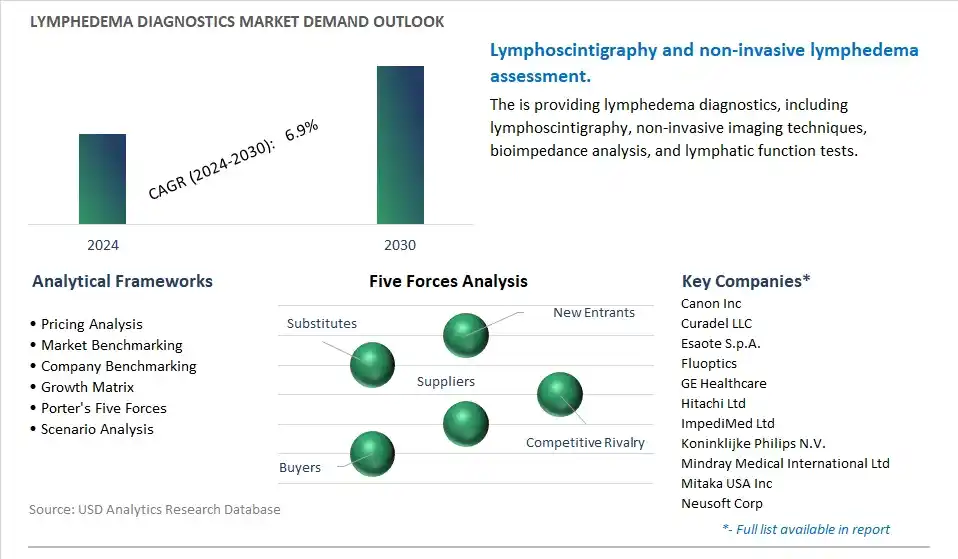
Lymphedema Diagnostics Market is estimated to increase at a Compounded Annual Growth Rate of 6.9% CAGR over the forecast period from 2024 to 2030
The Lymphedema Diagnostics Market study analyzes and forecasts the market size across 6 regions and 24 countries for diverse segments- By Technology (X-ray Lymphography, Lymphoscintigraphy, Computed Tomography, Ultrasound Imaging, Magnetic Resonance Imaging, Bioimpedance Analysis, Near-infrared Fluorescence Imaging, ICG Lymphography, Fluorescein Sodium Micro lymphangiography), By Disease (Cancer, Cardiovascular Disease, Inflammatory Diseases, Others), By End-User (Hospitals, Diagnostic Centers, Research & Academic Institutes, Others).
An Introduction to Lymphedema Diagnostics Market in 2024
Lymphedema diagnostics encompass a variety of clinical and imaging-based methods used to assess and diagnose lymphatic dysfunction and the accumulation of lymphatic fluid in tissues, known as lymphedema. In 2024, lymphedema diagnostics remain essential for the early detection, staging, and monitoring of lymphedema in patients at risk, including those with cancer-related lymphedema, primary lymphedema, or secondary lymphedema due to surgery, radiation therapy, or trauma. Diagnostic modalities for lymphedema include physical examination, measurement of limb circumference, lymphoscintigraphy, magnetic resonance imaging (MRI), computed tomography (CT), and indocyanine green (ICG) lymphography, each offering unique insights into lymphatic anatomy, function, and pathology. Additionally, emerging technologies such as near-infrared fluorescence (NIRF) imaging and microlymphatic mapping provide real-time visualization of lymphatic vessels and lymph flow dynamics, enabling more accurate diagnosis and treatment planning for patients with lymphatic disorders. As awareness of lymphedema grows and the demand for effective management strategies increases, the development and refinement of non-invasive, objective diagnostic tools remain crucial in improving patient outcomes, facilitating early intervention, and reducing the burden of this chronic and debilitating condition.
Market Trend: Adoption of Non-invasive Diagnostic Techniques
A prominent trend in the lymphedema diagnostics market is the increasing adoption of non-invasive diagnostic techniques. Traditionally, the diagnosis of lymphedema relied on invasive procedures such as lymphangiography or lymphoscintigraphy, which may be uncomfortable for patients and carry risks of complications. However, advancements in imaging modalities, such as lymphedema MRI (magnetic resonance imaging) and lymphedema ultrasound, offer non-invasive and safer alternatives for assessing lymphatic function and identifying lymphatic abnormalities. These non-invasive diagnostic techniques provide detailed imaging of lymphatic vessels, lymph nodes, and lymphatic flow patterns, enabling healthcare providers to accurately diagnose lymphedema, monitor disease progression, and tailor treatment plans for individual patients. The shift towards non-invasive diagnostic approaches reflects a growing emphasis on patient comfort, safety, and personalized healthcare delivery in the lymphedema diagnostics market.
Market Driver: Growing Awareness and Incidence of Lymphedema
A key driver fueling the demand for lymphedema diagnostics is the growing awareness of lymphedema and its associated risk factors, as well as the increasing incidence of lymphedema globally. Lymphedema, characterized by the accumulation of lymphatic fluid and swelling in the limbs or other parts of the body, can result from various causes, including cancer treatment (such as lymph node dissection or radiation therapy), trauma, infection, or congenital conditions. As awareness of lymphedema-related risk factors and symptoms grows among healthcare professionals and patients, there is a heightened demand for accurate and timely diagnostics to facilitate early intervention and prevent complications. Additionally, the rising incidence of cancer and other conditions requiring lymphatic interventions contributes to the growing need for lymphedema diagnostics as an essential component of comprehensive patient care.
Market Opportunity: Development of Point-of-Care Diagnostic Devices
A significant opportunity for the lymphedema diagnostics market lies in the development of point-of-care diagnostic devices for early detection and monitoring of lymphatic dysfunction. Point-of-care devices offer several advantages, including rapid results, accessibility in diverse healthcare settings (such as primary care clinics, community health centers, and home care settings), and reduced dependence on specialized imaging facilities. By leveraging technologies such as handheld ultrasound devices, bioimpedance spectroscopy, or near-infrared fluorescence imaging, developers can create portable and user-friendly tools for assessing lymphatic function and detecting early signs of lymphedema. These point-of-care diagnostic devices empower healthcare providers to perform timely screenings, facilitate prompt referrals to specialized lymphedema clinics or treatment centers, and monitor patients' responses to therapy in real-time, ultimately improving outcomes and quality of life for individuals at risk of or living with lymphedema. Investing in the development and commercialization of point-of-care diagnostic devices represents a strategic opportunity for companies to address unmet needs in lymphedema management and enhance the accessibility and effectiveness of lymphedema diagnostics on a global scale.
Lymphedema Diagnostics Market Share Analysis: Near-infrared Fluorescence Imaging in Cancer-Related Lymphedema Diagnostics is the fastest growing segment over the forecast period to 2030
Among the segments listed, Near-infrared Fluorescence Imaging (NIRF) in Cancer-Related Lymphedema Diagnostics is experiencing the most rapid growth in the Lymphedema Diagnostics Market. This growth is driven by several key factors. Firstly, NIRF offers a non-invasive and real-time imaging technique that allows for the visualization and assessment of lymphatic vessels and lymph nodes, making it a valuable tool for the early detection and monitoring of lymphedema in cancer patients. Cancer-related lymphedema, often a consequence of surgical interventions such as lymph node dissection or radiation therapy, poses significant challenges for patients and healthcare providers, including impaired quality of life and increased risk of complications. NIRF provides clinicians with the ability to identify lymphatic abnormalities and assess lymphatic function, enabling timely intervention and preventive measures to mitigate the development and progression of lymphedema. Secondly, advancements in NIRF technology, including the development of novel contrast agents and imaging systems, have improved the sensitivity, specificity, and resolution of NIRF imaging for lymphedema diagnostics. These technological advancements allow for more accurate and comprehensive evaluation of lymphatic anatomy and function, facilitating tailored treatment planning and optimizing patient outcomes. Thirdly, the increasing prevalence of cancer and the growing emphasis on survivorship care have elevated the importance of lymphedema management in oncology practice. Healthcare providers are increasingly recognizing the impact of lymphedema on cancer survivors' quality of life and long-term health outcomes, driving the demand for advanced diagnostic tools such as NIRF imaging for early detection and intervention. Additionally, the expanding adoption of NIRF imaging in cancer centers, hospitals, and academic institutions reflects the growing recognition of its clinical utility and effectiveness in cancer-related lymphedema diagnostics. With ongoing technological innovation, expanding applications, and increasing awareness among healthcare providers, NIRF imaging in cancer-related lymphedema diagnostics is poised for sustained rapid growth in the Lymphedema Diagnostics Market.
Lymphedema Diagnostics Competitive Analysis
The market research study provides in-depth insights into leading companies including the SWOT analyses, product profile, financial details, and recent developments acrossCanon Inc, Curadel LLC, Esaote S.p.A., Fluoptics, GE Healthcare, Hitachi Ltd, ImpediMed Ltd, Koninklijke Philips N.V., Mindray Medical International Ltd, Mitaka USA Inc, Neusoft Corp, Shimadzu Corp, Siemens Healthineers AG, Stryker Corp, United Imaging Healthcare Co. Ltd
Lymphedema Diagnostics Market Segmentation
By Technology
X-ray Lymphography
Lymphoscintigraphy
Computed Tomography
Ultrasound Imaging
Magnetic Resonance Imaging
Bioimpedance Analysis
Near-infrared Fluorescence Imaging
ICG Lymphography
Fluorescein Sodium Micro lymphangiography
By Disease
Cancer
Cardiovascular Disease
Inflammatory Diseases
Others
By End-User
Hospitals
Diagnostic Centers
Research & Academic Institutes
Others
Geographical Analysis
North America (United States, Canada, Mexico)
Europe (Germany, France, United Kingdom, Spain, Italy, Rest of Europe)
Asia Pacific (China, India, Japan, South Korea, Rest of Asia Pacific)
South America (Brazil, Argentina, Rest of South America)
Middle East and Africa (Saudi Arabia, UAE, Rest of Middle East, South Africa, Egypt, Rest of Africa)
Lymphedema Diagnostics Market Companies
Canon Inc
Curadel LLC
Esaote S.p.A.
Fluoptics
GE Healthcare
Hitachi Ltd
ImpediMed Ltd
Koninklijke Philips N.V.
Mindray Medical International Ltd
Mitaka USA Inc
Neusoft Corp
Shimadzu Corp
Siemens Healthineers AG
Stryker Corp
United Imaging Healthcare Co. Ltd
Reasons to Buy the Lymphedema Diagnostics Market Study
• Deepen your industry insights and navigate uncertainties for strategy formulation, CAPEX, and Operational decisions
• Gain access to detailed insights on the Lymphedema Diagnostics Market, encompassing current market size, growth trends, and forecasts till 2030.
• Access detailed competitor analysis, enabling competitive advantage through a thorough understanding of market players, strategies, and potential differentiation opportunities
• Stay ahead of the curve with insights on technological advancements, innovations, and upcoming trends
• Identify lucrative investment avenues and expansion opportunities within the Lymphedema Diagnostics Market industry, guided by robust, data-backed analysis.
• Understand regional and global markets through country-wise analysis, regional market potential, regulatory nuances, and dynamics
• Execute strategies with confidence and speed through information, analytics, and insights on the industry value chain
• Corporate leaders, strategists, financial experts, shareholders, asset managers, and governmental representatives can make long-term planning scenarios and build an integrated and timely understanding of market dynamics
• Benefit from tailored solutions and expert consultation based on report insights, providing personalized strategies aligned with specific business needs.
TABLE OF CONTENTS
1 Introduction to 2024 Lymphedema Diagnostics Market
1.1 Market Overview
1.2 Quick Facts
1.3 Scope/Objective of the Study
1.4 Market Definition
1.5 Countries and Regions Covered
1.6 Units, Currency, and Conversions
1.7 Industry Value Chain
2 Research Methodology
2.1 Market Size Estimation
2.2 Sources and Research Methodology
2.3 Data Triangulation
2.4 Assumptions and Limitations
3 Executive Summary
3.1 Global Lymphedema Diagnostics Market Size Outlook, $ Million, 2021 to 2030
3.2 Lymphedema Diagnostics Market Outlook by Type, $ Million, 2021 to 2030
3.3 Lymphedema Diagnostics Market Outlook by Product, $ Million, 2021 to 2030
3.4 Lymphedema Diagnostics Market Outlook by Application, $ Million, 2021 to 2030
3.5 Lymphedema Diagnostics Market Outlook by Key Countries, $ Million, 2021 to 2030
4 Market Dynamics
4.1 Key Driving Forces of Lymphedema Diagnostics Industry
4.2 Key Market Trends in Lymphedema Diagnostics Industry
4.3 Potential Opportunities in Lymphedema Diagnostics Industry
4.4 Key Challenges in Lymphedema Diagnostics Industry
5 Market Factor Analysis
5.1 Value Chain Analysis
5.2 Competitive Landscape
5.2.1 Global Lymphedema Diagnostics Market Share by Company (%), 2023
5.2.2 Product Offerings by Company
5.3 Porter’s Five Forces Analysis
5.4 Pricing Analysis and Outlook
6 Growth Outlook Across Scenarios
6.1 Growth Analysis-Case Scenario Definitions
6.2 Low Growth Scenario Forecasts
6.3 Reference Growth Scenario Forecasts
6.4 High Growth Scenario Forecasts
7 Global Lymphedema Diagnostics Market Outlook by Segments
7.1 Lymphedema Diagnostics Market Outlook by Segments, $ Million, 2021- 2030
By Technology
X-ray Lymphography
Lymphoscintigraphy
Computed Tomography
Ultrasound Imaging
Magnetic Resonance Imaging
Bioimpedance Analysis
Near-infrared Fluorescence Imaging
ICG Lymphography
Fluorescein Sodium Micro lymphangiography
By Disease
Cancer
Cardiovascular Disease
Inflammatory Diseases
Others
By End-User
Hospitals
Diagnostic Centers
Research & Academic Institutes
Others
8 North America Lymphedema Diagnostics Market Analysis and Outlook To 2030
8.1 Introduction to North America Lymphedema Diagnostics Markets in 2024
8.2 North America Lymphedema Diagnostics Market Size Outlook by Country, 2021-2030
8.2.1 United States
8.2.2 Canada
8.2.3 Mexico
8.3 North America Lymphedema Diagnostics Market size Outlook by Segments, 2021-2030
By Technology
X-ray Lymphography
Lymphoscintigraphy
Computed Tomography
Ultrasound Imaging
Magnetic Resonance Imaging
Bioimpedance Analysis
Near-infrared Fluorescence Imaging
ICG Lymphography
Fluorescein Sodium Micro lymphangiography
By Disease
Cancer
Cardiovascular Disease
Inflammatory Diseases
Others
By End-User
Hospitals
Diagnostic Centers
Research & Academic Institutes
Others
9 Europe Lymphedema Diagnostics Market Analysis and Outlook To 2030
9.1 Introduction to Europe Lymphedema Diagnostics Markets in 2024
9.2 Europe Lymphedema Diagnostics Market Size Outlook by Country, 2021-2030
9.2.1 Germany
9.2.2 France
9.2.3 Spain
9.2.4 United Kingdom
9.2.4 Italy
9.2.5 Russia
9.2.6 Norway
9.2.7 Rest of Europe
9.3 Europe Lymphedema Diagnostics Market Size Outlook by Segments, 2021-2030
By Technology
X-ray Lymphography
Lymphoscintigraphy
Computed Tomography
Ultrasound Imaging
Magnetic Resonance Imaging
Bioimpedance Analysis
Near-infrared Fluorescence Imaging
ICG Lymphography
Fluorescein Sodium Micro lymphangiography
By Disease
Cancer
Cardiovascular Disease
Inflammatory Diseases
Others
By End-User
Hospitals
Diagnostic Centers
Research & Academic Institutes
Others
10 Asia Pacific Lymphedema Diagnostics Market Analysis and Outlook To 2030
10.1 Introduction to Asia Pacific Lymphedema Diagnostics Markets in 2024
10.2 Asia Pacific Lymphedema Diagnostics Market Size Outlook by Country, 2021-2030
10.2.1 China
10.2.2 India
10.2.3 Japan
10.2.4 South Korea
10.2.5 Indonesia
10.2.6 Malaysia
10.2.7 Australia
10.2.8 Rest of Asia Pacific
10.3 Asia Pacific Lymphedema Diagnostics Market size Outlook by Segments, 2021-2030
By Technology
X-ray Lymphography
Lymphoscintigraphy
Computed Tomography
Ultrasound Imaging
Magnetic Resonance Imaging
Bioimpedance Analysis
Near-infrared Fluorescence Imaging
ICG Lymphography
Fluorescein Sodium Micro lymphangiography
By Disease
Cancer
Cardiovascular Disease
Inflammatory Diseases
Others
By End-User
Hospitals
Diagnostic Centers
Research & Academic Institutes
Others
11 South America Lymphedema Diagnostics Market Analysis and Outlook To 2030
11.1 Introduction to South America Lymphedema Diagnostics Markets in 2024
11.2 South America Lymphedema Diagnostics Market Size Outlook by Country, 2021-2030
11.2.1 Brazil
11.2.2 Argentina
11.2.3 Rest of South America
11.3 South America Lymphedema Diagnostics Market size Outlook by Segments, 2021-2030
By Technology
X-ray Lymphography
Lymphoscintigraphy
Computed Tomography
Ultrasound Imaging
Magnetic Resonance Imaging
Bioimpedance Analysis
Near-infrared Fluorescence Imaging
ICG Lymphography
Fluorescein Sodium Micro lymphangiography
By Disease
Cancer
Cardiovascular Disease
Inflammatory Diseases
Others
By End-User
Hospitals
Diagnostic Centers
Research & Academic Institutes
Others
12 Middle East and Africa Lymphedema Diagnostics Market Analysis and Outlook To 2030
12.1 Introduction to Middle East and Africa Lymphedema Diagnostics Markets in 2024
12.2 Middle East and Africa Lymphedema Diagnostics Market Size Outlook by Country, 2021-2030
12.2.1 Saudi Arabia
12.2.2 UAE
12.2.3 Oman
12.2.4 Rest of Middle East
12.2.5 Egypt
12.2.6 Nigeria
12.2.7 South Africa
12.2.8 Rest of Africa
12.3 Middle East and Africa Lymphedema Diagnostics Market size Outlook by Segments, 2021-2030
By Technology
X-ray Lymphography
Lymphoscintigraphy
Computed Tomography
Ultrasound Imaging
Magnetic Resonance Imaging
Bioimpedance Analysis
Near-infrared Fluorescence Imaging
ICG Lymphography
Fluorescein Sodium Micro lymphangiography
By Disease
Cancer
Cardiovascular Disease
Inflammatory Diseases
Others
By End-User
Hospitals
Diagnostic Centers
Research & Academic Institutes
Others
13 Company Profiles
13.1 Company Snapshot
13.2 SWOT Profiles
13.3 Products and Services
13.4 Recent Developments
13.5 Financial Profile
List of Companies
Canon Inc
Curadel LLC
Esaote S.p.A.
Fluoptics
GE Healthcare
Hitachi Ltd
ImpediMed Ltd
Koninklijke Philips N.V.
Mindray Medical International Ltd
Mitaka USA Inc
Neusoft Corp
Shimadzu Corp
Siemens Healthineers AG
Stryker Corp
United Imaging Healthcare Co. Ltd
14 Appendix
14.1 Customization Offerings
14.2 Subscription Services
14.3 Related Reports
14.4 Publisher Expertise
By Technology
X-ray Lymphography
Lymphoscintigraphy
Computed Tomography
Ultrasound Imaging
Magnetic Resonance Imaging
Bioimpedance Analysis
Near-infrared Fluorescence Imaging
ICG Lymphography
Fluorescein Sodium Micro lymphangiography
By Disease
Cancer
Cardiovascular Disease
Inflammatory Diseases
Others
By End-User
Hospitals
Diagnostic Centers
Research & Academic Institutes
Others
Countries Analyzed
North America (United States, Canada, Mexico)
Europe (Germany, France, United Kingdom, Spain, Italy, Rest of Europe)
Asia Pacific (China, India, Japan, South Korea, Rest of Asia Pacific)
South America (Brazil, Argentina, Rest of South America)
Middle East and Africa (Saudi Arabia, UAE, Rest of Middle East, South Africa, Egypt, Rest of Africa)
