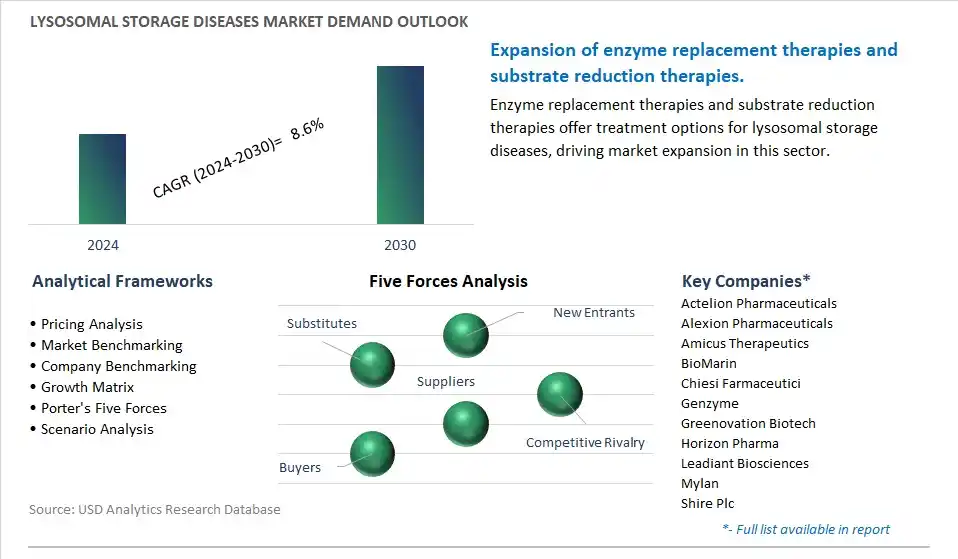
Lysosomal Storage Diseases Market is estimated to increase at a growth rate of 8.6% CAGR over the forecast period from 2024 to 2030.
The global Lysosomal Storage Diseases Market Study analyzes and forecasts the market size across 6 regions and 24 countries for diverse segments including By Type (Enzyme Replacement Therapy, Substrate Reduction Therapy, Cystine Depleting Agents), By Application (Hospitals, Ambulatory Surgical Centers).
An Introduction to Lysosomal Storage Diseases Market in 2024
The Lysosomal Storage Diseases Market in 2024 addresses the complex therapeutic challenges associated with inherited metabolic disorders characterized by lysosomal dysfunction and substrate accumulation. Lysosomal storage diseases (LSDs) encompass a diverse spectrum of rare genetic disorders, including Gaucher disease, Fabry disease, and Pompe disease, necessitating targeted enzyme replacement therapies, substrate reduction strategies, and gene therapies. The market observes significant growth driven by advancements in precision medicine, gene editing technologies, and newborn screening programs aimed at early diagnosis and intervention. Furthermore, collaborative efforts between pharmaceutical companies, patient advocacy groups, and regulatory agencies aim to expedite drug development efforts and improve access to life-saving treatments for patients with LSDs worldwide.
Lysosomal Storage Diseases Market Competitive Landscape
The global Lysosomal Storage Diseases Industry is highly competitive with a large number of companies focusing on niche market segments. Amidst intense competitive conditions, Lysosomal Storage Diseases Companies are investing in new product launches and strengthening distribution channels. Key companies operating in the Lysosomal Storage Diseases Industry include- Actelion Pharmaceuticals, Alexion Pharmaceuticals, Amicus Therapeutics, BioMarin, Chiesi Farmaceutici, Genzyme, Greenovation Biotech, Horizon Pharma, Leadiant Biosciences, Mylan, Shire Plc.
Lysosomal Storage Diseases Market Trend: Advancements in Enzyme Replacement Therapies
A prominent trend in the market for lysosomal storage diseases (LSDs) is the advancements in enzyme replacement therapies (ERTs) for the treatment of LSDs. LSDs are a group of inherited metabolic disorders characterized by deficiencies in lysosomal enzymes, leading to the accumulation of undegraded substrates within lysosomes and subsequent cellular dysfunction and tissue damage. ERTs involve the administration of recombinant lysosomal enzymes to replace the deficient enzyme activity, thereby reducing substrate accumulation and ameliorating disease symptoms. Recent advancements in biotechnology and protein engineering have led to the development of novel ERTs with improved pharmacokinetic properties, enhanced targeting to affected tissues, and increased stability and efficacy. These advancements offer new treatment options for patients with LSDs and drive research and development efforts in the field of enzyme replacement therapies.
Lysosomal Storage Diseases Market Driver: Expanded Newborn Screening Programs
The market for lysosomal storage diseases is driven by the expanded implementation of newborn screening programs for the early detection and diagnosis of LSDs. Newborn screening involves the systematic testing of newborns for inherited metabolic disorders, including LSDs, using biochemical assays, molecular genetic tests, or tandem mass spectrometry. Early diagnosis through newborn screening allows for prompt initiation of treatment and intervention strategies, such as dietary modifications, enzyme replacement therapy, or hematopoietic stem cell transplantation, before the onset of irreversible organ damage and clinical symptoms. With the increasing recognition of the benefits of early detection and intervention in improving outcomes for patients with LSDs, there is a growing demand for expanded newborn screening programs globally. This drives market growth and investment in diagnostic technologies, screening assays, and treatment modalities for LSDs, aiming to improve patient outcomes and quality of life through early detection and intervention.
Lysosomal Storage Diseases Market Opportunity: Development of Gene Therapy Approaches
A Market Opportunity in the market for lysosomal storage diseases lies in the development of gene therapy approaches for the treatment of LSDs. Gene therapy offers the potential to address the underlying genetic defect in LSDs by delivering functional copies of the defective gene or correcting the mutation directly within the patient's cells. Recent advancements in gene editing technologies, such as CRISPR-Cas9 and adeno-associated virus (AAV) vectors, have enabled precise and efficient targeting of the genetic mutations underlying LSDs, opening new avenues for therapeutic intervention. Gene therapy approaches, including gene replacement, gene editing, and gene modulation strategies, hold promise for providing long-term therapeutic benefits and potentially curative outcomes for patients with LSDs. By investing in the development and clinical translation of gene therapy approaches for LSDs, pharmaceutical companies can address unmet medical needs, expand treatment options, and improve outcomes for patients with these devastating genetic disorders, unlocking new opportunities for market differentiation and therapeutic innovation in the field of lysosomal storage diseases. Collaboration with academic researchers, gene therapy companies, and regulatory agencies can accelerate the development and commercialization of gene therapy approaches for LSDs, paving the way for transformative advances in patient care and disease management.
Lysosomal Storage Diseases Market Share Analysis: Enzyme Replacement Therapy is the fastest growing market segment over the forecast period to 2030
Among the various types of treatments for lysosomal storage diseases (LSDs), the segment experiencing rapid growth is Enzyme Replacement Therapy (ERT). LSDs are a group of inherited metabolic disorders characterized by the deficiency of specific enzymes required for the breakdown of various substances within lysosomes, leading to the accumulation of harmful substances and cellular dysfunction. ERT involves the administration of artificial enzymes to replace or supplement the deficient enzyme activity in affected individuals, aiming to reduce the buildup of substrates and alleviate disease symptoms. ERT has emerged as a cornerstone in the management of certain LSDs, such as Gaucher disease, Fabry disease, and Pompe disease, offering significant benefits in terms of improving patients' quality of life and slowing disease progression. The growing understanding of the underlying molecular mechanisms of LSDs, coupled with advancements in biotechnology and protein engineering, has led to the development of novel ERT formulations with improved efficacy, safety, and convenience. Additionally, expanding access to ERT through hospitals and ambulatory surgical centers has facilitated its widespread adoption and contributed to its fast growth as a preferred treatment modality for LSDs. As research continues to uncover new therapeutic targets and refine existing ERT approaches, the market for Enzyme Replacement Therapy in Lysosomal Storage Diseases is poised for continued expansion, offering hope to patients and caregivers affected by these rare and debilitating conditions.
Lysosomal Storage Diseases Market Segmentation
By Type
Enzyme Replacement Therapy
Substrate Reduction Therapy
Cystine Depleting Agents
By Application
Hospitals
Ambulatory Surgical Centers
Geographical Analysis
North America (United States, Canada, Mexico)
Europe (Germany, France, United Kingdom, Spain, Italy, Rest of Europe)
Asia Pacific (China, India, Japan, South Korea, Rest of Asia Pacific)
South America (Brazil, Argentina, Rest of South America)
Middle East and Africa (Saudi Arabia, UAE, Rest of Middle East, South Africa, Egypt, Rest of Africa)
Lysosomal Storage Diseases Companies
Actelion Pharmaceuticals
Alexion Pharmaceuticals
Amicus Therapeutics
BioMarin
Chiesi Farmaceutici
Genzyme
Greenovation Biotech
Horizon Pharma
Leadiant Biosciences
Mylan
Shire Plc
* List not Exhaustive
Reasons to Buy the Lysosomal Storage Diseases Market Study
• Deepen your industry insights and navigate uncertainties for strategy formulation, CAPEX, and Operational decisions
• Gain access to detailed insights on the Lysosomal Storage Diseases Market, encompassing current market size, growth trends, and forecasts till 2030.
• Access detailed competitor analysis, enabling competitive advantage through a thorough understanding of market players, strategies, and potential differentiation opportunities
• Stay ahead of the curve with insights on technological advancements, innovations, and upcoming trends
• Identify lucrative investment avenues and expansion opportunities within the Lysosomal Storage Diseases Industry, guided by robust, data-backed analysis.
• Understand regional and global markets through country-wise analysis, regional market potential, regulatory nuances, and dynamics
• Execute strategies with confidence and speed through information, analytics, and insights on the industry value chain
• Corporate leaders, strategists, financial experts, shareholders, asset managers, and governmental representatives can make long-term planning scenarios and build an integrated and timely understanding of market dynamics
• Benefit from tailored solutions and expert consultation based on report insights, providing personalized strategies aligned with specific business needs.
TABLE OF CONTENTS
1 Introduction to 2024 Lysosomal Storage Diseases Market
1.1 Market Overview
1.2 Quick Facts
1.3 Scope/Objective of the Study
1.4 Market Definition
1.5 Countries and Regions Analyzed
1.6 Units, Currency, and Conversions
1.7 Industry Value Chain
2 Research Methodology
2.1 Market Size Estimation
2.2 Sources and Research Methodology
2.3 Data Triangulation
2.4 Assumptions and Limitations
3 Executive Summary
3.1 Global Lysosomal Storage Diseases Market Size Outlook, $ Million, 2021 to 2030
3.2 Lysosomal Storage Diseases Market Outlook by Type, $ Million, 2021 to 2030
3.3 Lysosomal Storage Diseases Market Outlook by Product, $ Million, 2021 to 2030
3.4 Lysosomal Storage Diseases Market Outlook by Application, $ Million, 2021 to 2030
3.5 Lysosomal Storage Diseases Market Outlook by Key Countries, $ Million, 2021 to 2030
4 Market Dynamics
4.1 Key Driving Forces of Lysosomal Storage Diseases Industry
4.2 Key Market Trends in Lysosomal Storage Diseases Industry
4.3 Potential Opportunities in Lysosomal Storage Diseases Industry
4.4 Key Challenges in Lysosomal Storage Diseases Industry
5 Market Factor Analysis
5.1 Value Chain Analysis
5.2 Competitive Landscape
5.2.1 Global Lysosomal Storage Diseases Market Share by Company (%), 2023
5.2.2 Product Offerings by Company
5.3 Porter’s Five Forces Analysis
5.4 Pricing Analysis and Outlook
6 Growth Outlook Across Scenarios
6.1 Growth Analysis-Case Scenario Definitions
6.2 Low Growth Scenario Forecasts
6.3 Reference Growth Scenario Forecasts
6.4 High Growth Scenario Forecasts
7 Global Lysosomal Storage Diseases Market Outlook by Segments
7.1 Lysosomal Storage Diseases Market Outlook by Segments, $ Million, 2021- 2030
By Type
Enzyme Replacement Therapy
Substrate Reduction Therapy
Cystine Depleting Agents
By Application
Hospitals
Ambulatory Surgical Centers
8 North America Lysosomal Storage Diseases Market Analysis and Outlook To 2030
8.1 Introduction to North America Lysosomal Storage Diseases Markets in 2024
8.2 North America Lysosomal Storage Diseases Market Size Outlook by Country, 2021-2030
8.2.1 United States
8.2.2 Canada
8.2.3 Mexico
8.3 North America Lysosomal Storage Diseases Market size Outlook by Segments, 2021-2030
By Type
Enzyme Replacement Therapy
Substrate Reduction Therapy
Cystine Depleting Agents
By Application
Hospitals
Ambulatory Surgical Centers
9 Europe Lysosomal Storage Diseases Market Analysis and Outlook To 2030
9.1 Introduction to Europe Lysosomal Storage Diseases Markets in 2024
9.2 Europe Lysosomal Storage Diseases Market Size Outlook by Country, 2021-2030
9.2.1 Germany
9.2.2 France
9.2.3 Spain
9.2.4 United Kingdom
9.2.4 Italy
9.2.5 Russia
9.2.6 Norway
9.2.7 Rest of Europe
9.3 Europe Lysosomal Storage Diseases Market Size Outlook by Segments, 2021-2030
By Type
Enzyme Replacement Therapy
Substrate Reduction Therapy
Cystine Depleting Agents
By Application
Hospitals
Ambulatory Surgical Centers
10 Asia Pacific Lysosomal Storage Diseases Market Analysis and Outlook To 2030
10.1 Introduction to Asia Pacific Lysosomal Storage Diseases Markets in 2024
10.2 Asia Pacific Lysosomal Storage Diseases Market Size Outlook by Country, 2021-2030
10.2.1 China
10.2.2 India
10.2.3 Japan
10.2.4 South Korea
10.2.5 Indonesia
10.2.6 Malaysia
10.2.7 Australia
10.2.8 Rest of Asia Pacific
10.3 Asia Pacific Lysosomal Storage Diseases Market size Outlook by Segments, 2021-2030
By Type
Enzyme Replacement Therapy
Substrate Reduction Therapy
Cystine Depleting Agents
By Application
Hospitals
Ambulatory Surgical Centers
11 South America Lysosomal Storage Diseases Market Analysis and Outlook To 2030
11.1 Introduction to South America Lysosomal Storage Diseases Markets in 2024
11.2 South America Lysosomal Storage Diseases Market Size Outlook by Country, 2021-2030
11.2.1 Brazil
11.2.2 Argentina
11.2.3 Rest of South America
11.3 South America Lysosomal Storage Diseases Market size Outlook by Segments, 2021-2030
By Type
Enzyme Replacement Therapy
Substrate Reduction Therapy
Cystine Depleting Agents
By Application
Hospitals
Ambulatory Surgical Centers
12 Middle East and Africa Lysosomal Storage Diseases Market Analysis and Outlook To 2030
12.1 Introduction to Middle East and Africa Lysosomal Storage Diseases Markets in 2024
12.2 Middle East and Africa Lysosomal Storage Diseases Market Size Outlook by Country, 2021-2030
12.2.1 Saudi Arabia
12.2.2 UAE
12.2.3 Oman
12.2.4 Rest of Middle East
12.2.5 Egypt
12.2.6 Nigeria
12.2.7 South Africa
12.2.8 Rest of Africa
12.3 Middle East and Africa Lysosomal Storage Diseases Market size Outlook by Segments, 2021-2030
By Type
Enzyme Replacement Therapy
Substrate Reduction Therapy
Cystine Depleting Agents
By Application
Hospitals
Ambulatory Surgical Centers
13 Company Profiles
13.1 Company Snapshot
13.2 SWOT Profiles
13.3 Products and Services
13.4 Recent Developments
13.5 Financial Profile
List of Companies
Actelion Pharmaceuticals
Alexion Pharmaceuticals
Amicus Therapeutics
BioMarin
Chiesi Farmaceutici
Genzyme
Greenovation Biotech
Horizon Pharma
Leadiant Biosciences
Mylan
Shire Plc
14 Appendix
14.1 Customization Offerings
14.2 Subscription Services
14.3 Related Reports
14.4 Publisher Expertise
