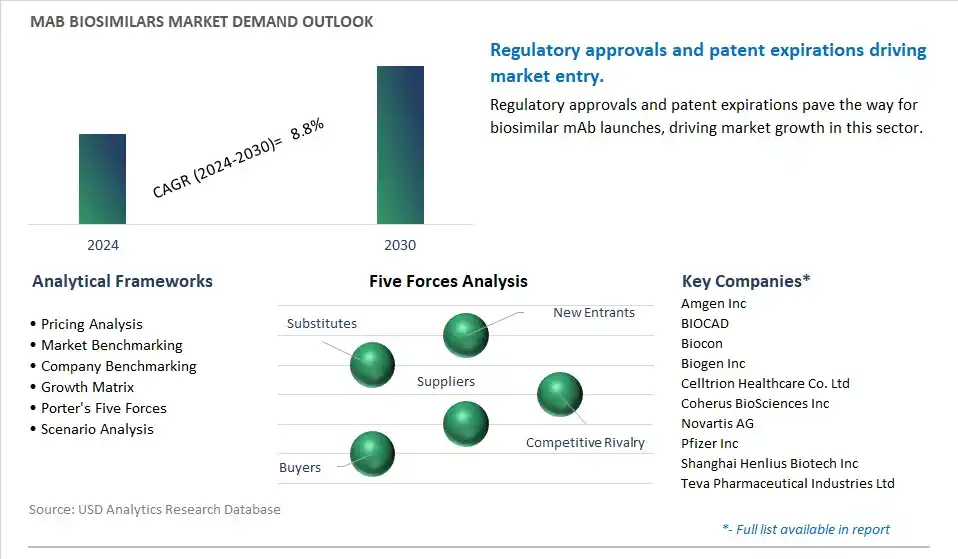
mAb Biosimilars Market is estimated to increase at a growth rate of 8.8% CAGR over the forecast period from 2024 to 2030.
The global mAb Biosimilars Market Study analyzes and forecasts the market size across 6 regions and 24 countries for diverse segments including By Type (Adalimumab, Bevacizumab, Infliximab, Rituximab, Trastuzumab, Others), By Indication (Oncology, Autoimmune diseases, Others), By End-User (Hospitals, Cancer Treatment centers, Others).
An Introduction to mAb Biosimilars Market in 2024
The mAb Biosimilars Market in 2024 signifies a transformative shift in the biopharmaceutical landscape, driven by the introduction of biosimilar monoclonal antibodies (mAbs) as cost-effective alternatives to originator biologics. Biosimilar mAbs offer comparable efficacy, safety, and quality profiles to reference products, providing patients with expanded access to innovative biologic therapies across various therapeutic areas. The market witnesses exponential growth fueled by patent expirations of blockbuster mAbs, increasing demand for affordable biologic drugs, and regulatory initiatives promoting biosimilar adoption. Moreover, strategic collaborations between biosimilar developers, contract manufacturing organizations, and healthcare providers aim to enhance market penetration and optimize patient access to high-quality and affordable mAb therapies.
mAb Biosimilars Market Competitive Landscape
The global mAb Biosimilars Industry is highly competitive with a large number of companies focusing on niche market segments. Amidst intense competitive conditions, mAb Biosimilars Companies are investing in new product launches and strengthening distribution channels. Key companies operating in the mAb Biosimilars Industry include- Amgen Inc, BIOCAD, Biocon, Biogen Inc, Celltrion Healthcare Co. Ltd, Coherus BioSciences Inc, Novartis AG, Pfizer Inc, Shanghai Henlius Biotech Inc, Teva Pharmaceutical Industries Ltd.
mAb Biosimilars Market Trend: Rapid Growth in Biosimilar Development
A prominent trend in the market for monoclonal antibody (mAb) biosimilars is the rapid growth in biosimilar development and commercialization. Biosimilars are biologic products that are highly similar to an approved reference biologic (originator) product, with no clinically meaningful differences in terms of safety, efficacy, and quality. As patents for many originator mAb products expire, there is a growing opportunity for biosimilar manufacturers to enter the market with lower-cost alternatives, driving competition and expanding patient access to biologic therapies. Recent advancements in biotechnology, manufacturing processes, and regulatory pathways have facilitated the development and approval of mAb biosimilars, leading to a robust pipeline of biosimilar candidates targeting various therapeutic indications. This trend underscores the increasing acceptance and adoption of biosimilars as viable alternatives to originator biologics, driving market growth and innovation in the field of mAb biosimilars.
mAb Biosimilars Market Driver: Demand for Affordable Biologic Therapies
The market for mAb biosimilars is driven by the demand for affordable biologic therapies to address the rising healthcare costs and improve patient access to essential treatments. Monoclonal antibodies have revolutionized the treatment of various diseases, including cancer, autoimmune disorders, and infectious diseases, offering targeted therapies with improved efficacy and safety compared to conventional drugs. However, the high cost of originator mAb products presents challenges for healthcare systems, payers, and patients, limiting access to these life-saving therapies, particularly in resource-constrained settings. Biosimilars offer the potential to reduce healthcare expenditures and increase affordability by providing cost-effective alternatives to originator biologics while maintaining comparable clinical outcomes. With the increasing pressure to contain healthcare costs and the growing demand for biologic therapies worldwide, there is a significant market opportunity for mAb biosimilars to address unmet medical needs, improve healthcare access, and enhance patient outcomes.
mAb Biosimilars Market Opportunity: Expansion into Emerging Markets
A Market Opportunity in the market for mAb biosimilars lies in the expansion into emerging markets to meet the growing demand for biologic therapies and capitalize on untapped market opportunities. Emerging markets, including countries in Asia, Latin America, and Eastern Europe, represent a significant and rapidly growing segment of the global pharmaceutical market, driven by factors such as economic growth, increasing healthcare expenditure, and expanding access to healthcare services. However, access to biologic therapies remains limited in many emerging markets due to cost barriers, regulatory constraints, and limited availability of originator biologics. Biosimilars offer a promising solution to address these challenges by providing more affordable alternatives to originator mAbs, thereby expanding treatment options and improving patient access to essential therapies. By entering emerging markets with competitively priced mAb biosimilars and establishing strategic partnerships with local manufacturers, distributors, and healthcare providers, pharmaceutical companies can capitalize on the growing demand for biologic therapies and unlock new avenues for market growth and expansion in these dynamic and evolving regions. Collaboration with regulatory authorities, healthcare stakeholders, and patient advocacy groups can facilitate market entry and market access strategies, ensuring successful commercialization and uptake of mAb biosimilars in emerging markets, and enhancing patient access to quality healthcare.
mAb Biosimilars Market Share Analysis: Oncology Indications is the fastest growing market segment over the forecast period to 2030
Among the various types of mAb (monoclonal antibody) biosimilars, the segment experiencing rapid growth is in Oncology indications. Monoclonal antibody biosimilars are biological products highly similar to reference monoclonal antibodies, offering cost-effective alternatives with comparable efficacy and safety profiles. In oncology, where targeted therapies play a crucial role in cancer treatment, biosimilar versions of monoclonal antibodies such as Rituximab and Trastuzumab have gained significant traction due to their potential to expand patient access to essential cancer therapies while reducing healthcare costs. Rituximab biosimilars, in particular, are witnessing rapid adoption in the treatment of various hematologic malignancies and autoimmune diseases, including non-Hodgkin lymphoma and rheumatoid arthritis. Trastuzumab biosimilars are also making strides in breast cancer treatment, offering patients access to HER2-targeted therapy with increased affordability. The oncology segment's fast growth can be attributed to the increasing prevalence of cancer worldwide, coupled with the rising demand for more affordable and accessible treatment options. As healthcare systems strive to optimize cancer care delivery and contain healthcare expenditures, the adoption of mAb biosimilars in oncology indications is expected to continue its upward trajectory, driving significant market expansion in the coming years.
mAb Biosimilars Market Segmentation
By Type
Adalimumab
Bevacizumab
Infliximab
Rituximab
Trastuzumab
Others
By Indication
Oncology
Autoimmune diseases
Others
By End-User
Hospitals
Cancer Treatment centers
Others
Geographical Analysis
North America (United States, Canada, Mexico)
Europe (Germany, France, United Kingdom, Spain, Italy, Rest of Europe)
Asia Pacific (China, India, Japan, South Korea, Rest of Asia Pacific)
South America (Brazil, Argentina, Rest of South America)
Middle East and Africa (Saudi Arabia, UAE, Rest of Middle East, South Africa, Egypt, Rest of Africa)
mAb Biosimilars Companies
Amgen Inc
BIOCAD
Biocon
Biogen Inc
Celltrion Healthcare Co. Ltd
Coherus BioSciences Inc
Novartis AG
Pfizer Inc
Shanghai Henlius Biotech Inc
Teva Pharmaceutical Industries Ltd
* List not Exhaustive
Reasons to Buy the mAb Biosimilars Market Study
• Deepen your industry insights and navigate uncertainties for strategy formulation, CAPEX, and Operational decisions
• Gain access to detailed insights on the mAb Biosimilars Market, encompassing current market size, growth trends, and forecasts till 2030.
• Access detailed competitor analysis, enabling competitive advantage through a thorough understanding of market players, strategies, and potential differentiation opportunities
• Stay ahead of the curve with insights on technological advancements, innovations, and upcoming trends
• Identify lucrative investment avenues and expansion opportunities within the mAb Biosimilars Industry, guided by robust, data-backed analysis.
• Understand regional and global markets through country-wise analysis, regional market potential, regulatory nuances, and dynamics
• Execute strategies with confidence and speed through information, analytics, and insights on the industry value chain
• Corporate leaders, strategists, financial experts, shareholders, asset managers, and governmental representatives can make long-term planning scenarios and build an integrated and timely understanding of market dynamics
• Benefit from tailored solutions and expert consultation based on report insights, providing personalized strategies aligned with specific business needs.
TABLE OF CONTENTS
1 Introduction to 2024 mAb Biosimilars Market
1.1 Market Overview
1.2 Quick Facts
1.3 Scope/Objective of the Study
1.4 Market Definition
1.5 Countries and Regions Analyzed
1.6 Units, Currency, and Conversions
1.7 Industry Value Chain
2 Research Methodology
2.1 Market Size Estimation
2.2 Sources and Research Methodology
2.3 Data Triangulation
2.4 Assumptions and Limitations
3 Executive Summary
3.1 Global mAb Biosimilars Market Size Outlook, $ Million, 2021 to 2030
3.2 mAb Biosimilars Market Outlook by Type, $ Million, 2021 to 2030
3.3 mAb Biosimilars Market Outlook by Product, $ Million, 2021 to 2030
3.4 mAb Biosimilars Market Outlook by Application, $ Million, 2021 to 2030
3.5 mAb Biosimilars Market Outlook by Key Countries, $ Million, 2021 to 2030
4 Market Dynamics
4.1 Key Driving Forces of mAb Biosimilars Industry
4.2 Key Market Trends in mAb Biosimilars Industry
4.3 Potential Opportunities in mAb Biosimilars Industry
4.4 Key Challenges in mAb Biosimilars Industry
5 Market Factor Analysis
5.1 Value Chain Analysis
5.2 Competitive Landscape
5.2.1 Global mAb Biosimilars Market Share by Company (%), 2023
5.2.2 Product Offerings by Company
5.3 Porter’s Five Forces Analysis
5.4 Pricing Analysis and Outlook
6 Growth Outlook Across Scenarios
6.1 Growth Analysis-Case Scenario Definitions
6.2 Low Growth Scenario Forecasts
6.3 Reference Growth Scenario Forecasts
6.4 High Growth Scenario Forecasts
7 Global mAb Biosimilars Market Outlook by Segments
7.1 mAb Biosimilars Market Outlook by Segments, $ Million, 2021- 2030
By Type
Adalimumab
Bevacizumab
Infliximab
Rituximab
Trastuzumab
Others
By Indication
Oncology
Autoimmune diseases
Others
By End-User
Hospitals
Cancer Treatment centers
Others
8 North America mAb Biosimilars Market Analysis and Outlook To 2030
8.1 Introduction to North America mAb Biosimilars Markets in 2024
8.2 North America mAb Biosimilars Market Size Outlook by Country, 2021-2030
8.2.1 United States
8.2.2 Canada
8.2.3 Mexico
8.3 North America mAb Biosimilars Market size Outlook by Segments, 2021-2030
By Type
Adalimumab
Bevacizumab
Infliximab
Rituximab
Trastuzumab
Others
By Indication
Oncology
Autoimmune diseases
Others
By End-User
Hospitals
Cancer Treatment centers
Others
9 Europe mAb Biosimilars Market Analysis and Outlook To 2030
9.1 Introduction to Europe mAb Biosimilars Markets in 2024
9.2 Europe mAb Biosimilars Market Size Outlook by Country, 2021-2030
9.2.1 Germany
9.2.2 France
9.2.3 Spain
9.2.4 United Kingdom
9.2.4 Italy
9.2.5 Russia
9.2.6 Norway
9.2.7 Rest of Europe
9.3 Europe mAb Biosimilars Market Size Outlook by Segments, 2021-2030
By Type
Adalimumab
Bevacizumab
Infliximab
Rituximab
Trastuzumab
Others
By Indication
Oncology
Autoimmune diseases
Others
By End-User
Hospitals
Cancer Treatment centers
Others
10 Asia Pacific mAb Biosimilars Market Analysis and Outlook To 2030
10.1 Introduction to Asia Pacific mAb Biosimilars Markets in 2024
10.2 Asia Pacific mAb Biosimilars Market Size Outlook by Country, 2021-2030
10.2.1 China
10.2.2 India
10.2.3 Japan
10.2.4 South Korea
10.2.5 Indonesia
10.2.6 Malaysia
10.2.7 Australia
10.2.8 Rest of Asia Pacific
10.3 Asia Pacific mAb Biosimilars Market size Outlook by Segments, 2021-2030
By Type
Adalimumab
Bevacizumab
Infliximab
Rituximab
Trastuzumab
Others
By Indication
Oncology
Autoimmune diseases
Others
By End-User
Hospitals
Cancer Treatment centers
Others
11 South America mAb Biosimilars Market Analysis and Outlook To 2030
11.1 Introduction to South America mAb Biosimilars Markets in 2024
11.2 South America mAb Biosimilars Market Size Outlook by Country, 2021-2030
11.2.1 Brazil
11.2.2 Argentina
11.2.3 Rest of South America
11.3 South America mAb Biosimilars Market size Outlook by Segments, 2021-2030
By Type
Adalimumab
Bevacizumab
Infliximab
Rituximab
Trastuzumab
Others
By Indication
Oncology
Autoimmune diseases
Others
By End-User
Hospitals
Cancer Treatment centers
Others
12 Middle East and Africa mAb Biosimilars Market Analysis and Outlook To 2030
12.1 Introduction to Middle East and Africa mAb Biosimilars Markets in 2024
12.2 Middle East and Africa mAb Biosimilars Market Size Outlook by Country, 2021-2030
12.2.1 Saudi Arabia
12.2.2 UAE
12.2.3 Oman
12.2.4 Rest of Middle East
12.2.5 Egypt
12.2.6 Nigeria
12.2.7 South Africa
12.2.8 Rest of Africa
12.3 Middle East and Africa mAb Biosimilars Market size Outlook by Segments, 2021-2030
By Type
Adalimumab
Bevacizumab
Infliximab
Rituximab
Trastuzumab
Others
By Indication
Oncology
Autoimmune diseases
Others
By End-User
Hospitals
Cancer Treatment centers
Others
13 Company Profiles
13.1 Company Snapshot
13.2 SWOT Profiles
13.3 Products and Services
13.4 Recent Developments
13.5 Financial Profile
List of Companies
Amgen Inc
BIOCAD
Biocon
Biogen Inc
Celltrion Healthcare Co. Ltd
Coherus BioSciences Inc
Novartis AG
Pfizer Inc
Shanghai Henlius Biotech Inc
Teva Pharmaceutical Industries Ltd
14 Appendix
14.1 Customization Offerings
14.2 Subscription Services
14.3 Related Reports
14.4 Publisher Expertise
