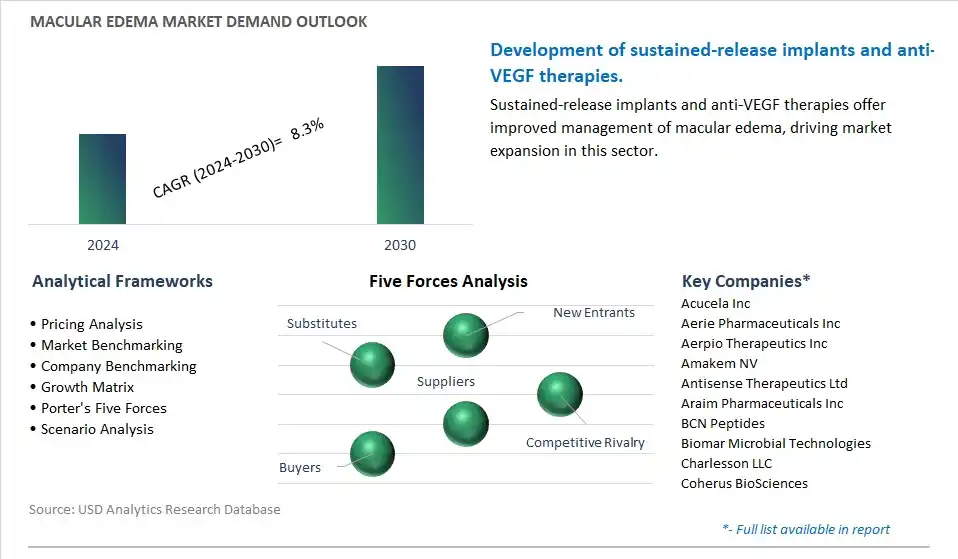
Macular Edema Market is estimated to increase at a growth rate of 8.3% CAGR over the forecast period from 2024 to 2030.
The global Macular Edema Market Study analyzes and forecasts the market size across 6 regions and 24 countries for diverse segments including By Type (Cystoid, Diabetic), By End-User (Hospitals, Ophthalmic Clinics, Research Institutes, Contract Research Organizations).
An Introduction to Macular Edema Market in 2024
The Macular Edema Market in 2024 addresses the complex pathophysiology and therapeutic challenges associated with retinal vascular disorders characterized by abnormal fluid accumulation in the macula, leading to vision impairment and blindness. Macular edema represents a significant cause of visual morbidity globally, necessitating targeted pharmacotherapies, laser interventions, and surgical treatments aimed at preserving vision and improving patient outcomes. The market observes dynamic growth driven by advancements in anti-vascular endothelial growth factor (VEGF) therapies, sustained-release drug delivery systems, and non-invasive imaging modalities for early detection and monitoring. Furthermore, expanding therapeutic indications and personalized treatment approaches underscore the market's pivotal role in addressing the unmet medical needs of patients with macular edema.
Macular Edema Market Competitive Landscape
The global Macular Edema Industry is highly competitive with a large number of companies focusing on niche market segments. Amidst intense competitive conditions, Macular Edema Companies are investing in new product launches and strengthening distribution channels. Key companies operating in the Macular Edema Industry include- Acucela Inc, Aerie Pharmaceuticals Inc, Aerpio Therapeutics Inc, Amakem NV, Antisense Therapeutics Ltd, Araim Pharmaceuticals Inc, BCN Peptides, Biomar Microbial Technologies, Charlesson LLC , Coherus BioSciences.
Macular Edema Market Trend: Advancements in Intravitreal Therapies
A prominent trend in the market for macular edema is the advancements in intravitreal therapies for the management of the condition. Macular edema, characterized by the accumulation of fluid in the macula, is a common complication of various retinal diseases, including diabetic retinopathy, age-related macular degeneration, and retinal vein occlusion. Intravitreal therapies, such as anti-vascular endothelial growth factor (anti-VEGF) agents, corticosteroids, and sustained-release implants, have revolutionized the treatment of macular edema by providing targeted delivery of therapeutic agents directly to the site of pathology within the eye. Recent advancements in drug delivery technologies, formulation optimization, and treatment regimens have led to the development of novel intravitreal therapies with improved efficacy, durability, and safety profiles, offering new options for the management of macular edema and vision preservation. This trend reflects the growing importance of intravitreal therapies in the management of retinal diseases and drives innovation and investment in the field of macular edema therapeutics.
Macular Edema Market Driver: Rising Prevalence of Diabetes and Age-related Macular Degeneration
The market for macular edema is driven by the rising prevalence of diabetes and age-related macular degeneration (AMD), two major risk factors for the development of the condition. Diabetes mellitus, a chronic metabolic disorder characterized by high blood sugar levels, is a leading cause of diabetic retinopathy and macular edema, affecting millions of people worldwide. Similarly, AMD, a progressive degenerative disease of the macula, is a leading cause of vision loss and blindness in elderly individuals, particularly those over the age of 50. As the global burden of diabetes and AMD continues to increase due to factors such as aging populations, sedentary lifestyles, and unhealthy dietary habits, the incidence and prevalence of macular edema are expected to rise correspondingly. This drives the demand for effective therapeutics to manage macular edema and prevent vision loss, leading to market growth and investment in the development of novel treatments and treatment modalities for the condition.
Macular Edema Market Opportunity: Development of Non-invasive Therapies
A Market Opportunity in the market for macular edema lies in the development of non-invasive therapies for the treatment of the condition. While intravitreal therapies have revolutionized the management of macular edema, they are associated with certain limitations and risks, including the need for repeated injections, intraocular inflammation, and the potential for intraocular pressure elevation and retinal detachment. Non-invasive therapies, such as oral medications, topical formulations, and minimally invasive procedures, offer the potential for safer, more convenient, and patient-friendly alternatives to intravitreal injections for the management of macular edema. By leveraging advancements in drug delivery technologies, pharmacology, and ocular imaging, pharmaceutical companies can develop novel non-invasive therapies that target the underlying pathophysiology of macular edema while minimizing treatment burden and risks for patients. Collaboration with academic researchers, ophthalmologists, and regulatory agencies can accelerate the development and clinical translation of non-invasive therapies for macular edema, unlocking new opportunities for market differentiation and therapeutic innovation in the field of retinal therapeutics.
Macular Edema Market Share Analysis: Diabetic Type is the fastest growing market segment over the forecast period to 2030
Among the different types of macular edema, the segment experiencing rapid growth is in Diabetic macular edema (DME). Diabetic macular edema is a common complication of diabetic retinopathy, a condition that affects the eyes of individuals with diabetes and can lead to vision loss if left untreated. DME occurs when fluid accumulates in the macula, the central part of the retina responsible for sharp, central vision. With the increasing prevalence of diabetes globally, particularly type 2 diabetes, the incidence of DME is on the rise, driving the demand for effective treatments and management strategies. Advances in the understanding of the pathophysiology of DME have led to the development of innovative therapies, including anti-vascular endothelial growth factor (anti-VEGF) agents, corticosteroids, and sustained-release drug delivery systems. These treatments aim to reduce macular edema, improve visual acuity, and prevent further vision loss in patients with DME. The fast growth of DME within the macular edema segment can be attributed to the rising incidence of diabetes, coupled with the increasing awareness among healthcare providers and patients about the importance of early detection and treatment of diabetic eye complications. As healthcare systems prioritize diabetic eye care and invest in innovative therapeutic solutions, the market for DME treatments is expected to continue its rapid expansion, addressing the unmet needs of diabetic patients and improving their visual outcomes.
Macular Edema Market Segmentation
By Type
Cystoid
Diabetic
By End-User
Hospitals
Ophthalmic Clinics
Research Institutes
Contract Research Organizations
Geographical Analysis
North America (United States, Canada, Mexico)
Europe (Germany, France, United Kingdom, Spain, Italy, Rest of Europe)
Asia Pacific (China, India, Japan, South Korea, Rest of Asia Pacific)
South America (Brazil, Argentina, Rest of South America)
Middle East and Africa (Saudi Arabia, UAE, Rest of Middle East, South Africa, Egypt, Rest of Africa)
Macular Edema Companies
Acucela Inc
Aerie Pharmaceuticals Inc
Aerpio Therapeutics Inc
Amakem NV
Antisense Therapeutics Ltd
Araim Pharmaceuticals Inc
BCN Peptides
Biomar Microbial Technologies
Charlesson LLC
Coherus BioSciences
* List not Exhaustive
Reasons to Buy the Macular Edema Market Study
• Deepen your industry insights and navigate uncertainties for strategy formulation, CAPEX, and Operational decisions
• Gain access to detailed insights on the Macular Edema Market, encompassing current market size, growth trends, and forecasts till 2030.
• Access detailed competitor analysis, enabling competitive advantage through a thorough understanding of market players, strategies, and potential differentiation opportunities
• Stay ahead of the curve with insights on technological advancements, innovations, and upcoming trends
• Identify lucrative investment avenues and expansion opportunities within the Macular Edema Industry, guided by robust, data-backed analysis.
• Understand regional and global markets through country-wise analysis, regional market potential, regulatory nuances, and dynamics
• Execute strategies with confidence and speed through information, analytics, and insights on the industry value chain
• Corporate leaders, strategists, financial experts, shareholders, asset managers, and governmental representatives can make long-term planning scenarios and build an integrated and timely understanding of market dynamics
• Benefit from tailored solutions and expert consultation based on report insights, providing personalized strategies aligned with specific business needs.
TABLE OF CONTENTS
1 Introduction to 2024 Macular Edema Market
1.1 Market Overview
1.2 Quick Facts
1.3 Scope/Objective of the Study
1.4 Market Definition
1.5 Countries and Regions Analyzed
1.6 Units, Currency, and Conversions
1.7 Industry Value Chain
2 Research Methodology
2.1 Market Size Estimation
2.2 Sources and Research Methodology
2.3 Data Triangulation
2.4 Assumptions and Limitations
3 Executive Summary
3.1 Global Macular Edema Market Size Outlook, $ Million, 2021 to 2030
3.2 Macular Edema Market Outlook by Type, $ Million, 2021 to 2030
3.3 Macular Edema Market Outlook by Product, $ Million, 2021 to 2030
3.4 Macular Edema Market Outlook by Application, $ Million, 2021 to 2030
3.5 Macular Edema Market Outlook by Key Countries, $ Million, 2021 to 2030
4 Market Dynamics
4.1 Key Driving Forces of Macular Edema Industry
4.2 Key Market Trends in Macular Edema Industry
4.3 Potential Opportunities in Macular Edema Industry
4.4 Key Challenges in Macular Edema Industry
5 Market Factor Analysis
5.1 Value Chain Analysis
5.2 Competitive Landscape
5.2.1 Global Macular Edema Market Share by Company (%), 2023
5.2.2 Product Offerings by Company
5.3 Porter’s Five Forces Analysis
5.4 Pricing Analysis and Outlook
6 Growth Outlook Across Scenarios
6.1 Growth Analysis-Case Scenario Definitions
6.2 Low Growth Scenario Forecasts
6.3 Reference Growth Scenario Forecasts
6.4 High Growth Scenario Forecasts
7 Global Macular Edema Market Outlook by Segments
7.1 Macular Edema Market Outlook by Segments, $ Million, 2021- 2030
By Type
Cystoid
Diabetic
By End-User
Hospitals
Ophthalmic Clinics
Research Institutes
Contract Research Organizations
8 North America Macular Edema Market Analysis and Outlook To 2030
8.1 Introduction to North America Macular Edema Markets in 2024
8.2 North America Macular Edema Market Size Outlook by Country, 2021-2030
8.2.1 United States
8.2.2 Canada
8.2.3 Mexico
8.3 North America Macular Edema Market size Outlook by Segments, 2021-2030
By Type
Cystoid
Diabetic
By End-User
Hospitals
Ophthalmic Clinics
Research Institutes
Contract Research Organizations
9 Europe Macular Edema Market Analysis and Outlook To 2030
9.1 Introduction to Europe Macular Edema Markets in 2024
9.2 Europe Macular Edema Market Size Outlook by Country, 2021-2030
9.2.1 Germany
9.2.2 France
9.2.3 Spain
9.2.4 United Kingdom
9.2.4 Italy
9.2.5 Russia
9.2.6 Norway
9.2.7 Rest of Europe
9.3 Europe Macular Edema Market Size Outlook by Segments, 2021-2030
By Type
Cystoid
Diabetic
By End-User
Hospitals
Ophthalmic Clinics
Research Institutes
Contract Research Organizations
10 Asia Pacific Macular Edema Market Analysis and Outlook To 2030
10.1 Introduction to Asia Pacific Macular Edema Markets in 2024
10.2 Asia Pacific Macular Edema Market Size Outlook by Country, 2021-2030
10.2.1 China
10.2.2 India
10.2.3 Japan
10.2.4 South Korea
10.2.5 Indonesia
10.2.6 Malaysia
10.2.7 Australia
10.2.8 Rest of Asia Pacific
10.3 Asia Pacific Macular Edema Market size Outlook by Segments, 2021-2030
By Type
Cystoid
Diabetic
By End-User
Hospitals
Ophthalmic Clinics
Research Institutes
Contract Research Organizations
11 South America Macular Edema Market Analysis and Outlook To 2030
11.1 Introduction to South America Macular Edema Markets in 2024
11.2 South America Macular Edema Market Size Outlook by Country, 2021-2030
11.2.1 Brazil
11.2.2 Argentina
11.2.3 Rest of South America
11.3 South America Macular Edema Market size Outlook by Segments, 2021-2030
By Type
Cystoid
Diabetic
By End-User
Hospitals
Ophthalmic Clinics
Research Institutes
Contract Research Organizations
12 Middle East and Africa Macular Edema Market Analysis and Outlook To 2030
12.1 Introduction to Middle East and Africa Macular Edema Markets in 2024
12.2 Middle East and Africa Macular Edema Market Size Outlook by Country, 2021-2030
12.2.1 Saudi Arabia
12.2.2 UAE
12.2.3 Oman
12.2.4 Rest of Middle East
12.2.5 Egypt
12.2.6 Nigeria
12.2.7 South Africa
12.2.8 Rest of Africa
12.3 Middle East and Africa Macular Edema Market size Outlook by Segments, 2021-2030
By Type
Cystoid
Diabetic
By End-User
Hospitals
Ophthalmic Clinics
Research Institutes
Contract Research Organizations
13 Company Profiles
13.1 Company Snapshot
13.2 SWOT Profiles
13.3 Products and Services
13.4 Recent Developments
13.5 Financial Profile
List of Companies
Acucela Inc
Aerie Pharmaceuticals Inc
Aerpio Therapeutics Inc
Amakem NV
Antisense Therapeutics Ltd
Araim Pharmaceuticals Inc
BCN Peptides
Biomar Microbial Technologies
Charlesson LLC
Coherus BioSciences
14 Appendix
14.1 Customization Offerings
14.2 Subscription Services
14.3 Related Reports
14.4 Publisher Expertise
