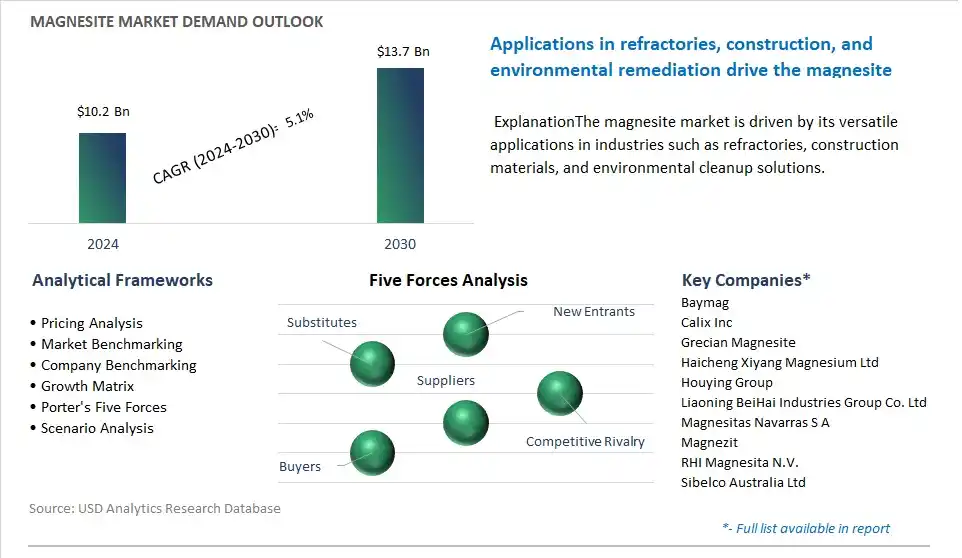
The global Magnesite Market is poised to register a 5.1% CAGR from $10.2 Billion in 2024 to $13.7 Billion in 2030.
The global Magnesite Market Study analyzes and forecasts the market size across 6 regions and 24 countries for diverse segments -By Type (Dead-Burned Magnesia, Fused Magnesia, Others), By Application (Agriculture, Chemical, Construction, Refractory, Others).
An Introduction to Global Magnesite Market in 2024
The future of magnesite as a mineral resource is influenced by several key trends, including increasing demand for magnesium-based products in industrial, environmental, and construction applications, advancements in mining technologies and processing methods, and growing emphasis on sustainability, resource efficiency, and circular economy principles. Magnesite is a magnesium carbonate mineral used as a raw material for producing magnesium oxide (magnesia), refractory materials, and magnesium compounds such as magnesium hydroxide and magnesium sulfate. With the rise of lightweight materials, emission reduction strategies, and infrastructure development, there's a growing need for magnesite that offers high purity, consistency, and availability while minimizing environmental impact and energy consumption in the extraction and processing stages. Moreover, advancements in magnesite beneficiation, calcination processes, and by-product utilization are driving the development of sustainable mining practices and value-added products with diverse applications in steelmaking, cement production, environmental remediation, and agriculture. Additionally, the integration of magnesite into carbon capture and storage (CCS) technologies, soil stabilization methods, and wastewater treatment processes is enhancing its role as a versatile and environmentally friendly mineral resource. Collaboration between magnesite producers, end-users, research institutions, and government agencies is essential to drive innovation, ensure resource sustainability, and address market demands in the magnesite industry.
Magnesite Market Competitive Landscape
The market report analyses the leading companies in the industry including Baymag, Calix Inc, Grecian Magnesite, Haicheng Xiyang Magnesium Ltd, Houying Group, Liaoning BeiHai Industries Group Co. Ltd, Magnesitas Navarras S A, Magnezit, RHI Magnesita N.V., Sibelco Australia Ltd.
Magnesite Market Dynamics
Magnesite Market Trend: Increasing Demand for Refractory Materials
One prominent market trend in the magnesite industry is the increasing demand for refractory materials. Magnesite, with its high heat resistance and refractory properties, is a key raw material used in the production of refractory bricks, linings, and other heat-resistant products. As industries such as steel, cement, and glass continue to expand, there's a growing need for refractory materials to line furnaces, kilns, and other high-temperature processes. This trend is driven by factors such as infrastructure development, industrialization, and the demand for durable materials that can withstand extreme heat conditions, leading to market growth in the magnesite refractories segment.
Magnesite Market Driver: Growth in Steel Production and Infrastructure Projects
A significant driver propelling the growth of the magnesite market is the growth in steel production and infrastructure projects. Magnesite plays a vital role in the steelmaking process as a refractory material for lining converters, ladles, and other equipment used in steel production. With increasing urbanization, construction activities, and investments in infrastructure projects such as roads, bridges, and buildings, there's a continuous demand for steel to support construction and development projects worldwide. This driver is fueled by factors such as population growth, urbanization, industrialization, and government initiatives to stimulate economic growth through infrastructure investments, driving market growth and demand for magnesite in steelmaking applications.
Magnesite Market Opportunity: Exploration of Magnesium-Based Products
An emerging opportunity for the magnesite market lies in the exploration of magnesium-based products beyond traditional refractory applications. Magnesium, derived from magnesite, has diverse industrial applications in sectors such as automotive, aerospace, electronics, and healthcare. Manufacturers can explore the development of magnesium alloys, magnesium compounds, and magnesium-based products for lightweight components, corrosion-resistant coatings, biomedical implants, and energy storage systems. By leveraging the unique properties of magnesium, such as its low density, high strength-to-weight ratio, and biocompatibility, stakeholders in the magnesite industry can tap into new market segments, create value-added products, and diversify their product portfolios. This opportunity enables manufacturers to innovate, differentiate their offerings, and capitalize on the versatility and potential of magnesite-derived materials in various industrial applications.
Magnesite Market Share Analysis: The Dead-Burned Magnesia segment generated the highest revenue in 2024
The Dead-Burned Magnesia segment is the largest in the Magnesite Market, primarily due to its wide range of applications across various industries. Dead-burned magnesia, also known as refractory magnesia, is a high-purity form of magnesia produced by calcining magnesite ore at high temperatures. It possesses excellent refractory properties, high heat resistance, and chemical stability, making it a crucial raw material in the production of refractory bricks, linings for steelmaking furnaces, and other high-temperature industrial applications. The steel industry is a major consumer of dead-burned magnesia, utilizing it extensively in the production of basic refractories for steelmaking processes such as ladle lining, converter lining, and electric arc furnace refractories. Additionally, dead-burned magnesia finds applications in the production of ceramics, cement, and magnesium-based chemicals. With the growing demand for steel and the expansion of industrial sectors requiring high-temperature materials, the Dead-Burned Magnesia segment continues to dominate the Magnesite Market, supported by its essential role in critical industrial processes.
Magnesite Market Share Analysis: The Refractory segment is poised to register the fastest growth rate (CAGR) over the forecast period to 2030
The Refractory segment is the fastest-growing segment in the Magnesite Market Refractory magnesia, derived from magnesite, is prized for its exceptional heat resistance, chemical stability, and durability, making it an essential component in refractory materials used in high-temperature industrial processes. Industries such as steelmaking, cement production, and non-ferrous metallurgy heavily rely on refractory materials to line furnaces, kilns, and reactors, where they withstand extreme temperatures and harsh chemical environments. With the increasing demand for steel and infrastructure development worldwide, the steel industry's need for refractory materials is surging. Additionally, the growing adoption of advanced refractory technologies in emerging sectors such as renewable energy, aerospace, and electronics further drives the demand for magnesite-based refractories. Accordingly, the Refractory segment experiences rapid growth in the Magnesite Market, fueled by the expanding industrial applications requiring reliable and high-performance refractory materials.
Magnesite Market Report Segmentation
By Type
Dead-Burned Magnesia
Fused Magnesia
Others
By Application
Agriculture
Chemical
Construction
Refractory
Others
Regions Included
North America (US, Canada, Mexico)
Europe (Germany, UK, France, Spain, Italy, Russia, Rest of Europe)
Asia Pacific (China, India, Japan, South Korea, Australia, South East Asia, Rest of Asia)
South America (Brazil, Argentina, Rest of South America)
Middle East and Africa (Saudi Arabia, UAE, Rest of Middle East, South Africa, Egypt, Rest of Africa)
Magnesite Companies Profiled in the Market Study
Baymag
Calix Inc
Grecian Magnesite
Haicheng Xiyang Magnesium Ltd
Houying Group
Liaoning BeiHai Industries Group Co. Ltd
Magnesitas Navarras S A
Magnezit
RHI Magnesita N.V.
Sibelco Australia Ltd
*- List Not Exhaustive
TABLE OF CONTENTS
1 Introduction to 2024 Magnesite Market
1.1 Market Overview
1.2 Quick Facts
1.3 Scope/Objective of the Study
1.4 Market Definition
1.5 Countries and Regions Covered
1.6 Units, Currency, and Conversions
1.7 Industry Value Chain
2 Research Methodology
2.1 Market Size Estimation
2.2 Sources and Research Methodology
2.3 Data Triangulation
2.4 Assumptions and Limitations
3 Executive Summary
3.1 Global Magnesite Market Size Outlook, $ Million, 2021 to 2030
3.2 Magnesite Market Outlook by Type, $ Million, 2021 to 2030
3.3 Magnesite Market Outlook by Product, $ Million, 2021 to 2030
3.4 Magnesite Market Outlook by Application, $ Million, 2021 to 2030
3.5 Magnesite Market Outlook by Key Countries, $ Million, 2021 to 2030
4 Market Dynamics
4.1 Key Driving Forces of Magnesite Industry
4.2 Key Market Trends in Magnesite Industry
4.3 Potential Opportunities in Magnesite Industry
4.4 Key Challenges in Magnesite Industry
5 Market Factor Analysis
5.1 Value Chain Analysis
5.2 Competitive Landscape
5.2.1 Global Magnesite Market Share by Company (%), 2023
5.2.2 Product Offerings by Company
5.3 Porter’s Five Forces Analysis
5.4 Pricing Analysis and Outlook
6 Growth Outlook Across Scenarios
6.1 Growth Analysis-Case Scenario Definitions
6.2 Low Growth Scenario Forecasts
6.3 Reference Growth Scenario Forecasts
6.4 High Growth Scenario Forecasts
7 Global Magnesite Market Outlook by Segments
7.1 Magnesite Market Outlook by Segments, $ Million, 2021- 2030
By Type
Dead-Burned Magnesia
Fused Magnesia
Others
By Application
Agriculture
Chemical
Construction
Refractory
Others
8 North America Magnesite Market Analysis and Outlook To 2030
8.1 Introduction to North America Magnesite Markets in 2024
8.2 North America Magnesite Market Size Outlook by Country, 2021-2030
8.2.1 United States
8.2.2 Canada
8.2.3 Mexico
8.3 North America Magnesite Market size Outlook by Segments, 2021-2030
By Type
Dead-Burned Magnesia
Fused Magnesia
Others
By Application
Agriculture
Chemical
Construction
Refractory
Others
9 Europe Magnesite Market Analysis and Outlook To 2030
9.1 Introduction to Europe Magnesite Markets in 2024
9.2 Europe Magnesite Market Size Outlook by Country, 2021-2030
9.2.1 Germany
9.2.2 France
9.2.3 Spain
9.2.4 United Kingdom
9.2.4 Italy
9.2.5 Russia
9.2.6 Norway
9.2.7 Rest of Europe
9.3 Europe Magnesite Market Size Outlook by Segments, 2021-2030
By Type
Dead-Burned Magnesia
Fused Magnesia
Others
By Application
Agriculture
Chemical
Construction
Refractory
Others
10 Asia Pacific Magnesite Market Analysis and Outlook To 2030
10.1 Introduction to Asia Pacific Magnesite Markets in 2024
10.2 Asia Pacific Magnesite Market Size Outlook by Country, 2021-2030
10.2.1 China
10.2.2 India
10.2.3 Japan
10.2.4 South Korea
10.2.5 Indonesia
10.2.6 Malaysia
10.2.7 Australia
10.2.8 Rest of Asia Pacific
10.3 Asia Pacific Magnesite Market size Outlook by Segments, 2021-2030
By Type
Dead-Burned Magnesia
Fused Magnesia
Others
By Application
Agriculture
Chemical
Construction
Refractory
Others
11 South America Magnesite Market Analysis and Outlook To 2030
11.1 Introduction to South America Magnesite Markets in 2024
11.2 South America Magnesite Market Size Outlook by Country, 2021-2030
11.2.1 Brazil
11.2.2 Argentina
11.2.3 Rest of South America
11.3 South America Magnesite Market size Outlook by Segments, 2021-2030
By Type
Dead-Burned Magnesia
Fused Magnesia
Others
By Application
Agriculture
Chemical
Construction
Refractory
Others
12 Middle East and Africa Magnesite Market Analysis and Outlook To 2030
12.1 Introduction to Middle East and Africa Magnesite Markets in 2024
12.2 Middle East and Africa Magnesite Market Size Outlook by Country, 2021-2030
12.2.1 Saudi Arabia
12.2.2 UAE
12.2.3 Oman
12.2.4 Rest of Middle East
12.2.5 Egypt
12.2.6 Nigeria
12.2.7 South Africa
12.2.8 Rest of Africa
12.3 Middle East and Africa Magnesite Market size Outlook by Segments, 2021-2030
By Type
Dead-Burned Magnesia
Fused Magnesia
Others
By Application
Agriculture
Chemical
Construction
Refractory
Others
13 Company Profiles
13.1 Company Snapshot
13.2 SWOT Profiles
13.3 Products and Services
13.4 Recent Developments
13.5 Financial Profile
Baymag
Calix Inc
Grecian Magnesite
Haicheng Xiyang Magnesium Ltd
Houying Group
Liaoning BeiHai Industries Group Co. Ltd
Magnesitas Navarras S A
Magnezit
RHI Magnesita N.V.
Sibelco Australia Ltd
14 Appendix
14.1 Customization Offerings
14.2 Subscription Services
14.3 Related Reports
14.4 Publisher Expertise
By Type
Dead-Burned Magnesia
Fused Magnesia
Others
By Application
Agriculture
Chemical
Construction
Refractory
Others
Countries Analyzed
North America (US, Canada, Mexico)
Europe (Germany, UK, France, Spain, Italy, Russia, Rest of Europe)
Asia Pacific (China, India, Japan, South Korea, Australia, South East Asia, Rest of Asia)
South America (Brazil, Argentina, Rest of South America)
Middle East and Africa (Saudi Arabia, UAE, Rest of Middle East, South Africa, Egypt, Rest of Africa)
