<h3><Strong><i>Malignant Mesothelioma Therapeutics Market is estimated to increase at a growth rate of 6.3% CAGR over the forecast period from 2024 to 2030.</h3></Strong></i>The global Malignant Mesothelioma Therapeutics Market Study analyzes and forecasts the market size across 6 regions and 24 countries for diverse segments including By Drug (Pemetrexed, Cisplatin, Carboplatin, Gemcitabine, Vinorelbine, Others), By Route of Administration (Oral, Parenteral), By End-User (Hospitals, Cancer Centers, Others).
<h2>An Introduction to Malignant Mesothelioma Therapeutics Market in 2024</h2>The Malignant Mesothelioma Therapeutics Market in 2024 confronts the clinical challenges posed by this aggressive asbestos-related cancer, necessitating multimodal treatment approaches aimed at improving patient outcomes and survival rates. Malignant mesothelioma affects the mesothelial lining of the lungs, abdomen, or heart, with limited treatment options and poor prognosis. The market witnesses dynamic growth driven by advancements in immunotherapy, targeted therapies, and multimodal treatment regimens combining surgery, chemotherapy, and radiation therapy. Moreover, increasing research initiatives, clinical trials, and regulatory incentives aim to accelerate drug development efforts and improve access to innovative therapeutics for patients with malignant mesothelioma worldwide.
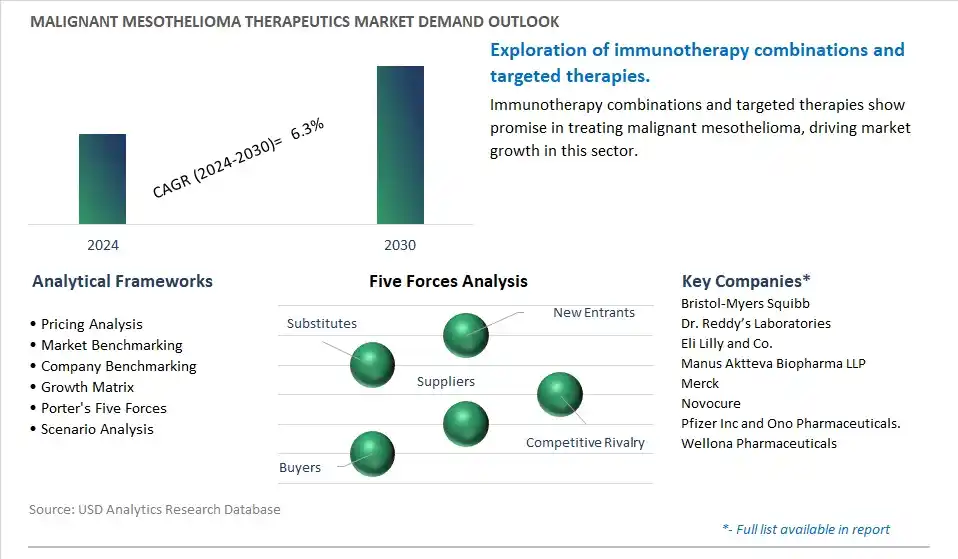
<h3>Malignant Mesothelioma Therapeutics Market Competitive Landscape</h3>The global Malignant Mesothelioma Therapeutics Industry is highly competitive with a large number of companies focusing on niche market segments. Amidst intense competitive conditions, Malignant Mesothelioma Therapeutics Companies are investing in new product launches and strengthening distribution channels. Key companies operating in the Malignant Mesothelioma Therapeutics Industry include- Bristol-Myers Squibb, Dr. Reddy’s Laboratories, Eli Lilly and Co., Manus Aktteva Biopharma LLP, Merck, Novocure, Pfizer Inc and Ono Pharmaceuticals., Wellona Pharmaceuticals.<h3>Malignant Mesothelioma Therapeutics Market Trend: Advancements in Immunotherapy Research</h3>A prominent trend in the market for malignant mesothelioma therapeutics is the focus on advancements in immunotherapy research for the treatment of this aggressive cancer. Malignant mesothelioma is a rare and often fatal cancer associated with asbestos exposure, characterized by its resistance to conventional chemotherapy and radiation therapy. In recent years, there has been growing interest in harnessing the immune system to target and destroy mesothelioma cells, leading to the development of novel immunotherapeutic approaches. Immunotherapy strategies for malignant mesothelioma include immune checkpoint inhibitors, chimeric antigen receptor (CAR) T-cell therapy, cancer vaccines, and adoptive cell therapy, among others. These immunotherapeutic modalities aim to enhance the anti-tumor immune response, overcome immune evasion mechanisms, and improve patient outcomes in mesothelioma. Clinical trials evaluating the safety and efficacy of immunotherapy agents alone or in combination with other treatment modalities are underway, offering hope for more effective and personalized therapeutic options for patients with malignant mesothelioma. The focus on immunotherapy research represents a significant shift in the treatment paradigm for mesothelioma and drives market growth and investment in innovative immunotherapeutic approaches for this challenging disease.<h3>Malignant Mesothelioma Therapeutics Market Driver: Increasing Incidence and Awareness of Mesothelioma</h3>The market for malignant mesothelioma therapeutics is driven by the increasing incidence and awareness of mesothelioma, particularly in regions with a history of asbestos use and exposure. Although asbestos use has declined in many countries, mesothelioma remains a significant public health concern due to its long latency period and continued occupational and environmental exposure to asbestos fibers. Additionally, there is growing recognition of non-occupational sources of asbestos exposure, such as secondary exposure through household contacts or environmental contamination, contributing to the rising incidence of mesothelioma in certain populations. Furthermore, improved diagnostic techniques and heightened awareness among healthcare providers have led to earlier detection and diagnosis of mesothelioma cases, prompting the need for effective treatment options to improve patient outcomes. The increasing incidence and awareness of mesothelioma drive market demand for therapeutics that can extend survival, alleviate symptoms, and enhance quality of life for patients with this aggressive cancer, fostering innovation and investment in mesothelioma research and drug development.<h3>Malignant Mesothelioma Therapeutics Market Opportunity: Personalized Medicine and Biomarker Development</h3>A Market Opportunity in the market for malignant mesothelioma therapeutics lies in the development of personalized medicine approaches and biomarker-based strategies for patient stratification and treatment selection. Malignant mesothelioma is a heterogeneous disease with variable clinical outcomes and treatment responses among patients, highlighting the need for tailored therapeutic interventions based on individual patient characteristics and tumor biology. Biomarkers play a critical role in identifying patients who are most likely to benefit from specific treatments, predicting treatment response and prognosis, and guiding therapeutic decision-making in mesothelioma. Recent advancements in genomics, proteomics, and molecular profiling techniques have enabled the identification of potential biomarkers associated with mesothelioma prognosis, treatment response, and resistance mechanisms. Biomarkers such as mesothelin, fibulin-3, and BAP1 mutations have shown promise as prognostic indicators and therapeutic targets in mesothelioma, offering opportunities for precision medicine approaches and targeted therapies. By incorporating biomarker-driven strategies into clinical trials and treatment algorithms, pharmaceutical companies and researchers can optimize patient selection, enhance clinical trial design, and improve the efficacy and safety of mesothelioma therapeutics. Collaboration between academia, industry, and regulatory agencies is essential to advancing biomarker discovery and validation efforts in mesothelioma, translating scientific discoveries into clinically meaningful tools and therapies that benefit patients with this devastating disease.<h3>Malignant Mesothelioma Therapeutics Market Share Analysis: Pemetrexed for Malignant Mesothelioma is the fastest growing market segment over the forecast period to 2030</h3>In the realm of Malignant Mesothelioma Therapeutics, the fast-growing drug is "Pemetrexed." Pemetrexed, often administered in combination with Cisplatin, stands out due to its effectiveness in treating malignant mesothelioma, a cancer primarily associated with asbestos exposure. Pemetrexed functions as an antimetabolite, inhibiting crucial enzymes involved in DNA and RNA synthesis, thereby impeding cancer cell proliferation. The drug's efficacy, coupled with its manageable toxicity profile, has propelled its adoption as a frontline treatment for mesothelioma. Furthermore, ongoing research and clinical trials exploring Pemetrexed's potential in combination therapies and alternative administration routes, such as oral formulations, indicate promising avenues for further growth and optimization in mesothelioma treatment. As a result, Pemetrexed emerges as a pivotal component in the therapeutic arsenal against Malignant Mesothelioma, driving significant advancements in patient outcomes and treatment strategies.<h2>Malignant Mesothelioma Therapeutics Market Segmentation</h2><Strong>By Drug</Strong>
Pemetrexed
Cisplatin
Carboplatin
Gemcitabine
Vinorelbine
Others
<Strong>By Route of Administration</Strong>
Oral
Parenteral
<Strong>By End-User</Strong>
Hospitals
Cancer Centers
Others
<Strong>Geographical Analysis</Strong>
North America (United States, Canada, Mexico)
Europe (Germany, France, United Kingdom, Spain, Italy, Rest of Europe)
Asia Pacific (China, India, Japan, South Korea, Rest of Asia Pacific)
South America (Brazil, Argentina, Rest of South America)
Middle East and Africa (Saudi Arabia, UAE, Rest of Middle East, South Africa, Egypt, Rest of Africa)<h2>Malignant Mesothelioma Therapeutics Companies</h2>Bristol-Myers Squibb
Dr. Reddy’s Laboratories
Eli Lilly and Co.
Manus Aktteva Biopharma LLP
Merck
Novocure
Pfizer Inc and Ono Pharmaceuticals.
Wellona Pharmaceuticals
* List not Exhaustive
<h3>Reasons to Buy the Malignant Mesothelioma Therapeutics Market Study</h3>• Deepen your industry insights and navigate uncertainties for strategy formulation, CAPEX, and Operational decisions
• Gain access to detailed insights on the Malignant Mesothelioma Therapeutics Market, encompassing current market size, growth trends, and forecasts till 2030.
• Access detailed competitor analysis, enabling competitive advantage through a thorough understanding of market players, strategies, and potential differentiation opportunities
• Stay ahead of the curve with insights on technological advancements, innovations, and upcoming trends
• Identify lucrative investment avenues and expansion opportunities within the Malignant Mesothelioma Therapeutics Industry, guided by robust, data-backed analysis.
• Understand regional and global markets through country-wise analysis, regional market potential, regulatory nuances, and dynamics
• Execute strategies with confidence and speed through information, analytics, and insights on the industry value chain
• Corporate leaders, strategists, financial experts, shareholders, asset managers, and governmental representatives can make long-term planning scenarios and build an integrated and timely understanding of market dynamics
• Benefit from tailored solutions and expert consultation based on report insights, providing personalized strategies aligned with specific business needs.
