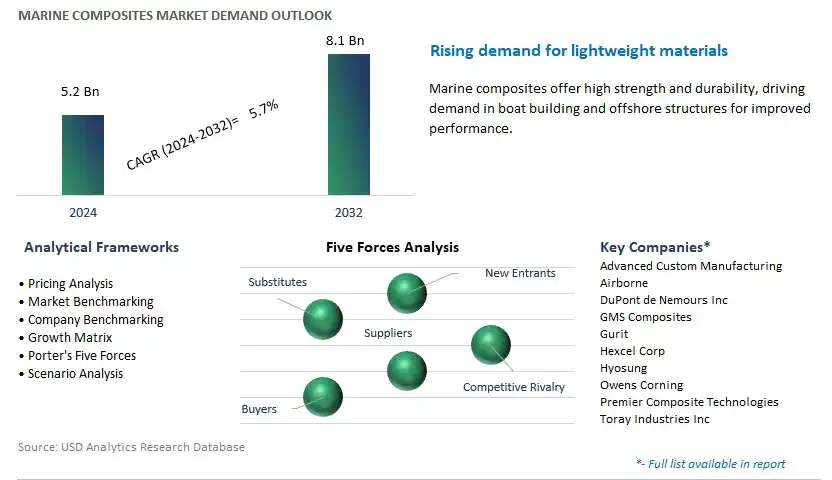
Global Marine Composites Market Size is valued at $5.2 Billion in 2024 and is forecast to register a growth rate (CAGR) of 5.7% to reach $8.1 Billion by 2032.
The global Marine Composites Market Study analyzes and forecasts the market size across 6 regions and 24 countries for diverse segments -By Type (Metal Matrix Composite (MMC), Ceramic Matrix Composite (CMC), Polymer Matrix Composite (PMC)), By Fiber (Glass Fiber, Carbon Fiber, Others, Aramid, Natural Fibers), By Resin (Polyester, Vinyl Ester, Epoxy, Thermoplastic, Others, Phenolic, Acrylic), By Vessel Type (Power Boats, Sailboats, Cruise Ships, Others).
An Introduction to Marine Composites Market in 2024
Marine composites are lightweight and durable materials used in the construction of marine vessels, offshore structures, and marine equipment. In 2024, the demand for marine composites s to grow as the marine industry seeks materials that offer superior strength-to-weight ratios, corrosion resistance, and design flexibility. Marine composites are typically composed of high-strength fibers such as carbon fiber, fiberglass, and aramid fibers embedded in a resin matrix such as epoxy or polyester. These materials exhibit excellent mechanical properties, including high tensile strength, stiffness, and impact resistance, making them suitable for marine applications where weight reduction, structural integrity, and performance are critical. Marine composites are used in the construction of boat hulls, decks, masts, propellers, and subsea structures, offering advantages such as improved fuel efficiency, reduced maintenance costs, and increased payload capacity. With advancements in composite manufacturing processes, such as resin infusion, vacuum bagging, and automated fiber placement, there is ongoing research into developing cost-effective and sustainable marine composite solutions. Additionally, the adoption of bio-based and recyclable composite materials aligns with environmental sustainability initiatives and regulatory requirements. As the marine industry s to evolve and demand advanced materials for lightweight and efficient marine structures, the market for marine composites is expected to witness significant growth, driven by technological innovation and the need for high-performance marine solutions.
Marine Composites Market Competitive Landscape
The market report analyses the leading companies in the industry including Advanced Custom Manufacturing, Airborne, DuPont de Nemours Inc, GMS Composites, Gurit, Hexcel Corp, Hyosung, Owens Corning, Premier Composite Technologies, Toray Industries Inc, and others.
Marine Composites Market Dynamics
Market Trend: Growing Demand for Lightweight and Durable Materials
A prominent market trend for marine composites is the increasing demand for lightweight and durable materials in the maritime industry. Marine composites, which are typically made from reinforced fibers such as fiberglass or carbon fiber embedded in a resin matrix, offer advantages such as high strength-to-weight ratio, corrosion resistance, and design flexibility. With the maritime sector seeking solutions to improve vessel performance, fuel efficiency, and durability, there's a noticeable trend towards the adoption of marine composites in boat building, marine infrastructure, and offshore structures. This trend is driven by the need to enhance vessel capabilities, reduce maintenance costs, and improve sustainability in the marine industry.
Market Driver: Performance Advantages and Technological Innovations
A key market driver for marine composites is the performance advantages offered by these materials coupled with ongoing technological innovations. Marine composites provide superior strength, stiffness, and fatigue resistance compared to traditional materials like steel and aluminum. Additionally, advancements in composite manufacturing processes, such as resin infusion, vacuum bagging, and automated layup techniques, have improved the quality and cost-effectiveness of marine composite components. The ability of composites to withstand harsh marine environments, including saltwater corrosion and UV exposure, further contributes to their growing adoption in marine applications. Technological innovations continue to drive the development of new composite materials and manufacturing methods, meeting the evolving needs of the maritime industry and fueling market growth.
Market Opportunity: Expansion into Offshore Wind Energy
A potential opportunity for marine composites lies in the expansion into the offshore wind energy sector. As the demand for renewable energy continues to rise, there's significant growth in the development of offshore wind farms to harness wind energy in coastal and offshore locations. Marine composites offer advantages such as lightweight construction, corrosion resistance, and ease of installation, making them well-suited for various components in offshore wind turbines and support structures. Opportunities exist for the use of composites in turbine blades, nacelles, support structures, and floating platforms, enabling cost-effective and durable solutions for offshore wind energy projects. By capitalizing on this emerging market opportunity, manufacturers of marine composites can diversify their customer base and contribute to the expansion of renewable energy infrastructure while driving growth in the marine composites market.
Marine Composites Market Share Analysis: Polymer Matrix Composite (PMC) segment generated the highest revenue in 2024
The Polymer Matrix Composite (PMC) segment is the largest segment within the marine composites market. PMC refers to a class of composite materials where a polymer resin matrix, such as epoxy, polyester, or vinyl ester, is reinforced with high-strength fibers, such as glass, carbon, or aramid fibers. These composites offer a combination of lightweight, corrosion resistance, high strength-to-weight ratio, and design flexibility, making them ideal for various marine applications. PMC finds extensive use in marine construction, including boat hulls, decks, superstructures, masts, and interior components, due to their ability to withstand harsh marine environments, including exposure to saltwater, UV radiation, and marine organisms. Additionally, PMC materials can be easily molded into complex shapes and structures, allowing for efficient manufacturing and customization to meet specific design requirements. Moreover, PMC materials offer advantages in terms of cost-effectiveness compared to metal matrix composites (MMC) and ceramic matrix composites (CMC), making them more accessible to a wider range of marine applications. Furthermore, the PMC segment benefits from the continuous advancements in composite materials technology, including the development of novel resin formulations, fiber reinforcements, and manufacturing processes, which further enhance their performance and expand their application scope in the marine industry. With their superior properties, versatility, and widespread adoption across various marine applications, the Polymer Matrix Composite (PMC) segment maintains its position as the largest and most significant segment within the marine composites market.
Marine Composites Market Share Analysis: Carbon Fiber is poised to register the fastest CAGR over the forecast period
The Carbon Fiber segment is the fastest-growing segment within the marine composites market. Carbon fiber composites offer exceptional strength-to-weight ratio, stiffness, fatigue resistance, and corrosion resistance, making them highly desirable for demanding marine applications. These materials are extensively utilized in marine construction for high-performance boat hulls, masts, rigging, hydrofoils, and structural components where lightweight, durability, and superior mechanical properties are essential. Additionally, carbon fiber composites exhibit excellent fatigue resistance, allowing marine structures to endure repeated loading cycles and harsh environmental conditions without compromising performance or safety. Furthermore, carbon fiber materials offer significant weight savings compared to traditional materials such as aluminum or steel, contributing to improved fuel efficiency, speed, and manoeuvrability of marine vessels. Moreover, the Carbon Fiber segment benefits from advancements in carbon fiber manufacturing processes, including higher production volumes, improved fiber alignment, and reduced production costs, making carbon fiber composites more accessible to a broader range of marine applications. Additionally, carbon fiber recycling initiatives and sustainable sourcing practices further enhance the appeal of carbon fiber composites as environmentally friendly alternatives in the marine industry. With their exceptional properties, growing acceptance, and expanding application scope in high-performance marine structures, the Carbon Fiber segment is poised to continue its rapid growth trajectory within the marine composites market.
Marine Composites Market Share Analysis: Polyester Resin segment generated the highest revenue in 2024
The Polyester Resin segment is the largest segment within the marine composites market. Polyester resins are widely utilized as matrix materials in marine composites due to their versatility, cost-effectiveness, and ease of processing. These resins offer good mechanical properties, corrosion resistance, and compatibility with various reinforcing fibers, making them suitable for a wide range of marine applications. Additionally, polyester resins can be formulated with additives to enhance specific performance characteristics such as UV resistance, fire retardancy, and hydrolytic stability, further expanding their application scope in marine environments. Moreover, polyester resins are compatible with different manufacturing processes, including hand lay-up, spray-up, vacuum infusion, and filament winding, providing manufacturers with flexibility in production methods and design options. Furthermore, polyester resins are readily available in the market and can be sourced from multiple suppliers, ensuring supply chain reliability and cost competitiveness. Additionally, polyester resins are preferred for their excellent adhesion to various substrates, including fiberglass, carbon fiber, and aramid fiber reinforcements, ensuring strong bonding and structural integrity in marine composite structures. With their wide-ranging applications, favorable properties, ease of processing, and cost advantages, the Polyester Resin segment maintains its position as the largest and most significant segment within the marine composites market.
Marine Composites Market Share Analysis: Cruise Ships is poised to register the fastest CAGR over the forecast period
The Cruise Ships segment is the fastest-growing segment within the marine composites market. Cruise ships represent a significant segment of the global marine industry, catering to leisure and luxury travel experiences for passengers worldwide. Cruise ship operators increasingly opt for marine composites in vessel construction and refurbishment projects to capitalize on the unique advantages offered by composite materials. Composite materials, including fiberglass, carbon fiber, and other reinforced plastics, provide cruise ships with lightweight, durable, and corrosion-resistant solutions for hulls, decks, superstructures, and interior fittings. Additionally, marine composites offer design flexibility, enabling architects and ship designers to create innovative and aesthetically pleasing structures while optimizing space utilization and enhancing onboard amenities. Moreover, cruise ship operators prioritize sustainability and environmental responsibility, driving the adoption of lightweight materials such as composites to reduce fuel consumption, greenhouse gas emissions, and environmental impact. Furthermore, the growing demand for luxury and expedition cruises, coupled with increasing cruise ship sizes and passenger capacities, fuels the need for advanced materials that offer superior performance, safety, and comfort. Additionally, cruise ship refurbishment projects present opportunities for composite material suppliers and shipyards to retrofit existing vessels with modern composite solutions, extending service life and enhancing competitiveness in the market. With the cruise industry's continued growth, technological advancements in marine composites, and a focus on sustainability and passenger experience, the Cruise Ships segment is poised to maintain its rapid growth trajectory within the marine composites market.
Marine Composites Market
By Type
Metal Matrix Composite (MMC)
Ceramic Matrix Composite (CMC)
Polymer Matrix Composite (PMC)
By Fiber
Glass Fiber
Carbon Fiber
Others
Aramid
Natural Fibers
By Resin
Polyester
Vinyl Ester
Epoxy
Thermoplastic
Others
Phenolic
Acrylic
By Vessel Type
Power Boats
Sailboats
Cruise Ships
Others
Countries Analyzed
North America (US, Canada, Mexico)
Europe (Germany, UK, France, Spain, Italy, Russia, Rest of Europe)
Asia Pacific (China, India, Japan, South Korea, Australia, South East Asia, Rest of Asia)
South America (Brazil, Argentina, Rest of South America)
Middle East and Africa (Saudi Arabia, UAE, Rest of Middle East, South Africa, Egypt, Rest of Africa)
Marine Composites Companies Profiled in the Study
Advanced Custom Manufacturing
Airborne
DuPont de Nemours Inc
GMS Composites
Gurit
Hexcel Corp
Hyosung
Owens Corning
Premier Composite Technologies
Toray Industries Inc
*- List Not Exhaustive
