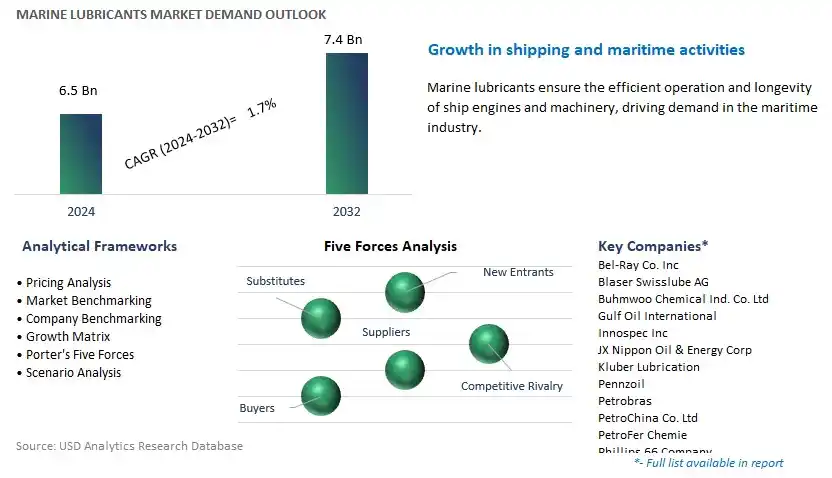
Global Marine Lubricants Market Size is valued at $6.5 Billion in 2024 and is forecast to register a growth rate (CAGR) of 1.7% to reach $7.4 Billion by 2032.
The global Marine Lubricants Market Study analyzes and forecasts the market size across 6 regions and 24 countries for diverse segments -By Type (Mineral Oil, Synthetic Oil, Bio-Based Oil), By Product (Engine Oils, Cylinder Oils, System Oils, Hydraulic Fluid, Compressor Oils, Others), By Ship Type (Bulk Carriers, Tankers, Container Ships, Others).
An Introduction to Marine Lubricants Market in 2024
Marine lubricants are specialized oils and greases used in marine engines, gearboxes, and hydraulic systems to reduce friction, wear, and corrosion in marine equipment. In 2024, the demand for marine lubricants remains robust as the maritime industry seeks reliable lubrication solutions to enhance equipment performance, reliability, and longevity. Marine lubricants are formulated to withstand the harsh operating conditions encountered in marine environments, including high temperatures, heavy loads, and exposure to saltwater and contaminants. They provide lubrication and protection for components such as engines, bearings, gears, and hydraulic systems, ensuring smooth operation and preventing mechanical failures. Common types of marine lubricants include engine oils, gear oils, hydraulic oils, and stern tube lubricants, each tailored to meet the specific requirements of different marine equipment and applications. With advancements in lubricant technology, there is a growing emphasis on developing environmentally friendly and biodegradable marine lubricants that comply with regulatory standards such as the International Maritime Organization's (IMO) regulations on marine pollution prevention. Further, the adoption of synthetic and bio-based lubricants offers additional benefits in terms of performance, longevity, and environmental sustainability. As the maritime industry s to prioritize safety, efficiency, and environmental responsibility, the market for marine lubricants is expected to witness steady growth, driven by the need for high-quality lubrication solutions that meet the evolving needs of marine operators and regulatory requirements.
Marine Lubricants Market Competitive Landscape
The market report analyses the leading companies in the industry including Bel-Ray Co. Inc, Blaser Swisslube AG, Buhmwoo Chemical Ind. Co. Ltd, Gulf Oil International, Innospec Inc, JX Nippon Oil & Energy Corp, Kluber Lubrication, Pennzoil, Petrobras, PetroChina Co. Ltd, PetroFer Chemie, Phillips 66 Company, Quaker Chemical Corp, Quepet Lubricants LLC, Repsol S.A., UniMarine Inc, Zeller+Gmelin GmbH & Co. KG, and others.
Marine Lubricants Market Dynamics
Market Trend: Shift towards Environmentally Friendly Lubricants
A prominent market trend for marine lubricants is the shift towards environmentally friendly formulations. With increasing regulatory scrutiny and growing awareness of marine ecosystem preservation, there's a notable trend towards the adoption of lubricants that minimize environmental impact. Bio-based lubricants, low-toxicity formulations, and lubricants with reduced emissions are gaining traction in the maritime industry. This trend is driven by the need for sustainable practices and compliance with stringent environmental regulations governing maritime activities, creating opportunities for manufacturers to innovate and offer eco-friendly marine lubricants.
Market Driver: Stringent Environmental Regulations and Emission Reduction Initiatives
A key market driver for marine lubricants is the stringent environmental regulations and emission reduction initiatives within the maritime industry. Governments and international organizations have implemented regulations to reduce marine pollution, control emissions, and protect marine ecosystems. These regulations mandate the use of environmentally friendly lubricants onboard vessels to minimize oil spills, reduce harmful emissions, and mitigate the impact of lubricant discharge on marine life. Additionally, shipping companies and vessel operators are increasingly adopting emission reduction initiatives to improve their environmental performance, driving the demand for compliant marine lubricants.
Market Opportunity: Development of High-Performance Eco-Friendly Lubricants
A potential opportunity for marine lubricants lies in the development of high-performance eco-friendly formulations. While there's a growing demand for environmentally friendly lubricants, there's also a need to ensure that these lubricants meet the stringent performance requirements of maritime operations. Opportunities exist for the development of bio-based lubricants with enhanced lubricity, wear protection, and thermal stability, as well as low-toxicity lubricants that comply with regulatory standards without compromising performance. By investing in research and development and collaborating with stakeholders in the maritime industry, manufacturers can capitalize on the demand for high-performance eco-friendly lubricants and gain a competitive edge in the marine lubricants market.
Marine Lubricants Market Share Analysis: Mineral Oil segment generated the highest revenue in 2024
The Mineral Oil segment is the largest segment within the marine lubricants market. Mineral oil-based lubricants have traditionally been the most widely used lubricants in the marine industry due to their availability, affordability, and proven performance in various marine applications. These lubricants are derived from crude oil through refining processes and offer good lubricity, viscosity stability, and thermal stability, making them suitable for a wide range of marine equipment and machinery. Additionally, mineral oil lubricants provide adequate protection against wear, corrosion, and oxidation in marine engines, gearboxes, hydraulic systems, and other critical components, ensuring smooth operation and extended service life. Moreover, mineral oil lubricants are compatible with most seals, gaskets, and materials commonly found in marine equipment, minimizing the risk of compatibility issues and downtime. Furthermore, the established infrastructure for mineral oil production, distribution, and disposal facilitates the widespread use and disposal of mineral oil-based lubricants in the marine industry. Additionally, mineral oil lubricants are preferred by many marine operators and shipowners for their simplicity, reliability, and familiarity, reducing the need for extensive training and maintenance procedures. With their proven performance, widespread availability, and cost-effectiveness, the Mineral Oil segment maintains its position as the largest and most significant segment within the marine lubricants market.
Marine Lubricants Market Share Analysis: Hydraulic Fluid is poised to register the fastest CAGR over the forecast period
The Hydraulic Fluid segment is the fastest-growing segment within the marine lubricants market. Hydraulic systems play a critical role in various marine applications, including steering, propulsion, winches, cranes, and deck machinery, requiring reliable and high-performance hydraulic fluids to ensure smooth operation and efficiency. Hydraulic fluids are essential for transmitting power, controlling motion, and lubricating moving parts within hydraulic systems, thereby facilitating the operation of essential marine equipment and machinery. The Hydraulic Fluid segment experiences significant growth due to the increasing demand for hydraulic systems in modern vessels, driven by trends such as automation, digitalization, and the integration of advanced hydraulic technologies. Moreover, the expansion of offshore wind farms, oil and gas exploration, and marine construction projects necessitates the use of hydraulic systems in specialized marine equipment such as jack-up rigs, offshore platforms, and subsea installations, further driving the demand for hydraulic fluids. Additionally, stringent environmental regulations and sustainability initiatives in the maritime sector prompt the adoption of eco-friendly and biodegradable hydraulic fluids, leading to the development of innovative formulations with enhanced performance and environmental compatibility. Furthermore, the Hydraulic Fluid segment benefits from ongoing research and development efforts aimed at improving fluid efficiency, thermal stability, and wear protection properties, ensuring optimal performance and longevity of hydraulic systems in marine environments. With the increasing reliance on hydraulic systems for marine operations and the continuous innovation in hydraulic fluid technologies, the Hydraulic Fluid segment is poised to maintain its rapid growth trajectory within the marine lubricants market.
Marine Lubricants Market Share Analysis: Container Ships segment generated the highest revenue in 2024
The Container Ships segment is the largest segment within the marine lubricants market. Container ships represent a significant portion of the global maritime fleet, serving as vital vessels for the transportation of goods and commodities across oceans and seas. Container ships operate under demanding conditions, including long voyages, varying weather conditions, and frequent port calls, necessitating reliable and high-performance lubricants to maintain operational efficiency and protect critical machinery and equipment. The Container Ships segment experiences substantial demand for marine lubricants across a wide range of applications, including main engines, auxiliary engines, propulsion systems, generators, pumps, and hydraulic systems. Moreover, container ships often employ large and sophisticated propulsion systems, including two-stroke and four-stroke engines, requiring specialized lubricants to meet stringent performance requirements and ensure optimal engine performance and durability. Additionally, the continuous expansion of global trade, e-commerce, and supply chain logistics drives the demand for container shipping services, leading to the deployment of new container vessels and the refurbishment of existing fleets, all of which require significant quantities of marine lubricants. Furthermore, container ships operate on fixed schedules and tight delivery deadlines, necessitating reliable lubrication solutions to minimize downtime, reduce maintenance costs, and ensure vessel reliability and safety. With their substantial market size, diverse lubrication needs, and strategic importance in global trade networks, the Container Ships segment maintains its position as the largest and most significant segment within the marine lubricants market.
Marine Lubricants Market
By Type
Mineral Oil
Synthetic Oil
Bio-Based Oil
By Product
Engine Oils
Cylinder Oils
System Oils
Hydraulic Fluid
Compressor Oils
Others
By Ship Type
Bulk Carriers
Tankers
Container Ships
Others
Countries Analyzed
North America (US, Canada, Mexico)
Europe (Germany, UK, France, Spain, Italy, Russia, Rest of Europe)
Asia Pacific (China, India, Japan, South Korea, Australia, South East Asia, Rest of Asia)
South America (Brazil, Argentina, Rest of South America)
Middle East and Africa (Saudi Arabia, UAE, Rest of Middle East, South Africa, Egypt, Rest of Africa)
Marine Lubricants Companies Profiled in the Study
Bel-Ray Co. Inc
Blaser Swisslube AG
Buhmwoo Chemical Ind. Co. Ltd
Gulf Oil International
Innospec Inc
JX Nippon Oil & Energy Corp
Kluber Lubrication
Pennzoil
Petrobras
PetroChina Co. Ltd
PetroFer Chemie
Phillips 66 Company
Quaker Chemical Corp
Quepet Lubricants LLC
Repsol S.A.
UniMarine Inc
Zeller+Gmelin GmbH & Co. KG
*- List Not Exhaustive
TABLE OF CONTENTS
1 Introduction to 2024 Marine Lubricants Market
1.1 Market Overview
1.2 Quick Facts
1.3 Scope/Objective of the Study
1.4 Market Definition
1.5 Countries and Regions Covered
1.6 Units, Currency, and Conversions
1.7 Industry Value Chain
2 Research Methodology
2.1 Market Size Estimation
2.2 Sources and Research Methodology
2.3 Data Triangulation
2.4 Assumptions and Limitations
3 Executive Summary
3.1 Global Marine Lubricants Market Size Outlook, $ Million, 2021 to 2032
3.2 Marine Lubricants Market Outlook by Type, $ Million, 2021 to 2032
3.3 Marine Lubricants Market Outlook by Product, $ Million, 2021 to 2032
3.4 Marine Lubricants Market Outlook by Application, $ Million, 2021 to 2032
3.5 Marine Lubricants Market Outlook by Key Countries, $ Million, 2021 to 2032
4 Market Dynamics
4.1 Key Driving Forces of Marine Lubricants Industry
4.2 Key Market Trends in Marine Lubricants Industry
4.3 Potential Opportunities in Marine Lubricants Industry
4.4 Key Challenges in Marine Lubricants Industry
5 Market Factor Analysis
5.1 Value Chain Analysis
5.2 Competitive Landscape
5.2.1 Global Marine Lubricants Market Share by Company (%), 2023
5.2.2 Product Offerings by Company
5.3 Porter’s Five Forces Analysis
5.4 Pricing Analysis and Outlook
6 Growth Outlook Across Scenarios
6.1 Growth Analysis-Case Scenario Definitions
6.2 Low Growth Scenario Forecasts
6.3 Reference Growth Scenario Forecasts
6.4 High Growth Scenario Forecasts
7 Global Marine Lubricants Market Outlook by Segments
7.1 Marine Lubricants Market Outlook by Segments, $ Million, 2021- 2032
By Type
Mineral Oil
Synthetic Oil
Bio-Based Oil
By Product
Engine Oils
Cylinder Oils
System Oils
Hydraulic Fluid
Compressor Oils
Others
By Ship Type
Bulk Carriers
Tankers
Container Ships
Others
8 North America Marine Lubricants Market Analysis and Outlook To 2032
8.1 Introduction to North America Marine Lubricants Markets in 2024
8.2 North America Marine Lubricants Market Size Outlook by Country, 2021-2032
8.2.1 United States
8.2.2 Canada
8.2.3 Mexico
8.3 North America Marine Lubricants Market size Outlook by Segments, 2021-2032
By Type
Mineral Oil
Synthetic Oil
Bio-Based Oil
By Product
Engine Oils
Cylinder Oils
System Oils
Hydraulic Fluid
Compressor Oils
Others
By Ship Type
Bulk Carriers
Tankers
Container Ships
Others
9 Europe Marine Lubricants Market Analysis and Outlook To 2032
9.1 Introduction to Europe Marine Lubricants Markets in 2024
9.2 Europe Marine Lubricants Market Size Outlook by Country, 2021-2032
9.2.1 Germany
9.2.2 France
9.2.3 Spain
9.2.4 United Kingdom
9.2.4 Italy
9.2.5 Russia
9.2.6 Norway
9.2.7 Rest of Europe
9.3 Europe Marine Lubricants Market Size Outlook by Segments, 2021-2032
By Type
Mineral Oil
Synthetic Oil
Bio-Based Oil
By Product
Engine Oils
Cylinder Oils
System Oils
Hydraulic Fluid
Compressor Oils
Others
By Ship Type
Bulk Carriers
Tankers
Container Ships
Others
10 Asia Pacific Marine Lubricants Market Analysis and Outlook To 2032
10.1 Introduction to Asia Pacific Marine Lubricants Markets in 2024
10.2 Asia Pacific Marine Lubricants Market Size Outlook by Country, 2021-2032
10.2.1 China
10.2.2 India
10.2.3 Japan
10.2.4 South Korea
10.2.5 Indonesia
10.2.6 Malaysia
10.2.7 Australia
10.2.8 Rest of Asia Pacific
10.3 Asia Pacific Marine Lubricants Market size Outlook by Segments, 2021-2032
By Type
Mineral Oil
Synthetic Oil
Bio-Based Oil
By Product
Engine Oils
Cylinder Oils
System Oils
Hydraulic Fluid
Compressor Oils
Others
By Ship Type
Bulk Carriers
Tankers
Container Ships
Others
11 South America Marine Lubricants Market Analysis and Outlook To 2032
11.1 Introduction to South America Marine Lubricants Markets in 2024
11.2 South America Marine Lubricants Market Size Outlook by Country, 2021-2032
11.2.1 Brazil
11.2.2 Argentina
11.2.3 Rest of South America
11.3 South America Marine Lubricants Market size Outlook by Segments, 2021-2032
By Type
Mineral Oil
Synthetic Oil
Bio-Based Oil
By Product
Engine Oils
Cylinder Oils
System Oils
Hydraulic Fluid
Compressor Oils
Others
By Ship Type
Bulk Carriers
Tankers
Container Ships
Others
12 Middle East and Africa Marine Lubricants Market Analysis and Outlook To 2032
12.1 Introduction to Middle East and Africa Marine Lubricants Markets in 2024
12.2 Middle East and Africa Marine Lubricants Market Size Outlook by Country, 2021-2032
12.2.1 Saudi Arabia
12.2.2 UAE
12.2.3 Oman
12.2.4 Rest of Middle East
12.2.5 Egypt
12.2.6 Nigeria
12.2.7 South Africa
12.2.8 Rest of Africa
12.3 Middle East and Africa Marine Lubricants Market size Outlook by Segments, 2021-2032
By Type
Mineral Oil
Synthetic Oil
Bio-Based Oil
By Product
Engine Oils
Cylinder Oils
System Oils
Hydraulic Fluid
Compressor Oils
Others
By Ship Type
Bulk Carriers
Tankers
Container Ships
Others
13 Company Profiles
13.1 Company Snapshot
13.2 SWOT Profiles
13.3 Products and Services
13.4 Recent Developments
13.5 Financial Profile
Bel-Ray Co. Inc
Blaser Swisslube AG
Buhmwoo Chemical Ind. Co. Ltd
Gulf Oil International
Innospec Inc
JX Nippon Oil & Energy Corp
Kluber Lubrication
Pennzoil
Petrobras
PetroChina Co. Ltd
PetroFer Chemie
Phillips 66 Company
Quaker Chemical Corp
Quepet Lubricants LLC
Repsol S.A.
UniMarine Inc
Zeller+Gmelin GmbH & Co. KG
14 Appendix
14.1 Customization Offerings
14.2 Subscription Services
14.3 Related Reports
14.4 Publisher Expertise
By Type
Mineral Oil
Synthetic Oil
Bio-Based Oil
By Product
Engine Oils
Cylinder Oils
System Oils
Hydraulic Fluid
Compressor Oils
Others
By Ship Type
Bulk Carriers
Tankers
Container Ships
Others
Countries Analyzed
North America (US, Canada, Mexico)
Europe (Germany, UK, France, Spain, Italy, Russia, Rest of Europe)
Asia Pacific (China, India, Japan, South Korea, Australia, South East Asia, Rest of Asia)
South America (Brazil, Argentina, Rest of South America)
Middle East and Africa (Saudi Arabia, UAE, Rest of Middle East, South Africa, Egypt, Rest of Africa)
