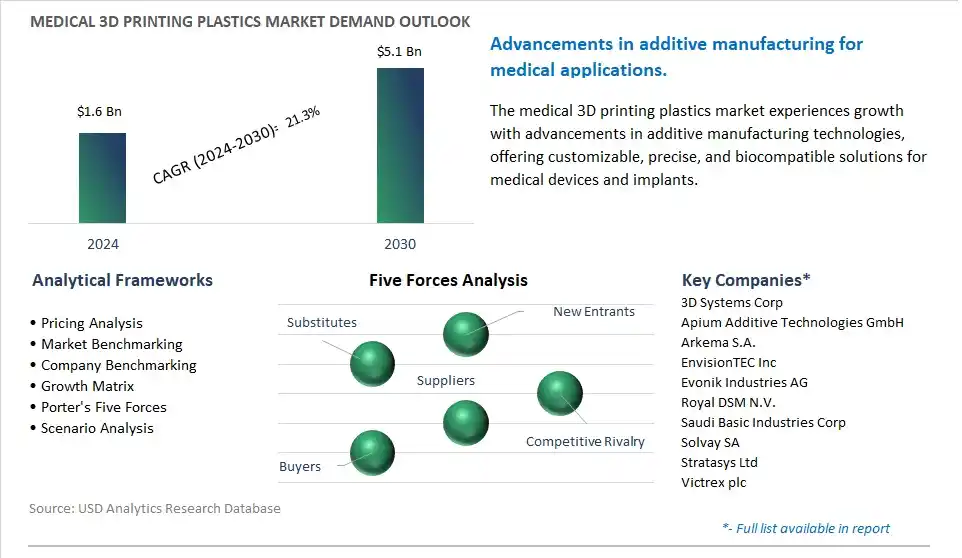
The global Medical 3D Printing Plastics Market is poised to register a 21.3% CAGR from $1.6 Billion in 2024 to $5.1 Billion in 2030.
The global Medical 3D Printing Plastics Market Study analyzes and forecasts the market size across 6 regions and 24 countries for diverse segments -By Type (ABS, PEEK, PETG, Photopolymer, Polyamide, Polylactic Acid), By Form (Filament, Powder, Ink).
An Introduction to Global Medical 3D Printing Plastics Market in 2024
The future of medical 3D printing plastics is influenced by several key trends reflecting advancements in additive manufacturing technology, personalized medicine, and regulatory standards in the healthcare industry. One significant trend is the increasing adoption of 3D printing technology for producing patient-specific medical devices, implants, and anatomical models tailored to individual anatomies and medical conditions. Medical-grade plastics, such as biocompatible polymers and resins, are widely used in 3D printing applications due to their versatility, sterilizability, and ability to replicate complex geometries with high precision. Additionally, advancements in material science, 3D printing processes, and post-processing techniques are expanding the range of medical-grade plastics available for 3D printing, enabling the production of implants with improved mechanical properties, biodegradability, and tissue integration. Moreover, there is growing interest in the development of regulatory standards and quality assurance protocols for medical 3D printing materials and processes to ensure patient safety, product efficacy, and regulatory compliance. As the healthcare industry continues to embrace digital technologies and personalized treatment approaches, the medical 3D printing plastics industry is poised for growth, with opportunities for innovation, collaboration, and market expansion to meet the evolving needs of healthcare providers, medical device manufacturers, and patients seeking customized and cost-effective solutions for diagnosis, treatment, and rehabilitation.
Medical 3D Printing Plastics Market Competitive Landscape
The market report analyses the leading companies in the industry including 3D Systems Corp, Apium Additive Technologies GmbH, Arkema S.A., EnvisionTEC Inc, Evonik Industries AG, Royal DSM N.V., Saudi Basic Industries Corp, Solvay SA, Stratasys Ltd, Victrex plc.
Medical 3D Printing Plastics Market Dynamics
Medical 3D Printing Plastics Market Trend: Advancements in Biocompatible and Sterilizable Materials
A significant trend in the Medical 3D Printing Plastics market is the continuous advancements in biocompatible and sterilizable materials. With the growing adoption of additive manufacturing technology in the medical field, there's a heightened demand for 3D printing plastics that meet stringent regulatory requirements for medical devices and implants. Manufacturers are developing specialized plastics formulations that are biocompatible, non-toxic, and capable of withstanding sterilization processes such as autoclaving and gamma irradiation. These advancements enable the production of custom-designed medical implants, prosthetics, surgical instruments, and anatomical models with precise geometries and tailored mechanical properties, driving innovation in the medical 3D printing industry.
Medical 3D Printing Plastics Market Driver: Personalized Medicine and Customized Healthcare Solutions
A key driver propelling the Medical 3D Printing Plastics market is the shift towards personalized medicine and customized healthcare solutions. With advancements in medical imaging technologies such as CT scans, MRI, and 3D scanning, healthcare providers can now generate patient-specific anatomical data to guide the design and fabrication of custom medical devices and implants. 3D printing plastics play a vital role in enabling the production of patient-specific implants and prosthetics that match the individual's unique anatomy, improving treatment outcomes and patient satisfaction. Additionally, the ability to rapidly prototype and iterate designs using 3D printing technology accelerates the development of innovative medical devices and contributes to the advancement of personalized healthcare solutions, thereby driving the demand for medical 3D printing plastics.
Medical 3D Printing Plastics Market Opportunity: Expansion into Point-of-Care Manufacturing
An opportunity in the Medical 3D Printing Plastics market lies in the expansion into point-of-care manufacturing. With the decentralization of healthcare and the rise of point-of-care diagnostics and treatments, there's a growing demand for on-site manufacturing capabilities in clinical settings such as hospitals, clinics, and ambulatory care centers. Medical 3D printing plastics can be utilized to produce custom medical devices, surgical guides, and anatomical models directly at the point of care, enabling healthcare providers to offer personalized treatments and interventions with reduced lead times and costs. By expanding into point-of-care manufacturing, manufacturers of medical 3D printing plastics can tap into a rapidly growing market segment and provide healthcare professionals with the tools and technologies needed to deliver high-quality, patient-centric care in real-time. This expansion presents a strategic opportunity for growth and market diversification in the Medical 3D Printing Plastics market.
Medical 3D Printing Plastics Market Share Analysis: Photopolymer generated the highest revenue in 2024
The largest segment in the Medical 3D Printing Plastics Market is Photopolymer. Photopolymers hold a dominant position in the market due to their unique properties and versatility in medical 3D printing applications. Photopolymers are photosensitive resins that solidify when exposed to light, making them ideal for producing precise and detailed medical components and devices using stereolithography (SLA) and digital light processing (DLP) 3D printing technologies. In the medical field, photopolymers are widely used for fabricating surgical guides, dental implants, prosthetics, orthopedic implants, and anatomical models with high accuracy, biocompatibility, and resolution. The ability of photopolymers to produce intricate geometries and complex structures with fine details meets the demanding requirements of medical applications, driving their adoption in the healthcare industry. Further, the growing demand for personalized and customized medical devices, along with advancements in 3D printing technology and materials, further propel the growth of photopolymers in the Medical 3D Printing Plastics Market. Additionally, the increasing focus on improving patient outcomes, reducing surgical time, and enhancing healthcare efficiency drives the demand for photopolymer-based 3D printed medical solutions. Over the forecast period, these factors establish photopolymers as the largest segment in the Medical 3D Printing Plastics Market.
Medical 3D Printing Plastics Market Share Analysis: Powder segment is poised to register the fastest growth rate (CAGR) over the forecast period to 2030
The fastest-growing segment in the Medical 3D Printing Plastics Market is Powder. Powder-based 3D printing materials are experiencing rapid growth due to their versatility, precision, and suitability for a wide range of medical applications. In powder-based 3D printing, such as selective laser sintering (SLS) and binder jetting, powdered plastics are selectively fused or bonded together layer by layer to create intricate medical components and devices with high resolution and accuracy. Powder-based 3D printing offers potential advantages in the medical field, including the ability to produce complex geometries, porous structures, and patient-specific implants with excellent mechanical properties and biocompatibility. Additionally, powder-based 3D printing enables the fabrication of custom prosthetics, orthopedic implants, and anatomical models tailored to individual patient needs, leading to improved patient outcomes and treatment efficacy. The growing demand for personalized medicine, coupled with advancements in powder-based 3D printing technologies and materials, drives the expansion of this segment in the Medical 3D Printing Plastics Market. Further, ongoing research and development efforts focused on enhancing powder-based 3D printing processes and materials further accelerate the growth of this segment, making it a promising area for innovation and investment in the medical field. Over the forecast period, these factors contribute to the rapid growth of powder-based 3D printing materials in the Medical 3D Printing Plastics Market.
Medical 3D Printing Plastics Market Report Segmentation
By Type
ABS
PEEK
PETG
Photopolymer
Polyamide
Polylactic Acid
By Form
Filament
Powder
Ink
Regions Included
North America (US, Canada, Mexico)
Europe (Germany, UK, France, Spain, Italy, Russia, Rest of Europe)
Asia Pacific (China, India, Japan, South Korea, Australia, South East Asia, Rest of Asia)
South America (Brazil, Argentina, Rest of South America)
Middle East and Africa (Saudi Arabia, UAE, Rest of Middle East, South Africa, Egypt, Rest of Africa)
Medical 3D Printing Plastics Companies Profiled in the Market Study
3D Systems Corp
Apium Additive Technologies GmbH
Arkema S.A.
EnvisionTEC Inc
Evonik Industries AG
Royal DSM N.V.
Saudi Basic Industries Corp
Solvay SA
Stratasys Ltd
Victrex plc
*- List Not Exhaustive
TABLE OF CONTENTS
1 Introduction to 2024 Medical 3D Printing Plastics Market
1.1 Market Overview
1.2 Quick Facts
1.3 Scope/Objective of the Study
1.4 Market Definition
1.5 Countries and Regions Covered
1.6 Units, Currency, and Conversions
1.7 Industry Value Chain
2 Research Methodology
2.1 Market Size Estimation
2.2 Sources and Research Methodology
2.3 Data Triangulation
2.4 Assumptions and Limitations
3 Executive Summary
3.1 Global Medical 3D Printing Plastics Market Size Outlook, $ Million, 2021 to 2030
3.2 Medical 3D Printing Plastics Market Outlook by Type, $ Million, 2021 to 2030
3.3 Medical 3D Printing Plastics Market Outlook by Product, $ Million, 2021 to 2030
3.4 Medical 3D Printing Plastics Market Outlook by Application, $ Million, 2021 to 2030
3.5 Medical 3D Printing Plastics Market Outlook by Key Countries, $ Million, 2021 to 2030
4 Market Dynamics
4.1 Key Driving Forces of Medical 3D Printing Plastics Industry
4.2 Key Market Trends in Medical 3D Printing Plastics Industry
4.3 Potential Opportunities in Medical 3D Printing Plastics Industry
4.4 Key Challenges in Medical 3D Printing Plastics Industry
5 Market Factor Analysis
5.1 Value Chain Analysis
5.2 Competitive Landscape
5.2.1 Global Medical 3D Printing Plastics Market Share by Company (%), 2023
5.2.2 Product Offerings by Company
5.3 Porter’s Five Forces Analysis
5.4 Pricing Analysis and Outlook
6 Growth Outlook Across Scenarios
6.1 Growth Analysis-Case Scenario Definitions
6.2 Low Growth Scenario Forecasts
6.3 Reference Growth Scenario Forecasts
6.4 High Growth Scenario Forecasts
7 Global Medical 3D Printing Plastics Market Outlook by Segments
7.1 Medical 3D Printing Plastics Market Outlook by Segments, $ Million, 2021- 2030
By Type
ABS
PEEK
PETG
Photopolymer
Polyamide
Polylactic Acid
By Form
Filament
Powder
Ink
8 North America Medical 3D Printing Plastics Market Analysis and Outlook To 2030
8.1 Introduction to North America Medical 3D Printing Plastics Markets in 2024
8.2 North America Medical 3D Printing Plastics Market Size Outlook by Country, 2021-2030
8.2.1 United States
8.2.2 Canada
8.2.3 Mexico
8.3 North America Medical 3D Printing Plastics Market size Outlook by Segments, 2021-2030
By Type
ABS
PEEK
PETG
Photopolymer
Polyamide
Polylactic Acid
By Form
Filament
Powder
Ink
9 Europe Medical 3D Printing Plastics Market Analysis and Outlook To 2030
9.1 Introduction to Europe Medical 3D Printing Plastics Markets in 2024
9.2 Europe Medical 3D Printing Plastics Market Size Outlook by Country, 2021-2030
9.2.1 Germany
9.2.2 France
9.2.3 Spain
9.2.4 United Kingdom
9.2.4 Italy
9.2.5 Russia
9.2.6 Norway
9.2.7 Rest of Europe
9.3 Europe Medical 3D Printing Plastics Market Size Outlook by Segments, 2021-2030
By Type
ABS
PEEK
PETG
Photopolymer
Polyamide
Polylactic Acid
By Form
Filament
Powder
Ink
10 Asia Pacific Medical 3D Printing Plastics Market Analysis and Outlook To 2030
10.1 Introduction to Asia Pacific Medical 3D Printing Plastics Markets in 2024
10.2 Asia Pacific Medical 3D Printing Plastics Market Size Outlook by Country, 2021-2030
10.2.1 China
10.2.2 India
10.2.3 Japan
10.2.4 South Korea
10.2.5 Indonesia
10.2.6 Malaysia
10.2.7 Australia
10.2.8 Rest of Asia Pacific
10.3 Asia Pacific Medical 3D Printing Plastics Market size Outlook by Segments, 2021-2030
By Type
ABS
PEEK
PETG
Photopolymer
Polyamide
Polylactic Acid
By Form
Filament
Powder
Ink
11 South America Medical 3D Printing Plastics Market Analysis and Outlook To 2030
11.1 Introduction to South America Medical 3D Printing Plastics Markets in 2024
11.2 South America Medical 3D Printing Plastics Market Size Outlook by Country, 2021-2030
11.2.1 Brazil
11.2.2 Argentina
11.2.3 Rest of South America
11.3 South America Medical 3D Printing Plastics Market size Outlook by Segments, 2021-2030
By Type
ABS
PEEK
PETG
Photopolymer
Polyamide
Polylactic Acid
By Form
Filament
Powder
Ink
12 Middle East and Africa Medical 3D Printing Plastics Market Analysis and Outlook To 2030
12.1 Introduction to Middle East and Africa Medical 3D Printing Plastics Markets in 2024
12.2 Middle East and Africa Medical 3D Printing Plastics Market Size Outlook by Country, 2021-2030
12.2.1 Saudi Arabia
12.2.2 UAE
12.2.3 Oman
12.2.4 Rest of Middle East
12.2.5 Egypt
12.2.6 Nigeria
12.2.7 South Africa
12.2.8 Rest of Africa
12.3 Middle East and Africa Medical 3D Printing Plastics Market size Outlook by Segments, 2021-2030
By Type
ABS
PEEK
PETG
Photopolymer
Polyamide
Polylactic Acid
By Form
Filament
Powder
Ink
13 Company Profiles
13.1 Company Snapshot
13.2 SWOT Profiles
13.3 Products and Services
13.4 Recent Developments
13.5 Financial Profile
3D Systems Corp
Apium Additive Technologies GmbH
Arkema S.A.
EnvisionTEC Inc
Evonik Industries AG
Royal DSM N.V.
Saudi Basic Industries Corp
Solvay SA
Stratasys Ltd
Victrex plc
14 Appendix
14.1 Customization Offerings
14.2 Subscription Services
14.3 Related Reports
14.4 Publisher Expertise
By Type
ABS
PEEK
PETG
Photopolymer
Polyamide
Polylactic Acid
By Form
Filament
Powder
Ink
Countries Analyzed
North America (US, Canada, Mexico)
Europe (Germany, UK, France, Spain, Italy, Russia, Rest of Europe)
Asia Pacific (China, India, Japan, South Korea, Australia, South East Asia, Rest of Asia)
South America (Brazil, Argentina, Rest of South America)
Middle East and Africa (Saudi Arabia, UAE, Rest of Middle East, South Africa, Egypt, Rest of Africa)
