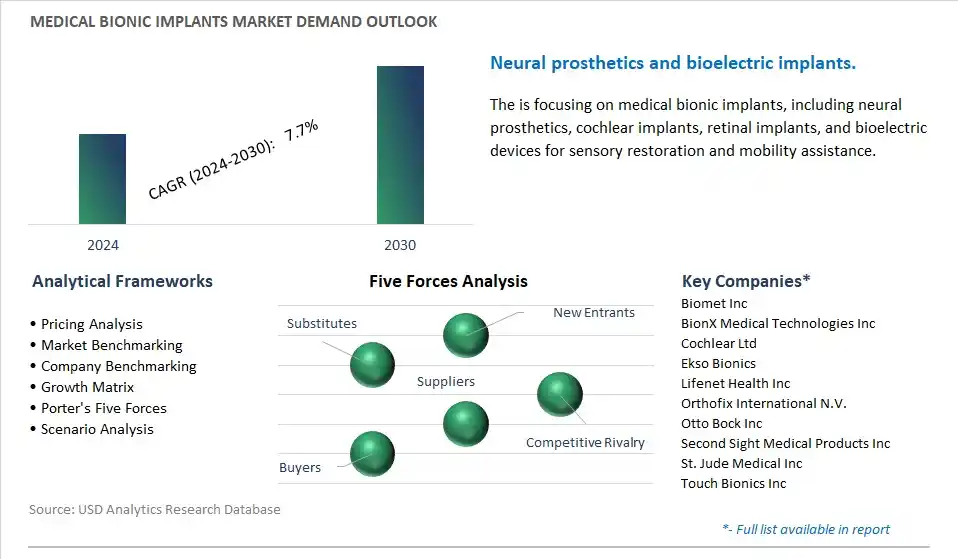
Medical Bionic Implants Market is estimated to increase at a Compounded Annual Growth Rate of 7.7% CAGR over the forecast period from 2024 to 2030
The Medical Bionic Implants Market study analyzes and forecasts the market size across 6 regions and 24 countries for diverse segments- By Product (Vision Bionics, Ear Bionics, Orthopedic Bionics, Heart Bionics, Neural /Brain Bionics), By Technology (Mechanical, Electronic), By Method of Fixation, Implantable, Externally Worn).
An Introduction to Medical Bionic Implants Market in 2024
Medical bionic implants are sophisticated devices designed to replace or augment missing or impaired biological functions in the human body, restoring mobility, sensory perception, or organ function. In 2024, medical bionic implants continue to represent a frontier of innovation in medical technology, offering life-changing solutions for individuals with disabilities or chronic health conditions. These implants include cochlear implants for hearing loss, retinal implants for vision restoration, prosthetic limbs with myoelectric control systems, and neural interfaces for motor or sensory function restoration. Advanced materials, such as biocompatible metals, ceramics, and polymers, enable seamless integration of bionic implants with biological tissues, minimizing immune response and promoting long-term functionality. Moreover, innovations in sensor technology, signal processing, and neural interfacing enhance the performance, reliability, and user experience of bionic implants, enabling recipients to regain independence, improve quality of life, and participate more fully in daily activities. As research and development in medical bionics continue to advance, the potential for novel applications, such as brain-computer interfaces, exoskeletons for mobility assistance, and organ-on-a-chip technologies, holds promise for further expanding the scope and impact of bionic implants in healthcare and human augmentation.
Market Trend: Advancements in Bionic Implant Technology
A prominent trend in the medical bionic implants market is the continuous advancements in implant technology. Innovations in materials science, bioengineering, and electronics are leading to the development of increasingly sophisticated bionic implants with enhanced functionality, durability, and biocompatibility. These implants, ranging from cochlear implants and artificial limbs to cardiac pacemakers and retinal implants, are designed to restore lost physiological functions, improve quality of life, and enable greater independence for individuals with disabilities or medical conditions. The trend towards advancements in bionic implant technology reflects a commitment to pushing the boundaries of medical innovation and addressing unmet needs in healthcare, driving market growth and expanding treatment options for patients.
Market Driver: Rising Incidence of Chronic Diseases and Disabilities
A key driver fueling the demand for medical bionic implants is the rising incidence of chronic diseases and disabilities globally. Chronic conditions such as hearing loss, limb amputation, neurological disorders, and cardiovascular diseases affect millions of people worldwide, leading to functional impairments and reduced quality of life. Bionic implants offer a promising solution for restoring lost or impaired functions, enabling individuals to regain mobility, sensory perception, or organ function and improve their overall well-being. As the prevalence of chronic diseases and disabilities continues to increase due to factors such as aging populations, lifestyle changes, and advances in medical diagnostics, the demand for bionic implants as a viable treatment option is expected to grow, driving market expansion and innovation in the field.
Market Opportunity: Personalized and Customized Implant Solutions
A significant opportunity for the medical bionic implants market lies in the development of personalized and customized implant solutions tailored to individual patient needs. Advances in 3D printing, digital imaging, and computer-aided design (CAD) technologies enable the creation of patient-specific implants that closely match anatomical structures and physiological requirements. Personalized implants offer several advantages, including improved fit, function, and comfort, as well as reduced risk of complications and faster recovery times. Additionally, customization allows for the incorporation of patient preferences, such as aesthetic considerations and lifestyle requirements, enhancing patient satisfaction and adherence to treatment. By investing in research and development efforts to develop personalized implant solutions and leveraging digital health technologies for patient-specific design and manufacturing, manufacturers can capitalize on this opportunity to address the evolving needs of patients and healthcare providers, driving market growth and differentiation in the competitive landscape of medical bionic implants.
Medical Bionic Implants Market Share Analysis: Orthopedic Bionics is the fastest growing segment over the forecast period to 2030
Among the segments listed, Orthopedic Bionics is experiencing the most rapid growth in the Medical Bionic Implants Market. This growth is driven by several key factors. Firstly, the prevalence of orthopedic conditions, such as osteoarthritis, rheumatoid arthritis, and musculoskeletal injuries, is increasing globally due to factors such as aging populations, sedentary lifestyles, and sports-related injuries. Orthopedic bionic implants offer innovative solutions for restoring mobility, function, and quality of life in patients with severe orthopedic impairments who are not adequately managed with conventional treatments like medications, physical therapy, or traditional orthopedic implants. Secondly, advancements in bionic technology and materials science have led to the development of next-generation orthopedic bionic implants with improved durability, biocompatibility, and performance characteristics. These implants utilize advanced materials such as titanium alloys, cobalt-chromium-molybdenum alloys, and biocompatible polymers to mimic the biomechanical properties of natural bone and joints, enhancing implant longevity and reducing the risk of complications such as implant wear, loosening, or failure. Thirdly, the growing demand for personalized medicine and patient-specific implants is driving innovation in orthopedic bionics, with the advent of custom-designed implants tailored to individual patient anatomy and functional requirements. Additive manufacturing (3D printing) technologies enable the production of patient-specific orthopedic implants with complex geometries and porous structures, facilitating osseointegration and optimizing biomechanical performance. Additionally, the expanding adoption of minimally invasive surgical techniques and robotic-assisted orthopedic surgery further enhances the precision and efficacy of orthopedic bionic implantation procedures, driving market growth. With ongoing technological innovation, expanding applications, and increasing demand for advanced orthopedic solutions, orthopedic bionics are poised for sustained rapid growth in the Medical Bionic Implants Market.
Medical Bionic Implants Competitive Analysis
The market research study provides in-depth insights into leading companies including the SWOT analyses, product profile, financial details, and recent developments acrossBiomet Inc, BionX Medical Technologies Inc, Cochlear Ltd, Ekso Bionics, Lifenet Health Inc, Orthofix International N.V., Otto Bock Inc, Second Sight Medical Products Inc, St. Jude Medical Inc, Touch Bionics Inc
Medical Bionic Implants Market Segmentation
By Product
Vision Bionics
Ear Bionics
Orthopedic Bionics
Heart Bionics
Neural /Brain Bionics
By Technology
Mechanical
Electronic
By Method of Fixation
Implantable
Externally Worn
Geographical Analysis
North America (United States, Canada, Mexico)
Europe (Germany, France, United Kingdom, Spain, Italy, Rest of Europe)
Asia Pacific (China, India, Japan, South Korea, Rest of Asia Pacific)
South America (Brazil, Argentina, Rest of South America)
Middle East and Africa (Saudi Arabia, UAE, Rest of Middle East, South Africa, Egypt, Rest of Africa)
Medical Bionic Implants Market Companies
Biomet Inc
BionX Medical Technologies Inc
Cochlear Ltd
Ekso Bionics
Lifenet Health Inc
Orthofix International N.V.
Otto Bock Inc
Second Sight Medical Products Inc
St. Jude Medical Inc
Touch Bionics Inc
Reasons to Buy the Medical Bionic Implants Market Study
• Deepen your industry insights and navigate uncertainties for strategy formulation, CAPEX, and Operational decisions
• Gain access to detailed insights on the Medical Bionic Implants Market, encompassing current market size, growth trends, and forecasts till 2030.
• Access detailed competitor analysis, enabling competitive advantage through a thorough understanding of market players, strategies, and potential differentiation opportunities
• Stay ahead of the curve with insights on technological advancements, innovations, and upcoming trends
• Identify lucrative investment avenues and expansion opportunities within the Medical Bionic Implants Market industry, guided by robust, data-backed analysis.
• Understand regional and global markets through country-wise analysis, regional market potential, regulatory nuances, and dynamics
• Execute strategies with confidence and speed through information, analytics, and insights on the industry value chain
• Corporate leaders, strategists, financial experts, shareholders, asset managers, and governmental representatives can make long-term planning scenarios and build an integrated and timely understanding of market dynamics
• Benefit from tailored solutions and expert consultation based on report insights, providing personalized strategies aligned with specific business needs.
TABLE OF CONTENTS
1 Introduction to 2024 Medical Bionic Implants Market
1.1 Market Overview
1.2 Quick Facts
1.3 Scope/Objective of the Study
1.4 Market Definition
1.5 Countries and Regions Covered
1.6 Units, Currency, and Conversions
1.7 Industry Value Chain
2 Research Methodology
2.1 Market Size Estimation
2.2 Sources and Research Methodology
2.3 Data Triangulation
2.4 Assumptions and Limitations
3 Executive Summary
3.1 Global Medical Bionic Implants Market Size Outlook, $ Million, 2021 to 2030
3.2 Medical Bionic Implants Market Outlook by Type, $ Million, 2021 to 2030
3.3 Medical Bionic Implants Market Outlook by Product, $ Million, 2021 to 2030
3.4 Medical Bionic Implants Market Outlook by Application, $ Million, 2021 to 2030
3.5 Medical Bionic Implants Market Outlook by Key Countries, $ Million, 2021 to 2030
4 Market Dynamics
4.1 Key Driving Forces of Medical Bionic Implants Industry
4.2 Key Market Trends in Medical Bionic Implants Industry
4.3 Potential Opportunities in Medical Bionic Implants Industry
4.4 Key Challenges in Medical Bionic Implants Industry
5 Market Factor Analysis
5.1 Value Chain Analysis
5.2 Competitive Landscape
5.2.1 Global Medical Bionic Implants Market Share by Company (%), 2023
5.2.2 Product Offerings by Company
5.3 Porter’s Five Forces Analysis
5.4 Pricing Analysis and Outlook
6 Growth Outlook Across Scenarios
6.1 Growth Analysis-Case Scenario Definitions
6.2 Low Growth Scenario Forecasts
6.3 Reference Growth Scenario Forecasts
6.4 High Growth Scenario Forecasts
7 Global Medical Bionic Implants Market Outlook by Segments
7.1 Medical Bionic Implants Market Outlook by Segments, $ Million, 2021- 2030
By Product
Vision Bionics
Ear Bionics
Orthopedic Bionics
Heart Bionics
Neural /Brain Bionics
By Technology
Mechanical
Electronic
By Method of Fixation
Implantable
Externally Worn
8 North America Medical Bionic Implants Market Analysis and Outlook To 2030
8.1 Introduction to North America Medical Bionic Implants Markets in 2024
8.2 North America Medical Bionic Implants Market Size Outlook by Country, 2021-2030
8.2.1 United States
8.2.2 Canada
8.2.3 Mexico
8.3 North America Medical Bionic Implants Market size Outlook by Segments, 2021-2030
By Product
Vision Bionics
Ear Bionics
Orthopedic Bionics
Heart Bionics
Neural /Brain Bionics
By Technology
Mechanical
Electronic
By Method of Fixation
Implantable
Externally Worn
9 Europe Medical Bionic Implants Market Analysis and Outlook To 2030
9.1 Introduction to Europe Medical Bionic Implants Markets in 2024
9.2 Europe Medical Bionic Implants Market Size Outlook by Country, 2021-2030
9.2.1 Germany
9.2.2 France
9.2.3 Spain
9.2.4 United Kingdom
9.2.4 Italy
9.2.5 Russia
9.2.6 Norway
9.2.7 Rest of Europe
9.3 Europe Medical Bionic Implants Market Size Outlook by Segments, 2021-2030
By Product
Vision Bionics
Ear Bionics
Orthopedic Bionics
Heart Bionics
Neural /Brain Bionics
By Technology
Mechanical
Electronic
By Method of Fixation
Implantable
Externally Worn
10 Asia Pacific Medical Bionic Implants Market Analysis and Outlook To 2030
10.1 Introduction to Asia Pacific Medical Bionic Implants Markets in 2024
10.2 Asia Pacific Medical Bionic Implants Market Size Outlook by Country, 2021-2030
10.2.1 China
10.2.2 India
10.2.3 Japan
10.2.4 South Korea
10.2.5 Indonesia
10.2.6 Malaysia
10.2.7 Australia
10.2.8 Rest of Asia Pacific
10.3 Asia Pacific Medical Bionic Implants Market size Outlook by Segments, 2021-2030
By Product
Vision Bionics
Ear Bionics
Orthopedic Bionics
Heart Bionics
Neural /Brain Bionics
By Technology
Mechanical
Electronic
By Method of Fixation
Implantable
Externally Worn
11 South America Medical Bionic Implants Market Analysis and Outlook To 2030
11.1 Introduction to South America Medical Bionic Implants Markets in 2024
11.2 South America Medical Bionic Implants Market Size Outlook by Country, 2021-2030
11.2.1 Brazil
11.2.2 Argentina
11.2.3 Rest of South America
11.3 South America Medical Bionic Implants Market size Outlook by Segments, 2021-2030
By Product
Vision Bionics
Ear Bionics
Orthopedic Bionics
Heart Bionics
Neural /Brain Bionics
By Technology
Mechanical
Electronic
By Method of Fixation
Implantable
Externally Worn
12 Middle East and Africa Medical Bionic Implants Market Analysis and Outlook To 2030
12.1 Introduction to Middle East and Africa Medical Bionic Implants Markets in 2024
12.2 Middle East and Africa Medical Bionic Implants Market Size Outlook by Country, 2021-2030
12.2.1 Saudi Arabia
12.2.2 UAE
12.2.3 Oman
12.2.4 Rest of Middle East
12.2.5 Egypt
12.2.6 Nigeria
12.2.7 South Africa
12.2.8 Rest of Africa
12.3 Middle East and Africa Medical Bionic Implants Market size Outlook by Segments, 2021-2030
By Product
Vision Bionics
Ear Bionics
Orthopedic Bionics
Heart Bionics
Neural /Brain Bionics
By Technology
Mechanical
Electronic
By Method of Fixation
Implantable
Externally Worn
13 Company Profiles
13.1 Company Snapshot
13.2 SWOT Profiles
13.3 Products and Services
13.4 Recent Developments
13.5 Financial Profile
List of Companies
Biomet Inc
BionX Medical Technologies Inc
Cochlear Ltd
Ekso Bionics
Lifenet Health Inc
Orthofix International N.V.
Otto Bock Inc
Second Sight Medical Products Inc
St. Jude Medical Inc
Touch Bionics Inc
14 Appendix
14.1 Customization Offerings
14.2 Subscription Services
14.3 Related Reports
14.4 Publisher Expertise
By Product
Vision Bionics
Ear Bionics
Orthopedic Bionics
Heart Bionics
Neural /Brain Bionics
By Technology
Mechanical
Electronic
By Method of Fixation
Implantable
Externally Worn
Countries Analyzed
North America (United States, Canada, Mexico)
Europe (Germany, France, United Kingdom, Spain, Italy, Rest of Europe)
Asia Pacific (China, India, Japan, South Korea, Rest of Asia Pacific)
South America (Brazil, Argentina, Rest of South America)
Middle East and Africa (Saudi Arabia, UAE, Rest of Middle East, South Africa, Egypt, Rest of Africa)
