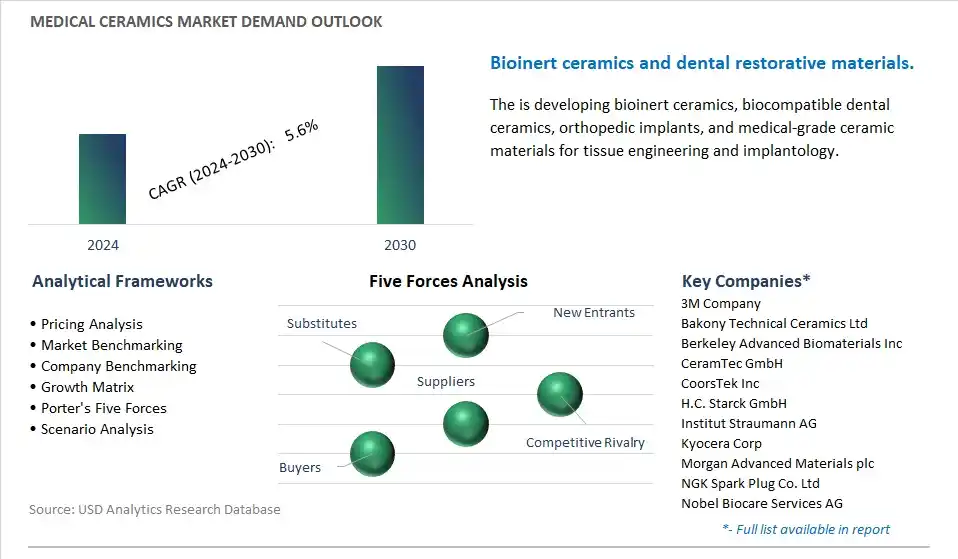
Medical Ceramics Market is estimated to increase at a Compounded Annual Growth Rate of 5.6% CAGR over the forecast period from 2024 to 2030
The Medical Ceramics Market study analyzes and forecasts the market size across 6 regions and 24 countries for diverse segments- By Material (Bioinert Ceramics, Bioactive Ceramics, Bioresorbable Ceramics), By Application (Dental Applications, Orthopedic Applications, Surgical Instruments, Others).
An Introduction to Medical Ceramics Market in 2024
Medical ceramics are biocompatible materials used in a variety of medical applications, including orthopedic implants, dental prosthetics, surgical instruments, and biomedical engineering. In 2024, medical ceramics continue to be valued for their unique combination of properties, including high strength, wear resistance, biocompatibility, and inertness to bodily fluids and tissues. These ceramics, such as alumina, zirconia, and hydroxyapatite, offer advantages over traditional metal alloys and polymers in certain medical applications due to their ability to mimic the mechanical properties of natural bone and tooth enamel, leading to improved patient outcomes and longevity of implant devices. Moreover, advancements in ceramic processing techniques, such as computer-aided design and manufacturing (CAD/CAM) and additive manufacturing, enable the fabrication of complex shapes and customized implants tailored to individual patient anatomy. As the demand for implantable medical devices and regenerative therapies grows, medical ceramics play an increasingly important role in orthopedics, dentistry, and tissue engineering, driving ongoing research and innovation in material science, surface engineering, and biocompatibility testing to address clinical needs and improve patient care.
Market Trend: Growing Demand for Bioinert and Biocompatible Materials
A prominent trend in the medical ceramics market is the growing demand for bioinert and biocompatible materials. Medical ceramics, such as alumina, zirconia, and hydroxyapatite, are valued for their excellent biocompatibility, corrosion resistance, and mechanical properties, making them ideal for various medical applications, including orthopedic implants, dental prosthetics, and surgical instruments. As healthcare providers prioritize patient safety and long-term implant success, there is increasing interest in utilizing medical ceramics for their ability to minimize adverse reactions, promote tissue integration, and withstand physiological environments without degradation. This trend towards bioinert and biocompatible materials underscores the importance of material selection in ensuring the effectiveness and longevity of medical devices and implants, driving market growth and innovation in the medical ceramics sector.
Market Driver: Aging Population and Orthopedic Implant Demand
A key driver fueling the demand for medical ceramics is the aging population and the corresponding increase in demand for orthopedic implants. With aging comes a higher prevalence of degenerative bone and joint disorders, such as osteoarthritis and osteoporosis, leading to an escalating need for joint replacement surgeries and orthopedic interventions. Medical ceramics are favored for orthopedic implants due to their biocompatibility, wear resistance, and low friction properties, offering patients durable and long-lasting solutions for restoring mobility and alleviating pain. Additionally, the growing popularity of minimally invasive procedures and advancements in implant design and materials contribute to the adoption of medical ceramics in orthopedic applications. As the aging population continues to expand globally, the demand for orthopedic implants made from medical ceramics is expected to rise, driving market growth and innovation in the field.
Market Opportunity: Expansion into Dental and Surgical Applications
A significant opportunity for the medical ceramics market lies in the expansion into dental and surgical applications. Dental ceramics, such as zirconia and lithium disilicate, are increasingly used for dental restorations, crowns, bridges, and implants due to their natural appearance, biocompatibility, and excellent mechanical properties. Similarly, medical ceramics find applications in surgical instruments, such as scalpels, forceps, and bone drills, offering advantages such as sharpness, hardness, and resistance to corrosion. By leveraging the versatility and performance characteristics of medical ceramics, manufacturers have the opportunity to expand their product portfolios into dental and surgical markets, catering to the growing demand for high-quality, biocompatible materials in these fields. Investing in research and development efforts to develop innovative ceramic formulations and manufacturing processes tailored to dental and surgical applications can enable companies to capitalize on this opportunity, enhance market penetration, and drive revenue growth in the dynamic medical ceramics market.
Medical Ceramics Market Share Analysis: Bioactive Ceramics in Orthopedic Applications is the fastest growing segment over the forecast period to 2030
Among the segments listed, Bioactive Ceramics in Orthopedic Applications is experiencing the most rapid growth in the Medical Ceramics Market. This growth is propelled by several key factors. Firstly, there is a growing demand for innovative orthopedic implants and biomaterials that promote bone regeneration, osseointegration, and long-term implant stability. Bioactive ceramics, such as hydroxyapatite and glass ceramics, possess unique properties that enable them to bond directly with bone tissue, stimulate osteogenesis, and facilitate the formation of a durable interface between the implant and surrounding bone. These bioactive properties make ceramics an ideal choice for orthopedic implants, particularly in load-bearing applications such as hip and knee arthroplasty, spinal fusion, and trauma fixation. Secondly, advancements in bioactive ceramic manufacturing techniques, such as powder metallurgy, sol-gel processing, and 3D printing, have led to the development of highly porous and interconnected ceramic scaffolds with tailored microstructures and surface properties. These scaffolds mimic the natural architecture of bone tissue and provide a conducive environment for cell attachment, proliferation, and differentiation, enhancing bone ingrowth and implant integration. Thirdly, the increasing prevalence of orthopedic disorders, including osteoarthritis, osteoporosis, and traumatic injuries, is driving the demand for orthopedic implants and devices that offer superior biocompatibility, durability, and performance characteristics. Bioactive ceramics address these clinical needs by providing biologically active surfaces that promote tissue healing, reduce implant-related complications, and improve patient outcomes. Additionally, the expanding adoption of minimally invasive surgical techniques and patient-specific implant designs further accelerates the growth of bioactive ceramics in orthopedic applications, as these technologies enable precise implant placement and personalized treatment strategies. With ongoing research and development efforts, expanding applications, and increasing acceptance by orthopedic surgeons and patients, bioactive ceramics in orthopedic applications are poised for sustained rapid growth in the Medical Ceramics Market.
Medical Ceramics Competitive Analysis
The market research study provides in-depth insights into leading companies including the SWOT analyses, product profile, financial details, and recent developments across3M Company, Bakony Technical Ceramics Ltd, Berkeley Advanced Biomaterials Inc, CeramTec GmbH, CoorsTek Inc, H.C. Starck GmbH, Institut Straumann AG, Kyocera Corp, Morgan Advanced Materials plc, NGK Spark Plug Co. Ltd, Nobel Biocare Services AG, Rauschert GmbH, Royal DSM N.V., Superior Technical Ceramics, Tosoh Corp
Medical Ceramics Market Segmentation
By Material
Bioinert Ceramics
-Zirconia
-Aluminium Oxide
-Others
Bioactive Ceramics
-Hydroxyapatite
-Glass Ceramics
Bioresorbable Ceramics
By Application
Dental Applications
Orthopedic Applications
Surgical Instruments
Others
Geographical Analysis
North America (United States, Canada, Mexico)
Europe (Germany, France, United Kingdom, Spain, Italy, Rest of Europe)
Asia Pacific (China, India, Japan, South Korea, Rest of Asia Pacific)
South America (Brazil, Argentina, Rest of South America)
Middle East and Africa (Saudi Arabia, UAE, Rest of Middle East, South Africa, Egypt, Rest of Africa)
Medical Ceramics Market Companies
3M Company
Bakony Technical Ceramics Ltd
Berkeley Advanced Biomaterials Inc
CeramTec GmbH
CoorsTek Inc
H.C. Starck GmbH
Institut Straumann AG
Kyocera Corp
Morgan Advanced Materials plc
NGK Spark Plug Co. Ltd
Nobel Biocare Services AG
Rauschert GmbH
Royal DSM N.V.
Superior Technical Ceramics
Tosoh Corp
Reasons to Buy the Medical Ceramics Market Study
• Deepen your industry insights and navigate uncertainties for strategy formulation, CAPEX, and Operational decisions
• Gain access to detailed insights on the Medical Ceramics Market, encompassing current market size, growth trends, and forecasts till 2030.
• Access detailed competitor analysis, enabling competitive advantage through a thorough understanding of market players, strategies, and potential differentiation opportunities
• Stay ahead of the curve with insights on technological advancements, innovations, and upcoming trends
• Identify lucrative investment avenues and expansion opportunities within the Medical Ceramics Market industry, guided by robust, data-backed analysis.
• Understand regional and global markets through country-wise analysis, regional market potential, regulatory nuances, and dynamics
• Execute strategies with confidence and speed through information, analytics, and insights on the industry value chain
• Corporate leaders, strategists, financial experts, shareholders, asset managers, and governmental representatives can make long-term planning scenarios and build an integrated and timely understanding of market dynamics
• Benefit from tailored solutions and expert consultation based on report insights, providing personalized strategies aligned with specific business needs.
TABLE OF CONTENTS
1 Introduction to 2024 Medical Ceramics Market
1.1 Market Overview
1.2 Quick Facts
1.3 Scope/Objective of the Study
1.4 Market Definition
1.5 Countries and Regions Covered
1.6 Units, Currency, and Conversions
1.7 Industry Value Chain
2 Research Methodology
2.1 Market Size Estimation
2.2 Sources and Research Methodology
2.3 Data Triangulation
2.4 Assumptions and Limitations
3 Executive Summary
3.1 Global Medical Ceramics Market Size Outlook, $ Million, 2021 to 2030
3.2 Medical Ceramics Market Outlook by Type, $ Million, 2021 to 2030
3.3 Medical Ceramics Market Outlook by Product, $ Million, 2021 to 2030
3.4 Medical Ceramics Market Outlook by Application, $ Million, 2021 to 2030
3.5 Medical Ceramics Market Outlook by Key Countries, $ Million, 2021 to 2030
4 Market Dynamics
4.1 Key Driving Forces of Medical Ceramics Industry
4.2 Key Market Trends in Medical Ceramics Industry
4.3 Potential Opportunities in Medical Ceramics Industry
4.4 Key Challenges in Medical Ceramics Industry
5 Market Factor Analysis
5.1 Value Chain Analysis
5.2 Competitive Landscape
5.2.1 Global Medical Ceramics Market Share by Company (%), 2023
5.2.2 Product Offerings by Company
5.3 Porter’s Five Forces Analysis
5.4 Pricing Analysis and Outlook
6 Growth Outlook Across Scenarios
6.1 Growth Analysis-Case Scenario Definitions
6.2 Low Growth Scenario Forecasts
6.3 Reference Growth Scenario Forecasts
6.4 High Growth Scenario Forecasts
7 Global Medical Ceramics Market Outlook by Segments
7.1 Medical Ceramics Market Outlook by Segments, $ Million, 2021- 2030
By Material
Bioinert Ceramics
-Zirconia
-Aluminium Oxide
-Others
Bioactive Ceramics
-Hydroxyapatite
-Glass Ceramics
Bioresorbable Ceramics
By Application
Dental Applications
Orthopedic Applications
Surgical Instruments
Others
8 North America Medical Ceramics Market Analysis and Outlook To 2030
8.1 Introduction to North America Medical Ceramics Markets in 2024
8.2 North America Medical Ceramics Market Size Outlook by Country, 2021-2030
8.2.1 United States
8.2.2 Canada
8.2.3 Mexico
8.3 North America Medical Ceramics Market size Outlook by Segments, 2021-2030
By Material
Bioinert Ceramics
-Zirconia
-Aluminium Oxide
-Others
Bioactive Ceramics
-Hydroxyapatite
-Glass Ceramics
Bioresorbable Ceramics
By Application
Dental Applications
Orthopedic Applications
Surgical Instruments
Others
9 Europe Medical Ceramics Market Analysis and Outlook To 2030
9.1 Introduction to Europe Medical Ceramics Markets in 2024
9.2 Europe Medical Ceramics Market Size Outlook by Country, 2021-2030
9.2.1 Germany
9.2.2 France
9.2.3 Spain
9.2.4 United Kingdom
9.2.4 Italy
9.2.5 Russia
9.2.6 Norway
9.2.7 Rest of Europe
9.3 Europe Medical Ceramics Market Size Outlook by Segments, 2021-2030
By Material
Bioinert Ceramics
-Zirconia
-Aluminium Oxide
-Others
Bioactive Ceramics
-Hydroxyapatite
-Glass Ceramics
Bioresorbable Ceramics
By Application
Dental Applications
Orthopedic Applications
Surgical Instruments
Others
10 Asia Pacific Medical Ceramics Market Analysis and Outlook To 2030
10.1 Introduction to Asia Pacific Medical Ceramics Markets in 2024
10.2 Asia Pacific Medical Ceramics Market Size Outlook by Country, 2021-2030
10.2.1 China
10.2.2 India
10.2.3 Japan
10.2.4 South Korea
10.2.5 Indonesia
10.2.6 Malaysia
10.2.7 Australia
10.2.8 Rest of Asia Pacific
10.3 Asia Pacific Medical Ceramics Market size Outlook by Segments, 2021-2030
By Material
Bioinert Ceramics
-Zirconia
-Aluminium Oxide
-Others
Bioactive Ceramics
-Hydroxyapatite
-Glass Ceramics
Bioresorbable Ceramics
By Application
Dental Applications
Orthopedic Applications
Surgical Instruments
Others
11 South America Medical Ceramics Market Analysis and Outlook To 2030
11.1 Introduction to South America Medical Ceramics Markets in 2024
11.2 South America Medical Ceramics Market Size Outlook by Country, 2021-2030
11.2.1 Brazil
11.2.2 Argentina
11.2.3 Rest of South America
11.3 South America Medical Ceramics Market size Outlook by Segments, 2021-2030
By Material
Bioinert Ceramics
-Zirconia
-Aluminium Oxide
-Others
Bioactive Ceramics
-Hydroxyapatite
-Glass Ceramics
Bioresorbable Ceramics
By Application
Dental Applications
Orthopedic Applications
Surgical Instruments
Others
12 Middle East and Africa Medical Ceramics Market Analysis and Outlook To 2030
12.1 Introduction to Middle East and Africa Medical Ceramics Markets in 2024
12.2 Middle East and Africa Medical Ceramics Market Size Outlook by Country, 2021-2030
12.2.1 Saudi Arabia
12.2.2 UAE
12.2.3 Oman
12.2.4 Rest of Middle East
12.2.5 Egypt
12.2.6 Nigeria
12.2.7 South Africa
12.2.8 Rest of Africa
12.3 Middle East and Africa Medical Ceramics Market size Outlook by Segments, 2021-2030
By Material
Bioinert Ceramics
-Zirconia
-Aluminium Oxide
-Others
Bioactive Ceramics
-Hydroxyapatite
-Glass Ceramics
Bioresorbable Ceramics
By Application
Dental Applications
Orthopedic Applications
Surgical Instruments
Others
13 Company Profiles
13.1 Company Snapshot
13.2 SWOT Profiles
13.3 Products and Services
13.4 Recent Developments
13.5 Financial Profile
List of Companies
3M Company
Bakony Technical Ceramics Ltd
Berkeley Advanced Biomaterials Inc
CeramTec GmbH
CoorsTek Inc
H.C. Starck GmbH
Institut Straumann AG
Kyocera Corp
Morgan Advanced Materials plc
NGK Spark Plug Co. Ltd
Nobel Biocare Services AG
Rauschert GmbH
Royal DSM N.V.
Superior Technical Ceramics
Tosoh Corp
14 Appendix
14.1 Customization Offerings
14.2 Subscription Services
14.3 Related Reports
14.4 Publisher Expertise
By Material
Bioinert Ceramics
-Zirconia
-Aluminium Oxide
-Others
Bioactive Ceramics
-Hydroxyapatite
-Glass Ceramics
Bioresorbable Ceramics
By Application
Dental Applications
Orthopedic Applications
Surgical Instruments
Others
Countries Analyzed
North America (United States, Canada, Mexico)
Europe (Germany, France, United Kingdom, Spain, Italy, Rest of Europe)
Asia Pacific (China, India, Japan, South Korea, Rest of Asia Pacific)
South America (Brazil, Argentina, Rest of South America)
Middle East and Africa (Saudi Arabia, UAE, Rest of Middle East, South Africa, Egypt, Rest of Africa)
