
The global Medical Coatings For Implants Market Study analyzes and forecasts the market size across 6 regions and 24 countries for diverse segments -By Product (Hydroxyapatite (HA), Titanium Plasma Spray, Nanoparticle, Others), By Technology (Plasma Spray, Vacuum Spray, Physical Vapor Deposition, Others), By Application (Orthopedic Implant Screws, Dental Implants, Cardiovascular Implants, Others).
The future of medical coatings for implants is shaped by several key trends reflecting advancements in biomaterials science, surface engineering, and medical device innovation. One significant trend is the development of advanced coatings designed to improve the biocompatibility, performance, and longevity of medical implants used in orthopedic, cardiovascular, and dental applications. These coatings, typically applied to metallic, ceramic, or polymer substrates, serve various functions such as enhancing tissue integration, reducing friction and wear, and preventing bacterial adhesion and infection. Additionally, advancements in coating deposition techniques, such as plasma spraying, chemical vapor deposition, and electrochemical deposition, enable precise control over coating thickness, composition, and surface properties, allowing for tailored solutions to meet specific clinical requirements and patient needs. Moreover, there is growing interest in the use of bioactive coatings containing therapeutic agents, growth factors, or antimicrobial agents to promote tissue healing, osseointegration, and implant success rates. As demand for minimally invasive surgeries, personalized medicine, and implantable medical devices continues to grow, the medical coatings industry is poised for expansion, with opportunities for innovation, collaboration, and market expansion to meet the evolving needs of healthcare providers, medical device manufacturers, and patients seeking safe, effective, and long-lasting implant solutions.
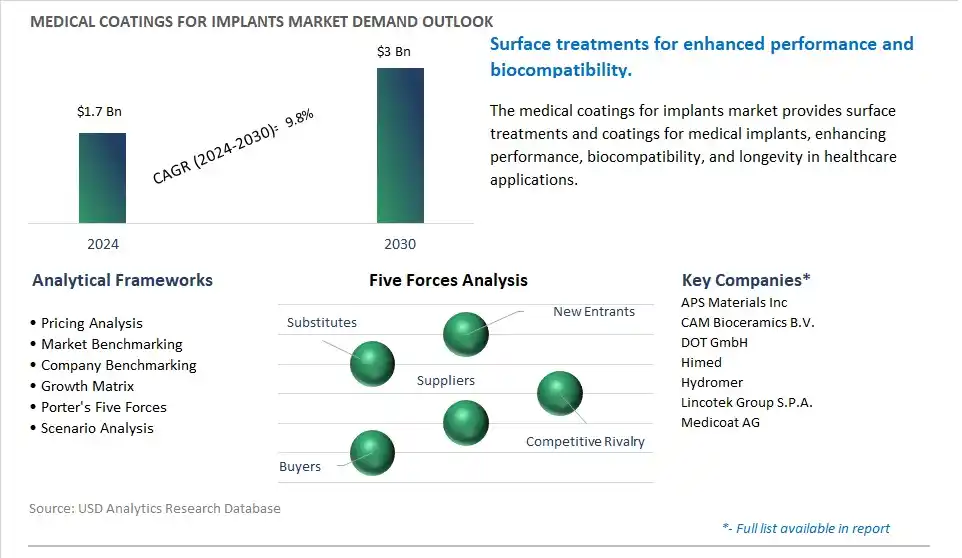
The market report analyses the leading companies in the industry including APS Materials Inc, CAM Bioceramics B.V., DOT GmbH, Himed, Hydromer, Lincotek Group S.P.A., Medicoat AG.
A significant trend in the Medical Coatings for Implants market is the development of antibacterial and antimicrobial coatings. With the increasing prevalence of implant-related infections, there's a growing demand for coatings that can prevent bacterial colonization and biofilm formation on implant surfaces. Manufacturers are innovating with coatings containing antimicrobial agents such as silver nanoparticles, antibiotics, and antimicrobial peptides to enhance the biocompatibility of implants and reduce the risk of post-operative infections. This demand of antibacterial coatings drives improving patient outcomes and reducing the need for revision surgeries due to implant-associated infections.
A key driver propelling the Medical Coatings for Implants market is the aging population and the consequent rise in demand for medical implants. As the global population ages, the prevalence of age-related conditions such as osteoarthritis, cardiovascular diseases, and dental disorders increases, driving the need for surgical interventions and implantable medical devices. Coatings for implants play a crucial role in enhancing the biocompatibility, durability, and functionality of medical implants, ensuring successful integration with the patient's body and minimizing the risk of complications. With a growing number of patients opting for implant-based treatments to improve their quality of life, there's a corresponding increase in demand for advanced coatings that can prolong implant lifespan and enhance patient outcomes.
An opportunity in the Medical Coatings for Implants market lies in the integration of drug-eluting coatings for controlled drug delivery. In addition to providing antimicrobial properties, coatings can be engineered to release therapeutic agents such as pain medications, anti-inflammatory drugs, or growth factors directly at the implant site, promoting tissue regeneration and reducing post-operative complications. By incorporating drug-eluting capabilities into implant coatings, manufacturers can offer customized solutions that address specific patient needs and optimize treatment outcomes. This integration of drug delivery technology presents a strategic opportunity for differentiation and value creation in the Medical Coatings for Implants market, catering to the evolving demands of healthcare providers and patients for enhanced implant performance and patient comfort.
The largest segment in the Medical Coatings for Implants Market is Hydroxyapatite (HA). HA coatings are widely used in medical implants due to their excellent biocompatibility, osteoconductivity, and osseointegration properties. Hydroxyapatite is a natural mineral form of calcium apatite found in bones and teeth, making it highly compatible with the human body. HA coatings promote bone growth and bonding to implant surfaces, facilitating the integration of orthopedic and dental implants with surrounding bone tissue. This enhances implant stability, longevity, and overall success rates in various medical procedures, including joint replacements, dental implants, and spinal surgeries. Further, HA coatings provide a bioactive surface that encourages cell attachment and tissue regeneration, promoting faster healing and reducing the risk of implant rejection or complications. As the demand for implantable medical devices continues to rise, driven by aging populations and the increasing prevalence of musculoskeletal disorders, the use of HA coatings in medical implants is expected to grow steadily. Additionally, ongoing research and development efforts focused on enhancing HA coating techniques and formulations further contribute to the dominance of HA coatings in the Medical Coatings for Implants Market. Over the forecast period, these factors establish Hydroxyapatite as the largest and most preferred segment in the market.
The fastest-growing segment in the Medical Coatings for Implants Market is Physical Vapor Deposition (PVD). PVD technology involves the deposition of thin films of coating materials onto implant surfaces through physical processes such as evaporation or sputtering in a vacuum environment. PVD coatings offer potential advantages for medical implants, including improved adhesion, uniformity, and control over coating thickness, as well as the ability to deposit biocompatible materials with high purity and density. Additionally, PVD coatings exhibit excellent wear resistance, corrosion resistance, and biocompatibility, enhancing the performance and longevity of medical implants. The growing demand for advanced implant coatings with superior properties, such as reduced friction, enhanced biointegration, and antibacterial properties, drives the adoption of PVD technology in the Medical Coatings for Implants Market. Further, advancements in PVD coating processes and equipment, along with increasing investments in research and development, further accelerate the growth of this segment. As medical device manufacturers strive to develop innovative implant solutions that meet the evolving needs of patients and healthcare providers, PVD technology emerges as a promising and rapidly expanding segment in the Medical Coatings for Implants Market. Over the forecast period, these factors contribute to the significant growth of PVD technology in the market.
The fastest-growing segment in the Medical Coatings for Implants Market is Orthopedic Implant Screws. Orthopedic implant screws are experiencing rapid growth due to the increasing prevalence of musculoskeletal disorders, sports injuries, and degenerative conditions requiring surgical interventions. These screws are essential components in orthopedic implants used for fracture fixation, joint arthroplasty, spinal fusion, and orthopedic trauma surgeries. The demand for orthopedic implant screws with advanced coatings is driven by the need for improved implant performance, biointegration, and patient outcomes. Coatings applied to orthopedic screws enhance their biocompatibility, corrosion resistance, and osseointegration, promoting faster healing, reduced infection rates, and enhanced stability of orthopedic implants. Further, advancements in coating technologies, such as hydroxyapatite, titanium plasma spray, and antimicrobial coatings, contribute to the growth of this segment by providing solutions that address specific clinical needs and challenges in orthopedic surgery. As the aging population increases and the demand for orthopedic procedures rises, the orthopedic implant screws segment is expected to continue its rapid growth trajectory in the Medical Coatings for Implants Market. Over the forecast period, these factors underscore the significance of orthopedic implant screws as a fast-growing segment in the market.
By Product
Hydroxyapatite (HA)
Titanium Plasma Spray
Nanoparticle
Others
By Technology
Plasma Spray
Vacuum Spray
Physical Vapor Deposition
Others
By Application
Orthopedic Implant Screws
-Pedicle Screws
-Sacroiliac SI Joint Screws
-Others
Dental Implants
Cardiovascular Implants
Others
Regions Included
North America (US, Canada, Mexico)
Europe (Germany, UK, France, Spain, Italy, Russia, Rest of Europe)
Asia Pacific (China, India, Japan, South Korea, Australia, South East Asia, Rest of Asia)
South America (Brazil, Argentina, Rest of South America)
Middle East and Africa (Saudi Arabia, UAE, Rest of Middle East, South Africa, Egypt, Rest of Africa)
APS Materials Inc
CAM Bioceramics B.V.
DOT GmbH
Himed
Hydromer
Lincotek Group S.P.A.
Medicoat AG
*- List Not Exhaustive
TABLE OF CONTENTS
1 Introduction to 2024 Medical Coatings For Implants Market
1.1 Market Overview
1.2 Quick Facts
1.3 Scope/Objective of the Study
1.4 Market Definition
1.5 Countries and Regions Covered
1.6 Units, Currency, and Conversions
1.7 Industry Value Chain
2 Research Methodology
2.1 Market Size Estimation
2.2 Sources and Research Methodology
2.3 Data Triangulation
2.4 Assumptions and Limitations
3 Executive Summary
3.1 Global Medical Coatings For Implants Market Size Outlook, $ Million, 2021 to 2030
3.2 Medical Coatings For Implants Market Outlook by Type, $ Million, 2021 to 2030
3.3 Medical Coatings For Implants Market Outlook by Product, $ Million, 2021 to 2030
3.4 Medical Coatings For Implants Market Outlook by Application, $ Million, 2021 to 2030
3.5 Medical Coatings For Implants Market Outlook by Key Countries, $ Million, 2021 to 2030
4 Market Dynamics
4.1 Key Driving Forces of Medical Coatings For Implants Industry
4.2 Key Market Trends in Medical Coatings For Implants Industry
4.3 Potential Opportunities in Medical Coatings For Implants Industry
4.4 Key Challenges in Medical Coatings For Implants Industry
5 Market Factor Analysis
5.1 Value Chain Analysis
5.2 Competitive Landscape
5.2.1 Global Medical Coatings For Implants Market Share by Company (%), 2023
5.2.2 Product Offerings by Company
5.3 Porter’s Five Forces Analysis
5.4 Pricing Analysis and Outlook
6 Growth Outlook Across Scenarios
6.1 Growth Analysis-Case Scenario Definitions
6.2 Low Growth Scenario Forecasts
6.3 Reference Growth Scenario Forecasts
6.4 High Growth Scenario Forecasts
7 Global Medical Coatings For Implants Market Outlook by Segments
7.1 Medical Coatings For Implants Market Outlook by Segments, $ Million, 2021- 2030
By Product
Hydroxyapatite (HA)
Titanium Plasma Spray
Nanoparticle
Others
By Technology
Plasma Spray
Vacuum Spray
Physical Vapor Deposition
Others
By Application
Orthopedic Implant Screws
-Pedicle Screws
-Sacroiliac SI Joint Screws
-Others
Dental Implants
Cardiovascular Implants
Others
8 North America Medical Coatings For Implants Market Analysis and Outlook To 2030
8.1 Introduction to North America Medical Coatings For Implants Markets in 2024
8.2 North America Medical Coatings For Implants Market Size Outlook by Country, 2021-2030
8.2.1 United States
8.2.2 Canada
8.2.3 Mexico
8.3 North America Medical Coatings For Implants Market size Outlook by Segments, 2021-2030
By Product
Hydroxyapatite (HA)
Titanium Plasma Spray
Nanoparticle
Others
By Technology
Plasma Spray
Vacuum Spray
Physical Vapor Deposition
Others
By Application
Orthopedic Implant Screws
-Pedicle Screws
-Sacroiliac SI Joint Screws
-Others
Dental Implants
Cardiovascular Implants
Others
9 Europe Medical Coatings For Implants Market Analysis and Outlook To 2030
9.1 Introduction to Europe Medical Coatings For Implants Markets in 2024
9.2 Europe Medical Coatings For Implants Market Size Outlook by Country, 2021-2030
9.2.1 Germany
9.2.2 France
9.2.3 Spain
9.2.4 United Kingdom
9.2.4 Italy
9.2.5 Russia
9.2.6 Norway
9.2.7 Rest of Europe
9.3 Europe Medical Coatings For Implants Market Size Outlook by Segments, 2021-2030
By Product
Hydroxyapatite (HA)
Titanium Plasma Spray
Nanoparticle
Others
By Technology
Plasma Spray
Vacuum Spray
Physical Vapor Deposition
Others
By Application
Orthopedic Implant Screws
-Pedicle Screws
-Sacroiliac SI Joint Screws
-Others
Dental Implants
Cardiovascular Implants
Others
10 Asia Pacific Medical Coatings For Implants Market Analysis and Outlook To 2030
10.1 Introduction to Asia Pacific Medical Coatings For Implants Markets in 2024
10.2 Asia Pacific Medical Coatings For Implants Market Size Outlook by Country, 2021-2030
10.2.1 China
10.2.2 India
10.2.3 Japan
10.2.4 South Korea
10.2.5 Indonesia
10.2.6 Malaysia
10.2.7 Australia
10.2.8 Rest of Asia Pacific
10.3 Asia Pacific Medical Coatings For Implants Market size Outlook by Segments, 2021-2030
By Product
Hydroxyapatite (HA)
Titanium Plasma Spray
Nanoparticle
Others
By Technology
Plasma Spray
Vacuum Spray
Physical Vapor Deposition
Others
By Application
Orthopedic Implant Screws
-Pedicle Screws
-Sacroiliac SI Joint Screws
-Others
Dental Implants
Cardiovascular Implants
Others
11 South America Medical Coatings For Implants Market Analysis and Outlook To 2030
11.1 Introduction to South America Medical Coatings For Implants Markets in 2024
11.2 South America Medical Coatings For Implants Market Size Outlook by Country, 2021-2030
11.2.1 Brazil
11.2.2 Argentina
11.2.3 Rest of South America
11.3 South America Medical Coatings For Implants Market size Outlook by Segments, 2021-2030
By Product
Hydroxyapatite (HA)
Titanium Plasma Spray
Nanoparticle
Others
By Technology
Plasma Spray
Vacuum Spray
Physical Vapor Deposition
Others
By Application
Orthopedic Implant Screws
-Pedicle Screws
-Sacroiliac SI Joint Screws
-Others
Dental Implants
Cardiovascular Implants
Others
12 Middle East and Africa Medical Coatings For Implants Market Analysis and Outlook To 2030
12.1 Introduction to Middle East and Africa Medical Coatings For Implants Markets in 2024
12.2 Middle East and Africa Medical Coatings For Implants Market Size Outlook by Country, 2021-2030
12.2.1 Saudi Arabia
12.2.2 UAE
12.2.3 Oman
12.2.4 Rest of Middle East
12.2.5 Egypt
12.2.6 Nigeria
12.2.7 South Africa
12.2.8 Rest of Africa
12.3 Middle East and Africa Medical Coatings For Implants Market size Outlook by Segments, 2021-2030
By Product
Hydroxyapatite (HA)
Titanium Plasma Spray
Nanoparticle
Others
By Technology
Plasma Spray
Vacuum Spray
Physical Vapor Deposition
Others
By Application
Orthopedic Implant Screws
-Pedicle Screws
-Sacroiliac SI Joint Screws
-Others
Dental Implants
Cardiovascular Implants
Others
13 Company Profiles
13.1 Company Snapshot
13.2 SWOT Profiles
13.3 Products and Services
13.4 Recent Developments
13.5 Financial Profile
APS Materials Inc
CAM Bioceramics B.V.
DOT GmbH
Himed
Hydromer
Lincotek Group S.P.A.
Medicoat AG
14 Appendix
14.1 Customization Offerings
14.2 Subscription Services
14.3 Related Reports
14.4 Publisher Expertise
By Product
Hydroxyapatite (HA)
Titanium Plasma Spray
Nanoparticle
Others
By Technology
Plasma Spray
Vacuum Spray
Physical Vapor Deposition
Others
By Application
Orthopedic Implant Screws
-Pedicle Screws
-Sacroiliac SI Joint Screws
-Others
Dental Implants
Cardiovascular Implants
Others
Countries Analyzed
North America (US, Canada, Mexico)
Europe (Germany, UK, France, Spain, Italy, Russia, Rest of Europe)
Asia Pacific (China, India, Japan, South Korea, Australia, South East Asia, Rest of Asia)
South America (Brazil, Argentina, Rest of South America)
Middle East and Africa (Saudi Arabia, UAE, Rest of Middle East, South Africa, Egypt, Rest of Africa)
Global Medical Coatings For Implants is forecast to reach $3 Billion in 2030 from $1.7 Billion in 2024, registering a CAGR of 9.8%
Emerging Markets across Asia Pacific, Europe, and Americas present robust growth prospects.
APS Materials Inc, CAM Bioceramics B.V., DOT GmbH, Himed, Hydromer, Lincotek Group S.P.A., Medicoat AG
Base Year- 2023; Estimated Year- 2024; Historic Period- 2018-2023; Forecast period- 2024 to 2030; Currency: Revenue (USD); Volume